


Being stretched thin is an understatement. You’re touring homes with clients or attending inspections. On top of that, you spend hours on administrative tasks instead of the work that closes deals. As a result, smaller teams lose out to bigger companies that have more bandwidth.
Volume is only half the problem. Timing is another. Serious buyers or sellers may call after hours or when no one is available. And as you know, every missed conversation is a missed opportunity.
This is where conversational AI in real estate is changing the game. Voice agents and chat tools can handle conversations 24/7. Agents are freed up to do what they do best: build relationships and close deals.
We’ll walk you through some real-world use cases of conversational AI for real estate teams. With these examples, we’ll also show you AI solutions that can help you scale your real estate business.
What is conversational AI in real estate?
Conversational AI in real estate refers to AI-powered tools that can talk to clients in natural, human-like language. Instead of forcing buyers and sellers to wait for a follow-up call, conversational AI can serve them in real time.
Conversational AI in real estate tools — like voice agents and chatbots — are trained to recognize context and intent. That way, they can guide people to the best next step. And your team can take on more clients.
But conversational AI isn’t meant to replace your real estate agents. It’s designed to reduce busywork, eliminate missed calls, and act as the first point of contact when your team is unavailable. By handling conversations, AI helps real estate professionals stay responsive to their current and potential clients.
7 ways real estate businesses can use conversational AI
Conversational AI in real estate can handle client interactions the moment they happen. Here are a few ideas your team can implement.
1. Capture and qualify leads around the clock
Every real estate professional knows the pain of losing a hot lead because they didn’t return a call fast enough. Buyers and sellers don’t wait around: they move onto the next agent. Traditional solutions like a real estate answering service can help, but they’re often too expensive for a small or mid-sized company. Their customer service is also often very inconsistent from one call to the next.
Conversational AI solves this problem by answering every call consistently. With Sona, the AI voice agent from Quo, formerly OpenPhone, your team never has to worry about losing business due to a missed call. Here’s how Sona can take calls off your plate while helping your team close more qualified leads.
- Always available to pick up the phone. Sona automatically picks up incoming calls when your team is busy or when a call comes in outside business hours. Potential sellers and renters don’t slip through the cracks, and they always have a professional, polished experience.
- Capture caller details and what property they’re looking for. During an AI phone call, Sona can ask questions to collect the details your real estate team needs. This includes information about their budget, timeline, location, and property type. Your team can review the call, and it eliminates back-and-forth later.
- Check the caller’s readiness to buy. Knowing if a buyer is financially prepared helps your real estate agents prioritize high-quality leads. To help figure this out, Sona can ask if the caller is pre-approved for a mortgage, for example.
- Move qualified buyers to next steps. If the caller meets your lead qualification criteria, Sona can capture their contact information. This can include the caller’s name, phone number, and other key details that your agents can use to follow up. Sona can also send callers a text message with a link to your agent’s booking page during a live call. That way, they can schedule a follow-up call on their own.
2. Schedule property viewings and consultations
Few things slow down closing a deal more than scheduling. A client asks about a showing, and you send available times. They respond hours later, your availability has changed, and you start all over again.
Conversational AI removes this friction. With Sona, scheduling can happen during the call. The AI voice agent can text callers a link to your scheduling software, like Calendly. The caller opens the link, selects a time that works for them, and the appointment is confirmed instantly. This will streamline customer interactions. It saves your team from repetitive tasks and the hassle of trying to schedule showings.

3. Deliver property recommendations that match buyer needs
When someone calls about available property listings, they’re already in research mode. Real estate AI fills the need to get the client information right away.
For example, if the caller asks about properties in New York, Sona can send a link to listings on your website. That way, the potential buyer can review listing photos or virtual tours.
Sometimes, though, callers want more details about a particular property. Sona can recognize that scenario and transfer the call to a human agent or take a message. The agent can then provide more in-depth information.
Real estate teams can also use AI chatbots on their website, like EliseAI, to help users with their property search. These can share listings, answer questions, or provide information about a property’s availability. This helps turn your website into a 24/7 digital assistant.

4. Automatically spot cross-sell and upsell opportunities
Good real estate agents know the subtle signals that can turn into additional business. A client might casually mention they’re “buying another investment property soon.” But when your phone is constantly ringing and your workload is heavy, it’s easy to miss those moments.
A voice agent like Sona listens for the same cues an experienced agent would. If a caller brings up investing, upgrading, or buying another property, Sona can flag the call as an upsell opportunity and transfer it to your team. That way, agents don’t have to dig through conversations later to find these moments.
5. Detect shifts in buyer and renter demand through conversation data
Most of the best market intelligence isn’t in spreadsheets or dashboards. It’s tucked into everyday conversations. Buyers mention which neighborhoods they prefer, which amenities matter most, or what they’re struggling to find.
Quo’s AI call tags automatically categorize your calls by topic, like “home office,” “investment property,” or “downsizing.” Call tags allow you to quickly scan conversations to see which topics are mentioned most often. With this data, you can also track how interests shift over time.
AI-powered call summaries in Quo also make reviewing calls easier. Instead of re-listening to a full conversation, agents can skim through a concise summary that describes what the caller asked. For teams juggling hundreds of calls per week, this cuts down on administrative work and leads to more personalized follow-ups.
Because Quo stores your client’s entire call history indefinitely, you can reference it later. If the client returns in a few years when they’re finally ready to buy, your agents can quickly pull those past conversations. This helps them pick up where things left off, and you can provide a high level of service again.

6. Improve agent and campaign performance with call insights
Even the most seasoned real estate professionals benefit from hearing a variety of client calls. Conversations can unfold in many different ways: objections, responses to listings, and where they break down.
Instead of listening to long call recordings, you can review transcripts in Quo. You can use these to identify coaching moments and make sure all agents understand and meet clients’ needs.
AI transcriptions capture the full conversations and provide a time-stamped breakdown by speaker. You can see where the script is working and where callers lose interest, which helps you improve your script for future campaigns. With AI summaries, you can review the next steps discussed on the call. If an agent forgets to confirm a showing or doesn’t set a follow-up, managers can coach them on staying proactive.
Calls are automatically categorized by topic with AI call tags. You can track buyer inquiries, seller leads, or common pricing questions . Sifting through calls by call tags helps you find coaching opportunities. Knowing the types of calls that come up repeatedly can help you improve the team’s performance and the overall customer experience.
7. Use smart lead routing to connect clients with the right agent
If someone calls with a question about properties in a specific place, they should speak to an agent with local real estate market expertise. Smart lead routing ensures potential buyers immediately connect with the person best suited to help them.
Conversational AI gives your team the tools to set up this type of routing via web chat. These workflows improve conversion rates because callers don’t have to repeat themselves or wait for an internal handoff.
Tools like Roof AI offer automated smart routing through a real estate chatbot. Website visitors who ask the chatbot about a specific city are instantly connected to the right specialist.

Quo: The best conversational AI tools for real estate
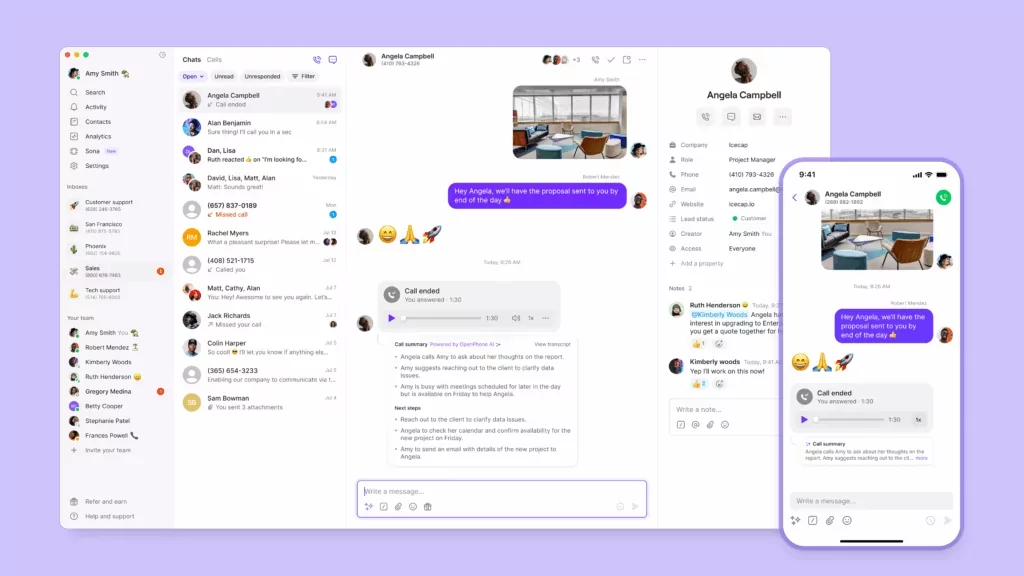
Real estate professionals need tools built for the pace of the industry. As a VoIP AI phone system, Quo ensures every lead gets attention, every conversation is captured, and every agent has the context they need to deliver a personalized experience. Let’s take a closer look at four of its conversational AI in real estate features:
- Sona, Quo’s AI voice agent, can automatically answer incoming calls. Plus, it can also send links in SMS messages during live calls and qualify leads by asking targeted questions.
- AI call tags automatically organize conversations by topic, such as buyer inquiries. This helps real estate teams see market trends and understand what properties renters and sellers are asking about.
- AI call transcriptions that provide a time-stamped transcript of each call, broken down by speaker. Managers can review how calls went by checking important details without listening to recordings.
- AI call summaries highlight the important points from a call, including the next steps discussed, so agents can follow up faster.
In addition to conversational AI in real estate features, Quo also lets you share phone numbers with your assistant or other colleagues so you can work together behind the scenes to close deals. You’ll also be able to privately message your team using internal threads. Plus, it lets you connect your business phone system with the other tools you rely on, like HubSpot.
If you want to see how Quo can benefit your business, you can sign up for a 7-day free trial.
FAQs
Conversational AI in real estate helps teams deliver a smoother client experience. It can:
– Capture every lead, even after hours, so you never miss an opportunity.
– Give every caller immediate attention and customer engagement, increasing conversion rates.
– Scale your business without adding additional realtors.
– Allow existing agents to spend more time on higher-value activities, such as showings and negotiations.
– Deliver faster response times, leading to more listings and sales.
– Provide instant and automated responses to keep leads warm until a human agent can take over.
– Gather better data and real-time insights about which properties generate the most interest.
– Track team performance and identify coaching opportunities.
Conversational AI solutions are also a cost-effective way to grow a real estate business. Human answering services, also known as virtual assistants or virtual receptionists, can cost anywhere from $300 to $2,000 per month. In contrast, Quo’s AI voice agent, Sona, costs $0–$200 per month.
Modern artificial intelligence understands context extremely well. AI-driven solutions like Sona use advanced natural language processing to interpret questions about listings, neighborhoods, timelines, budgets, and property types. A high level of accuracy ensures buyers can get real answers quickly, without waiting for a human agent.
Transparency builds trust. We recommend an introduction that discloses to the client they’re talking to an AI agent. It’s a bad user experience for callers to believe they’re talking to a human, only to discover later it’s an AI agent.
A simple greeting like, “Hi, I’m Sona, the AI assistant for [your agency’s name]” ensures your callers are clear that they’re talking to AI. From there, Sona can explain what it can do, such as, “I can help answer questions about our properties and schedule showings. Would you like to speak with me, or wait for an agent?”
Conversational AI refers to tools that can have natural, human-like conversations with clients via phone, text, or web bot. In real estate and property management, these tools can answer questions about listings. Plus, they can send links to your booking software during live calls and qualify leads by asking questions — before you or your team steps in.
Absolutely. Large firms usually have 24/7 answering services, lead generation teams, advanced CRMs, and customer support. Conversational AI gives smaller and mid-sized real estate teams the ability to respond instantly, nurture leads consistently, and operate with the professionalism of a much larger organization. You can achieve scalability without the overhead and at a fraction of the cost.


