You probably already have bits and pieces of a customer experience program in place. Maybe a few thank-you emails, some online reviews, or a customer survey here and there. But if those efforts feel scattered, you’re missing the bigger picture.
A great customer experience program brings all those touchpoints together into one system. It’s a structured way to listen, learn, and improve every interaction across your business. With the right approach — and the right tools — you can turn everyday conversations into lasting customer loyalty.
In this guide, you’ll learn what a CX program is, why it matters, and how to build one step by step.
Why create a customer experience program?
A CX program helps you truly understand your customers: what they want, what frustrates them, and where your product or service falls short. You won’t nail everything on the first try, and that’s expected. A structured, continuous-improvement loop helps you spot issues early and fix them fast.
Creating a better experience helps you reduce churn, which has a significant financial impact. For example, say you have 100 customers spending $1,000 annually. If you reduce churn from 20% to 10%, that’s $10,000 in retained revenue.
Your reputation is at stake, too. Word of mouth can be more cost-effective than any ad campaign. A well-run CX strategy makes sure that every interaction reinforces trust. It also delivers the kind of experience people can’t wait to tell others about.
Signs your business needs a customer experience program
How do you know it’s time to beef up your customer experience management? Here’s a quick checklist:
✓ You’re losing customers but don’t know why
✓ Customer conversations are scattered across multiple tools and channels
✓ Several team members interact with the same customers without coordination
✓ You collect customer insights but don’t analyze or follow up on them
✓ Team members give different answers to the same customer questions
✓ You’re spending more on acquiring new customers than retaining existing ones
✓ You’re unsure which interactions are going well versus which ones are breaking down
If most of these don’t apply to you, you can shift your efforts to building customer relationships and boosting customer satisfaction. If they do apply, keep reading. We’ve got some good stuff for you.
4 Core components of a CX program
A good CX program doesn’t have to be complicated. It just needs clear ownership, consistent feedback, and a plan for acting on what you learn.
1. Program ownership
First, decide who owns your customer experience strategy. This person will oversee customer feedback, track reviews, and coordinate improvements. In a small business, that might be you or a trusted team member.
Ownership doesn’t mean doing it all alone. It means leading the process, setting meeting cadences, and keeping everyone accountable. Schedule regular check-ins — say, monthly — where sales, support, and marketing review what’s working and what needs to change.
Whoever owns CX should also champion it internally. Building a customer-focused culture means making great service everyone’s job, not just your front-line reps.
2. Feedback loops
Next, decide how you’ll collect and act on customer input across phone, email, text, and other channels. Feedback loops can include implementing surveys, monitoring reviews, and analyzing customer interactions.
You can start simple:
- A post-purchase email survey asking one or two quick questions
- A monthly review of customer calls or chat logs
- Occasional interviews with repeat customers
Together, these help you understand the ‘voice of the customer’. This reveals things like what they love, what frustrates them, and what makes them leave.
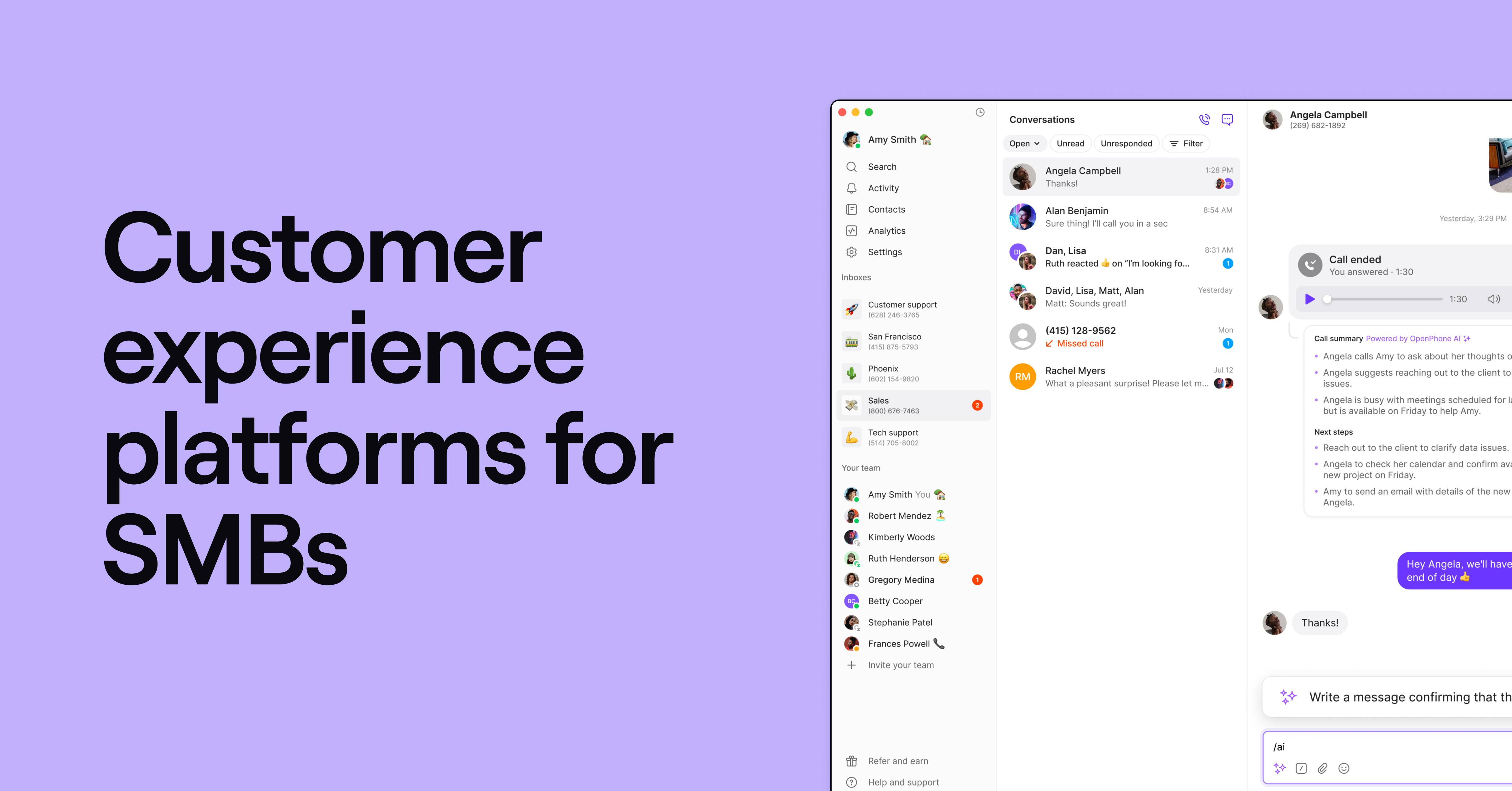
With Quo, formerly OpenPhone, you don’t have to review everything manually. AI call summaries and transcripts give you a clear picture of every conversation without the need for endless playback time. You can even use AI call tags to gauge sentiment across hundreds of interactions, helping you spot trends before they escalate.
3. Action plans based on feedback
Feedback without follow-through is wasted effort. Once you’ve identified recurring themes, document what happens next.
For example:
- If a call shows negative sentiment, a senior customer service representative is assigned to follow up within 24 hours.
- If a survey mentions a competitor by name, sales is notified for competitive intel.
Quo makes it easy to coordinate follow-ups with shared inboxes and internal threads. The person overseeing CX can tag the right teammate and make sure every customer gets a response before small issues turn into big ones.
4. Success metrics and reporting
You can’t improve what you don’t measure. Decide which metrics matter most to your CX program, like:
- Customer satisfaction score, or CSAT
- Net Promoter Score®, or NPS
- Response time
- Resolution rate
- Customer retention
Building a program to track these KPIs helps you identify patterns early and optimize your approach.

With Quo’s analytics dashboard, you can view call volume, busiest hours, and performance metrics at a glance. It also integrates with tools like Salesforce, HubSpot, Zapier, and Make. All the data is pushed into one unified customer experience platform. That way, you have a single source of truth.
How to start a customer experience program
You don’t need to overhaul your entire business to build a CX program. A few key steps can help you clarify who your customers are and what they need.
1. Create customer personas
Most CX initiatives start with customer personas. These are detailed profiles of your typical customers based on data from your interactions and sales history.
You can start building yours by segmenting your customers. There are a few ways to do this:
- Look at where they are in the customer lifecycle journey. First-time buyers need different support than loyal customers who’ve been with you for years.
- Group them by purchase behavior. Segment price-sensitive shoppers separately from customers who prioritize quality over cost.
Once you’ve identified your segments, gather data about each group. Send out surveys, review purchase history, or conduct quick customer interviews. This helps you understand their motivation and pain points.
Use the data you gather to build fictional personas for each segment. Include their demographics, shopping behavior, goals, and pain points.
Example customer persona
To bring this to life, here’s a sample persona:
Budget-conscious Beth
Demographics
- Age: 35–45
- Location: Suburban areas
- Annual income: $50,000–$70,000
Shopping behavior
- Only shops during sales or with discount codes
- Compares multiple options before buying
- Often abandons the cart if no promotion is available
Goals
- Get the best deal without sacrificing quality
- Build a wardrobe/home on a budget
Pain points
- Feels pressured by expiring promotions
- Frustrated when purchases don’t meet expectations
With these personas in place, you can deliver a more personalized experience for each customer type as you build out your CX program.
2. Start mapping the customer journey
Customer journey mapping is the process of tracking where and how customers interact with your business. Your customers might reach you by phone, text, email, social media, or in person.
Start by deciding which touchpoints matter most to your business based on volume or impact. If you offer a service, for instance, you might focus on the experience customers get when they call in or text your company. If customers frequently complain that no one answers the phone, that’s where you should start.
You don’t have to create a complex diagram or use software to map your customer journey. A simple list of touchpoints in chronological order would do.
For example:
- Customer sees your ad on social media
- Customer calls with questions about your service
- Rep sends follow-up text with pricing
- Customer books an appointment
- Customer receives confirmation email
- Customer shows up for the appointment
- Rep sends thank-you text after service
Even a basic outline helps you see gaps you might have missed and prioritize what to fix first.
3. Set 90-day goals
A good way to check if your CX program is working is to track your progress over 90 days. This timeframe is short enough to maintain momentum but long enough to see meaningful results.
If you already have some tracking in place, you can work toward objectives like:
- Reduce the average response time from four hours to two hours for texts
- Get 70% of customers to respond to your post-purchase survey
- Review all negative customer calls once a week
- Increase your NPS score by identifying and fixing the top three reasons customers are unhappy
Make sure your goals are specific and measurable. For example, “We want to increase our CSAT from 75% to 85%” is much more actionable than saying, “We need to improve customer satisfaction.” Objectives like these make it easy to track your progress.
If you’re starting from scratch, your first 90 days might focus on establishing measurement systems. That’s okay — setting up tracking is a valid goal on its own.
4. Build your initial feedback mechanism
Start with one feedback method that aligns with the touchpoint you prioritized earlier. Don’t try to set everything up at once.

If you focus on phone calls, you might review call recordings each week and create a quick post-call SMS survey.
If you focus on new customer onboarding, you might try sending a 30-day check-in email with a short survey. Keep it to two simple questions, like “How easy was it to get started?” or “What almost prevented you from choosing us?”
Keep your surveys short and customer-centric. Ask questions that help you understand their experience. The simpler and shorter you keep them, the more likely customers are to respond.
5. Review and iterate
After your first 90 days, take time to review everything you’ve learned and tracked. You’ll want to look at two types of data: operational data and experience data.
Operational data shows you what happened during that period. You might see that repeat purchases have dropped by 20%. Experience data shows you why it happened. Your customer surveys might reveal that people find your new checkout process confusing.
You need both to make changes that improve customer experience. The numbers tell you there’s a problem, and real-world customer feedback tells you which problem to solve.
As you review your data, ask yourself:
- Did you hit your goals?
- What surprised you?
- What feedback themes emerged?
From there, decide what to keep doing, what needs adjusting, and what to stop completely. Share your findings with the team to get their buy-in before making changes. Then set your next 90-day goals.
Your first 90 days won’t be perfect, and that’s normal. You’re building the habit of listening to customers and responding systematically. Over time, this becomes your competitive advantage.
What to look for in a customer experience platform
Here are a few things to consider when choosing the best customer experience software for your business:
- Integrations: Does the platform pull feedback from surveys, SMS, email, calls, and social media into one place? Having a complete picture makes it easier to understand customer needs.
- Performance dashboards: Admins need to see big-picture metrics. Team members need to see data for their job. Make sure the platform offers both.
- Customer support: You don’t want to be stuck troubleshooting on your own when a technical issue arises. Make sure the provider offers reliable support you can reach when you need help.
- Ease of use: As a small business without a dedicated IT team, the tool you choose should be simple to set up and easy for your team to learn.
- Shared inboxes and team chat: These features enable quick action on customer issues. Your team can see problems as they come in and respond before they escalate.
Kickstart your customer experience program with Quo

Quo brings everything you need for CX management into one system. You get shared inboxes for calls and texts, AI call tagging for faster insights, and integrations with 8,000+ tools to sync your customer data seamlessly.
This built-in customer experience automation helps you listen to customers and work better as a team. It also makes it easier to deliver great service across every channel. With built-in analytics and AI summaries, you can skip the manual work and focus on real improvements that move your business forward.
If you’re ready to see how it all fits together, sign up for a free seven-day trial of Quo today.
FAQs
It’s a structured plan for improving every interaction a customer has with your business. A CX program helps you measure satisfaction, close feedback loops, and continually refine how you serve customers.
The best CX platform is one that helps your team manage and collaborate on all customer conversations in one place. Quo makes that easy with shared inboxes, call tagging, and automation tools designed for small teams.
It depends on your setup. Basic programs may only cost a few hours per week, plus free tools like surveys or spreadsheets.
Intermediate programs using a customer experience platform like Quo typically range from $15–$35 per user per month. Most small businesses can launch for under $100 per month — and the return on investment from improved retention often pays for itself.
They stand for:
– Product: How well your product meets customer expectations
– Process: How easy interactions are
– People: Your team’s responsiveness
– Perception: How customers view your brand
Better experiences lead to stronger emotional connections. When customers feel valued, they’re more likely to buy again and recommend your brand to others.
You’ll usually notice early wins within 90 days, especially when you start consistently tracking and acting on feedback.
In small businesses, the CEM, or customer experience manager, is often the owner or a team lead. Their job is to coordinate feedback and analyze results. Ultimately, they make sure improvements are implemented company-wide.