

Vonage doesn’t look terribly expensive — at least, from the outside looking in. But between its residential program and its sprawling commercial website, it’s hard to figure out how much it might actually cost your business.
These days, most of Vonage’s customers aren’t using its pre-built business communications plans, mostly because they’re too expensive to maintain. Instead, they’ve opted for Vonage’s APIs and international calling system — both of which require deep pockets and coding knowledge.
If you’re curious about how much it costs to purchase a Vonage plan, you can use this guide to get the full picture. Don’t like what you see and want a cost-effective option? We offer a Vonage alternative at the end of the guide.
Vonage pricing plans at a glance

Vonage’s plans are priced according to the number of employees you have. There are volume-based discounts of up to 30% on the first 99 lines, but that won’t help a small business.
Annual plan pricing structure:
- 1-4 users: $13.99 / $20.99 / $27.99
- 5-19 users: $12.59 / $19.59 / $26.59
- 20-99 users: $10.49 / $17.49 / $24.49
- 100+ users: Contact sales
Monthly plan pricing structure:
- 1-4 users: $19.99 / $29.99 / $39.99
- 5-19 users: $17.99 / $27.99 / $37.99
- 20-99 users: $14.99 / $24.99 / $34.99
- 100+ users: Contact sales
Here’s a closer look at how Vonage business communication solutions compare:
| Feature | Mobile | Premium | Advanced |
|---|---|---|---|
| Price per user per month | $13.99 per user per month | $20.99 per user per month | $27.99 per user per month |
| SMS/MMS in US and Canada | ✓ | ✓ | ✓ |
| Toll-free minutes | X | X | X |
| Call analytics | ✓ | ✓ | ✓ |
| Number porting | ✓ | ✓ | ✓ |
| Desk phone support | X | ✓ | ✓ |
| Video conferencing | X | Up to 200 participants | Up to 200 participants |
| CRM integrations | X | ✓ | ✓ |
| Team messaging | X | ✓ | ✓ |
| Voicemail transcription | X | X | ✓ |
| Call groups (simultaneous ring) | X | X | ✓ |
| Call recording | X | X | On-demand only |
Mobile
Pricing: $13.99 per line per month billed annually or $19.99 per line per month billed monthly
Best for: Solopreneurs or very small teams with basic calling and texting needs
The Mobile plan unlocks basic VoIP features such as unlimited domestic calling, SMS/MMS, and voicemail.
You’ll also get these capabilities:
- Call analytics
- Auto attendant
- Call forwarding
- Business phone number porting
- Desktop and mobile apps
- Simple voicemail without transcriptions
Unfortunately, the Mobile plan doesn’t offer any bells and whistles. You won’t be able to access video meetings or team messaging, and if you want transcriptions of your voicemails, you’ll have to upgrade to the highest tier.
You’ll also need to tap into the Vonage SMS API if you want to send or receive MMS — think images, videos, audio messages, or PDFs — which is not ideal if you don’t have a developer on your team. Plus, Vonage’s communication APIs isn’t included in plans and are charged with custom or pay-as-you-go options.
Premium
Pricing: $20.99 per line per month billed annually or $29.99 per line per month billed monthly
Best for: Mid-sized teams that need video meetings and basic integrations
Vonage’s Premium plan unlocks more business-specific features, including:
- Team messaging
- Video meetings
- Single sign-on
- VoIP desk phone support
- Third-party integrations
Just keep in mind these third-party integrations are limited — popular cloud CRMs such as Pipedrive aren’t available as native integrations on their platform. You may also have to pay extra for the ‘luxury’ of some integrations. Connecting to Salesforce, for example, costs an extra $4.99 per month.
Call handling features also fall short on this plan — there are no call groups, call recordings, or voicemail transcriptions. Mission-critical features like toll-free numbers, shared business inboxes, and call queues are only available as expensive add-ons.
The not-so-great cherry on top? The lack of a free trial. There’s no way to try Vonage before you buy, which could trap your small business into a phone system you don’t love.
Advanced
Pricing: $27.99 per line per month billed annually or $39.99 per line per month billed monthly
Best for: Enterprise teams that need advanced call management features and customization
Vonage’s most expensive plan finally taps into Vonage’s best features, including:
- Call groups (simultaneous ring)
- On-demand call recording
- Visual voicemail
Feeling underwhelmed? You’re not alone. Most VoIP apps offer these features on their base plans.
Plus, Vonage’s most expensive plan is still missing essential features, including the ability to set up shared phone numbers or get automatic call recording for your team.
Want to tap into AI tools? Vonage won’t make this easy. Its AI Virtual Assistant is only available for an undisclosed add-on fee. You also won’t have access to time-saving AI tools such as AI message responses, call summaries, or contact suggestions as you would on OpenPhone.
Hidden fees to know
The price you pay per line with Vonage only scratches the surface of what you’ll pay per month.
Here’s the full breakdown of Vonage’s hidden additional fees:
- 411 directory assistance: Want to search your local area for a new vendor or supplier? You’ll pay $1.99 per call to research numbers and addresses over the phone.
- Call recording: If you don’t want to upgrade to the Advanced plan for on-demand call recording, you can purchase it as a separate add-on for $4.99 per month. However, if you want automatic call recording, be prepared to shell out $49.99 per month.
- Call transcription: Call transcriptions aren’t included with any Vonage plan, which means you have to leverage WebSockets to integrate your own transcription service. Then, you have to pay per-second billing.
- Unified business inbox: It costs $9.99 per month to organize your SMS, MMS, and Facebook Messenger texts in a single, unified view.
- Toll-free numbers: Every toll-free number costs $39.99 per month, which is nearly eight times the cost of toll-free numbers from Quo ($5 per month).
- Call queue: If you want to place incoming callers on hold before a rep becomes available, you’ll need to pay an extra $14.99 per month.
- Secondary line appearance: The only way to manage incoming calls as a team is to pay $14.99 per month (applies to desk phones only).
- International calling: Vonage does offer VoIP international calls, but this is a separate service that isn’t bundled with pre-built plans. Worse, Vonage isn’t transparent about how much this costs, so you’ll have to contact sales if you want a custom quote.
- SMS API pricing: Want to send texts globally with delivery tracking and sender ID? You’ll pay at least $0.008 per message, with costs varying by destination and features.
- Messages API pricing: Cross-platform messaging through SMS, WhatsApp, and Facebook Messenger starts at $0.001 per message, but costs add up quickly at scale.
- Voice API pricing: Developer voice features like IVR and real-time speech-to-text transcription start at $0.014 per minute — which can get expensive with high call volume.
- AI virtual assistant: Vonage offers an answering service that can route calls and collect survey responses, but you’ll have to contact sales for a quote.
Quo: A more effective alternative to Vonage
Vonage’s phone service may not look expensive on the surface, but if you peek under the hood, you’ll find all sorts of unexpected surprises.
Plus, its pre-built plans don’t offer the solutions most growing small businesses need, including shared numbers, call recordings, and advanced features like call transcriptions without clunky APIs.
Thankfully, Quo is a much simpler Vonage alternative offering cost-effective plans that scale as you grow. Each one comes with call recording, unlimited calls, and built-in SMS. There’s no need to code or hire a developer, either.
| Features | OpenPhone | Vonage |
|---|---|---|
| Starting price | $15 per user per month | $13.99 per line per month |
| Unlimited calling | ✓ | ✓ |
| Unlimited SMS, MMS to US & Canada | ✓ | (MMS requires API + extra costs) |
| Toll-free numbers | ✓ | ✓ ($39.99 per month) |
| Additional phone numbers | $5 per number | $4.99 per local number |
| Number porting | ✓ | ✓ |
| Call recording | ✓ | Requires upgrade |
| Shared phone numbers | ✓ | X (Shared inbox only) |
| Group text messaging | ✓ | X |
| Shared contacts | ✓ | X |
| Auto-replies | ✓ | Requires upgrade |
| Text message templates | ✓ | Requires upgrade |
| Slack integration | ✓ | Requires upgrade |
| AI features | ✓ | Requires add-on |
| Gmail integration | ✓ | Requires upgrade |
| Zapier integration | ✓ | Requires upgrade |
| iOS and Android apps | ✓ | ✓ |
| Web-based apps | ✓ | ✓ |
1. Small business-friendly pricing plans
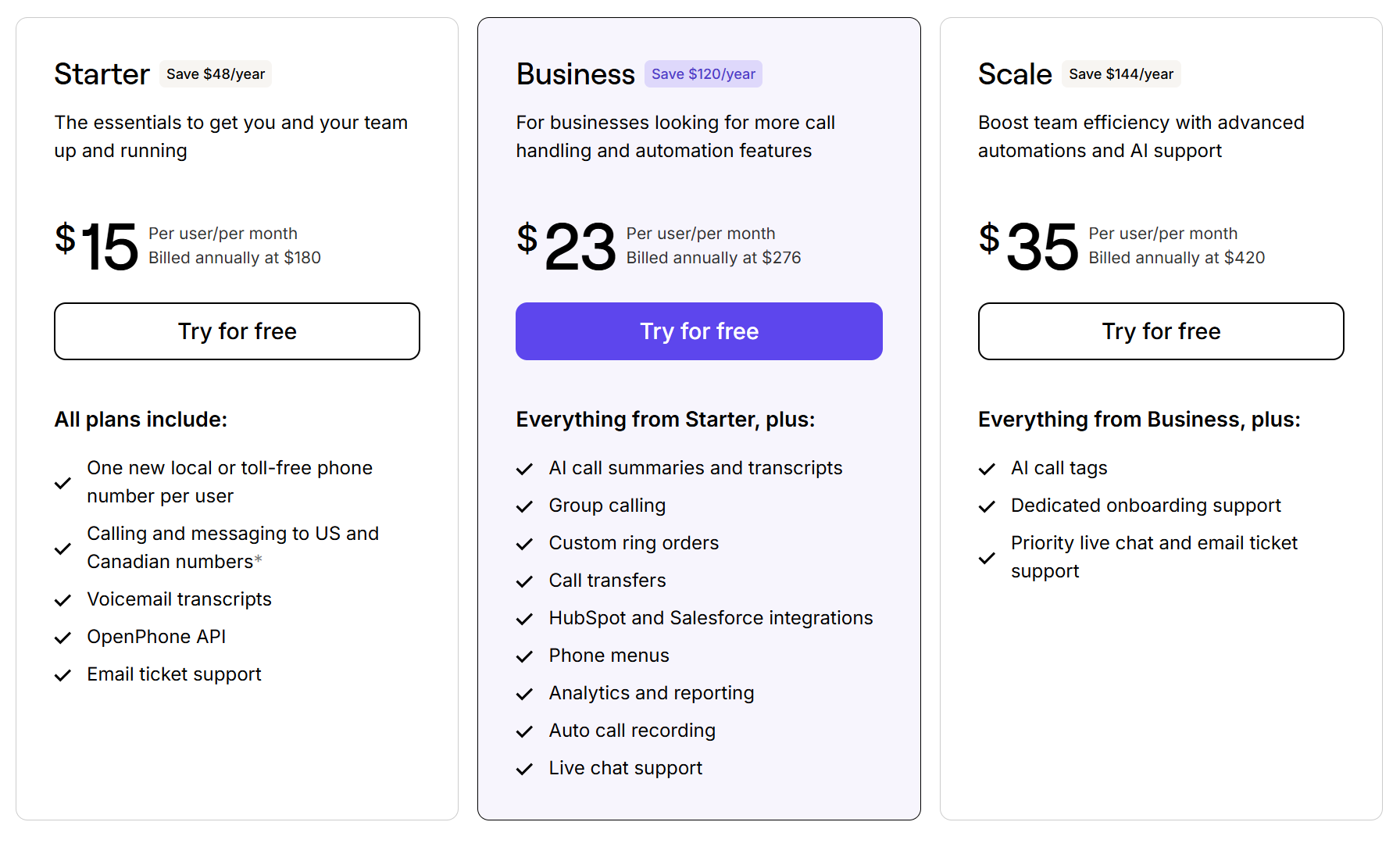
Unlike Vonage, Quo pricing starts at $15 per user per month — with no minimum annual contracts or sneaky hidden fees. Our transparent pricing lives on a single, accessible page so you never have to guess what your monthly bills will be.
Plus, Quo’s plans were designed to scale alongside you, making it easy to move up or down however your business needs. You’ll never have to upgrade plans before you’re ready.
And by the way: Quo doesn’t charge extra for teams with fewer users. It’s always the same price to add more teammates to your account. Plus, each one comes with their own US or Canadian local number (or North American toll-free number). You can purchase as many additional numbers as you need for $5 per month.
2. Record calls without breaking the bank
Quo offers unlimited on-demand call recording on every pricing tier. Want to record every call that reaches your number? Auto call recording is available on our Business plan.
Since we don’t charge fees or per-minute pricing for call recording, you’re free to make (and store) as many recordings as your team needs. You can record calls for training purposes, quality assurance, and even legal purposes, in case of a dispute.
Need to send call recordings somewhere other tha Quo? You can automatically push call recordings to another platform by creating a simple workflow in Zapier — no developers or coding required.
3. Easy to set up with your team

Vonage was built for mass communications. Quo was designed for human collaboration. Each plan comes with shared numbers, shared contacts, and threads and mentions, which allow everyone on your team to work together as a unit.
There’s no need to wait on us to set up the features you need. You can set up call flows, phone menus, and shared number capabilities inside our simple desktop or web app. There’s no need to deal with APIs if you don’t want to — you can set up your account in 15 minutes or less.
4. Give customers a good impression with texting automations
Automations with Vonage can be frustrating and time-consuming since they’re not available on pre-built plans and require an API developer. But with Quo, it’s easy to set up customizable workflows that save hours for your team (and countless headaches for you).
For example, you can use:
- Snippets to create text message templates and respond to FAQs
- Auto-replies to save time texting and respond to every missed call, text, and voicemail
- Text message scheduling to queue up a message in the recipient’s time zone (so it’s never outside of business hours)
5. No-fuss cancellations

Trying to cancel your plan with Vonage? They have a nasty reputation for using dark patterns and junk fees.
With Quo (formerly OpenPhone), all you have to do is log into the app and unsubscribe in a few taps.
We get that life doesn’t always go as planned, so we made it quick and easy. We’ll even hang on to your number(s) and call history for you in case you decide to come back.
6. Built-in AI tools to help you work more effectively

Unlike with Vonage, you’ll get access to time-saving AI tools such as AI message responses, call summaries, and contact suggestions on Quo plans.
You can also tap into AI call tags to automatically categorize calls based on conversation content. These features help your team save time and create a better customer experience.
Pros and cons of Vonage pricing plans
Vonage works best as an enterprise business phone system; it’s often too complex and expensive for most small business needs.
Pros:
- Video conferencing: You can access UCaaS solutions that include video conferencing.
- Microsoft Teams integration: This allows you to connect with the software you’re already using.
- Adjustable API: With the help of your developer and the Vonage customer support team, you can integrate your business apps with pre-made communication features.
Cons:
- No shared phone numbers: There’s no way for everyone on your team to work from the same number (even sharing a line requires a desk phone).
- AI tools require an add-on fee: Vonage’s most impressive AI features require an undisclosed monthly add-on cost.
- Coding required for best features: Vonage is more of a communication API than a business phone system, and many of its best features — including AI tools and call transcriptions — require a developer to implement.
See why Quo is the best VoIP service provider

Vonage was created as a customizable phone system for large enterprises, not a simple pre-built one for small businesses. That’s why thousands of small business owners have migrated from Vonage to Quo — the best VoIP app for teams and small businesses.
We make it easy to manage your calls with a system that comes with all the bells and whistles. We’re built to scale alongside you, so upgrade when you’re ready. And when you’re ready for an API, no worries: we can help with that, too.
See why 1,800+ reviewers rated Quo (formerly OpenPhone) the #1 business phone system on G2 by testing our software with a free seven-day trial.
FAQs
Vonage is a VoIP communications platform that launched in 2001. Its two major services, Vonage Residential and Vonage Business, were designed to replace landlines with internet calls. Today, Vonage also offers ‘unified communications’ for businesses — which includes phone calls, text messages, and video calls — provided you’re willing to upgrade your plan.
Vonage works with softphone apps on your computer and mobile devices, but you can purchase optional desk phones and hardware if you need.
Quo offers more competitive pricing compared to Vonage and fewer hidden fees. For example, Quo’s base plan starts at $15 per month and includes voicemail transcripts and on-demand call recording — features that only come on Vonage’s most expensive plan at $27.99 per line per month.
Is Vonage good for small business?
Vonage isn’t the best choice for small businesses because it’s priced per line rather than per user, charges hidden fees, and locks basic features behind expensive add-ons. It’s a better fit for enterprise companies who can get volume-based discounts and customize Vonage with their APIs.


