Some things get better with age. But some business phone providers? Not so much. And when it comes to legacy systems like 1-VoIP, many of its features haven’t aged gracefully.
Sure, 1-VoIP offers solid basic features, but many growing teams need more. A lot of its features were designed for traditional office landlines, which means you might pay for features you never use.
If 1-VoIP isn’t right for your team, we’ve rounded up the 10 best 1-VoIP alternatives. We break down their prices, features, and limitations so you can choose the right fit for your business needs.
But first:
Here’s what you need to know about 1-VoIP

1-VoIP is a VoIP system that provides residential home phones and business VoIP services. It also offers a SIP Trunking service, which creates a virtual ‘cable’ between your PBX and the public telephone network so you can make calls over the internet. SIP trunking was useful when businesses relied on old-school phone systems, but today, it just adds extra setup that most modern VoIP providers don’t need.
1-VoIP has been around since 2005 and still offers outdated features like paging groups and intercoms. The problem is that it’s struggled to keep up with what modern teams need. Features like AI call tags, additional numbers, texting automations, and third-party integrations are limited or missing.
This, unfortunately, is just the start of its limitations.
Here are more reasons why 1-VoIP isn’t the right fit for most small and growing businesses:
No third-party integrations
1-VoIP doesn’t support integrations with third-party apps, which limits your ability to connect with other tools in your tech stack.
Need to automatically log call activity in your CRM? This isn’t possible. Want to send phone call recordings to Slack channels? You’ll have to do it manually.
Businesses that care about increasing their team’s efficiency will find 1-VoIP’s lack of integrations a major roadblock.
No texting automations like auto-replies or scheduled texts
1-VoIP supports SMS on its softphone app, but it can’t automate sending text messages at all:
- No SMS auto-replies: You can’t automatically respond to missed calls, texts, or voicemails, which makes it harder to stay responsive when you’re unavailable.
- No scheduled texts: 1-VoIP doesn’t support scheduled messaging. You have to manually send texts whenever a reply is needed, which gets tricky when working across time zones, staying TCPA compliant, or setting up appointment reminder texts weeks in advance.
- No message templates: You can’t save common replies as snippets. That means typing out full responses every time — even if it’s the same answer you sent two minutes ago.
Call recordings are only stored for seven days
Need to keep call recordings for training or compliance? 1-VoIP won’t make this easy. It only stores call recordings for up to seven days, which likely won’t be enough in the event of a dispute or miscommunication.
Limited tools for team collaboration
There’s no internal messaging available at all, which means coworkers can’t chat with one another or collaborate without a third-party platform.
The good news is that VoIP providers like Quo offer team messaging so you can leave comments, tag team members, and more to connect with coworkers without switching apps.
1-VoIP pricing

All of 1-VoIP’s business plans come with the same 40 features, including call queues, auto-attendants, and virtual fax. Upgrading your plan unlocks free office phones and unlimited minutes, so you don’t need to pay for additional hardware or call time.
Let’s break it down:
- Metered: $14.97 per extension per month for per-minute pricing ($0.02 per minute in the US and Canada)
- Corporate: $19.97 per extension per month for all-inclusive minutes
- Professional: $34.97 per extension per month for a free office phone plus a business phone number
But compared to other business phone services, 1-VoIP is expensive for what you get. Switching to a modern business phone system like Quo gives you more bang for your buck — like unlimited minutes in the US and Canada and texting automations for $15 per user per month.
Comparing the best 1-VoIP alternatives
If 1-VoIP doesn’t make the grade for your business, one of these alternatives could be a better fit:
| Provider | Starting price | Free calling to US & Canada | SMS/MMS to US & Canada | Shared phone numbers | Additional phone numbers |
|---|---|---|---|---|---|
| 1-VoIP | $14.97 per user per month | X (requires upgrade) | ✓ | ✓ | $4.95 to $5.95 per number per month |
| OpenPhone | $15 per user per month | ✓ | ✓ | ✓ | $5 per number per month |
| Dialpad | $15 per user per month | ✓ | US & Canadian customers only | ✓ | Requires upgrade, plus $5 to $15 per month |
| GoTo Connect | Contact for a quote | ✓ | US & Canadian customers only | ✓ (shared inbox only) | Price varies by country and number type |
| Vonage | $19.99 per user per month (1-year contract) | ✓ | Local US & Canadian numbers only | Requires upgrade | $14.99 per number per month |
| Nextiva | $20 per user per month | Requires upgrade | Requires upgrade | ✓ | Requires the purchase of an additional user seat |
| Aircall | $30 per user per month (3-user minimum) | ✓ | SMS & MMS (MMS is only available for US & Canadian numbers) | ✓ (calls only) | $6 per number per month |
| RingCentral | $20 per user per month | ✓ | ✓ (starts at 25 SMS per user per month) | ✓ | $4.99 per number per month |
| Google Voice | $17 per user per month (must have Google Workspace) | Unlimited calls to Canada from the US only | US customers only | Requires upgrade (ring groups only) | X |
| Ooma | $19.95 per user per month | ✓ | Requires upgrade | ✓ | $4.99 per number month |
| Zoom Phone | $10 per user per month | Requires upgrade | ✓ | ✓ (calls only) | $5 per number per month |
Let’s start with the #1 business phone system as rated by G2:
1. Quo (formerly OpenPhone): Best 1-VoIP alternative for small and growing businesses

Pros
- No hardware required
- 7,000+ third-party integrations via Zapier and Make
- Unlimited call recording storage
- Texting automations on every plan
- Shared phone numbers for team messaging
Cons
- No verification through two-factor authentication*
*Nearly all virtual phone numbers share this problem. Companies like Facebook, Uber, and Google rarely let you authenticate accounts through a virtual phone number.
Quo is a VoIP provider built for small and growing businesses. Once you sign up, you can send unlimited calls and texts to anyone in the US and Canada — no per-minute costs or expensive hardware fees required.
Getting started with Quo takes 15 minutes or less. First, you pick a local or toll-free number in the US or Canada or port an existing number to our system. Then, you can assign separate numbers or create shared numbers so everyone on your team can text and call customers.
Quo keeps calls and texts from falling through the cracks by putting collaboration and flexibility front and center. We offer modernized features that work from any device with an internet connection. That way, you can:
- Delegate tasks with internal threads and comments. In Quo, team members can tag one another in comments to ask questions, share context, or follow up on assigned tasks.
- Stay in control of who answers your calls. You can create phone menus, ring groups, and call forwarding so incoming calls reach the right person — even if someone’s busy or out of the office.
- Automatically text customers at the right time. You can use Quo to save time with scheduled texts, set up message templates, and automatically reply to missed calls, voicemails, and texts.
- Stay organized and proactively solve problems. Quo’s AI call tags automatically label conversations based on categories you’ve defined (like ‘Happy customer’ or ‘Billing issue’). That way, you can identify issues like negative call drivers and look for ways to solve them.
- Automatically sync call activity to your CRM. You can integrate Quo with HubSpot or Salesforce to automatically log call activity under the relevant contact in your CRM. If you use a different app, Quo provides Make and Zapier integrations that let you build custom workflows so you can connect your current tech stack.
- Never lose track of important conversations. Quo offers unlimited call recording storage, so you can go back and review any call whenever you need to.
To help your team save time, Quo can even provides AI call summaries and transcripts. After each call, you’ll automatically get a written summary and full transcript, so there’s no need to take notes or re-listen to recordings. On our Scale plan, you’ll also get access to AI call tags, which label conversations with topics like “billing issue” or “demo request,” making it faster to sort and follow up.
Missing a contact from a recent call or voicemail? Quo’s suggested contacts use AI to spot names, numbers, or emails in your call summaries and voicemails — and suggest creating a new contact when one isn’t already saved.
For all these reasons and many more, Quo is rated the #1 small business phone solution by users on G2.
See why thousands of customers say we’re the best 1-VoIP alternative by signing up for a seven-day free trial.
Key features of Quo
- Manual and automatic call recording
- AI transcriptions and call summaries
- Scheduled texts, auto-replies, and snippets
- Web, desktop, and mobile phone apps
- One free number per user on your account
- IVR
- Quo API
Quo pricing
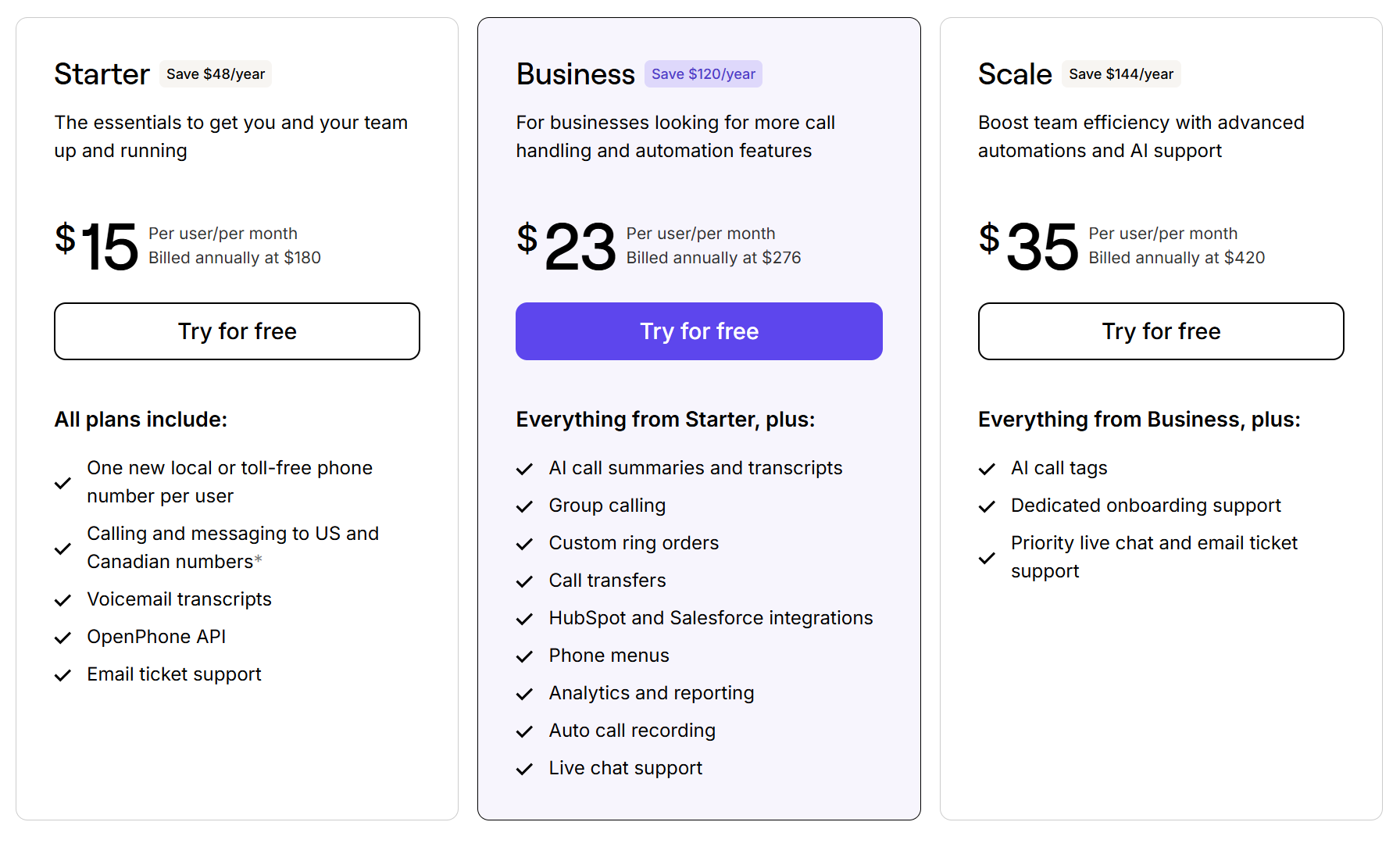
Quo’s pricing provides three different plans for you to choose from:
- Starter: $15 per user per month for unlimited calls and texts in the US and Canada, voicemail transcriptions, caller ID, Quo API, on-demand call recording, texting automations, and international calling
- Business: $23 per user per month for automatic call recording, advanced call forwarding, phone menus, call transfers, ring order, and CRM integrations (HubSpot, Salesforce, and more)
- Scale: $35 per user per month for conditional call routing, AI call tags, priority live chat, and onboarding support
2. Dialpad: Best 1-VoIP alternative for contact centers

Pros
- Unlimited calling in the US and Canada
- Team messaging for internal communications
Cons
- Additional phone numbers require an upgrade
- ‘Premium’ integrations like Zapier require a more expensive plan
- Texting is limited to 250 messages per user per month
Dialpad is a business communications tool that combines calls, texts, and video meetings on the same platform. Unlike 1-VoIP, it offers unlimited calling on the base plan — calls to the US, Canada, and your own country are included for free.
Dialpad also supports team messaging and internet faxing so you can take care of conversations outside of texts and voice calls.
But while Dialpad has solid features, it can quickly get expensive as your team grows. There’s no way to add extra phone numbers, connect with Slack or Zapier, or unlock international texting without upgrading your plan.
Dialpad makes sense for larger call centers that want a phone system with built-in team messaging. It may not be the most scalable system for small businesses, but since it provides third-party integrations, it’s certainly an upgrade from 1-VoIP.
Key features of Dialpad
- Real-time analytics
- Three-way calling
- SMS, MMS, and team messaging features
- Google Workspace integration
- Internet fax (paid add-on)
Dialpad pricing

Dialpad offers three pricing plans to pick from:
- Standard: $15 per user per month for SMS and MMS, multi-level auto-attendant, visual voicemail, call recording, and team messaging
- Pro: $25 per user per month for international texting, additional phone numbers, and integrations with Salesforce, HubSpot, Zapier, and Slack (three-user minimum)
- Enterprise: Custom price for phone number extensions, unlimited ring groups, 99.9% uptime, and single sign-on capabilities (100-user minimum)
Get the full scoop on Dialpad’s pricing.
3. GoTo Connect: Best 1-VoIP alternative for Microsoft Teams users

Pros
- Microsoft Teams integration on the base plan
- Calls to 50+ countries are included for free
Cons
- Limited toll-free minutes
- Shared inbox requires an upgrade
- Limited SMS credits per month
GoTo Connect is a business phone system built for sales and customer support teams. Its base plan includes calling to more than 50 countries, which makes it a solid option for businesses with international contacts.
Sales and customer support teams will get the most out of GoTo Connect since it offers a mix of legacy features (like paging and intercom) and modern ones (like Microsoft Teams integrations and custom surveys). Just keep in mind these ‘advanced features’ require upgrades — you can’t access shared inboxes, AI call summaries and transcripts, or integrations like Zoho without the Connect CX plan or higher.
Do you use toll-free numbers? Prepare to pay up. GoTo Connect only includes 1,000 toll-free minutes on every plan, which are shared across all team members on your account. There’s also no way to upgrade your bandwidth. If you’re getting more than ~17 hours of toll-free calls per month, it would be cheaper to opt for a GoTo Connect alternative.
Key features of GoTo Connect
- SMS, MMS, and team chat
- Unlimited auto-attendants
- Unlimited call recordings
- Calling to 50+ countries is included in the base plan
- AI call summaries and transcripts (requires upgrade)
GoTo Connect pricing

GoTo Connect’s pricing is no longer publicly available. This means the only way to get a quote is to contact the sales team.
Looking for a ballpark number? GoTo Connect’s pricing — last publicly recorded in 2024 — started at $24 per user per month, plus $5 per month for additional numbers.
4. Vonage: Best 1-VoIP alternative for video conferencing

Pros
- Unlimited video conferencing (requires upgrade)
- Unlimited domestic calling to the US and Canada
Cons
- Toll-free numbers are only for US customers
- Simultaneous ring requires the most expensive plan
- Call recording requires an upgrade to the most expensive plan
Vonage is another VoIP service provider that offers unified communications (e.g., calls, texts, and video). One of its biggest claims to fame is video meetings: if you upgrade to the second-tier plan, you can host video conferences with up to 200 participants. You can also tap into its customizable APIs as long as you have the coding skills or want to hire a developer.
Most Vonage users stick to its built-in features, though compared to other VoIP services, they’re pretty underwhelming. Basic tools like on-demand call recording, simultaneous ring, and visual voicemail are locked behind the most expensive plan ($39.99 per user per month).
And speaking of expensive, some of Vonage’s best features only exist as pricey add-ons. Want a toll-free number? That’ll cost an extra $39.99 per month. What’s more, it’s only available to US customers.
Key features of Vonage
- Vonage APIs
- Voicemail
- SMS and MMS support
- Mobile and desktop apps
- Desk phone support (requires upgrade)
Vonage pricing

There are three Vonage pricing plans to choose from. Below is what you can expect to pay for four users:
- Mobile: $19.99 per user per month for unlimited domestic calling, text messaging support, basic voicemail, virtual receptionists, and access to the mobile and desktop apps
- Premium: $29.99 per user per month for desk phone support, team messaging, video meetings, access to the VBC App Center, and single sign-on
- Advanced: $39.99 per user per month for on-demand call recording, call groups, and visual voicemail
5. Nextiva: Best 1-VoIP alternative for Oracle Sales Cloud users

Pros
- Support for non-voice communication channels (chat, social media, email, etc.)
- Microsoft Teams integration (add-on or upgrade only)
Cons
- Basic VoIP functionality require upgrades
- Toll-free numbers are locked behind multiple plans
- Integrations may require extra setup, implementation, and usage fees
Like 1-VoIP, Nextiva is a legacy platform built for sales and customer service teams. But unlike 1-VoIP, it does support integrations with tools like Oracle Sales Cloud — but only on higher-tier plans.
However, Nextiva was built for more than calls and texts — think email, social media, live chatbots, and other points of contact you have with your customers.
In fact, it focuses so heavily on omnichannel communications that you can’t access its VoIP features without upgrading to the Core plan ($30 per user per month). Even if you do, prepare for steep limitations. For example:
- Texting is limited to just 100 messages per user per month
- Integrations require extra fees beyond upgrading your plan
- Advanced integrations (like Microsoft Teams) require an add-on that’s only available on the Core plan
The cherry on top? No toll-free numbers. These only exist as add-ons once you upgrade to the Core plan.
You shouldn’t have to pay extra just to access toll-free numbers when other providers offer them on any plan for $5 per number per month.
Key features of Nextiva
- Digital user inbox
- Inbound and outbound voice calls (require upgrade)
- Basic messaging apps like Facebook (SMS requires upgrade)
- Toll-free numbers (requires upgrade)
- Simple IVR (requires upgrade)
Nextiva pricing

Nextiva offers four pricing plans to consider:
- Digital: $20 per user per month for competitive monitoring, social media channels, and customer review management
- Core: $30 per user per month for voice, video, and SMS support, AI-powered voicemail transcription, and mobile and desktop apps for SMS and voice
- Engage: $40 per user per month for web chat, advanced reporting, toll-free numbers, and the Microsoft Teams integration
- Power Suite: $60 per user per month for priority and skills-based routing, unified team interface, and ACD callback
Keep in mind these plans don’t include add-ons like integrations, voice call recording, and digital fax. If you want the specifics of Nextiva’s pricing, you’ll need to contact the sales team for a quote.
6. Aircall: Best 1-VoIP alternative for integrations

Pros
- 100+ third-party integrations on every plan
- Smart routing (requires upgrade)
Cons
- User minimums on every plan
- Steep pricing compared to competitors
- Shared inboxes are only for calls (not SMS)
Aircall is a customer communications platform with 100+ integrations on the base plan. It’s easy to connect with the tools and services you already use, like HubSpot and Gorgias.
Aircall also offers its Aircall AI add-on that provides tools to help make after-call work easier, like call scoring and AI-generated call summaries. The catch? It requires an add-on priced at $9 per user per month.
If you think that’s expensive, take a closer look at Aircall’s plans. You’ll notice there’s a user minimum required on each, which means the lowest you can pay for the base plan is $90 per month (even if you only need two seats).
Aircall’s basic features are also limited. Tools like shared inboxes only split responsibility for incoming calls, meaning there’s no way to juggle incoming texts with your team.
Key features of Aircall
- Unlimited domestic inbound and outbound calls
- Desktop and mobile apps (iOS and Android)
- SMS and MMS support
- Six months of call recording storage
- Sentiment analysis (requires paid add-on)
Aircall pricing

Aircall’s pricing depends on the plan you choose:
- Essential: $30 per user per month for unlimited domestic calling, 100+ basic integrations, IVR, click-to-call, call recording, and access to mobile and desktop apps (three-user minimum)
- Professional: $50 per user per month for desk phone support, Salesforce integration, smart routing, queue callback, and Power Dialer (three-user minimum)
- Custom: Contact for pricing for all Professional features plus unlimited international calls, custom onboarding, and priority customer support (25-user minimum)
Keep in mind this doesn’t include add-on pricing for Aircall AI ($9 per user per month) or Analytics+ ($15 per user per month).
7. RingCentral: Best option for desk phone rentals

Pros
- Desk phone support
- Supports calls, texts, video meetings, and team messaging
Cons
- Limited SMS credits
- Limited toll-free minutes
- Unlimited storage requires an upgrade
RingCentral is the oldest VoIP phone service on this list, offering calls, texts, and video conferencing tools. Being a legacy provider, it still offers traditional phone features like virtual fax and desk phone support. It also provides a more modern range of business phone features such as visual voicemail, IVR, and automatic call recording.
RingCentral’s features allow you to transcribe calls, texts, and video meetings. It can also help you summarize unread messages, translate texts, and write, draft, and edit SMS messages.
But if you look closer, you’ll notice RingCentral is more limited than it appears. The base plan limits you to:
- 25 text messages per user per month
- 100 pooled toll-free minutes per month
- Limited storage for team messaging and file sharing
For context, other VoIP platforms like Quo offer unlimited bandwidth for all three.
Key features of RingCentral
- Unlimited domestic calling
- Business SMS and MMS (limited)
- Shared voicemail
- Call transcriptions and summaries
- Basic call queues
RingCentral pricing

You can choose from three RingCentral pricing plans:
- Core: $20 per user per month for 100 shared toll-free minutes, 25 business SMS per user per month, limited storage, visual voicemail, and on-demand call recording
- Advanced: $25 per user per month for 1,000 shared toll-free minutes, 100 business SMS per user per month, automatic call recording, and advanced call monitoring
- Ultra: $35 per user per month for 10,000 shared toll-free minutes, 200 business SMS per user per month, and unlimited storage
Learn more about RingCentral’s pricing.
8. Google Voice: Best option for Google Workspace users

Pros
- Connects with Google Workspace
- Ring groups (requires upgrade)
Cons
- No integrations outside of Google apps
- No toll-free numbers
- No texting automations
Google Voice is a VoIP solution with two options: a free plan for personal use and a paid version for business communication. The business plan offers comparable features to 1-VoIP, including desk phone support, call forwarding tools, and calls and texts in the US.
Google Voice also offers features you can’t get with 1-VoIP, like integrations with other Google apps and unlimited minutes to the USA (as long as you’re in the US) without needing to pay extra.
But this is where the benefits end.
Google Voice’s limitations speak for themselves:
- If you opt for the free version, you can’t get multiple numbers per account.
- Google Voice doesn’t support auto-replies, scheduled texts, or text snippets, which means you have to write and send every message manually.
- There’s no way to get toll-free numbers on Google Voice (which even 1-VoIP supports).
If you want a cheaper provider than 1-VoIP, Google Voice’s free version can fit the bill. But keep in mind these two platforms are eerily similar — there are no third-party apps, texting automations, or team messaging tools.
Key features of Google Voice
- Desk phone support (requires upgrade)
- Google Workspace integrations
- Unlimited texting in the US
- Web and mobile apps
- Call forwarding
Google Voice pricing

Google Voice offers three business pricing plans:
- Starter: $10 per user per month for unlimited calls in the US and Canada, voicemail transcriptions, unlimited texting in the US, and call forwarding (10 user max)
- Standard: $20 per user per month for unlimited users, on-demand call recording, SIP link, ring groups, desk phone support, and multi-level auto-attendants
- Premier: $30 per user per month for unlimited international locations, advanced reporting features (BigQuery), and automatic call recording
Keep in mind that Google Voice pricing doesn’t include the extra $7 per user per month for Google Workspace.
9. Ooma Office: Best 1-VoIP alternative for teams that need overhead paging

Pros
- Overhead paging and intercom on every plan
- Compatible with IP phones
Cons
- Starts at 250 text messages per account per month
- 500 inbound calls per month, regardless of plan
- Integrations with Google and Office 365 require an upgrade
Ooma is a business phone number app offering unlimited calls in the US, Canada, Mexico, and Puerto Rico. Similar to 1-VoIP, it supports overhead paging on the base plan. You can make calls from the mobile app or from a desk phone that’s compatible with Ooma.
But what you can’t do with Ooma’s base plan is send text messages. Even if you upgrade, you can only send 250 text messages per user per month. For more than that, prepare to upgrade to the Pro Plus plan ($29.95 per user per month).
Toll-free numbers with Ooma suffer a similar limit — you only get 500 minutes of inbound calls per month on all plans. You also have to upgrade to access third-party integrations like Google Workspace and Office 365.
The bottom line? Ooma can be useful if you have a physical location and need to use paging or intercoms to track down your team. But if you need something more flexible (or at least customizable), you might want to look for an Ooma alternative.
Key features of Ooma
- Ring groups
- Music on hold
- Overhead pager/intercom
- Call forwarding
- Call transfer
Ooma pricing

Ooma has three pricing plans for small businesses:
- Essentials: $19.95 per user per month for access to the mobile app, unlimited calls (US, Canada, Mexico, and Puerto Rico), extension call monitoring, and virtual receptionists
- Pro: $24.95 per user per month for access to the desktop app, video calling, call recording, 250 text messages per user per month, and integrations with Microsoft Office 365 and Google Workspace
- Pro Plus: $29.95 per user per month for integrations with CRMs (including HubSpot and Salesforce), team messaging, call queues, hotdesking, and advanced text messaging (1,000 text messages per user per month)
This doesn’t include the other aspects of Ooma’s pricing, including Directory Assistance fees, extended warranties, and Pro Plus text messaging,
10. Zoom Phone: Best 1-VoIP alternative for existing Zoom users

Pros
- Integrates with Zoom Meetings
- Flat pricing for international calls (requires upgrade)
Cons
- Unlimited domestic calling requires an upgrade
- Shared phone numbers don’t include shared texts
- No free trial without contacting sales
Zoom Phone is a VoIP phone system that’s available as an add-on to Zoom Meetings. It’s the natural choice for businesses already using Zoom for large industry events, such as hosting webinars with over 500 attendees.
With Zoom Phone, you’ll get features like call whispering, call recording, and post-call summaries. You’ll also have access to the AI Companion, which can help prioritize voicemails, list action items, and more.
But where Zoom Phone falls short is with per-minute pricing. Unless you upgrade to the Regional Unlimited plan, prepare to spend extra on every outbound call.
While it does let you answer incoming calls from shared phone numbers, to answer incoming calls, they can’t send or receive texts. Plus, if you upgrade to the Global Select plan, you can’t send texts at all.
Don’t care about texting limitations? Zoom Phone might not be a bad 1-VoIP alternative. But if you need more robust texting limits plus automations to save time, you’re better off looking for a scalable alternative.
Key features of Zoom Phone
- Post-call summaries
- Team messaging
- HD call quality
- SMS and MMS support (select plans only)
- Apps for cell phones (iOS, Android) and desktops (Windows, MacOS, Linux)
Zoom Phone pricing

There are five different Zoom Phone pricing plans to choose from.
If you only care about VoIP calls, choose from one of these plans:
- US & Canada Metered: $10 per user per month for metered calling in the US and Canada, metered international calling, and toll-free numbers
- US & Canada Unlimited: $15 per user per month for unlimited calls in the US and Canada and everything in the US & Canada Metered plan
- Global Select: $20 per user per month for unlimited calling in 40+ countries and direct dial number (DID) for each user (this plan does not support SMS and MMS)
If you want to bundle Zoom Phone with Zoom Workplace, choose one of these plans:
- Pro Plus: $18.32 per user per month (billed annually) for US & Canada Unlimited (no BYOC, third-party PBX, or VDI) and Zoom Workplace Pro (unlimited meetings and access to the AI Companion)
- Business Plus: $22.49 per user per month (billed annually) for US & Canada Unlimited, Zoom Workplace Business, 10 GB cloud storage, and visitor management tools
Quo: The best 1-VoIP alternative

1-VoIP introduced thousands of business owners to the world of VoIP technology. But while the times have changed, 1-VoIP has not. For most growing businesses, it hasn’t stood the test of time.
But now that you’re familiar with what’s on the market, you can see how much more you can expect from a modern business phone system. For 58,000+ businesses, the best 1-VoIP alternative is Quo — it’s simple to set up, easy to use, and built for how people work today.
With Quo (formerly OpenPhone), you can call and text from your computer or phone using your business number, so you’re never tied to a desk. Need to collaborate? You can share a number with your team and see every conversation in one thread, so nothing slips through the cracks. You can also separate work and personal calls, set business hours, and automatically route calls to the right teammate — all from one app.
Test Quo’s features today by signing up for a seven-day free trial.