Your law firm’s success depends on being accessible.
Whether it’s a potential client calling for the first time or an existing client expecting an update, people need to feel they can always reach you. In a field this sensitive, even the perception of being hard to reach can push clients toward a competitor.
Running your business from your personal phone or relying on a VoIP provider that doesn’t meet your needs holds your legal practice back. The right business phone system lets you stay responsive without burning out.
In this guide, you’ll find 10 of the best VoIP for law firms in 2025, plus tips on how to choose the right system for your practice. We’ll also cover key security considerations to keep in mind when picking options.
What are VoIP phone systems, and how do they support law firms?
VoIP, or Voice over Internet Protocol, is a phone system that lets you make calls and send texts over the internet.
Instead of relying on landlines or your personal cell, you get a dedicated business number that works on the devices you already use, like your computer, smartphone, or tablet. That means you don’t have to share your personal number with clients, courts, or opposing counsel.
So, how do you get started?
You sign up with a VoIP for law firms provider, download their app, and pay for a monthly or yearly subscription. As long as you have an internet connection, you can call and text. You can use WiFi, a mobile hotspot, cellular data, or an Ethernet connection.
Here’s why making the switch to VoIP is worth it for legal professionals:
- Flexibility: Take calls and respond to texts from anywhere, whether you’re at the office, waiting in court, or visiting a client.
- Professionalism: Keep work and personal communications separate with a dedicated firm number.
- Cost savings: VoIP costs are typically more affordable than traditional phone systems. You pay predictable monthly fees and no surprise costs.
- Features built for responsiveness: VoIP goes beyond just making calls. It gives you tools that help you stay organized and deliver better service.
For example, with Quo, formerly OpenPhone, you get:
- Unlimited calls to the US and Canada
- Unlimited texting for both SMS and MMS
- Shared numbers so your team can split responsibility and see all of the firm’s communications in one place
- Call forwarding and routing to ensure clients always reach the right person
- Call recording, transcripts, and summaries to track conversations and reduce note-taking
- Integrations with over 8,000 tools through Zapier and Make, for example, with your practice management software, time tracking, and billing platforms
And more features designed to help your firm stay connected and in control.
The top VoIP systems for law firms: A visual comparison
What do the top VoIP systems for law firms look like side by side? You can use this handy comparison chart to find out.
| Provider | Price | Unlimited calling to US & Canada | Unlimited SMS, MMS to US & Canada | Shared phone numbers | Additional phone numbers |
|---|---|---|---|---|---|
| Quo | Starts at $15 per user per month | ✔️ | ✔️ | ✔️ | $5 per number per month |
| Ooma | Starts at $19.95 per user per month | ✔️ | Requires upgrade | ❌ | $9.95 per number per month |
| RingCentral | Starts at $20 per user per month | ✔️ | 25 texts per user per month | ✔️ | $4.99 per number per month |
| 8×8 | Contact for quote | Unlimited domestic calls | X | ✔️ | Pricing not publicly available |
| Nextiva | Starts at $15 per user per month | ✔️ | Requires upgrade | ✔️ | Requires the purchase of an additional user seat |
| Corvum | Calling plans start at $27.95 | ✔️ | ✔️ | ✔️ | Pricing not publicly available |
| Vonage | Starts at $13.99 | Unlimited domestic calls | ❌ | ✔️ | Pricing for local numbers isn’t available. Toll-free numbers cost $39.99 per month. |
| Zoom Phone | Starts at $10 per user per month | Unlimited domestic calling, requires upgrade | ❌ | ✔️ | $5 per number per month |
| Dialpad | Starts at $15 per user per month | ✔️ | ❌ | ✔️ | Requires upgrade |
| Grasshopper | Starts at $14 per month | ✔️ | ✔️ | ✔️ | Requires upgrade, then costs $9 per month per number |
Keep reading as we break down the top systems.
10 best VoIPs for law firms
While there are dozens of options out there, let’s start with the phone system rated #1 for customer satisfaction on G2:
1. Quo: Best VoIP provider for growing practices

Pros
- Unlimited calls and texts to the US and Canada
- SOC 2 compliance for secure data
- Shared phone numbers and simultaneous ring
- Auto-attendant functions or IVR for inbound calls
- Call recordings, transcripts, and summaries
- Automatic call recording notifications for call recording compliance
- AI features like AI voice agent, call tags, and call transcripts and summaries
- Integrations with 8,000+ apps, including Slack, Salesforce, and HubSpot
Cons
- No verification through two-factor authentication*
*Nearly all virtual phone numbers share this problem. Companies like Facebook, Uber, and Google rarely let you authenticate accounts through a virtual phone number.
Quo gives growing and small law firms a reliable way to stay accessible to clients without sacrificing privacy.
Quo supports data privacy standards like the California Consumer Privacy Act, or CCPA. It’s also SOC 2 compliant, helping you meet your ethical obligations around security and confidentiality. Read more about security at Quo.
Quo gives you unlimited texting and calling in the US and Canada. Each user also gets a dedicated local or toll-free number. Want to manage communications together? Set up shared numbers.

Quo also works on all the smart devices you already have, like your phone, computer, or tablet. So you can work from home or elsewhere as a virtual lawyer.
Automatically record your calls to keep accurate client records and protect your firm in case of disputes. On Quo’s Business and Scale plans, each call also comes with call summaries and transcripts.
Simultaneous ring and ring groups make sure your team never misses an important call. If no one answers after a set number of rings, the call automatically routes to another attorney, paralegal, or even Sona, Quo’s AI voice agent. You can set up exactly how this works.
Set auto-replies to let clients know you’ve received their message and when they can expect a reply. This reassures clients you’re on top of their case, even if you can’t answer right away.

Need help answering calls when your team is away or can’t pick up?
Sona greets callers, collects details, and handles routine questions. Each call comes with a transcript and summary, so you always have oversight.
“With Sona, I never worry about missing a call again. It’s like having a smart, reliable assistant who always picks up. It’s professional, friendly, and on it 24/7.” — Christopher Sands, CEO of Hannon De Palma

Through Zapier and Make, Quo integrates with over 8,000 tools for better efficiency and record-keeping. For example, you can integrate with your time and billing software to see how much time you spend on calls. Then, link it directly to billable hours.
See for yourself why growing law firms use Quo. You can sign up for a free seven-day trial in 15 minutes and use a temporary phone number to test the platform. Then when you’re ready, easily port an existing US, Canadian, or North American toll-free number over.
Key features of Quo
- Unlimited calling and texting
- Call recording
- AI voice agent
- Call routing and ring groups
- Phone menus and multi-level IVR
- Conditional call routing, including business hours routing
- 8,000+ integrations, including popular CRMs like HubSpot, Salesforce, and Jobber
- Text message automations like scheduled messages, auto-replies, and snippets
- Internal threads to tag teammates and collaborate
- Call analytics
Quo pricing
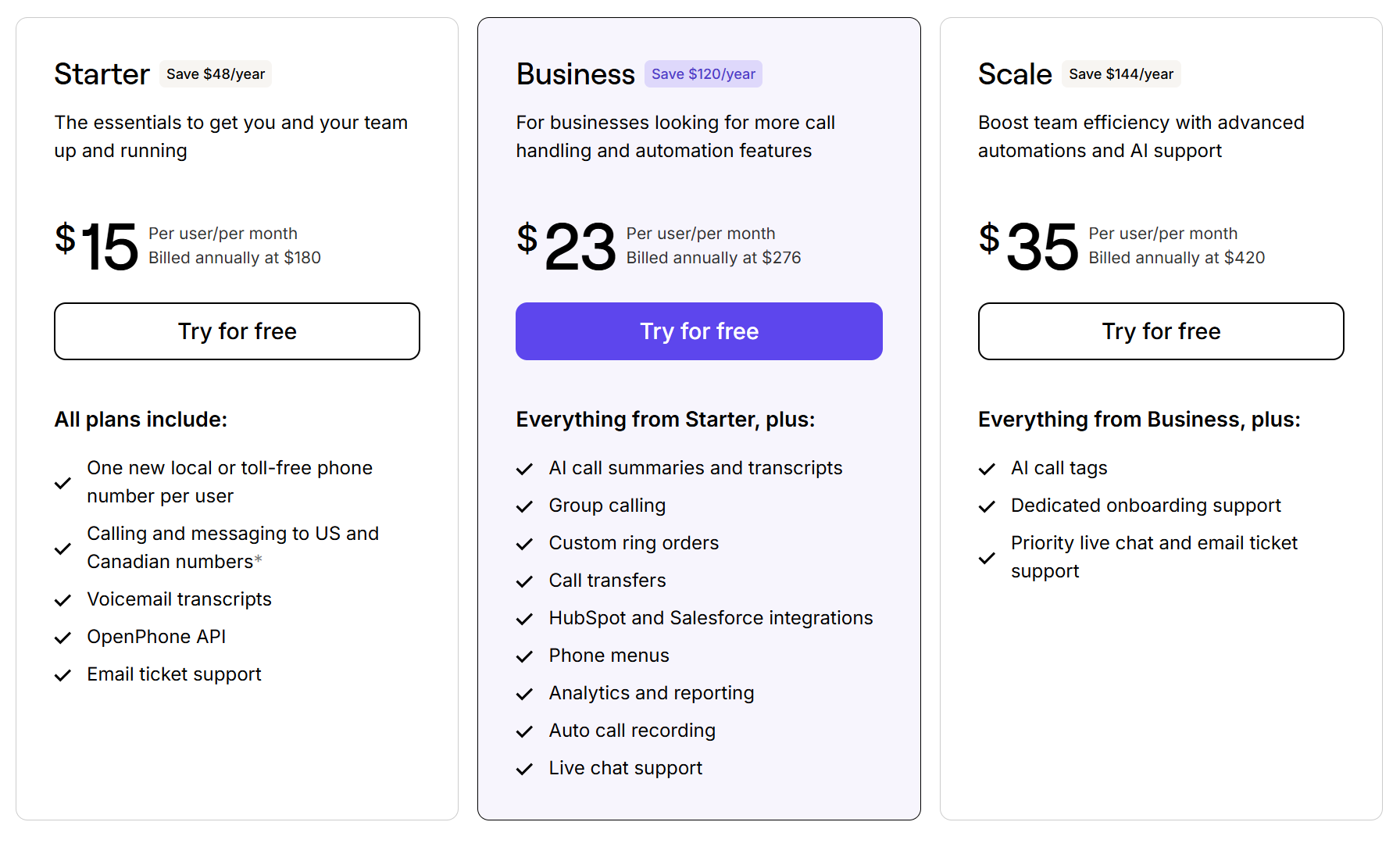
You can choose between three Quo pricing plans:
- Starter: $15 per user per month for free calls and texts to the US and Canada, texting automations, Sona, on-demand call recording, voicemail transcription, and more
- Business: $23 per user per month for phone menus, call transfers, analytics and reporting, integrations with CRMs like HubSpot and Salesforce, and more
- Scale: $35 per user per month for AI call tags, dedicated onboarding, and priority chat and email support
2. Ooma: Best service for desk phone rentals

Pros
- Unlimited calling in the US, Canada, Mexico, and Puerto Rico
- Desk phone support
- Video conferencing on higher plans
Cons
- Texting requires an upgrade
- Text messaging is capped at 250 per month on the Pro plan
- Call recordings and voicemail transcriptions are unavailable on the base plan
- Not SOC 2 compliant
Ooma is a legacy phone system built for small businesses in traditional office environments. With Ooma, you get unlimited calling in four countries and territories. You also get additional office-friendly features like overhead paging and an intercom.
But essential features like a desktop app, call recording, and CRM integrations are only available on more expensive tiers.
You also don’t get texting on the base plan. If you upgrade to Pro, you’re still limited to just 250 messages per month. The most expensive plan comes with 1,000 messages per month. So you might have that cost at the back of your mind when texting clients rather than fully focusing on the conversation.
Key features of Ooma
- Unlimited calls in the US, Canada, Mexico, and Puerto Rico
- Overhead paging and intercom tools
- Desk phone support
- Call recording requires an upgrade
- Text messaging requires an upgrade
- Call forwarding and transfers
Ooma pricing

Ooma’s pricing has three plans:
- Essentials: $19.95 per user per month for unlimited calling in the US, Canada, Mexico, and Puerto Rico, extension call monitoring, virtual receptionists, overhead paging, intercom tools, and access to the mobile app
- Pro: $24.95 per user per month for 25-member video calls, 250 texts, call recording, voicemail transcriptions, integrations with Microsoft Office 365 and Google, and access to the desktop app
- Pro Plus: $29.95 per user per month for CRM integrations like Salesforce, team chat, call queues, hotdesking., 100-participant video conferencing, and 1,000 text messages
If you’re porting your number to Ooma, you’ll also have to pay a one-time fee of $39.95.
3. RingCentral: Best for unified communications

Pros
- Unlimited calls to the US and Canada
- Offers video calls with an upgrade
- Offers desk phone rentals
Cons
- Texting is limited to 25 texts per user per month on the base plan
- CRM integrations require an upgrade
- Call recording requires an upgrade
- Toll-free calling is limited
RingCentral is a unified communications, or UCaaS, platform. It supports video conferences, audio calls, and texts. It’s also compatible with desk phones. So, it’s a solid choice if you still use on-premises hardware. Also, some lawyers choose RingCentral for its online fax capabilities.
That said, RingCentral’s Core plan only offers 25 texts per user per month. You could run through that in a week. Plus, you only get 100 toll-free minutes per month unless you upgrade to the Advanced plan.
Finally, RingCentral deletes certain saved files after a specific time. Call recordings, both on-demand and automatic, are only stored for 90 days. And you’ll lose your call logs after nine to 12 months, depending on your account type. Even if you upgrade to the most expensive plan, you still have to worry about time limits. In tiny script at the bottom of their pricing page, you’ll find a link to their retention policy.
Key features of RingCentral
- Unlimited domestic calls
- Limited SMS and MMS support
- Multi-level auto-attendant
- Video meetings
- Team messaging and file sharing
- On-demand and automatic call recording
- Shared lines
- Call queues
- Desk phone rentals
RingCentral pricing

RingCentral’s pricing includes three plans:
- Core: $20 per user per month for 25 text messages, on-demand call recording, and up to 100 video meeting participants
- Advanced: $25 per user per month for 100 text messages, automatic call recording, and advanced call monitoring functions like call whispering and call barging
- Ultra: $35 per user per month for 200 text messages, device analytics and alerts, and “unlimited” storage with time-based limits
4. 8×8: Best for global calling

Pros
- Unlimited international calling on some licenses
- Microsoft Teams integration is available
- Global local number support
Cons
- Can be complex to set up
- Smaller integration library with only 74 integrations
- Must contact sales for pricing and to trial
- Outdated support articles
8×8 is an older VoIP provider that offers international calling plans to larger firms. Depending on your plan, you can make unlimited calls in up to 48 countries. You can also buy local phone numbers to create a familiar presence overseas. 8×8 also integrates with Microsoft Teams, so you can connect it to 8×8 to keep everything in one place.
Unfortunately, 8×8 doesn’t clearly explain its features, plans, and pricing on its website. For example, the platform is HIPAA compliant and SOC 2 audited. But it’s not clear which plans give you access to these security measures. So you’ll have to contact sales for details.
Plus, 8×8 doesn’t offer as many integrations compared to other providers on this list. This can silo your system and require you to switch between tools. If you want a communication system with more transparent VoIP costs, you might want to browse 8×8 alternatives.
Key features of 8×8
- Video meetings and AI meeting summaries
- High-volume messaging
- Calling and texting
- Global coverage
- Call recording
- Team chat
- Fax
8×8 pricing

At the time of writing, 8×8 doesn’t list its pricing publicly. You’d have to reach out to the 8×8 sales team for a quote.
5. Nextiva: Best for large businesses using Microsoft products

Pros
- Microsoft integration
- Inbound and outbound calls in the US and Canada
- Video calls are available on the base plan
Cons
- Limited SMS and MMS
- Call recording requires an upgrade
- Most integrations require an add-on fee
Nextiva is a customer experience platform for enterprises. And they’ve also designed a simple offering for small and medium-sized businesses. You can use Nextiva for calls and texts inside the US and Canada. Nextiva also offers video calling on the base plan. Plus, they’re SOC 2 compliant and offer some HIPAA-compliant services.
Need to integrate with Microsoft products? Nextiva offers a native integration as an add-on.
That said, some limitations may drive your bill up:
- The Core plan only gives you 100 texts per user per month. That’s ~three messages per day for each person.
- Voice call recording is only available as an add-on on the Core plan. Otherwise, you have to upgrade to the second pricing tier.
- Video call recording requires an upgrade to the second pricing tier. That’s nearly double the price of the base plan, and it comes with features you likely don’t need, like 30 linked social media accounts.
Key features of Nextiva
- Free unlimited video calls and voice calls in the US and Canada
- Limited texting
- Virtual fax
- Smart call routing with an upgrade
- Team chat
- Microsoft Teams integration with an add-on or upgrade
- Integrations with email, social media, web forms, and other business apps
Nextiva pricing

There are three tiers of Nextiva pricing:
- Core: $15 per user per month for voice calls, 100 text messages, team chat, voicemail transcriptions, and access to the mobile app
- Engage: $25 per user per month for the Microsoft Teams integration, 500 text messages, digital fax, voice analytics, 2,000 toll-free minutes, and call recording
- Power Suite: $75 per user per month for up to 100 agents for skills-based routing, IVR, call transcriptions and summaries, and API integrations
6. Corvum: Best for Canadian firms using Clio

Pros
- Integration with Clio
- Unlimited texts and calls in the US and Canada
- Supports desk phones
Cons
- No integrations besides Clio are available
- Call recording is only available as an add-on
Corvum is a cloud phone system with dedicated data security for Canadian firms. It offers two main plans: an SMS-only plan and a Voice + Text plan. If you have more than 30 team members, you can also get a custom plan with volume discounts.
The Voice + Text plan comes with unlimited phone calls and texts in the US and Canada. Plus, it includes features like routing, phone menus, and virtual fax. Call recordings, transcripts, and summaries are add-ons.
Corvum also comes with a native Clio integration. This lets you sync call information and text conversations to simplify billing and record management.
Just know that Corvum doesn’t offer any other integrations. This siloes your data and means you have to take care of tasks like following up with clients or updating contact information manually. That takes time and increases the chances of errors.
Unlike Quo, Corvum doesn’t give you the option to automatically transcribe every call. You have to ask Corvum to transcribe the ones you want, then wait for the results. Corvum offers the basics to law firms. But at the moment, it’s not a system that can grow with you.
Key features of Corvum
- Clio integration
- Unlimited calling and texting in the US and Canada
- Phone menus
- Call routing and ring groups
- Group calling
- Fax
- Call recording and transcription are available as add-ons
- AI call summaries are available as an add-on
Corvum pricing

Corvum offers three pricing plans:
- Text: $22.95 per month for unlimited texting, a new business number or number porting, mobile app access, and Clio Manage integration
- Voice + Text: $27.95 per month for all texting features plus unlimited phone calls, call recording and transcriptions, detailed time tracking, call management features, and E911 service
- Custom: Contact Corvum for pricing for teams with more than 30 members
7. Vonage: Best choice for business communication APIs

Pros
- Unlimited domestic calling
- Offers APIs to automate texting
- Offers video meetings with limited storage
Cons
- On-demand call recording requires an add-on
- Toll-free numbers require an add-on
- Shared inboxes require an add-on
Vonage is a legacy business phone service. It offers pretty basic features on each plan, including:
- A mobile and desktop app
- Unlimited domestic calling
- SMS support
- A virtual receptionist or phone menu
Plus, it offers APIs that let you customize how you automate templated texts. Think thank-you notes and appointment reminders. Starting from the mid-tier pricing plan, you also get video calls. Just know that you can only record and store up to 15 hours of meetings. And recordings are only stored for 30 days.
The biggest limitation with Vonage, though, is how expensive it is to access essential business phone features.
For example, automatic call recording is only available as an add-on. It’s the same for on-demand recording, unless you want to upgrade to Vonage’s most expensive plan, starting at $27.99 per user per month. You can also only get call groups and voicemail transcriptions on the most expensive Vonage plan.
Vonage key features
- Unlimited domestic calling
- SMS and MMS
- Texting API
- Video meetings with an upgrade
- On-demand call recording with an upgrade
- Desk phone support with an upgrade
- Team messaging with an upgrade
Vonage pricing

Vonage’s pricing has three subscription plans based on the number of users you have. Here’s how much you’ll pay if you have a team of four or fewer users:
- Mobile: $13.99 per number per month for unlimited domestic calling, SMS and MMS, voicemail, virtual receptionists, and desktop and mobile apps
- Premium: $20.99 per number per month to access team messaging, video meetings, desk phone support, CRM integrations, and single sign-on
- Advanced: $27.99 per number per month to access on-demand call recording, visual voicemail with transcriptions, and simultaneous ring
8. Zoom Phone: Best for firms already using Zoom

Pros
- Perfect integration with Zoom
- Familiar interface
- SMS and MMS are available
- Desk phone integration on certain plans
Cons
- Outbound calls are metered unless you upgrade to an unlimited plan
- SMS/MMS are only available in the US and Canada
- Shared numbers don’t support texting
- Limited integrations
Zoom Phone is a solid option for practices that already use Zoom for video calls. It has a familiar interface and gives you the essentials like:
- Inbound and outbound calling
- Shared phone numbers
- Text messaging support
You also get Zoom Phone’s AI companion on most plans. The AI can summarize your calls, extract tasks from voicemails, and prioritize your voicemail.
One big caveat is that domestic calling in the US and Canada is limited on the base plan. You’ll have to buy a US & Canada Calling plan for $15 per user per month. Keep an eye out for other extra costs, like needing the Power Pack add-on to access analytics.
You also don’t get many integrations with Zoom Phone. For example, you can’t integrate it with most legal software. Zoom Phone’s integrations include:
- Salesforce
- Slack
- Microsoft Calendar and Outlook
- Google Calendar and Gmail
- Twilio
- Five9
- Genesys
- NICE inContact
- Talkdesk
Key features of Zoom Phone
- Domestic calling
- Metered international calling
- AI meeting companion
- Call queues
- Call routing and IVR
- Call recording
- SMS and MMS support
- Advanced analytics with an add-on
Zoom Phone pricing

While they’re not easy to spot on the website, there are five Zoom Phone pricing plans to consider:
- US & Canada metered: $10 per user per month for limited and metered domestic calling, access to international calling, and support for toll-free numbers
- US & Canada Calling unlimited: $15 per user per month for unlimited domestic calling, plus an add-on for unlimited calling to 19 countries
- Global Select: $20 per user per month for unlimited domestic calling in 40+ countries and territories, plus one direct-dial number, or DID, for each license
You can also bundle Zoom Phone with Zoom Workplace:
- Pro Plus: $18.33 per user per month for Zoom Workplace Pro plus Zoom Phone US & Canada Unlimited
- Business Plus: $22.49 per user per month for Zoom Workplace Business, Zoom Phone US & Canada Unlimited, and visitor management
9. Dialpad: Best for large contact centers

Pros
- Unlimited calling in the US and Canada
- HIPAA and BAA compliance
- AI features are available on the base plan
Cons
- Minimum user requirements can hike up costs
- Slack and Zapier integrations require an upgrade
- No additional numbers are available on the base plan
Like Quo, Dialpad is a secure VoIP app for lawyers. It supports calls, texts, and videos. You also get some call handling essentials like call queues, forwarding, and routing.
But Dialpad’s primary focus is on AI solutions. For example, it gives you call and voicemail transcriptions. You can also add on a live AI coach to remind reps of things like talking too fast or too slow. This can be particularly helpful if you need to coach anyone you’ve contracted at an answering service company.
That said, Dialpad has some important limitations you should know:
- You can’t get additional numbers for your team without upgrading to the Pro plan, which costs $10 more per user per month. Then there’s $5 per user per month for the additional number.
- You can’t integrate with practice management tools like Clio unless you upgrade.
- You don’t get unlimited SMS/MMS. Dialpad’s texting support is limited to 250 messages per month, after which you’re charged for every message sent.
Finally, Dialpad’s Standard and Pro plans have a three-person minimum limit. So, if you want essential features that are only available on higher-end plans, you’ll have to pay for more than you need.
Key features of Dialpad
- SOC 2 and HIPAA compliance
- Unlimited calling
- Limited SMS and MMS
- Video conferencing
- Multi-level IVR
- Call recording
- Team messaging
- Call transcription
- Voicemail transcription
- Real-time analytics and reporting
- Limited integrations, like Zapier and Slack, with an upgrade
Dialpad pricing

Dialpad offers three pricing tiers to choose from:
- Standard: $15 per user per month for unlimited calling, multi-level IVR, toll-free number support, call recording, and call and voicemail transcription
- Pro: $25 per user per month for international texting support, additional numbers, third-party integrations, and 25 ring groups
- Enterprise: Custom quote for unlimited ring groups, more integrations, and a 100% uptime guarantee
10. Grasshopper: Best for solo lawyers

Pros
- Unlimited calling to the US and Canada
- Desktop and mobile app
Cons
- Only integrates with Google Voice
- Only one number per account unless you upgrade to the most expensive plan
- Call recording requires an upgrade
- Expensive international calling
- No international texting
Grasshopper is a virtual phone system designed for small business owners and solo lawyers. On all plans, you get the basics and not much more. For example, you can have call routing, forwarding, and unlimited calling and texting.
But the base plan is only for one user and gives you one phone number. The mid-tier plan also gives you one number, but allows for unlimited users.
Grasshopper is a decent option for a solo lawyer who just wants the fundamentals. But it won’t be useful for firms that plan to scale. For one, you don’t get any integrations besides Google Voice. So you risk out-of-sync data across your tools.
You also don’t get shared numbers. So you can’t collaborate with other lawyers, paralegals, or team members. And you won’t have any context about who said what, so you risk coming off as unreliable to clients.
In the words of one reviewer, “[The] downside was that we grew rather quickly and needed to switch to another company to meet our needs.”
Key features of Grasshopper
- Free unlimited calls and texts in the US and Canada
- Call recording with an upgrade
- Local and toll-free numbers, with additional numbers for $9 per month each
- Phone number extensions, with additional extensions for $3 per month each, with an upgrade
- Call forwarding
- Call transfers with an upgrade
- Voicemail transcriptions
- 24/7 customer support
- Mobile and desktop apps
Grasshopper pricing

Grasshopper offers three pricing plans to customers:
- True Solo: $14 per month for one user, one phone number, and one extension
- Solo Plus: $25 per month for unlimited users, one phone number, and three extensions
- Small Business: $55 per month for unlimited users, four phone numbers, and unlimited extensions
Before picking providers: VoIP security essentials for law practices
Using VoIP means your phone system runs on a third-party provider’s cloud infrastructure. Because of this, lawyers have ethical duties when using cloud-based systems. This includes thoroughly vetting the provider that hosts and stores your clients’ data.

⚠️Remember: The right VoIP provider is as secure as traditional phone systems, if not more. That’s thanks to dedicated security teams, regular updates, and stronger data protections.
To make sure your future provider can protect you and your clients, look for these security features:
- SOC 2 Type II compliance: Independent audits verify how the provider manages and protects data.
- End-to-end encryption: Calls, messages, and files are encrypted in transit and at rest. No one else can read or intercept it.
- Data location transparency: The provider clearly states where its servers are located. This is important because data stored outside your country may be subject to different privacy laws and legal access rules.
- Access controls. Features like multi-factor authentication and role-based permissions prevent unauthorized access.
- Regular security audits. Third-party testing ensures ongoing compliance and identifies vulnerabilities early.
- Backup and recovery. Automated backups and clear recovery procedures protect against data loss.
- Compliance certifications. CCPA, GDPR, PIPEDA, and other regional standards relevant to your jurisdiction.
📌 Make sure to bookmark this page so you can come back to this security checklist when you’re comparing providers.
Step-by-step guide to implementing VoIP in your law practice
Getting started with cloud phone systems doesn’t require any IT expertise. Here’s how to set up VoIP in a few straightforward steps:
- Assess your current system: Document your existing phone setup, call volume, and pain points. What features are you missing, and what’s your budget for the switch?
- Test your internet connection: You need less than 0.5 Mbps download speed and 100 Kbps of bandwidth per concurrent VoIP call. Run speed tests during peak usage hours to identify potential issues.
- Research and demo VoIP providers: The best providers let you create an account online and trial the software without being forced to talk to a sales team. When trialing providers, test call quality, mobile apps, and integrations with your practice management software.
- Plan your number strategy: Decide if you want a new number or if you’ll keep your existing one. Number porting can take 5-10 business days, so plan for this in advance. But don’t worry, you won’t lose connection with your current provider until you’re fully switched to the new one.
- Communicate with clients: Inform clients about the transition timeline and provide alternate contact methods during the switchover period to maintain accessibility.
- Configure your new system: Set up call routing, auto-attendants, voicemail, and user permissions. Test all features before going live to ensure everything works as expected.
- Train your team: Provide hands-on training for all staff on the new system’s features, mobile apps, and troubleshooting basics. Create quick reference guides for common tasks.
- Monitor and optimize: Track system performance, gather staff feedback, and fine-tune settings based on actual usage patterns.
Choosing the right VoIP system: A law firm’s checklist
Not all VoIP systems are built for the way law firms work. Here’s a checklist to help you narrow down your options more easily:
- Total cost: Look beyond the monthly per-user price. Factor in setup fees, additional number costs, and potential overage charges. Some “affordable” providers become costly once hidden fees add up.
- Ease of setup: Consider how quickly you can get up and running. Can you port existing numbers easily? Is there a complex IT setup, or can your team start using it immediately? Downtime during migration can cost clients.
- Scalability without switching plans: Choose a provider that grows with your practice. Can you add new users or numbers easily without upgrading to a higher tier? Avoid systems that force expensive plan changes as you expand.
- Client communication preferences: Ensure the system supports how your clients want to communicate. If your clients need to reach you via text, avoid platforms with limited texting support.
- Trial period and contract flexibility: Check if you can test the platform before committing and whether you’re locked into long-term contracts. Flexibility lets you easily adjust as your firm’s needs evolve.
- Essential features: Look for strong call quality, reliable service, necessary integrations, and SMS/MMS support. Features like call recording, auto-replies, and transcripts also help you stay organized and responsive.
Quo: The best VoIP for law firms

With Quo, your firm never has to worry about missed calls or slow responses. Quo is a secure legal phone system that keeps all your conversations organized. You can stay accessible and protect client privacy while doing your best work.
Quo gives you everything you need to manage client communication from anywhere. You can call and text from your existing devices, record and review calls, and automatically save transcripts for accurate records. Sona, our built-in AI voice agent, can capture leads and take messages 24/7. Whether you’re busy, in court, or asleep, you can stay accessible.
Samantha Kompa, Founder of Kompa Law, puts it plainly:

“Quo is the most important tool in my tech stack to run my digital law firm.”
Hundreds of law firms use Quo to deliver faster, more reliable client service while reducing the time spent on admin. You can see how it fits your firm with a free seven-day trial.
FAQs
No. VoIP runs over the internet, so you’ll need a stable connection — WiFi, Ethernet, or mobile data — to make and receive calls. As a backup, you can forward calls to a cell number or a landline if your internet goes down.
Look for features that keep your firm responsive, organized, and compliant:
– Reliability: Look for clear, consistent call quality and high uptime.
– Unlimited calling and texting: Stay reachable without worrying about usage limits.
– Call recording and transcripts: Keep accurate records of client communications.
– Security: Ensure encryption, secure storage, and compliance with data protection laws.
– Integrations: Sync calls and messages with your case management or billing tools.
– Scalability: Add users or numbers easily as your firm grows.
– AI or automation tools: Streamline repetitive tasks and use AI voice agents like Quo’s Sona to help clients get help 24/7.
A VoIP system is a cloud-based phone service that lets you make and receive calls or texts over the internet instead of traditional phone lines. You can use your existing devices like your PC and smartphone. VoIP systems provide law firms with professional numbers, call recording, transcripts, and advanced routing. This way, you can manage client communication more efficiently and professionally.
Most VoIP providers, including Quo, don’t require specialized hard phones. You can use your computer, smartphone, or tablet to make and receive calls once you sign up for a plan.
If you need an old-fashioned phone, look for VoIP-compatible desk phones from brands like Poly, Cisco, or Yealink. They plug into your internet connection and work with some providers like Dialpad.
Quo is one of the best VoIP systems for law firms. It offers unlimited calls and texts, secure data storage, and call recording and transcripts. You also get advanced routing and Sona, our AI voice agent, so you can handle calls smoothly.
Yes. Most providers, including Quo, let you port your current numbers to your new VoIP system. Don’t worry, your clients can continue reaching you at the same number.