If you’re old enough to remember when ‘on fleek’ was a thing, you’re old enough to remember when Aircall launched. This VoIP system was designed for enterprise brands and today serves call centers and help desks with a cloud-based business phone system.
While Aircall may be a solid fit for enterprise brands, it’s not always the right choice for growing small businesses. The price you pay doesn’t always match the features you get, and if you read the fine print, it might cost more than you think.
Getting the whole picture of Aircall’s pricing can be stressful, but the good news is we’re here to help. This guide breaks down Aircall pricing, major limitations, and better alternatives.
Aircall pricing and plans
Aircall offers three VoIP plans: Essentials, Professional, and Custom. The biggest difference between them is the number of enterprise features you get, which range from 100+ integrations and click-to-dial to single sign-on and access to API developer support.
Keep in mind the first two plans come with a three-user minimum, so at a bare minimum, you’re paying $90 per month.
| Essentials | Professional | Custom |
|
|---|---|---|---|
| Pricing | $30 per user per month | $50 per user per month | Must contact their sales team |
| Number of local or toll-free phone numbers | 1 | 1 | 1 |
| Number of users | 3 users minimum | 3 users minimum | 25 users minimum |
| Inbound and internal calls (toll-free excluded) | Unlimited | Unlimited | Unlimited |
| Outbound calls - domestic | Unlimited in US and Canada | Unlimited in US and Canada | Unlimited in US and Canada |
| Outbound calls - international | Contact sales | Contact sales | Unlimited |
| SMS and MMS | Contact sales | Contact sales | Contact sales |
| Call recording | ✔ (up to 1 year storage by request, 6 months available in Dashboard) | ✔ (unlimited storage by request, 6 months available in Dashboard) | ✔ (unlimited storage by request, 6 months available in Dashboard) |
| AI call summaries | Requires purchase of Aircall AI add-on | Requires purchase of Aircall AI add-on | Requires purchase of Aircall AI add-on |
| 100+ Integrations and API access | ✔ (not including Salesforce) | ✔ | ✔ |
| Advanced analytics and live monitoring | ✔ | ✔ | |
| Queue call back and smart routing | ✔ | ✔ | |
| Email and phone support | ✔ | ✔ | ✔ |
| Prioritized customer support | ✔ |
Let’s take a closer look at what you get on each plan:
Essentials plan
Pricing: $30 per user per month billed annually ($40 per user per month if billed monthly)
The Essentials plan gives you access to essential telephony features like phone menus, unlimited outbound and inbound calling in the US and Canada, and the ability to send SMS and MMS.
You’ll also get key business features, including:
- Basic integrations (HubSpot, Slack, etc.)
- Call and voicemail transcriptions
- Click-to-dial
- Warm transfers
- Business numbers
- Call recording
- Call forwarding
- IVR
Keep in mind this plan comes with certain limitations, like only being able to access call recordings for up to a year. You can only send MMS in the US and Canada, and SMS/MMS credits are very limited (more on this later).
May work for: Small teams that need core calling features and basic integrations, but don’t need to support high call volumes or access advanced analytics.
Professional plan
Pricing: $50 per user per month billed annually ($70 per user per month if billed monthly)
The Professional plan unlocks several sales and support features, such as mandatory call tagging and advanced analytics. That said, you should know you’ll be limited to just six months of analytics data — you’ll have to upgrade again to the next tier and purchase the Analytics+ add-on for unlimited data.
Professional plan features include:
- Unlimited business teams
- Advanced analytics
- Smart routing
- Queue callback
- Call monitoring and whispering
- Mandatory tagging
- Live feed
- Power Dialer
- Voicemail Drop
- Salesforce integrations
- Dedicated account managers (15-user minimum)
- Personalized onboarding (15-user minimum)
May work for: Mid-sized sales and support teams that need advanced features, greater oversight, and dedicated account management — but don’t mind paying extra for full data access.
Custom plan
Pricing: Contact sales
The Custom plan unlocks all of Aircall’s enterprise features, and you get unlimited outbound international calling. However, you still have to pay extra for Aircall AI and Analytics+. And no matter how much you pay, you won’t have access to modern business features such as AI contact suggestions, AI message responses, and more.
Custom plan features include:
- Prioritized customer support
- Single sign-on (SAML)
- API developer support
- Analytics+ add-on
- Unlimited analytics data
- Unlimited international outbound calls
May work for: Large enterprises needing unlimited international calls, advanced analytics, and enterprise-grade support.
Aircall pricing for add-on options
As mentioned, you can purchase add-ons to enhance your Aircall plan:
Aircall AI add-on

Pricing: $9 per license per month
This add-on unlocks features like AI-generated call summaries, sentiment analysis tools, call scoring, and CRM logging. Since Aircall comes with a three-user minimum, unlocking AI costs at least $27 extra per month.
However, most VoIP providers include AI features in their base plans — they don’t require you to purchase add-ons. This only adds more expense to an already expensive plan — especially when you’re already paying a premium per user.
Analytics+ add-on

Pricing: $15 per user per month
Analytics+ comes with advanced analytics dashboards, unlimited data histories, unanswered call statistics, and caller heatmaps.
While this doesn’t sound bad on paper, analytics dashboards like these are table stakes for other VoIP providers. Plus, this add-on isn’t available for purchase unless you upgrade to the highest-tier Custom plan.
AI Voice Agent

Pricing: $.99 per minute
Aircall’s AI virtual receptionist can pick up the phone 24/7 when your team is unavailable, answer FAQs, ask custom caller intake questions, and transfer calls to agents with context. While these features sound impressive, the pricing is on the higher end for what virtual receptionists cost. Other providers charge with AI receptionists per conversation instead of by the minute so it’s easier to scale interactions.
Aircall’s hidden fees you need to know
Aircall’s user minimums and add-on costs aren’t the only surprises you might find on your bill.
You should also be aware of these hidden fees:
- SMS limits: Aircall only includes 250 outbound SMS and 50 outbound MMS per user, per month before messaging rates apply. Rates vary based on usage, number type, and the destination country.
- Limited storage: Aircall’s Essentials plan only offers one year of call recording storage. If you want unlimited storage, you need to upgrade to the Professional plan ($50 per user per month). Considering Aircall’s three-user minimum, upgrading could cost you $60 more per month.
- Additional numbers: Even though there’s a 3-user minimum on the Essentials and Professional plans, you only get 1 phone number (local or toll-free) included in the plan. Even for the Custom plan, which has a 25-user minimum, you only get 1 number included. Additional numbers will cost you $6 per number per month.
7 things to keep in mind before committing to Aircall

While Aircall’s user minimums and add-on costs are frustrating, they barely scratch the surface of why companies switch away from Aircall.
Here are a few more reasons to consider Aircall alternatives:
1. Limited options for team collaboration
If you need a phone system that enables team collaboration, you might want to explore an Aircall alternative. Several of its team-based features (including smart call routing) require an expensive upgrade away from the base plan.
You also have to accept several limited features, including:
- No options to collaborate with teammates on text responses. If your team wants to work together on a reply or loop in colleagues for more context, you won’t be able to do that inside Aircall (unless you use a third-party app).
- No unified conversation threads. There’s no way to track all conversations in one place.
- Limited shared numbers. You can share inboxes and call recordings with your team, but you can only share phone numbers for calling through extensions, and you won’t be able to text on a shared number.
- Limited logging in native CRM integrations. You need to purchase the Aircall AI add-on ($9 per user per month) to automate logging in your CRM.
- No native way to send group messages. Your only alternative is to purchase third-party software and hope it integrates with Aircall’s tools.
Even if you do pay extra for CRM integration logging, you may face reliability issues, as you can see in the video below:

2. Costly to get started and scale
The cheapest Aircall plan starts at $30 per user per month, which is nearly twice the cost of other VoIP providers. You also have to contend with user minimums, which range from three to 25 licenses, depending on the plan.
These costs only get higher as your team grows. For example, while Aircall offers shared phone numbers, they don’t provide new numbers for every member of your team. Instead, you’ll have to purchase additional numbers — $6 per number per month — for everyone to have their own line.
3. Trial accounts are limited
Want to try before you buy? Aircall won’t make this easy. The seven-day free trial comes with heaps of limitations, including:
- The inability to make more than one call at a time
- No calls longer than seven minutes
- Just 100 outbound SMS segments (which equals roughly 50 texts)
- No access to monitoring dashboards
Perhaps the most frustrating limit is reduced total call time, although the actual number isn’t disclosed online. Even if you can test a few of Aircall’s core features, it will be hard to know if it’s a fit before signing on the dotted line.
4. Toll-free minutes cost extra
Most VoIP providers offer unlimited toll-free minutes in the US and Canada. But with Aircall, you have to pay extra.
There’s no official pricing posted online, but the company mentions you’ll pay different prices depending on the outbound number you call (landline, mobile, or premium area codes). You also have to pay extra for inbound toll-free calls, although again, you’ll need to contact their team for specific pricing.
Want to send inbound calls to another device? No dice: even call forwarding counts as an outbound call.
You’ll pay a steep price to use toll-free numbers with Aircall — and it will only get more expensive as your business grows.

5. International calling and texting add up quickly
If you’re using your number to make international calls, Aircall’s prices may be prohibitively expensive. You’ll also have to choose a method to buy international credits, although both are frustratingly slow and unnecessarily complex.
One method is to purchase bundles for the country (or countries) you want to reach. However, these price rates aren’t listed publicly — you have to send Aircall a list of the countries and then wait for them to respond.
The other method is upgrading to the Custom plan for unlimited international minutes — but remember, this requires the purchase of at least 25 user licenses.
If you’re a small business just trying to reach customers overseas, Aircall may not be the right fit for you.
6. Advanced texting features locked behind add-on

Aircall might help you send basic text messages, but its best SMS features are hidden behind a paywall.
If you want advanced messaging features such as:
- Shared messaging inboxes
- A2P 10DLC compliance
- SMS templates
- Scheduled messages
You’ll have to pay $20 extra per user per month, plus $0.01 per SMS and $0.04 per MMS for the Advanced Messaging add-on.
Keep in mind this package is only available in the US and Canada, so if you’re located overseas, you have to settle for just the basic features.
And even if you’re satisfied with these bare-bones options, remember MMS messages are only available for US and Canada numbers.
The good news is that Aircall is the exception rather than the rule. Business phone systems like Quo offer these same features at a fraction of the cost.
7. Getting your team set up can be complicated
Aircall has a steep learning curve, even if you’re familiar with other VoIP systems. Many past users say they were frustrated setting up their accounts, especially when it came to traditionally easy tasks like building an inbound call flow.

But call flows aren’t the only thing Aircall users find confusing.
Take a look at these reviews:
- “The porting process was a bit confusing and arduous, and there were a couple of processes that were miscommunicated (namely SMS registration).” — G2
- “The number configuration is sometimes confusing, especially IVR.” — G2
- “I’ve found the iPhone app UI a bit confusing sometimes. It’s easy to call, but I haven’t worked out how the address book syncs with my contacts.” — G2
Quo: A more effective alternative to Aircall
Aircall works well as call center software and could be a fit for enterprise brands. But for growing small businesses, it can be prohibitively expensive and unnecessarily limited.
That’s why thousands of small business owners turn to Quo instead — the #1 business phone solution as voted by G2. We make it easy to grow and scale your brand while building better relationships with customers around the world.
See for yourself how Quo compares to Aircall:
| Features | Quo | Aircall |
|---|---|---|
| Price per month | $15 per user per month* | $30 per user per month (3-user minimum)* |
| Unlimited calling | ✓ | ✓ (toll-free inbound calls excluded) |
| Unlimited SMS, MMS to US & Canada | ✓ | X (SMS/MMS billed separately) |
| Free toll-free number calls and texts in the US and Canada | ✓ | X |
| Additional phone numbers | $5 per number | $6 per number |
| SMS auto-replies, scheduled messages, and snippets | ✓ | Requires third-party apps or API integrations |
| AI call summaries | Available on Business plan | Requires purchase of Aircall AI add-on |
| Shared phone numbers | ✓ | Only via extensions |
| Unlimited storage | ✓ | Requires upgrade |
| G2 rating | 4.7/5 (2,600+ reviews) | 4.3/5 (1,200+ reviews) |
*When paid annually
1. Pay less without sacrificing features
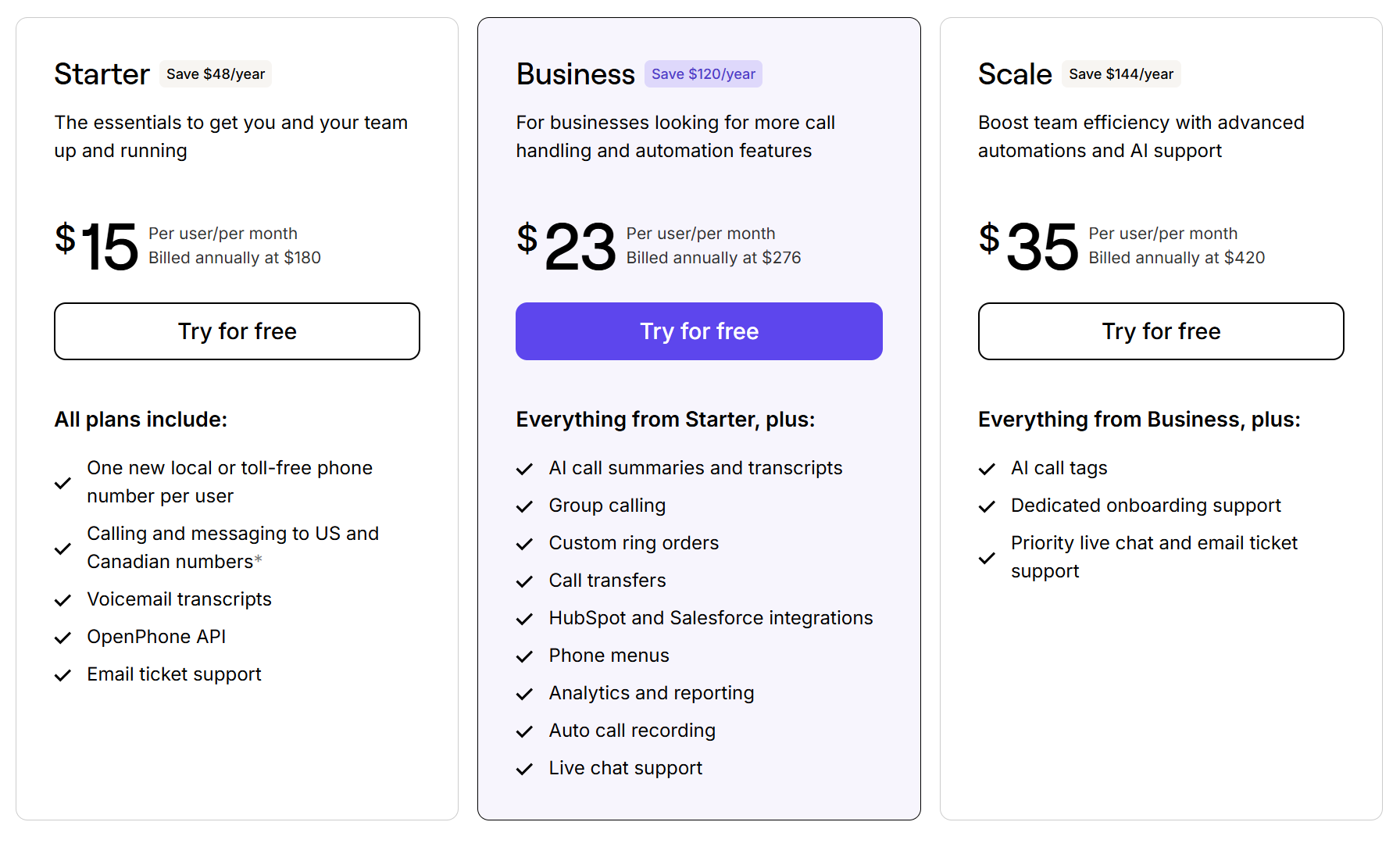
Quo pricing is half the cost of Aircall — with no hidden fees and no user minimums.
Here’s a look at what you get on each plan:
- Starter: $15 per user per month for shared phone numbers, internal threads, contact notes, voicemail transcriptions, scheduled messages, auto-replies, manual call recording, and more
- Business: $23 per user per month for automatic call recording, group calling, AI call summaries and transcripts, and phone integrations with HubSpot and Salesforce
- Scale: $35 per user per month for AI call tags, dedicated onboarding, and priority chat and email support
Plus, Quo scales alongside your business so you don’t have to spend more until you need more. Each member of your plan comes with one free US, Canadian, or toll-free number, which means everyone on your team can get a personalized business phone number.
2. Get AI and analytics on every plan

With Aircall, you have to purchase costly add-ons if you want AI or advanced analytics. With Quo (formerly OpenPhone), analytics dashboards and AI tools are available on every plan.
It’s never been easier to save time and money with:
- Manual and automatic call recordings: Your team can record specific phone calls on demand or auto-record all calls that go to a certain number. Plus, Quo offers unlimited storage for all call recordings, so you’ll always have them for context, training, and quality assurance.
- AI transcripts and action items: Don’t have time to listen to past calls? Use Quo AI tools to generate a transcript and summary. You can also get a list of action items so critical tasks don’t fall through the cracks.
- Analytics: Quo analytics can help you track unanswered calls, identify unique conversations, and access heatmaps of busy times. You also have access to unlimited data histories — something Aircall locks behind an expensive add-on.
- AI-generated message responses: If you’re not sure how to respond to customer texts, you can use AI-generated message responses to brainstorm ideas. This can help you spend less time in analysis paralysis and more time crossing critical tasks off your list.
3. Set up your phone system in 15 minutes or less

Getting started with Aircall requires live group onboarding sessions, plus connecting with customer support to set up international calling.
The good news is you don’t need either to get started with Quo — it only takes minutes to set up your small business phone system.
We make it easy to customize your settings at a glance, including call flows, business hours, and phone menus for customers. Plus, our intuitive user interface was modeled after your cell phone, so everyone on your team can start making calls immediately.
4. Collaborate with your team directly on-platform

No need to bounce from app to app to keep teammates in the know. With Quo (formerly OpenPhone), you can stay in touch with everyone on your team by creating a shared phone number.
With shared numbers, everyone who’s a member of the number can see the same contacts, phone calls, and text messages. They also receive incoming calls and texts so the next available person can simply pick up the phone.
You can also create personalized contact properties for details like addresses, tags, and URLs. That way, everyone on your team can stay organized with priority customers, and necessary details don’t fall by the wayside.
Need to ask for more context or provide clarification? This is easy to do with Quo’s internal threads and mentions. Just leave a comment on voicemails, missed calls, and texts, then tag team members in the comment to get (or share) clarification.
5. Automate dozens of repetitive tasks

Aircall might offer enterprise calling features, but it doesn’t offer many ways to automate daily tasks. This is especially true of business texts — unless you pay for the expensive Advanced Messaging add-on.
In contrast, Quo offers automations on every plan. They include:
- Snippets that let you create and send text message templates for frequently asked questions.
- Scheduled text messages that help you queue up text messages in the recipient’s time zone (and automatically cancel that message if they respond before it is sent).
- Auto-replies that instantly respond to customers’ missed calls, texts, and voicemails so you can set expectations even away from your phone.
- Webhooks and Zapier can create automations and sync customer interactions between Quo and your CRM.
Speaking of CRMs, we offer direct integrations with Salesforce and HubSpot so you can connect your relationship management software in minutes.
Aircall pros and cons
Aircall may be an attractive platform for sales teams, call centers, and customer support teams. However, it might not be a fit for small business owners who manage fewer team members and have 1:1 conversations.
Here’s a closer look:
Pros
- International numbers in 100+ countries
- Included third-party integrations including Zendesk, Pipedrive, and Intercom
- Competitive pricing for additional numbers ($6 per month)
Cons
- Hidden fees
- User minimums on each plan
- Costly add-ons for analytics and AI features
- Expensive priority support
- Limited SMS/MMS on plans
See why Quo is the best business phone provider

In the Aircall vs. Quo debate, there is no contest. Quo is less expensive and offers far more features with every plan. You don’t need three licenses to get up and running — just a computer, a laptop, and a good WiFi connection.
No need to take us at face value. Test our platform yourself with our seven-day free trial.
FAQs
Aircall pricing starts at $30 per user per month, but with a three-user minimum you’ll pay at least $90 per month. You’ll have to upgrade to the Professional plan to access the Salesforce integration, call tagging, and advanced analytics, which costs $50 per user per month (or $150 per month with the three-user minimum). Additional numbers on Aircall cost $6 per month each.
Aircall has some downsides, including:
– You have to pay for a minimum of three users
– AI call summaries require an add-on
– Unlimited call recording storage requires an upgrade
– Texting (SMS/MMS) isn’t included in plans
Quo offers more features to speed up texting, like auto-replies, scheduled messages, and snippets (pre-written text templates). Aircall only offers basic SMS and MMS messaging. You’ll need to add a third-party app or use the Aircall API to get access to advanced texting features, which adds to your costs.
Aircall is also more expensive compared to Quo. Aircall starts at $30 per user per month with a three-user minimum, while Quo starts at $15 per user per month with zero user minimums (billed annually). AI call summaries are available in Quo’s Business plan, but if you want to access them with Aircall, you need to purchase their AI add-on, which is an additional $9 per user per month.
Yes, Aircall lets you purchase international numbers in more than 100 countries. However, rates for calling aren’t transparent — you’ll have to contact sales for a quote.