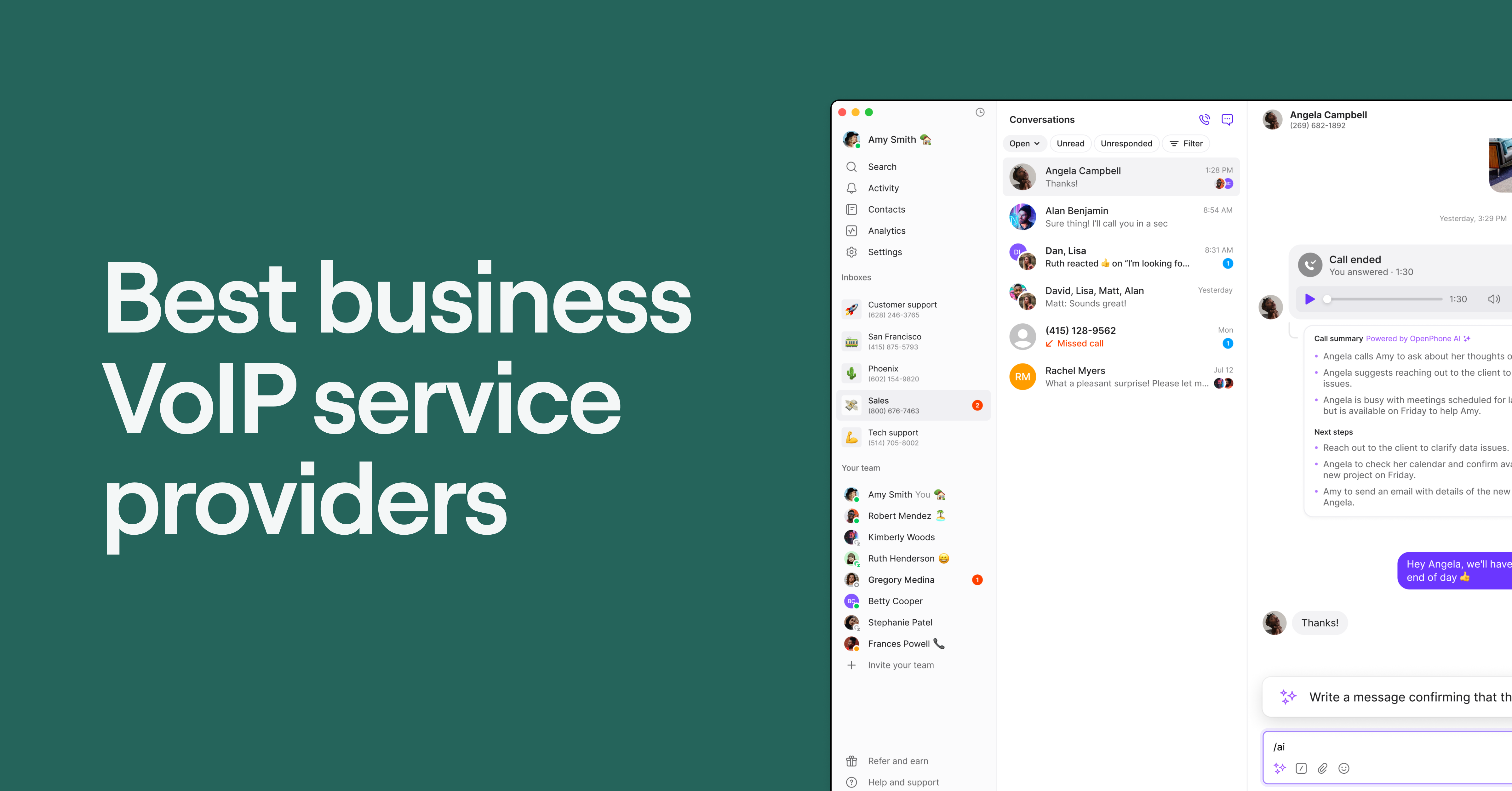
With 2025 here, we’re hearing a lot about New Year’s resolutions and seeing gyms packed with fresh faces. It got us thinking: choosing a VoIP service provider is a lot like finding a gym membership — you want the right features, solid support, and a price that doesn’t make you sweat.
And the right VoIP phone system isn’t just about making and receiving phone calls and texts — it’s about connecting with customers seamlessly and scaling your business.
Let’s apply the SEAT framework to find the one that’s best for your business so you can serve your customers well.
SEAT: How to choose your VoIP provider
Born from endless conversations with overwhelmed small business owners, the SEAT framework (Shortlist, Evaluate, Assess, Trial) began as a rough sketch on a whiteboard. Today, it’s a lifeline — a simple, reliable 4-step process that guides you to the right VoIP provider for your business.
Let’s start with the first step — figuring out what features your team needs.
‘S’ — Shortlist the features your team needs
Here’s how you can identify the features that will support your team’s workflow.
1. Call routing to direct customers to the right place
Missed calls can mean missed opportunities — and customers won’t hesitate to move on to another business. A solid VoIP phone system should include call routing features that let you make and receive calls from a single phone number on multiple devices or manage multiple numbers on one device.
For example, ring groups let you customize who receives incoming calls and when. For example, if you set up simultaneous ring, all of your devices will be notified about an incoming call until someone answers. Auto-attendants are another must-have call-routing feature that lets you automate answering calls and directing them to the right department or team member. Some VoIP providers like Quo let phone numbers that contain auto-attendants receive text messages for added convenience.
2. Collaboration features to work together as a team
Teamwork makes the dream work, but only if your tools enable it. Shared phone numbers let your team answer calls and texts as one voice and keep all conversations in one place. Warm transfer capabilities let team members transfer calls with context so customers don’t have to repeat themselves.
And if you need some backup, group calls let multiple team members work together to resolve issues. Additionally, internal messaging tools like threads let you tag teammates in messages and assign tasks without switching to another app.
3. Business texting to build stronger customer relationships
Text messaging is a powerful way to connect with customers. Look for providers that offer both SMS and MMS support, allowing you to send text messages and photos, videos, and GIFs for more personalized engagement. Tools like auto-replies help keep communication prompt, while scheduled texts let you reach customers at optimal times, even if you’re unavailable.
4. Call recording to find coaching opportunities and cover your bases
Great communication is a skill, and the top VoIP providers can help you improve it. Opt for a provider that offers manual and automatic call recording options so you can review calls for training and identify opportunities to enhance your team’s performance. Additionally, built-in VoIP AI call transcripts and summaries help with record keeping in case disputes arise.
5. Prompt customer support to get issues resolved faster
Your VoIP provider’s support team is critical to your success. Reliable customer service ensures technical issues are quickly resolved, minimizing downtime for your business. Having the best support means you can focus on serving your customers without worrying about interruptions.
With these features in mind, you’re ready to evaluate your VoIP provider options. Let’s move on to the next step.
‘E’ — Evaluate providers
Once you’ve outlined the features you need, it’s time to evaluate potential VoIP providers. It’s important to note that at this stage, it’s not just about finding the cheapest option — it’s about identifying the provider that offers the best overall value.
Here’s what to consider:
- Reviewing providers’ pricing pages: Don’t focus solely on the cost per month. Check which features are included in the base price and see if you’ll need to upgrade or pay extra for what you need.
- Automation: Look for tools that save time and improve efficiency. For example, features like snippets (text message templates) let you quickly answer frequently asked questions. Some providers offer APIs that let you send automated messages and messages based on triggers.
- Mobile devices, desktop, and web apps: If your team needs flexibility and compatibility, make sure the provider’s service works on various devices, such as desktops, mobile phones, and tablets.
- Unlimited calling to the US and Canada: For businesses with high call volumes to US and Canadian numbers, unlimited calling plans can help you avoid costly inbound and outbound per-minute rates.
- Integrations and API access: The ability to connect your VoIP system with third-party tools is crucial. Look for integrations with CRMs like HubSpot that make it easy to log call activity or messaging apps like Slack so you can notify teammates about missed calls in specific channels.
- Additional phone numbers: Check if you’ll be able to purchase multiple phone numbers, like local, toll-free, or vanity, to expand your reach as your business grows.
- Customer reviews: Research user experiences on platforms like G2. Reviews and ratings from real customers can provide valuable insights into reliability, ease of use, and customer support quality, helping you make a well-informed decision.
By carefully evaluating providers based on these factors, you’ll be ready to choose one that meets your and your team’s needs.
‘A’ — Assess security and uptime
We’ve talked a lot about features, but before you decide on one, you should know that it’s also about finding a service you can trust with your business communication.
Start by evaluating their security features and uptime reliability. Do they encrypt text messages to safeguard sensitive customer information? How often do they back up data to multiple physical locations to make sure it’s retained for as long as you need it? A strong uptime score, ideally 99.9% or higher, is essential to ensure your business phone system is always ready when you need it most.
‘T’ — Trial tools to test features
Before committing to a VoIP platform, it’s important to trial it to know it’s the right fit for your business. A free trial offers a hands-on opportunity to see how well the platform meets your needs, integrates with your team’s workflow, and delivers on its promises.
During the trial, focus on the usability of core features like call forwarding, routing, texting capabilities, and integrations with third-party tools. Test the platform in real-time across different devices — desktop, mobile, and tablet — to confirm it works seamlessly no matter where your team is. Lastly, pay attention to call quality and reliability by making a few test calls.

Getting a new phone number from almost anywhere in the world is a simple process when you choose Quo as your virtual phone number provider. Follow these four steps:
- Create an account with OpenPhone (when you sign up, you get a free seven-day trial).
- During signup, choose your city or area code in the US to select your preferred phone number.
- Once the signup process is complete, you’re all set to use your new virtual phone number!
- Once you’ve confirmed Quo is a good fit, you can easily port over any US, Canadian, or North American toll-free number (if needed).
Quo: The best VoIP provider for small businesses

Finding the right VoIP provider might seem daunting, but the SEAT framework simplifies the process into clear, actionable steps. By shortlisting the essential features, evaluating providers, assessing their reliability, and trialing their tools, you’re equipped to choose a solution that truly supports your business.
When it comes to small businesses, OpenPhone is the stand-out choice as a reliable, flexible, and feature-rich VoIP provider. It has essential tools like call routing, shared inboxes, SMS and MMS messaging, and automation features like auto-replies and scheduled texts to streamline communication.
With options like warm transfers, group calls, and internal messaging, Quo makes it easy for your team to collaborate. It offers unlimited calling to US and Canadian numbers, ensuring predictable costs as your business grows. It’s also backed by encrypted communications, top-tier uptime, and responsive customer support, so you don’t have to worry about outages or disruptions.
Now that you know what to look for in a VoIP provider, why not see for yourself why Quo is one of the best? With a free seven-day trial, you can explore how Quo simplifies communication, boosts collaboration, and scales to meet your needs.