

Customer service expectations are at an all-time high, so if a caller reaches your voicemail, you’ve probably already lost them.
That’s why AI receptionists are essential for growing businesses. These are essentially “always-on” teammates who can pick up the phone on weekends, nights, and holidays.
If it feels like there are a million AI answering services to choose from, you can use this guide to help narrow down your search. I’ve tested and compiled the best AI phone answering services — plus prices, features, and limitations — so you can find a fit for your team.
How I chose the top AI answering services

I tested each AI receptionist service’s setup process and call quality before compiling this list. I also evaluated these services based on key factors:
- Cost-effective: Per-minute pricing can get expensive fast — a chatty customer asking about hours suddenly costs $10+. Look for per-call pricing and check what’s actually included. Some providers charge extra for features like call transfers or appointment booking.
- Consistent service quality: Nothing kills customer trust faster than dropped calls or garbled transcripts during your busiest sales period. Ask about uptime guarantees —anything under 99.5% is a red flag — and transcript accuracy rates.
- Visibility and oversight: You need to know what your AI has told customers, especially if things go sideways. Look for real-time dashboards and detailed call logs, not just daily email summaries. If it’s buried in a standalone app you never check, you’ll miss important insights.
- Integrations: It’s better to go with a provider that integrates with CRMs and tools like Zapier so your data syncs seamlessly. This keeps customer data accessible across your entire team.
- Compliance: You’ll want to check if the service encrypts your data, is SOC 2 Type II certified, and has other security and compliance protocols like GDPR.
- Escalation capacity: Not every call can be resolved by AI. Look for services that let you define specific escalation triggers — like caller sentiment, keywords, or request type — and route to the right person on your team. Some services, like Smith.ai, offer live human agents as a backup. Others, like Quo’s Sona, let you build custom escalation jobs that transfer calls to a team member.
- Workflow complexity: Consider how much control you need over what happens during a call. If you just need basic message-taking and FAQ answering, most services will work. But if your calls involve conditional logic — like qualifying leads, sending booking links via text mid-call, or routing to different team members depending on the request type — you’ll want a service that supports custom workflows or skills.
- Customer support: When your AI service has issues during your busiest day, you need responsive human help. Test their support by sending a pre-sales question and check G2 reviews for feedback on response times.
Best AI call answering services at a glance
Here’s how the best AI receptionist services stack up side-by-side:
| Answering service | Starting price | Key features | Best for | Free trial |
|---|---|---|---|---|
| Sona AI | Free for up to 10 calls per month | In-app call transcripts and summaries, call transfers, custom job handling, and CRM integrations | Growing businesses needing a built-in AI receptionist with their phone system | Seven-day free trial |
| Rosie AI | $49 per month for 250 minutes | Message taking, Spanish/English answering, and appointment links | Small businesses needing bilingual answering and message-taking | Seven-day free trial |
| RingCentral AI | $59 per month for 100 minutes | Customizable agents, automatic SMS, and call transcripts | SMBs that want to customize agent voice and tone | ❌ |
| Voiceflow | Free for up to 100 credits | CRM integrations, transcript history, and business texting | Tech-savvy businesses needing to build custom phone and chat agents | Seven-day free trial |
| Goodcall | $79 per agent per month for unlimited minutes and tokens | Zapier integration, performance dashboard, and local numbers | Teams needing to connect large tech stacks | 14-day free trial |
| Dialzara | $29 per month for 60 minutes | Knowledge base uploads, call transfers, and Zapier integration | Small businesses needing a basic virtual receptionist | Seven-day free trial |
| Abby Connect AI | $99 per month for 50 minutes | Custom call flows, bilingual answering, and live chat available | SMBs needing a backup human receptionist | 14-day free trial |
| Lucy AI by Curious Thing | $24 per month for unlimited calls | Call summaries, FAQ answering, and call transfers | Medical practices needing HIPAA compliance | Seven-day free trial |
| Smith.ai | $95 per month for ~50 calls | Lead qualification, appointment booking, and call transfers | Businesses needing lead qualification | 30-day money-back guarantee |
| Synthflow | $0.09 per minute | Appointment scheduling, no-code builder, integrations | No-code custom agents | Free to start |
10 best AI answering services for SMBs: In-depth analysis
We’ll start with the strongest option on our list for small and growing businesses:
1. Sona AI: Best for growing businesses

Pros
- Works natively within Quo for full visibility
- Direct integrations with HubSpot, Salesforce, Jobber, Zapier, Make, and more
- Handles call transfers, lead qualification, and more
- Supports English, Spanish, and French
Cons
- Free tier is limited to about 10 calls per month
Sona is an AI phone answering service built into Quo, which is a business phone system for startups and fast-growing teams. It captures key details from callers, transfers calls, and provides instant call summaries so you can follow up faster.
You can also create custom jobs in Sona. These jobs are instructions that can be used for handling specific call situations like lead qualification, taking a message, and providing information.
Here’s how it works:
- Sona answers the phone before the call goes to voicemail
- It gives a custom greeting based on where the caller is in your call flow
- It listens to the caller’s request
- Then it either answers the question, transfers the call, or takes a message for a callback
- You can also set a custom job so that during a phone call Sona can send a text message; for example if they want to schedule an appointment, Sona texts them a booking link
- After the call, it generates a transcript and summary of what the caller shared
You can train Sona with key business info — like your pricing, hours, and FAQs — to make it even smarter. It also improves continuously based on customer feedback, and you’ll benefit from new features as they roll out.
Sona works seamlessly with the rest of your Quo communication, giving you full visibility into every conversation without switching platforms.
You can use Quo and Sona together to:
- Split responsibility for calls and texts with shared numbers
- Get context and action items from past conversations with call transcripts and summaries
- Automate text messages with auto-replies and scheduled messages
- Use AI to analyze phone calls and spot call drivers by organizing call recordings by topic, sentiment, or keywords
The best part? You can easily test Quo and Sona in-app with a free seven-day trial before confirming they’re a fit for your business or call flow. Then if you have an existing number, easily move a US, Canadian, or North American toll-free number to Quo.
Want to learn more first?
See Sona in action below:

Key features of Sona AI
- 24/7 availability
- Easy to set up
- Shared team inbox with Sona conversation history
- Call recordings, transcripts, and summaries
- Call tags for automatically labeling calls
- Custom phone menus
- Third-party integrations with 8,000+ tools
- English, Spanish, and French language support
- Casual and formal voice and tone options
- SOC 2 Type II certified
Sona AI pricing
Voice AI pricing for Sona is available as an add-on to any Quo plan with these credit tiers:
| Tier 1 | Tier 2 | Tier 3 | Tier 4 | Tier 5 | |
|---|---|---|---|---|---|
| Sona tiers | Free | $25 per month | $49 per month | $99 per month | $199 per month |
| Included credits | 1,000 credits/10 calls | 4,000 credits/40 calls | 10,000 credits/100 calls | 25,000 credits/250 calls | 60,000 credits/600 calls |
| Overage rate per credit | $0.01 | $0.0075 | $0.0065 | $0.0055 | $0.0045 |
| Overage rate per call | $1.00 | $0.75 | $0.65 | $0.55 | $0.45 |
Quo itself has three plans to choose from:
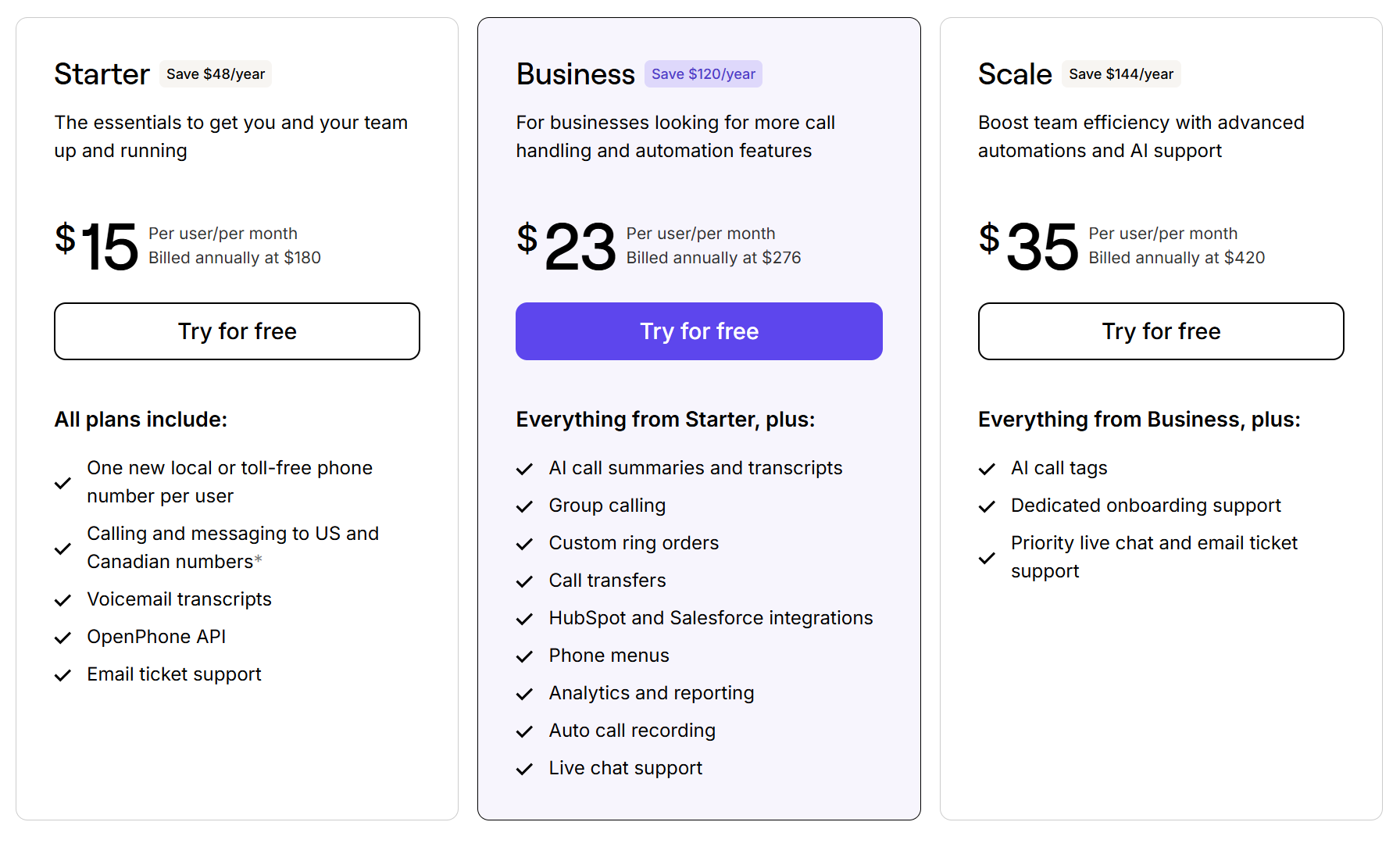
- Starter: $15 per user per month for shared phone numbers, voicemail transcriptions, unlimited calls and texts in the US and Canada, and dozens of ways to streamline your business’s phone communication
- Business: $23 per user per month for phone menus, call transcripts, call transferring, and more advanced features
- Scale: $35 per user per month for call tags, dedicated onboarding, and priority chat and email support
2. Rosie AI: Best for email and text notifications

Pros
- Detailed call documentation
- Bilingual support
- Spam filtering
Cons
- Requires call forwarding
- Customer conversation history stored on its platform
Rosie is an answering service for small businesses that sends real-time email and text notifications for missed calls. All plans come with call transcripts, summaries, and recordings. With Zapier integrations, you can automatically send call records to your CRM. Rosie also offers English and Spanish support to provide better customer experiences across multilingual customer bases.
There’s a free seven-day trial, which is great for business owners who want to try before they buy. Once that ends, you’ll need to upgrade to a paid tier, starting at $49 per month for up to 250 minutes.
Just keep in mind the starter plan doesn’t include appointment links or call transfers, which are only available on the $149 per month tier. And if you manage multiple locations or want custom CRM integrations, you’ll need to contact sales for the Enterprise plan, which has no public pricing.
Another important caveat: Rosie is a standalone phone answering system, so you’ll have to forward calls to it from your existing phone service. This means you’ll need to toggle between apps to piece together conversation histories.
Key features of Rosie AI
- Free seven-day trial
- Appointment links with upgrade
- Spam detection
- Zapier integrations
- Live transfers with upgrade
Rosie AI pricing
Rosie has three plans to choose from:

- Professional: $49 per month for up to 250 minutes, message taking with custom questions, smart spam detection, and English and Spanish language options
- Scale: $149 per month to unlock up to 1,000 minutes, appointment links, sending texts during calls, and call transfers
- Growth: $299 per month to unlock up to 2,000 minutes, training files and custom agent training
3. RingCentral AI: Best for custom agent tones

Pros
- Works natively within RingCentral’s phone system
- Dozens of AI voice and personality options
- Automated SMS workflows
Cons
- No trial option
- Limited features on RingEx base plan
RingCentral has an AI receptionist that can connect directly to any business phone system. You can use it with a RingCentral plan or as a standalone service. It covers the basics you’d expect from an AI assistant — like keyword recognition, intelligent call routing, call transcripts, and analytics. It can also send automated SMS messages for events like appointment confirmations.
One standout feature is the ability to customize your AI agent’s tone. You can choose from dozens of voice options across different languages, including casual, professional, and energetic.
Unfortunately, it’s not easy to try before you buy since there’s no free trial. Plus, RingCentral’s AI Receptionist is only available to US businesses, so international companies will need to look elsewhere.
There are also limitations to RingCentral’s phone system to consider. For example, RingCentral’s base plan doesn’t allow oversight without upgrading. You’ll need the Advanced plan or higher to get transcripts for any conversation the receptionist handles. You’ll also be limited in how many SMS messages you can send. The most expensive tier offers 200 per user per month, which isn’t ideal if you rely heavily on SMS.
Key features of RingCentral AI Receptionist
- Custom call routing
- Casual or formal receptionist voices
- Automatic SMS for specific questions
- Call transcripts
- Call analytics
- HIPAA compliant
- Multiple language support
RingCentral AI Receptionist pricing
RingCentral’s AI receptionist offers two pricing options:
- Standalone AI receptionist: $59 per month for 100 minutes and $0.50 per additional minute
- AI receptionist with RingEx Core plan: $69 per month for 100 minutes and $0.50 per additional minute
You can also buy additional minute bundles which are billed in 30-second increments.If you want to upgrade your RingEx plan, you have a couple of options:

- Core: $20 per user per month for unlimited calls in the US and Canada, IVR, 25 texts per user, and 100 pooled toll-free minutes
- Advanced: $25 per user per month for automatic call recording, 100 texts per user, and 1,000 pooled toll-free minutes
- Ultra: $35 per user per month for unlimited call recording storage, 200 texts per user, and 10,000 pooled toll-free minutes
4. Voiceflow: Best platform for building AI phone agents

Pros
- In-app team collaboration
- Extensive third-party integrations
- Flexible workflow options
Cons
- Steep learning curve
- Limited analytics and support
Voiceflow isn’t an AI answering service, but an artificial intelligence platform that lets you build, manage, and scale chat and voice agents. You can use flexible flow editors to create personalized workflows, then collaborate in-app by leaving comments and tagging coworkers.
Voiceflow connects to the apps you’re already using, like Zendesk, Salesforce, OpenAI, and Shopify. They also have pre-built functions available for teams — think tracking agent interactions via Segment or sending SMS messages with Twilio.
Just remember that Voiceflow doesn’t offer a built-in phone system or CRM tools. You’ll have to connect an existing phone service to the mix — like integrating Voiceflow with Vonage, a VoIP platform that comes with multiple hidden fees.
Voiceflow doesn’t make it easy to track team efficiency, either. Its analytics dashboard can help track call minutes and tokens but doesn’t offer support for flow analytics or custom dashboards.
You should also know there’s a steep learning curve for Voiceflow’s workflow builder, so you may need someone with technical knowledge to help build and deploy it. Considering there’s no email support unless you’re on the Business plan or higher, it may not be the right option for growing teams without in-house IT support.
Key features of Voiceflow
- Test user personas
- Transcript history with up to six months of storage
- Business texting available
- Knowledge base
- CRM integrations
- GDPR, ISO 27001, SOC 2 Type II, and HIPAA-compliant
Voiceflow pricing

Voiceflow has four pricing plans to choose from:
- Starter: $0 per month for one user, one concurrent voice call, 50 knowledge base sources per agent, two AI agents, and 100 credits
- Pro: $60 per month for five concurrent voice calls, 200 knowledge base sources per agent, 20 agents, and 10K credits
- Team: $150 per month for 15 concurrent voice calls, 5,000 knowledge base sources per agent, unlimited agents, and 30K credits
- Enterprise: Custom pricing for unlimited workspaces, custom concurrent call limits, private cloud hosting, and priority customer support
Additional editor seats are available for $50 per editor per month.
5. Goodcall: Best for third-party integrations

Pros
- Customer-based pricing model
- Integrations with 1,000+ tools via Zapier
- Customizable workflows
Cons
- Requires a new Goodcall number
- Limited data retention
Goodcall is an AI phone answering service that responds to callers with the knowledge you’ve given it. It lets you set up different skills to tell your agent how to do certain tasks. Then, you can set up flow patterns to get information from the caller.
You can also use Goodcall to connect with more than 1,000 different tools via Zapier, which is perfect for teams with large tech stacks. There are lots of creative use cases to try. For example, you can connect Goodcall to your CRM data to personalize greetings for different callers.
But you should know that Goodcall doesn’t fully integrate with existing business numbers. You can either get a new Goodcall number with your preferred area code or conditionally forward calls from your existing number. Either way, conversations end up split between two platforms, which makes it harder to manage follow-ups or maintain a complete call history.
Goodcall also doesn’t do well in keeping a clear communication trail since customer and call details get deleted after seven days on the base plan. The cherry on top is the steep learning curve. If you don’t have much time to spare on setup, it might be worth considering a Goodcall alternative.
Key features of Goodcall
- Integrates with 1,000+ tools
- Performance dashboard
- Unlimited minutes and tokens on the base plan
- Call and customer information storage
- Permission-based viewing settings
Goodcall pricing

Goodcall has three pricing plans to pick from:
- Starter: $79 per agent per month for unlimited minutes and tokens, three team members, seven days of call and customer details, and 100 unique customers monthly
- Growth: $129 per agent per month for nine team members, 30 days of call and customer details, and 250 unique customers monthly
- Scale: $249 per agent per month for 50 team members, unlimited call and customer details, and 500 unique customers monthly
6. Dialzara: Best for record-keeping

Pros
- Detailed transcripts for each call
- User-friendly setup
Cons
- Expensive upgrades for integrations
- Requires call forwarding from your cell phone
- Strict limits on talk time
Dialzara is an AI answering service that serves businesses of all sizes and industries — think law firms, realtors, and home services companies. Its greatest strength is its record-keeping. After every call, your AI agent will send a summary email or text, which also includes links to the call recording and full transcript.
Unlike some platforms on this list, Dialzara is easy to set up and doesn’t require technical experience. It can create AI prompts based on the knowledge you upload, which you can customize later. It also integrates with Zapier to push caller information to platforms like HubSpot or Slack.
Unfortunately, Zapier is the only native integration you get with Dialzara. This means you can’t tap into any CRMs or productivity tools without setting up your own workflows. Integrations via Zapier also require an upgrade to Business Pro, which is three times the price of the base plan at $99 per month. Want more talk time or knowledge base uploads? You’ll have to upgrade your plan again. Considering other AI phone answering services offer an unlimited amount of both, this might feel restrictive for those who manage high call volume.
Call management is also fairly limited. For example, you can only forward unanswered calls from your cell phone. This requires disabling visual voicemail and your existing call-forwarding feature. If you’re hoping to selectively route calls between Dialzara and other lines, this system may be too rigid.
Key features of Dialzara
- Call transferring
- Knowledge base uploads
- Over 40 voices to choose from
- Zapier integration with upgrade
- External call transferring with upgrade
Dialzara pricing

After you’ve taken a seven-day free trial, you can sign up for one of Dialzara’s three plans:
- Business Lite: $29 per month for 60 minutes of talk time plus self-editable prompts and five knowledge base uploads
- Business Pro: $99 per month for 220 minutes of talk time plus external call transfers and third-party integrations via Zapier
- Business: $199 per month for 500 minutes of talk time plus unlimited knowledge base uploads and white-glove prompt engineering
7. Abby Connect AI: Best for backup human agents

Pros
- Handles lead pre-qualification, intake, and routing
- Provides customer sentiment scores
- High service quality
Cons
- Expensive for small businesses
- Limited integrations
- Requires call forwarding
Abby Connect offers both AI and human receptionists that can capture, pre-qualify, and intake callers, route and answer calls, and schedule appointments. The mobile app also gives you access to AI-generated call summaries, transcripts, recordings, and customer sentiment scores.
Abby Connect’s biggest claim to fame is its human receptionist backup. If the AI can’t answer a customer’s question, a team of five to seven live receptionists can take over.
The high answering service cost for Abby Connect may be prohibitive for small businesses, with plans starting at $99 per month plus a $95 setup fee. You’ll also have a limited number of monthly minutes — there’s no unlimited option available on any plan.
Beyond price, feature limitations could slow you down. You’re capped at six integrations — and there’s no built-in phone number. You’ll have to forward calls to Abby Connect. So if a team member needs to follow up with a customer later, they’ll have to piece together conversation history across multiple tools.
Key features of Abby Connect AI
- English and Spanish answering
- Offers live chat on separate plan
- Custom call flows
- Workflow integrations
- Human backups on demand with upgrade
Abby Connect AI pricing
Here’s what you’ll pay for its AI receptionist plans:
- Starter: $99 per month for up to 50 minutes of reception time, 24/7 call handling, call flows, call transfers, FAQ answering support, workflow integrations, and backup human receptionist services
- Essential: $165 per month for up to 100 minutes of reception time and all features in Starter
- Professional: $299 for up to 200 minutes of reception time and all features in Starter
- Growth: $690 per month for up to 500 minutes of reception time and all features in Starter
You’ll also have to pay a $95 setup fee to start any receptionist plan.
8. Lucy AI by Curious Thing: Best for HIPAA compliance

Pros
- Specialized agents for payment reminders, follow-ups and FAQs
- HIPAA-compliant agents
- Multilingual support: Spanish, French, Chinese, Portuguese, or Korean
Cons
- No native CRM integrations
- Complex call forwarding setup
Lucy by Curious Thing is an AI call answering service with plug-and-play AI phone assistants for inbound and outbound call centers. Each agent focuses on slightly different use cases, like FAQs, conversational calls, follow-ups, and payment reminders. You’ll also get unlimited call summaries, automated answering, and link sharing for your online booking system.
If you’re in the healthcare industry, Curious Thing offers HIPAA-compliant custom agents, which are ideal for capturing patient information securely. You can add multilingual support in Spanish, French, Chinese, Portuguese, or Korean to better serve diverse audiences.
That said, Curious Thing doesn’t offer native integrations — just an open API — meaning there’s no simple way to sync data with your CRM. Call forwarding also has some quirks. You’ll need to disable your existing call forwarding feature and route all calls to a Lucy AI phone answering number. Disabling conditional call forwarding may cause you to lose your voicemail — fixing it may require help from your carrier.
Key features of Lucy AI
- Call summaries
- Call notifications
- FAQs with upgrade
- Call transferring
- Link sharing
Lucy AI pricing
Here’s how Lucy’s pricing breaks down:
- Lucy AI Professional: $24 per month for unlimited calls and summaries, notifications for all calls, removed branding, custom message taking, sharing important links, and bilingual capabilities
- Lucy AI Business: $99 per month to unlock multiple skills, smart call transferring, and advanced messaging taking
9. Smith.ai: Best for lead intake and qualification

Pros
- Hybrid AI-human model with 24/7 live agent backup
- Handles lead qualification and new client intake
- Dedicated local or toll-free business number included
Cons
- Expensive per-call pricing model
- Annual plans start at $500 per month with a yearly commitment
- Inconsistent service quality in agent responses
Smith.ai offers AI receptionists that handle initial call screening and basic customer interactions. For example, AI agents can ask up to 10 short answer questions for intake. Agents can also escalate complex calls to live human receptionists when necessary for an extra $3 per call.
You should know that Smith.ai now splits its pricing into two tracks. Self-service monthly plans start at $95 per month for ~2 calls per day, but don’t include dedicated support, custom call flows or integrations, or a customer success manager. To get those, you’ll need an annual plan starting at $500 per month.
Key features of Smith.ai
- Direct CRM and Zapier integrations
- New client intake
- Lead qualification
- Appointment booking
- Call transfers
- Call recording, summaries, and transcripts
Smith.ai pricing
Smith.ai’s offers self-service monthly plans and annual “done for you” plans:
Self-service month-to-month plans:
- Starter: $95 per month for ~2 calls per day
- Basic: $270.00 per month for ~5 calls per day
- Pro: $800.00 per month for ~15 calls per day
- Enterprise: Contact sales for a custom plan
Annual plans:
- $500 per month for ~10 calls per day
- $1,000 per month for ~25 calls per day
- $2,000 per month for ~55 calls per day
Annual plans include dedicated AI configuration, a customer success manager, custom integrations, and call rollover. No free trial is available, but Smith.ai offers a 30-day money-back guarantee.
10. Synthflow: Best for no-code custom agents

Pros
- SOC 2, GDPR, ISO 27001, and HIPAA compliant on Enterprise plan
- 200+ third party integrations
- No-code drag-and-drop workflow builder
- Free to start with usage-based billing
Cons
- Per-minute costs are hard to predict
- No built-in phone system
- Voice-only platform
Synthflow is a no-code voice AI platform that lets you build phone agents with a drag-and-drop conversation builder. It handles both inbound and outbound calls and integrates with CRMs like HubSpot, Salesforce, and Freshworks, plus 200+ other tools.
Where Synthflow stands out is compliance. It’s SOC 2, GDPR, and ISO 27001 certified on all plans, with HIPAA available on Enterprise. If you’re in healthcare, financial services, or any industry handling sensitive customer data, that might make it the right platform.
The trade-off is pricing transparency. Synthflow uses a pay-as-you-go model where your per-minute rate depends on which LLM, telephony provider, and add-ons you choose. A typical setup runs between $0.15 and $0.24 per minute all-in, which can be hard to forecast if your call volume fluctuates.
There’s also no built-in phone system. You’ll need to bring your own Twilio account or use Synthflow’s managed telephony for an extra $0.02 per minute. And since Synthflow is voice-only — no shared inbox, native SMS, or web chat — you’ll need a separate platform for these channels.
Key features of Synthflow AI
- Unlimited AI agents
- No-code drag-and-drop workflow builder
- Inbound and outbound call handling
- CRM integrations with HubSpot, Salesforce, GoHighLevel, and Zapier
- Call recording and transcription
- Human fallback and escalation routing
- SOC 2, GDPR, ISO 27001, and HIPAA compliance
- Multilingual support in 30+ languages
Synthflow pricing

Synthflow’s pricing has a pay-as-you-go tier that starts at $0.09 per minute and has fees for:
- The LLM you choose
- Integrations with Twilio
- Extra concurrent calls
- Phone numbers
- Advanced compliance, including multi-region deployment
The Enterprise plan offers custom pricing for teams, starting at 10,000 minutes per month.
The only AI phone answering service you need: Sona

There are dozens of AI phone answering services on the market — but only one is clearly designed for fast-growing businesses. Quo’s Sona was built for startups and fast-growing businesses ready to answer more calls and build deeper customer relationships.
Unlike other AI receptionists, Sona charges by the call — not by the minute, which keeps your virtual receptionist costs simple and predictable. Since calls aren’t forwarded to a separate app or platform, you get better visibility and control over your conversations.
Every call comes with a transcript, summary, and AI tags on the Scale plan. This helps you easily track, prioritize, and follow up with callers. You can also connect with shared phone numbers so everyone on your team can split responsibility for messages.
Confirm that Quo is a fit for your business with a free seven-day trial.
Then, test calling with Sona in the Quo mobile app and see how our AI phone answering service ensures you never miss a call.
FAQs
An AI phone answering service, sometimes called an AI agent or virtual receptionist, answers customer calls when your team members can’t. Instead of sending callers to voicemail, it gives customers clear expectations for when they can expect a reply. It can also guide customers with helpful next steps, like:
– Answering FAQs
– Capturing key customer details
– Automating appointment booking
AI phone answering isn’t new, but today’s tools are smarter, simpler, and sound more natural than older iterations. They can also run in the background so your team will never miss a call.
The average cost of a traditional answering service is around $250 per month for a fixed number of call minutes. AI answering services cost a fraction of the price of legacy services, starting as low as $25 per month.
Many AI virtual receptionists offer free plans with a limited number of calls or minutes. For example, you can try Sona AI for free for up to 1,000 credits or 10 calls per month.
The best AI receptionist is the one that meets your business needs. You should look for a provider that’s easily customizable, offers after-hours support, and can be instantly set up on your phone system, like Quo’s Sona.
AI phone answering services pick up calls before they go to voicemail and let callers know they’ve reached your business. They then answer questions or capture key details so your team can respond when they’re back in the office.
Virtual receptionists can answer customer calls when your team can’t pick up the phone and help direct your callers to the right team member or department.
Just keep in mind that live virtual receptionists cost more than an AI phone answering service. With AI, callers can find the right team member or department, leave a message, or get answers directly from the AI software without talking to a team member.
Learn more about what a virtual receptionist is and how it can benefit your business.
Service businesses like plumbers, electricians, and contractors most commonly use answering services. Real estate agents, legal practices, and healthcare providers use them as well.
These industries benefit from automated call handling, since missed calls often mean lost business opportunities and revenue.
AI answering services are great at handling routine calls, basic scheduling, and frequently asked questions. But they can’t fully replace human receptionists for complex situations requiring empathy or nuanced problem-solving.
The best approach for most businesses is a hybrid model where AI handles simple tasks and transfers complex calls to human reps when needed.
The best AI answering service depends on what your callers typically need. If you’re a medical practice handling patient intake, look for HIPAA-compliant options like Lucy AI by Curious Thing or Synthflow AI’s Enterprise plan.
If your team fields a mix of sales leads and support calls, a service with lead qualification, escalation, and appointment booking — like Sona or Smith.ai — will give you the most flexibility. And if you just need basic message-taking and answering common questions, a straightforward option like Rosie or Dialzara can handle that without added complexity.


