Are you considering RingCentral as a phone solution but weighing your options? Or are you a current RingCentral customer and ready to move on? If so, you’ve come to the right place.
In this article, we’ll cover 11 popular RingCentral alternatives in depth. We looked at their features, pros and cons, and pricing, so you can choose a business phone that’s right for you. We pulled insights from Reddit and G2 to give you peer feedback on each alternative.
Here’s what you need to know. The top RingCentral alternatives are Quo, Dialpad, Nextiva, Ooma, and Zoom Phone. Depending on your needs, you could also go with Grasshopper, Google Voice, Vonage, Aircall, Phone.com, and 8×8. Curious about why businesses switch from RingCentral? It comes down to four reasons:
- Complex user interface
- Texting and storage limits
- Poor customer support
- Shared texting costs extra
Read on to see our in-depth comparison of the best 11 RingCentral alternatives.
Best RingCentral alternatives by business type
Every business phone platform is designed for a specific type of business. Here’s a quick category overview of which alternatives are best suited to each type of business:
1. Sales teams
The top RingCentral alternatives for sales teams are Aircall, Dialpad, and Quo.
- Aircall gives your team access to a power dialer to make high-volume outbound calls at scale.
- Dialpad gives sales teams access to AI call coaching features and real-time battlecards.
- Quo gives SMB sales teams automated texting features to nurture leads over long sales cycles.
2. Support teams
The top RingCentral alternatives for support teams are Nextiva, Quo, and 8×8.
- Nextiva helps your team connect social media and WhatsApp channels. You’ll be able to bring all your support conversations into one place.
- Quo offers internal threads and task management capabilities. Your team can coordinate on customer requests and tackle them in one app.
- 8×8 offers contact center routing for enterprise teams. If you have a global organization with hundreds of support reps, this is the platform for you.
3. Healthcare businesses
The top RingCentral alternatives for healthcare businesses are Phone.com and Quo.
- Phone.com offers HIPAA-enabled video conferencing for teams. You can provide telehealth services while adhering to HIPAA rules and regulations.
- Quo provides unlimited call recording storage and texting to US and Canadian numbers. You can have as many conversations with patients as you need without worrying about hitting storage limits.
4. Home service and trade businesses
The top RingCentral alternatives for home service businesses are Google Voice and Quo.
- Google Voice is a good second phone number option for businesses that are just getting started.
- Quo integrates with home service tools like Jobber and DripJobs. Your team can move faster with managing incoming service requests.
5. Tech-enabled businesses
The top RingCentral alternatives for integration-heavy businesses are Vonage and Quo.
- Vonage has APIs to connect to every tool in your tech stack. It has dedicated SMS APIs to be able to send high-volume texts to your customers.
- Quo has native integrations, an API, and an MCP to connect to your favorite AI tools. Our integrations are easy to set up and maintain. We also provide extensive documentation to help you make the most of them.
How to choose the right RingCentral alternative
Start with why you’re switching. The most common reasons businesses move away from RingCentral include:
- Clunky user experience and steep ramp-up
- Features bundled into expensive tiers you don’t need
- Poor support experiences
- Storage limits on calls and texts.
Once you know your top pain point, weigh providers on these six criteria:
- Reliability: System issues like downtime can hurt your reputation. Over time, it leads to lost customers and directly impacts your bottom line. Opt for providers with consistent connections and call quality.
- Value for money: How much does the VoIP system return for each dollar invested? Does it save you enough money by reducing costs and offering flexibility?
- Budget: Low pricing shouldn’t be the most important thing on your list, but you should avoid hidden fees and excessive costs.
- Third-party integrations: Check whether a provider has integrations with the rest of your tech stack. At Quo, we’ve seen how the right business phone integrations can save hours of manual work.
- Ease of use: Complex systems can mean increased spending on training staff. The result could be a lower ROI.
- Customer support: Is customer support easy to reach? They should be able to offer quick solutions when you need them most. Through testing different providers, we’ve seen firsthand how easy it is for teams to adopt systems with a simple setup and features.
11 Best RingCentral alternatives
Many RingCentral alternatives offer more features that’ll help your business scale.
Here’s how each compares at a glance:
11 Best RingCentral alternatives compared
| Provider | Starting price | Unlimited calling to US & Canada | SMS/MMS to US & Canada | Shared phone numbers | G2 rating |
|---|---|---|---|---|---|
| RingCentral | $20 per user per month | Limited toll-free minutes | 25 messages per user per month | Calls only | 4.2 (~1,210 reviews) |
| Quo, formerly OpenPhone | $15 per user per month | ✅ | ✅ | ✅ | 4.7 (~3,290 reviews) |
| Ooma | $19.95 per user per month | ✅ | Requires upgrade | X | 4.6 (~130 reviews) |
| Dialpad | $15 per user per month | ✅ | For US and Canadian customers only | ✅ | 4.4 (~3,930 reviews) |
| Grasshopper | $14 per month | ✅ | Local numbers only | X | 3.9 (~150 reviews) |
| Nextiva | $15 per user per month | ✅ | 100 texts per user per month | ✅ | 4.5 (~2,200 reviews) |
| Phone.com | $15 per user per month | Limited area codes in Canada | Requires upgrade | Ring groups only | 3.5 (~35 reviews) |
| Google Voice | $10 per month for individual plan | Unlimited calls to Canada from the US only | US customers only | Requires upgrade, ring groups only | 4.1 (~160 reviews) |
| Vonage | $13.99 per user per month for 1–4 users | ✅ | Local US and Canadian numbers only | Shared line appearance only | 4.3 (~490 reviews) |
| Zoom Phone | $10 per user per month | Requires upgrade | ✅ | Requires add-on | 4.6 (~2,640 reviews) |
| Aircall | $30 per user per month, three-user minimum | ✓ | ✓ | ✓ | 4.4 (~1,460 reviews) |
| 8×8 | Contact for a quote | ✓ | ✓ | ✓ | 4.2 (~932 reviews) |
1. Quo: Best RingCentral alternative for fast-growing teams

Pros
- Free calling, SMS, and MMS messages in the US and Canada
- International calls and texts at affordable rates
- Shared inboxes and internal threads
- Voicemail transcriptions
- On-demand and automatic call recording
- AI-powered features: call summaries, transcripts, and an AI agent
Cons
- No verification through two-factor authentication*
*Nearly all virtual phone numbers share this problem. For safety reasons, companies like Facebook, Uber, and Google rarely let you authenticate accounts through a virtual phone number.
Quo is a business phone system built for startups and fast-growing small businesses. Our VoIP phone platform offers the same features as RingCentral but with a modern user experience. You get unlimited SMS and MMS to US and Canadian numbers. You aren’t held back by RingCentral’s texting limits and overage fees. Plus, unlike RingCentral’s TCR registration hurdles and delays, Quo makes the process quick and easy.
RingCentral only offers shared lines for incoming calls. If you want a shared text inbox, you have to purchase its Business SMS Booster add-on. With Quo, your team can field incoming texts and calls together without paying extra. This cuts down on your response time and gives customers the level of service they deserve. And all our plans offer unlimited call recording storage, so you’re not paying extra to keep what you record.
Beyond the basics, Quo includes AI features that help your team get more done in less time. Summarize and transcribe calls automatically with our AI note-taking features. Quo offers both AI transcriptions and call summaries. That way, sales and support teams can find what customers said without having to playback full call recordings. Sona, Quo’s 24/7 AI voice agent, greets callers, answers questions, takes messages, and can transfer or message your team when needed. It’s priced per call instead of per minute, which typically saves hundreds a month compared to other AI answering services.
Who Quo is best for
Quo works best for small and fast-growing businesses that need a phone system the whole team can collaborate in. Here are a few other features that make a difference for small teams:
- Save time texting with auto-replies, scheduled messages, and snippets
- Connect Quo with 9,000+ integrations, including HubSpot, Salesforce, Zapier, and Jobber
- Analyze your Quo calls and texts quickly with our Claude and ChatGPT integrations
- Protect patient communications as a healthcare business with a HIPAA-compliant VoIP system
Don’t just take it from us — Quo has a 4.7 out of 5 G2 rating. Plus, thousands of customers have switched from RingCentral to Quo:
“We switched to Quo from RingCentral during the COVID-19 pandemic since it allowed us to work remotely without missing any calls. It allows us to have better customer service levels, quicker responses as anyone can respond to customers in real-time while traveling.” – Amira Harris, President and Owner, Aisle Travel
Try Quo out for yourself. Get started today with our seven-day free trial.
Quo pricing
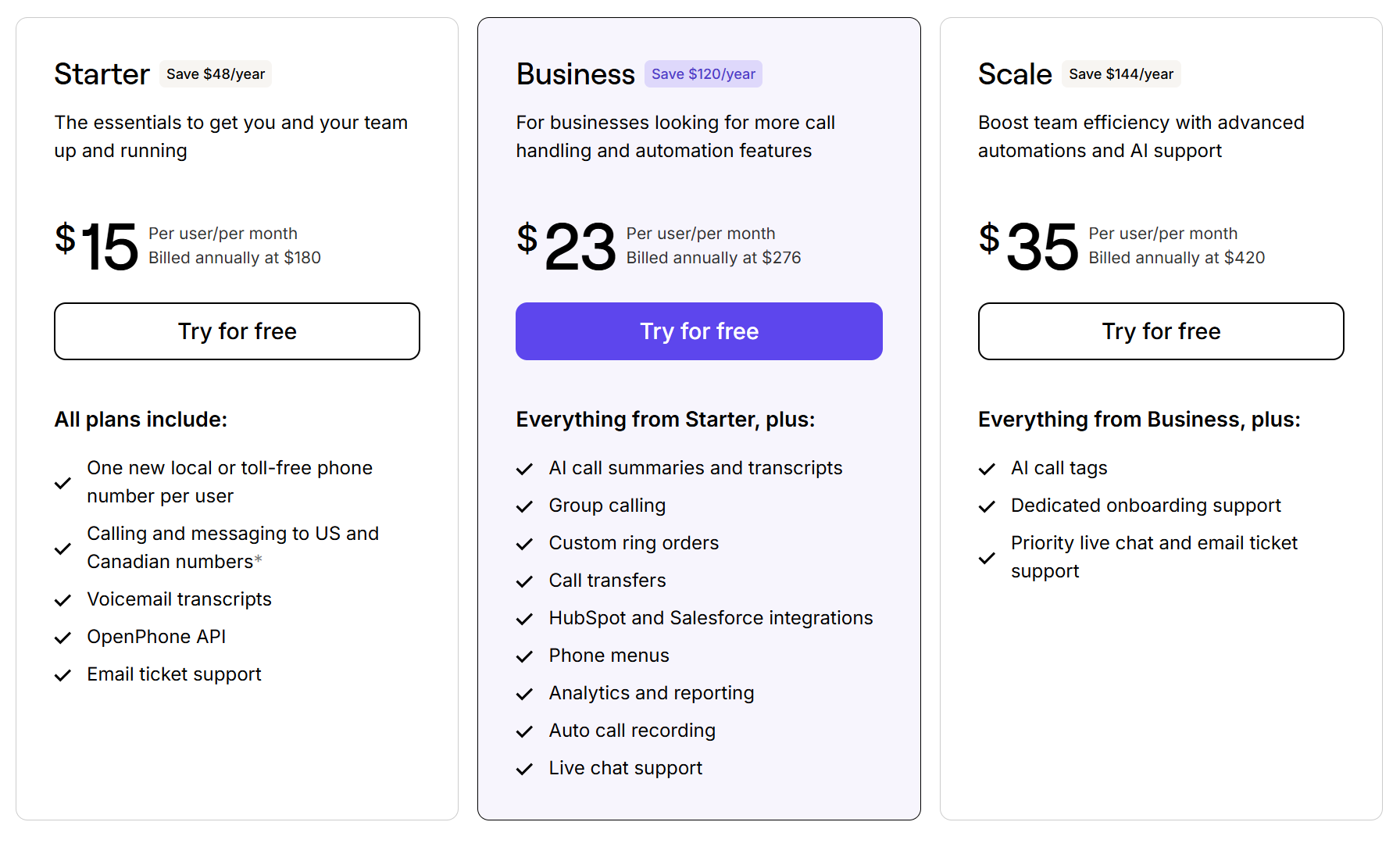
Looking for a VoIP provider with transparent rates? Quo’s pricing plans offer three tiers with no annual contracts required:
- Starter: $15 per user per month for shared numbers with up to 10 teammates, calling and messaging to US and Canadian numbers, scheduled texts, and more
- Business: $23 per user per month for call transfers, phone menus, HubSpot CRM integration, unlimited teammates on a shared number, and more
- Scale: $35 per user per month for AI call tags, inbound phone support, dedicated onboarding, and priority chat and email support
Learn more about Quo vs RingCentral.
2. Ooma: Best alternative for overhead paging

Pros
- Legacy phone features like overhead paging and analog fax are available
Cons
- Texting requires an upgrade
- Call recording requires an upgrade
- Voicemail transcription requires an upgrade
Ooma is a solid option for older businesses making the jump from traditional PBX phone systems to VoIP. With the base plan, you can access a mobile app, virtual receptionists, virtual faxing, and overhead paging support. You also get features RingCentral doesn’t include on its base plan, like advanced ring groups, extension monitoring, and extensions.
Who Ooma is best for
Ooma works best for small offices that still want analog fax, overhead paging, or hardware integrations. No contracts and month-to-month billing make it low-risk to try.
It’s less of a fit if you need modern collaboration features. The base plan doesn’t offer texting or call recording at all. You have to upgrade to use Ooma’s desktop app for calling.
Ooma also isn’t known for having the best customer service:
“It was lacking realtime dashboard analytics features that we need for our day to day operations. Calling support was sometimes an issue, there is a language barrier and at times I would have to explain my issue multiple times so they could understand my inquiry. We were not able to easily integrate it with our other software.” – Jesus A. on G2
Ooma fills a narrow niche for businesses transitioning from legacy landlines. If you don’t need overhead paging or analog fax, you’ll find better value and more features elsewhere.
Ooma pricing

Let’s break down Ooma’s pricing plans:
- Essentials: $19.95 per user per month for 100 standard phone features, virtual receptionist, mobile app, and music on hold
- Pro: $24.95 per user per month to unlock text messaging, video conferencing, Ooma’s desktop app for calling, call recording, and analytics
- Pro Plus: $29.95 per user per month to access the Salesforce integration, hot desking, call queuing, and shared voicemail boxes
- Enterprise: Custom pricing to access SIP trunking, Microsoft Teams integration, advanced CX features, and advanced analytics
3. Dialpad: Best for large contact centers

Pros
- Unlimited calling to US and Canadian numbers
- Desktop and mobile apps are available
Cons
- User minimums on higher-tier plans
- Difficult to set up and navigate
- Unreliable service
Dialpad is a virtual phone system established in 2011. It’s known for its AI features like real-time transcription, automated call summaries, and AI-driven sentiment analysis for sales and support reps. If you’re looking for AI-powered features for global support teams, you should consider Dialpad.
The base phone plan, Dialpad Connect, gives you some features only available on higher-tier plans on RingCentral. For example, automatic call recording is available in all Dialpad plans. Dialpad also offers unlimited texting to US and Canadian numbers, which you don’t get in RingCentral. You also get Google Workspace and Microsoft 365 integrations, and internet fax as a paid add-on.
Who Dialpad is best for
Dialpad works best for large call centers that want to lean on AI for sales coaching, support QA, or post-call analytics. Local number support in 70+ countries also makes it a fit for global contact centers.
It’s less of a fit for small teams that want to move fast. Multiple customers have complained about the layout and reliability. Most of Dialpad’s best features, like AI-powered customer service scorecards, are locked behind other plans. And if you want to buy additional phone numbers, you’ll have to upgrade.
Dialpad is rated 4.4 out of 5 on G2. Customers often have connection issues:
“The only negative aspect of Dialpad Connect is that certain advanced features and reporting capabilities are not as powerful as the ones of traditional phone systems. The quality of the calls might be poor in case of the unstable internet connection and certain integration may need additional configuration. The system is also simple to operate in general, although the more advanced customization requires time to master.” – Darshan K. on G2
Dialpad pricing

Dialpad’s pricing plans offer three different options for you to choose from:
- Standard: $15 per user per month for unlimited calling, unlimited AI Meetings for up to 150 participants, SMS, MMS, and team messaging
- Pro: $25 per user per month with a three-user minimum for 24/7 live agent support, CRM integrations like Salesforce, Zendesk, Zoho, and global SMS
- Enterprise: Custom quote with a 100-user minimum for 99.9% uptime, unlimited ring groups, and dial-by-extension
4. Grasshopper: Best for single-person teams

Pros
- Local and toll-free phone numbers are available
- Multi-digit phone number extensions are available
Cons
- No third-party integrations besides Google Voice
- Limited productivity features
- Call recording requires an upgrade
Grasshopper is an older VoIP provider that launched in 2003 and is designed for single-person businesses. Its biggest differentiator is you can have unlimited users on the second tier plan. If you have a small team that all answers the same phone number, the math can favor Grasshopper. You’ll also get features RingCentral doesn’t include on its base plan, like phone number extensions, unlimited SMS, and auto-replies to new customers.
Who Grasshopper is best for
It works best for solo operators and very small businesses who need a professional business number with extensions and basic call forwarding.
It’s not a fit for teams that want to grow. Grasshopper isn’t designed to be shared. You can’t collaborate on ongoing customer conversations without switching to a different app. There are no third-party integrations to keep your call and text data in sync with the rest of your stack. International calling also requires a $500 deposit.
Grasshopper works for solopreneurs who only need to separate personal and business calls. The moment you add a second team member or need integrations, you’ll outgrow it.
On G2, Grasshopper has a lower rating than other alternatives at 3.9 out of 5. Customers commonly complain about bugs and call drops:
“It freezes a lot. It asks for multiple updates, and it does not update. Sometimes calls drop without a notice, and if they close the call, then it freezes and we have to restart the app.” – Samuel M. on G2
Grasshopper pricing

You have three different Grasshopper pricing plans to pick from:
- True Solo: $14 per month for one user, one phone number, and one extension
- Solo Plus: $25 per month for unlimited users, one number, and three extensions
- Small Business: $55 per month for unlimited users, four numbers, and unlimited extensions
5. Nextiva: Best for omnichannel communications

Pros
- Inbound and outbound calls in the US and Canada
- Social media and WhatsApp connections are available
Cons
- SMS and MMS have a capped message limit
- Shared SMS inboxes require an upgrade
- Call recording requires an upgrade
- Most integrations require an add-on fee
Nextiva is a cloud-based communications platform that launched in 2006. It offers a true omnichannel inbox. Voice, web chat, email, and social channels like Facebook, WhatsApp, and Instagram are all routed to one place. With Nextiva, you can manage all your customer messages in one workspace on the base plan. This is a feature RingCentral only offers on its more expensive Contact Center tier.
You also get threaded conversations, call log reports, and a desktop app for voice, SMS, and video calls. These are solid basics for a growing team.
Who Nextiva is best for
Nextiva is a fit for teams that handle customer conversations across multiple channels. They can bring these conversations in one place and handle them efficiently.For example, if your support team gets Instagram DMs, phone calls, and web chat questions, they can reply to all of them in Nextiva’s platform.
It’s less of a fit if texting volume is high since SMS is limited to 100 messages per user per month on the base plan. Similarly, features like call recording and toll-free calling are only available in higher-tier plans or as add-ons.
Nextiva has a solid 4.5 out of 5 rating on G2. However, customers commonly cite its difficult setup:
“…There is a bit of a learning curve when you’re first getting everything set up—especially if you plan to use some of the more advanced features. The interface can also feel a little cluttered at times, particularly when you’re moving between different settings and options.” – Ronell P. on G2
Nextiva pricing

You can choose from three different Nextiva pricing plans:
- Core: $15 per user per month for voice calls, SMS/MMS up to 100 messages per user per month, voicemail transcriptions, and simple IVR
- Engage: $25 per user per month to access voice call recording, video meeting recording, and Microsoft Teams integration
- Scale: $75 per user per month for voice and web chat, priority and skills-based routing, and ACD callback
6. Phone.com: Best for HIPAA-compliant videoconferencing

Pros
- Unlimited calling on every plan
Cons
- Call recording requires an upgrade
- CRM integrations require an upgrade
- Poor customer support
Phone.com is a HIPAA-compliant phone system with a user-friendly interface. On the base plan, medical-related businesses can discuss patients’ health-related issues by video. You’ll also get features RingCentral’s Core plan lacks, like fax from your phone and call recording storage for 13 months.
Who Phone.com is best for
Phone.com works best for solo healthcare practitioners and very small medical practices that need HIPAA-eligible video on a tight budget.
It’s less of a fit if you want affordable call recording, CRM integrations, or call analytics. Those are all locked behind the top-tier Pro plan. Customer support has also rated poorly in some recent reviews.
Phone.com has a lower G2 rating of 3.4 out of 5. Many users have issues with customer support:
“The service was fine. The customer service is non-existent. I had to change my debit card due to fraud. I can’t update my new payment method! The online form they provide can’t be used. They can’t help via chat. They can’t answer your calls within 30 minutes of being on hold!!” – Alex on Trustpilot
Phone.com pricing

Phone.com has three pricing plans to choose from:
- Basic: $15 per user per month for unlimited minutes, video recording, and HIPAA-compliant voice
- Plus: $22.50 per user per month to unlock outbound texting, voicemail transcriptions, and AI call routing
- Pro: $33.33 per user per month to unlock call recording, call analytics, CRM integrations, and 10-year data retention
7. Google Voice: Best for existing Google Workspace users

Pros
- Integrations with Google Workspace apps
- Unlimited calls and texts to the US
Cons
- No third-party integrations
- No desktop app
- No advanced texting features
Google Voice is a fit for solopreneurs and very small teams already on Google Workspace who only need basic US calling and texting. If you’re just getting started with your business, Google Voice works okay.
It’s not a fit if you want toll-free phone numbers, advanced texting features like auto-replies, scheduled texts, or snippets. You’re also better off looking elsewhere if you’re planning to scale with a team.
If you want to see how Google Voice stacks up against RingCentral, we’ve done a complete comparison of both platforms. See our breakdown of Google Voice vs RingCentral.
Google Voice has a fair G2 rating of 4.1 out of 5. However, users commonly cite missing features:
“Super simple and basic. Wasn’t able to do many “enhanced” things like, keeping a text unread, or having auto-responses setup, etc. Worked great for just a small family business, but once we started to grow, we just needed something more robust.” – Lizzy O. on G2
Google Voice pricing

Google Voice for personal use is free, but it’s not intended for business purposes. Google Voice for Business offers four plans:
- Starter with Voice only: $10 per user per month for one user for unlimited calling in the US, unlimited domestic texting, voicemail transcription, three-way calling, call transfers, and call recording
- Starter: $10 per user per month for voicemail transcripts, unlimited text messaging in the US, and calls to the US from any Google Voice number
- Standard: $20 per user per month to unlock on-demand call recordings, ring groups, and phone menus
- Premier: $30 per user per month to unlock automatic call recordings and advanced reporting
Apart from the Starter with Voice only plan, every other Google Voice plan requires a subscription to Google Workspace. This adds at least an additional $7 per user per month to every plan.
8. Vonage: Best for single sign-on support

Pros
- Unlimited phone calls in the US, Canada, Puerto Rico, and Mexico
Cons
- Setting up SMS automations requires API
- Clunky user interface
- Shared inboxes are an add-on
Vonage was launched in 2001 and is a legacy business phone service. It’s designed for enterprise businesses with requirements like single sign-on, or SSO. Like RingCentral, Vonage offers pretty basic features on each base plan. These include a mobile and desktop app, unlimited domestic calling and SMS, and virtual receptionists.
Who Vonage is best for
Vonage works for mid-sized businesses that need a unified communications platform with voice, video, messaging, and file sharing in one place. Vonage is HIPAA, SOC 2, GDPR, and PCI DSS compliant, making it a reasonable pick for regulated industries.
It’s less of a fit for businesses trying to maximize their business communications budget. Most essential features like automatic call recording, toll-free numbers, and integrations are paid add-ons. Call groups and voicemail transcription only come on the highest tier.
Vonage’s G2 rating is a solid 4.3 out of 5. Many negative reviews cite texting limitations:
“SMS functionality [is] unreliable, delayed, or outright shut down for extended periods due to technical or regulatory issues. Also it is difficult or impossible to export contacts or certain data from the system.” – Erika P. on G2
Vonage pricing

Vonage’s pricing has three primary subscription plans based on the number of users you have. Here’s how much you’ll pay if you have a team of four or fewer users:
- Mobile: $13.99 per number per month for voicemail, virtual receptionists, and desktop and mobile apps
- Premium: $20.99 per number per month to access team messaging, desk phone support, CRM integrations, and single sign-on
- Advanced: $27.99 per number per month for up to 15 hours of call recording, visual voicemail with transcriptions, and simultaneous ring
9. Zoom Phone: Best alternative for existing Zoom users

Pros
- Works with the Zoom ecosystem
Cons
- Outbound calling requires an upgrade
- Poor customer support
- Call quality issues
Zoom Phone is the business phone companion to Zoom’s video conferencing platform. Along with meetings, Zoom Phone offers calling, SMS, and voicemail in the same app. With unlimited SMS to the US and Canada on every plan, Zoom Phone has a real messaging edge over RingCentral. Plus, automatic call recording is included on every plan. Push-to-talk is also available on every Zoom Phone plan. RingCentral, on the other hand, charges extra for this feature.
Who Zoom Phone is best for
Zoom makes sense for teams already paying for Zoom Workplace. The bundled Pro Plus and Business Plus plans offer Zoom Workplace + Zoom Phone at a discount, which can be cost-effective for video-heavy teams.
It’s less of a fit for teams that need unlimited outbound calling on the cheapest plan, or that share phone numbers across larger groups. Zoom Phone caps shared numbers at 10 teammates with four concurrent calls.
On G2, Zoom Phone has a good rating of 4.6 out of 5. However, many users report issues with connectivity and setup:
“Sometimes the call quality is not consistent if the internet is weak, especially when speaking with international clients. It also takes some time to understand certain settings at the start. Simpler setup and more affordable pricing options would make it even better. Making the interface more beginner-friendly would really help, especially for first-time users.” – Prabhu B. on G2
Zoom Phone pricing

Zoom Phone’s pricing includes three plans:
- Metered: $10.50 per user per month for metered outbound calling, toll-free numbers, auto-attendants, SMS and MMS, and voicemail transcriptions
- Regional Unlimited: $16 per user per month for everything in Metered, plus unlimited outbound calling
- Global Select: $25 per user per month for everything in Regional Unlimited, plus local and toll-free telephony services across 49+ countries
You can also bundle Zoom Phone with Zoom Workplace at a discounted rate:
- Pro Plus: $20.50 per user per month for Zoom Phone US & Canada unlimited, video meetings for up to 100 participants, Zoom Docs, and the AI companion
- Business Plus: $24.50 per user per month for everything in Pro Plus, 15GB cloud storage, hybrid integration with legacy PBXs, 24/7 live chat and phone support, real-time reporting and quality dashboards, and bring your own carrier support
10. Aircall: Best for teams needing a power dialer

Pros
- Unlimited calls to the US and Canada
- On-call AI coaching with an add-on
Cons
- Minimum seat requirements
- Limited texting features
- Lack of collaboration features
- Capped call recording storage
Aircall is an international business phone system that offers local numbers in over 100 countries. You can use ring groups and advanced call routing to better distribute calls to your global team. Sales teams can use the power dialer to speed up cold calling.
Who Aircall is best for
Aircall works for distributed sales or support teams that need international numbers or CRM-integrated calling workflows. The Professional tier’s Power Dialer and call whispering features are real productivity drivers for outbound sales.
However, it’s less of a fit for small teams. The basic plan costs $30 per user per month with a three-user minimum, so the real entry price is $90 per month. You also don’t get unlimited texting and outbound calls. Aircall workspaces also lack collaboration features like internal threads shared inboxes that small teams typically want. Your team will need a separate app to stay in sync.
On G2, Aircall has a good rating of 4.4 out of 5. However, users often cite technical issues:
“One downside of Aircall is that some features and settings can feel limited or less flexible, especially when it comes to advanced customization and reporting. There can also be occasional call quality or latency issues depending on network conditions, and the pricing can feel a bit high as teams scale.” – Sowmiya R. on G2
Aircall pricing

Here’s how the Aircall pricing plans break down:
- Essentials: $30 per user per month with a three-user minimum for local, toll-free, or international numbers, IVR, call recording, and click-to-call
- Professional: $50 per user per month with a three-user minimum for the Power Dialer, mandatory call tagging, and the Salesforce integration
- Custom: Personalized quote with a 25-user minimum for custom onboarding, API developer support, and unlimited calls worldwide
11. 8×8: Best for global enterprises

Pros
- High-volume messaging is available
Cons
- No public pricing available
- Scheduling texts requires an API
8×8 is a cloud communications platform founded in 1987. It’s ideal for large enterprises with complex contact center needs. It offers IVR software that lets callers route themselves to the right department. There’s also IVR analytics so you can see where callers drop off and improve your call flow. You can send SMS and MMS in the US and Canada, though scheduling texts requires using 8×8’s SMS API.
Who 8×8 is best for
8×8 is a good fit for global enterprises that need a unified communications platform with deep contact center capabilities. This includes omnichannel routing, advanced queue management, video meetings, and APIs for custom integrations.
It’s not as ideal for small businesses. The setup is heavier than most of the other options on this list. Also, no public pricing means you’ll need to talk to sales for a quote.
8×8 has a 4.2 out of 5 G2 rating. Many past users complain about the complex setup and slow support:
“One thing I dislike is that sometimes the app can feel a little slow, especially when switching between features. There have also been moments where the interface feels less intuitive on mobile compared to desktop. Another area that could improve is customer support response time for urgent issues. Overall, the platform is useful, but a few performance and usability improvements would make the experience even better.” – Joseph Y. on G2
8×8 pricing

8×8’s pricing isn’t public. However, these are the features you can expect to get on each plan.
- Contact Center: Omnichannel routing, analytics, secure payment processing, and Microsoft Teams integration
- CX Beyond the Contact: Advanced queue management, video meetings, and global coverage
- Communication APIs: Video API, voice API, messaging API, and high-volume SMS API
- Unified Communications: Receptionist console, calls, team instant messaging, and file sharing
RingCentral alternatives: Why businesses choose to switch
RingCentral positions itself as the only business phone you’ll ever need. But there are plenty of drawbacks that force businesses to switch to RingCentral alternatives. For a full breakdown of the platform’s strengths and weaknesses, read our RingCentral review.
Here’s a list of the biggest RingCentral drawbacks:
1. Complex user interface to set up
RingCentral offers a lot of features, which means it takes a long time to set up when you sign up for an account. Even users who like its software find its interface complex to navigate.
“While RingEX has been very helpful overall, there are a few things that have been less than ideal for me. First, the interface can sometimes feel a bit overwhelming at first — especially with so many features packed in — and it took me a while to get comfortable navigating everything.” – Veronica M. on G2
“It honestly felt like switching from a 1995 PC to a new MacBook Pro. The clunky UI, terrible customer service, and constant usability issues seemingly vanished when we switched.” – Cory P. on G2
If you want to text customers in the US, you have to register virtual numbers with The Campaign Registry, or TCR. But RingCentral’s TCR registration can take 20–30 days, which slows teams down significantly. The most frustrating part? You’ll still pay for texting features you can’t use while customers try to reach you through messages you can’t receive.
2. Texting and storage limits
Texting your customers is a part of modern business communications. But if you use RingCentral, you won’t know it. RingCentral limits texting on every single pricing tier, starting with 25 texts per user on its base plan. If you’re growing fast, you can’t predict your monthly phone bill. RingCentral charges you for each message when you exceed its limits. It isn’t built for scalability.
With VoIP phone systems, it’s easier than ever to record your phone calls and reference past conversation threads that are stored in the cloud. But RingCentral limits your storage on each of its plans. RingCentral only stores call recordings for 90 days. After that, they’re automatically deleted.
That might be fine if you just need to review a recent conversation. But it becomes a problem if you want to save important calls. Maybe you want to train new team members, resolve long-term customer issues, or keep records for legal or compliance reasons.
Most teams don’t want to worry about a countdown every time they record a call. You need the flexibility to keep key conversations on hand for as long as they’re useful, not just for 90 days.
For a closer look at the platform’s texting caps and per-message overage charges, see our RingCentral SMS guide.
3. Shared texting costs extra
Using a shared VoIP number to text your customers is an essential feature to deliver a standout customer experience. That’s not the case with RingCentral.
While it includes shared calling on its plans, shared texting is only available with its Business SMS Booster add-on. It costs an additional $25 per month and includes compliance features and text templates.
Shared texting is an essential feature to manage team communications. Since RingCentral doesn’t include it in its plans, teams often switch to providers that offer it by default.
“The ability to share SMS inboxes with other members of my team is absolutely critical. I don’t know how any small business that communicates by SMS with their customers can survive without this functionality. It is the key feature that got us to switch from RingCentral.” – Christopher F. on G2
4. Unpredictable AI add-on fees
RingCentral has three AI offerings for businesses:
- RingEX AI assistant
- RingCentral’s AI Receptionist, also known as AIR
- AI Conversation Expert, also known as ACE
Each RingCentral AI tool has a different pricing structure. RingEX’s AI features are scattered across different plans. AIR has a per-minute pricing model. ACE charges teams for every user with access to its features. With such complicated RingCentral pricing, it’s hard to know how much you’ll pay each month.
Get a full analysis of RingCentral’s AI features and where they fall short.
4. Poor customer support
Another reason businesses switch from RingCentral is its lack of customer support. Here are a couple of examples:


If you’re looking for a business phone that doesn’t limit your texting and is easy to set up and use, you need to sign up for a RingCentral alternative.
How to cancel your RingCentral account
Once you’ve decided to move to a different VoIP provider, you can choose to cancel or port your RingCentral phone numbers. Here’s how to cancel your RingCentral account:
- Check your contract status. Ask your RingCentral account manager for a copy of your contract. You may have to cover early termination or cancellation fees.
- Download your data. Export call logs, recordings, contacts, and any SMS history you need to keep. RingCentral does not guarantee data access after cancellation.
- Port your numbers first. If you’re keeping your phone numbers, initiate the porting process with your new provider BEFORE canceling RingCentral. You may lose your numbers permanently if you cancel before porting is complete.
- Contact RingCentral support. Call RingCentral’s billing department to request cancellation. They’ll ask you for:
- The main phone number associated with the company account
- The answer to your company account’s security question
- The last 4 digits of the company account’s credit card number
Note: Your account will be disabled for 30 days before being canceled. If you want to reactivate your account during this period, please call RingCentral support.
Start with why you’re switching. The most common reasons businesses move away from RingCentral include:
How to switch from RingCentral to another provider in five steps
Here’s how you can move your phone number from RingCentral to another provider:
- Verify or reset your voicemail PIN. Access the RingCentral app settings to set a known PIN.
- Locate the account number. Find your main company number in the billing section.
- Confirm the billing address. Ensure it matches RingCentral records exactly.
- Download a recent bill. Save a PDF or screenshot for verification.
- Submit your port request. Follow the porting guide for your preferred RingCentral alternative. Porting typically takes 5-7 business days. You’ll continue receiving calls on RingCentral during the porting process.
Note: Make sure to file your TCR registration with your new provider as your number gets ported. That way, you can continue to send and receive texts with your customers once your port is complete.
Final verdict: Which RingCentral alternative is right for you?

The best RingCentral alternative is the one that best matches your business needs.
For most small and fast-growing businesses, Quo is the right choice. It upgrades your business communications by making it easier to build customer relationships.
See what past RingCentral users had to say after they switched to Quo:
“I suffered all sorts of headaches for over 15 years using RingCentral, Grasshopper, and other VoIP providers. I am beyond amazed at the quality and service provided by Quo. I couldn’t recommend Quo more — which is why my clients are also switching over to Quo.” –
Ready to make the switch? Start a free trial of Quo today.
FAQs
RingCentral is a legacy communication platform that’s been in business since 1999. It offers basic call management features like voice calling and texting. But keep in mind, many of its limitations frustrate growing brands.
Still have questions? Find out more about how RingCentral works and if it’ll work for your business.
The best RingCentral alternative depends on your team’s needs:
• For small businesses that rely on texting, Quo offers unlimited SMS and shared inboxes.
• For omnichannel support, Nextiva integrates social and messaging channels.
• For sales teams, Aircall provides power dialers and international numbers.
• For solo operators, Grasshopper is the simplest option to set up and get started.
You can follow these steps to port a number from RingCentral to Quo:
1. Sign up for a Quo account.
2. Use the Quo app to submit your porting request.
3. Export your RingCentral contacts and import them into Quo so business customers don’t fall through the cracks.
Many RingCentral alternatives offer native integrations with CRMs or collaboration apps like Slack. Some of them may also offer an API you can use to build a direct integration.
Quo offers pre-built integrations with CRMs like Salesforce, Pipedrive, Zoho, and HubSpot. You’ll also get access to flexible integrations with tools like Zapier and Make to connect to thousands of other apps. If you want even more customization, you can build an integration to your preferred tool using the Quo API.
There’s no free alternative to RingCentral for business teams. If you’re a solo operator, you could use Google Voice’s free plan for personal use. But if you want to share a business number with your team, you’ll only be able to find paid alternatives.
Yes, VoIP phone number porting lets you keep your existing phone number when you switch from RingCentral.
Zoom Phone is a reasonable RingCentral alternative if your team already uses Zoom Workplace. It includes unlimited texting and automatic call recording on every plan, which RingCentral doesn’t. The catch: Zoom Phone’s base plan charges you for every call, so most teams need the next paid tier for unlimited calls and texts. If you’re not already invested in Zoom, a purpose-built business phone will usually be a better fit.
The best RingCentral alternative for remote teams depends on the type of remote team you manage.
For small and fast-growing remote businesses, Quo is the best RingCentral alternative.
• Teams can use Quo on any existing device, including desktops and mobile phones.
• Get access to shared calling and texting on every plan.
• Build texting workflows that send the right message at the right time to your customers.
• Remote teams can use our collaboration tools, like internal threads, to stay in sync. Our 9,000+ integrations make it easy for you to connect your phone to the rest of your tech stack.
For remote teams that have omnichannel communications, Nextiva is the best RingCentral alternative. You can connect your Facebook, Twitter, and WhatsApp accounts to Nextiva. It offers a single platform to manage all your customer interactions.
For remote teams that have high-volume sales activity, Aircall is the best RingCentral alternative. With a power dialer and international numbers, you can easily scale your sales team around the world.