T-Mobile is one of the biggest carriers in the US, so you might be surprised to learn it falls short as a business phone.
Sure, it might work if you only need mobile service. But growing teams find it doesn’t have service coverage and essential features to scale.
In this article, you’ll see why T-Mobile doesn’t do the job for most small business owners. You’ll also learn about seven T-Mobile business alternatives to consider instead.
Why businesses switch to T-Mobile business alternatives

T-Mobile offers plenty of perks to qualifying personal users — like Netflix subscriptions and discounted DoorDash orders.
But its small business phone plans have fewer bells and whistles. They’re also missing critical coverage and features that help your business grow.
With this in mind, let’s look at three major reasons why T-Mobile isn’t the best business phone option:
1. Limited cellular and mobile internet coverage in rural areas
T-Mobile’s 5G coverage covers a decent part of the US, but its 4G LTE and cellular connectivity fall short. Case in point: it’s 6% smaller than AT&T’s network and 8% smaller than Verizon’s. This could lead to poor coverage in rural areas, which isn’t ideal if you serve customers in smaller towns.
Here’s what a past T-Mobile customer has to say:
“I live in Kennesaw, GA, and I have experienced very poor T-Mobile coverage for years… Calls drop frequently, data is very weak, and coverage inside stores is almost unusable. Other carriers like AT&T have installed more small cells in this area, but T-Mobile coverage has not improved.” — Consumer Affairs
2. Limited business phone plans
In the pre-internet era, business phones ran on traditional landlines and cell-based networks. But now it’s become more common for teams to manage their business communications with cloud-based phones. These phones use Voice over Internet Protocol, or VoIP technology, to transmit calls and texts between businesses and customers.
The problem with T-Mobile is it hasn’t caught up with the times. It only offers traditional cellular business phone plans. You can’t pick plans that offer both cell service and VoIP calling. In contrast, AT&T and Verizon provide both options to their business customers.
Don’t like the idea of paying for VoIP and mobile service? You could always purchase a cost-effective plan from a VoIP provider. We cover how you can do that in the next section.
3. Lack of advanced business phone features
T-Mobile only offers cellular plans. It can’t provide many of the advanced features available on VoIP platforms.
You might notice that it’s missing:
- Shared numbers for simultaneous calling and texting
- SMS auto-replies, scheduled messages, and snippets
- AI features like call summaries, transcriptions, and AI agents
- Third-party integrations with platforms like HubSpot, Slack, or Microsoft Teams
7 best T-Mobile business alternatives
If T-Mobile for business doesn’t make sense for your brand, this list can help you find a better substitute.
Let’s start with a side-by-side comparison of the seven best T-Mobile alternatives:
1. Quo: The best T-Mobile business alternative for growing businesses
Pros
- Unlimited calls to the US and Canada
- Unlimited SMS and MMS to US and Canadian numbers
- Share incoming calls and texts
- 7,000+ third-party integrations
- AI features like call summaries, transcriptions, and voice agents
Cons
- Can’t use virtual phone numbers for two-factor authentication*
*Nearly all virtual phone numbers share this problem. For safety reasons, companies like Facebook, Uber, and Google rarely let you authenticate accounts through a virtual phone number
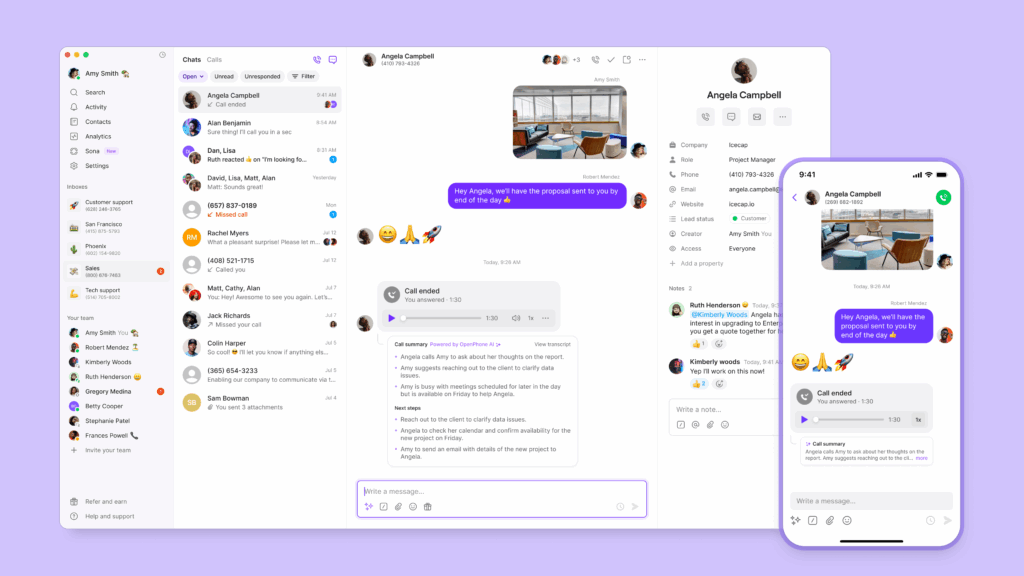
Quo, formerly known as Quo, is a VoIP phone system for small and growing businesses. Quo is rated as the #1 business phone in customer satisfaction on G2. You get all the basics of a T-Mobile business plan, including unlimited calls and texts in the US and Canada. You also get the ability to contact customers from anywhere with a WiFi connection.
With Quo, each user in your workspace can have a dedicated number when they sign up. You can choose local US or Canadian numbers or North American toll-free numbers. You can also turn any number into a shared phone number. This way, everyone on your team can split responsibility for incoming calls and texts.
Each plan comes with calling and messaging features T-Mobile can’t offer:
- Track conversations with automatic call recording, AI call summaries, and AI call tags
- Automate text messaging with auto-replies, snippets, and scheduled messages
- Set up call routing, call forwarding, and phone menus with our call flow builder
- Provide a 24/7 AI call answering service with Quo’s AI voice agent Sona
Quo also makes it easier for your team to work together. Use our 7,000+ third-party integrations, including tools like HubSpot, Salesforce, and Zapier. Share your call and text data wherever your team works. You can also collaborate with team members in real time with internal threads. Loop your colleagues into customer conversations to respond faster or troubleshoot issues quickly.
See for yourself why Quo is the best T-Mobile business alternative by signing up for a seven-day free trial.
Key features of Quo
- Free SMS and MMS support
- Free calls to the US and Canada
- Competitive rates for international calling and texting
- Shared phone numbers
- Forward calls to computers and phones
- Phone menus, or IVR
- On-demand and automatic call recording
- Quo API for custom integrations
Quo pricing
No need to bundle your mobile plan or sign up for auto-pay to lower your bills.
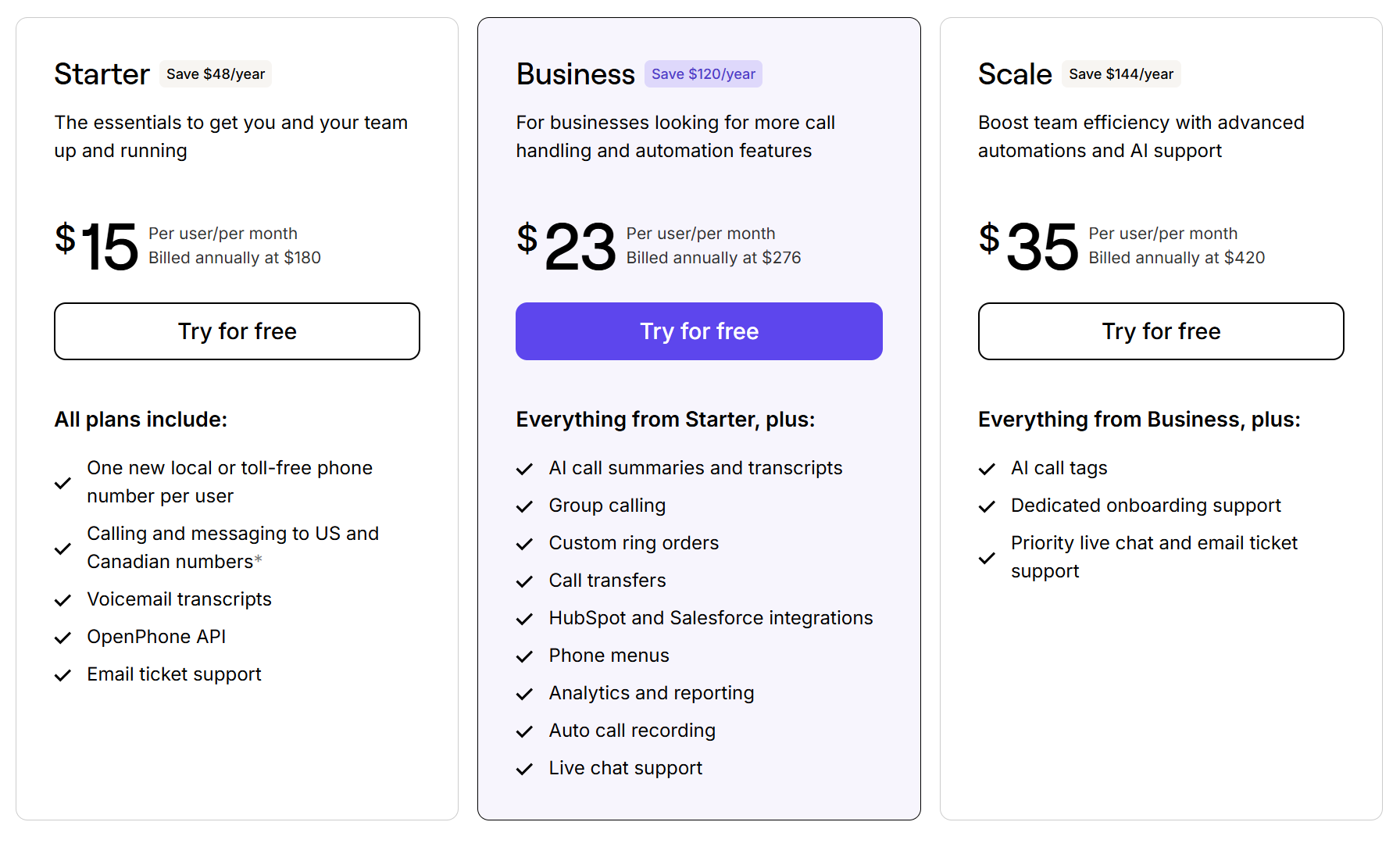
Quo offers three plans for teams to choose from:
- Starter: $15 per user per month for unlimited calling in the US and Canada, SMS and MMS support, texting automations, voicemail transcriptions, and on-demand call recording
- Business: $23 per user per month analytics and reporting, integrations with CRMs like Salesforce, call transfers, and phone menus
- Scale: $35 per user per month for AI call tags, dedicated onboarding, plus priority live chat, and dedicated email support
2. Nextiva: Best alternative for social media channel communication

Pros
- Calling and texting support on the base plan
- Integrates with multiple social media channels
Cons
- Toll-free numbers and minutes require an upgrade
- Shared numbers for texting requires an upgrade
- AI transcriptions and summaries require usage-based pricing
- No unlimited SMS on any plan
Nextiva is a VoIP provider that can act as your entire customer experience platform. Once you sign up for an account, you can connect all your social media channels into one place. Upgrade your plan to connect with channels like web chat, chatbots, and digital fax.
But Nextiva’s calling and texting features leave much to be desired. For one thing, you’re limited to 100 SMS messages per user per month on the base plan. The Engage plan only unlocks a max of 500 messages per user per month. You’ll have to upgrade to this plan anyway if you want shared numbers for texting.
Toll-free numbers are only available on Nextiva’s base plan with an add-on. You’ll have to upgrade your plan if you want toll-free minutes. Keep in mind you’ll only get a max of 2,000 minutes when you upgrade, which you’ll likely outgrow as your business scales. Similarly, third-party integrations with CRMs like Salesforce are only available as an add-on. Nextiva is a step up as a T-Mobile business alternative, but it may not be the best option for every business.
Key features of Nextiva
- Smart call routing, or IVR
- Voice call recording with an upgrade
- SMS and MMS and shared messaging with an upgrade
- Inbound and outbound calling in the US and Canada
- Third-party integrations with an upgrade
Nextiva pricing

Nextiva’s pricing includes:
- Core: $15 per user per month for unlimited voice calls, 100 text messages, team messaging, voicemail transcriptions, and the mobile app
- Engage: $25 per user per month for 500 text messages, digital fax, integration with Microsoft Teams, voice analytics, call recording, and up to 2,000 toll-free minutes per month
- Power Suite: $75 per user per month for up to 100 users, IVR phone menus, skills-based routing, call transcriptions and summaries, and API integrations
3. Google Voice: Best alternative for Google Workspace users

Pros
- Free plan for personal users
- Integrates with other Google Workspace apps
Cons
- No support for toll-free numbers
- User limits on the base plan
- Requires two subscriptions
- No integrations outside of Google products
You’re likely familiar with Google Voice: it’s one of the most popular VoIP phone systems for personal use. It also has a business version called Google Voice for Google Workspace. Google Voice for business offers features like voicemail transcripts and ring groups. Keep in mind you’ll need two subscriptions for this: one for Voice and another for Workspace.
Google Voice is missing many key features you can get from other small business phone plans. Toll-free numbers, for example, aren’t supported at all. And, there are no integrations outside of Google Meet or Google Calendar.
You should also know there’s a 10-user limit on the base plan. Once you hit 11 members, you have to upgrade to the Standard plan, which is twice the cost of the Starter plan. Fortunately, most Google Voice alternatives don’t have these user limits. If you want to try a free VoIP alternative to T-Mobile, Google Voice can get you started. However, you shouldn’t expect to scale your communications with Google Voice for business.
Key features of Google Voice
- Unlimited calls in the US and Canada, from US customers only
- Unlimited texts to the US, for US customers only
- Voicemail transcriptions
- Integrations with Google Calendar and Google Meet
- Multi-level auto-attendant with an upgrade
Google Voice pricing

The personal plan for Google Voice is 100% free. But business-specific features like call recording and auto-attendants require a business account.
First, purchase one of Google Voice’s pricing plans:
- Starter: $10 per user per month for a max of 10 users and 10 US locations, plus free calls and texts in the US
- Standard: $20 per user per month for unlimited users, on-demand call recording, ring groups, and auto-attendants
- Premier: $30 per user per month for unlimited international locations, automatic call recording, and advanced reporting with BigQuery
Then, add on a Google Workspace subscription for $7+ per user per month.
4. Grasshopper: Best alternative with multi-digit phone extensions

Pros
- Pay per number, not per user
- Compatible with traditional desk phones
Cons
- Pricing adds up quickly
- Additional numbers are costly
- Additional extensions require an upgrade
- Call recording and simultaneous ring are not included on the base plan
If you’d rather pay per number rather than per user, Grasshopper offers this as an option. It offers multi-digit extensions so multiple members of your team can use the same number. Keep in mind this pricing adds up fast. Additional numbers cost $9 per month. And if you want additional extensions, you need to upgrade your plan and pay $3 per month for each extension.
You should also know Grasshopper omits key features from its base plan. Without upgrading to the Solo Plus plan, you can’t:
- Record calls
- Split responsibility for incoming calls with simultaneous call handling
- Add multiple members to your plan
This could be frustrating and cost-prohibitive for growing brands.
Looking for similar features without the extra costs? You might want to explore some Grasshopper alternatives.
Key features of Grasshopper
- Auto-responses, for new callers only
- Multi-digit extensions varies per plan
- Voicemail-to-text
- Business hours
- Custom greetings
Grasshopper pricing

Grasshopper’s pricing is as follows:
- True Solo: $14 per month for one user, one number, and one extension
- Solo Plus: $25 per month for unlimited users, one phone number, and three extensions, plus call transfers and simultaneous call handling
- Small Business: $55 per month for unlimited users, four phone numbers, and unlimited extensions
You can also purchase additional numbers for $9 per number per month.
5. Ooma: Best T-Mobile business alternative with overhead paging

Pros
- Overhead paging and intercom are available on every plan
- Unlimited calling outside the US and Canada, including Mexico and Puerto Rico
Cons
- Desktop app requires an upgrade
- Call recording is not available on the base plan
- CRM integrations are locked behind the highest tier
- Text messaging requires an upgrade and isn’t unlimited
If your business is in a traditional office, Ooma Office may be a feasible T-Mobile substitute. You get similar features, like unlimited calling in four countries and territories. You also get additional office-friendly features like overhead paging and intercom. You can even bundle business internet with your phone service, like with T-Mobile.
But you should know Ooma’s services are difficult to scale. Features like the desktop app, call recording, and CRM integrations are only available in more expensive tiers.
Text messaging isn’t available on the base plan. Even after you upgrade, you’re still limited to just 250 messages per month. The most expensive plan comes with 1,000 messages per month. That may not be enough as your business grows.
Looking for a VoIP solution better suited for modern terms? Take a look at these Ooma alternatives.
Key features of Ooma
- Virtual receptionist
- Access to the mobile app
- Call forwarding and transfers
- Real-time customer support
- Can be bundled with business internet service
Ooma pricing

You can pick from one of three Ooma pricing plans:
- Essentials: $19.95 per user per month for unlimited calls in Puerto Rico, Mexico, Canada, and the US, extension call monitoring, virtual receptionists, and the mobile app
- Pro: $24.95 per user per month for call recording, 250 texts, and 25-participant video calling
- Pro Plus: $29.95 per user per month for team messaging, 1,000 text messages, hotdesking, call queues, and CRM integrations
Keep in mind these prices don’t include Ooma’s one-time activation fee, which ranges from $29.95 to $49.95.
6. Verizon One Talk: Best alternative for custom cell phone options

Pros
- Can purchase new mobile phones with One Talk built in
- 4G LTE desk phones are available
Cons
- Supports select devices only
- Confusing, non-transparent pricing
- Potentially can’t get all features on a single plan
- Must be a new or existing Verizon customer in the US to access
Verizon is one of the best-known T-Mobile alternatives. After all, it’s the largest wireless service provider by subscriber count in the US. It offers traditional business phone plans like T-Mobile. It also offers a service called One Talk, which is a VoIP platform that also runs on their cellular network. You can use One Talk in four ways: on VoIP desk phones, cellular-based desk phones, a mobile app, or a custom cell phone with a dual SIM or native dialer.
This provides some flexibility to growing businesses. However, not all the features you need are in one place. For example:
- Hunt group messaging is only supported by the mobile app, not the native dialer.
- Some phone models come with exclusive features you can’t get on others. For example, the One Talk T67LTE 4G comes with call recording disabling and wireless priority service.
- Overhead intercom is only available on desk phones.
Verizon claims One Talk offers “50+ calling features.” There’s no way to verify this without contacting sales. That’s because there are no plans or prices listed online.To qualify for Verizon One Talk, you must be a new or existing Verizon Business customer located in the US. If you’re ineligible for Verizon One Talk or are looking for other options, check out these Verizon One Talk alternatives.
Key features of Verizon One Talk
- Caller ID
- 50+ calling features; specifics are not listed
- Mobile app for iPhone and Android
- Auto-receptionist
- Hunt group
Verizon One Talk pricing
Verizon One Talk pricing is no longer listed online, but it does suggest that prices start between $15 and $20 per line. Different webpages claim different prices. You’ll need to contact sales for a straight answer.
Below is the last public information about Verizon One Talk’s plans and prices:
- Desk phone only: $25 per user per month for landline access and features, including bridge lines, call forwarding, and conference calling
- Native Dialer: $20 per user per month for a new iOS or Android phone preloaded with a One Talk compatible mobile number, plus video calling, two line appearances, and the ability to move callers from desk phones to mobile phones
- Mobile app only: $20 per user per month for One Talk on the mobile app, plus text messaging, line sharing, and integrations with nonspecific business apps
- Combo: $25 per user per month for access via desktop and the mobile app, video calling, call park and retrieve, and calls on hold
7. AT&T for Business: Best alternative with both cell and VoIP phone plans

Pros
- 5G network and WiFi calling
- Ability to bring your own device, or BYOD
Cons
- Confusing pricing compared to other providers
- Some features require additional apps
- Customer service may be slow
- BYOD may come with limitations
If you’re looking for a T-Mobile alternative that offers more flexibility, AT&T might be what you’re looking for. You’ll have access to its 5G network and WiFi calling through its VoIP plans. You can also bring existing “compatible” devices, but it doesn’t go into much detail about what that means.
AT&T offers AT&T Business and Office@Hand. AT&T Business is their traditional cellular offering. It gives teams access to unlimited talk, text, and high-speed data. Office@Hand is their VoIP solution that’s designed for small business collaboration. This solution provides features like auto-receptionist, call routing, and extensions.
However, both options fall short when it comes to pricing. With AT&T Business, you need six lines and discounts from AutoPay and paperless billing to get the best possible prices. You’ll also have to pay the following fees:
- Activation/upgrade fee: Up to $50 per line
- Early Termination/Cancellation Fee: Up to $750 per contract
- Monthly AT&T fees: From $0.20 per month for a Property Tax Allotment surcharge to $1.99 per month for an Administrative Fee
Office@Hand advertises their Standard and Premium plans, but pricing isn’t public. Essential features like automatic call recording are only available in the Premium plan. Even if you upgrade, you’re still capped at 200 messages per month.
Even if you don’t mind the nickel-and-diming, be prepared for slow customer service. Customers complain it takes a long time to hear back from reps, as you can see below:
“Service is good, but the support is painstakingly difficult. Plans are confusing, the store staff has limited knowledge, and [they’re] not that friendly.” — Gartner
Key features of AT&T for Business
- 5G and VoIP support
- Unlimited calling in the US and Canada
- Unlimited data usage
- Hotspot data varies by plan
- 1080p video streaming
AT&T for Business pricing

AT&T’s Business pricing depends on how many lines you need.
Here’s what you’ll pay for six numbers in a Business Unlimited plan:
- Business Unlimited Standard: $30 per number per month* for unlimited calling and texting in the US and Canada, unlimited data, and 5GB of hotspot data per number
- Business Unlimited Advanced: $35 per number per month* for access to 100GB of hotspot data per number and 1080p video streaming
- Business Unlimited Premium 2.0: $40 per number per month* for access to 200GB of mobile hotspot data per number, HD and 4K UHD video streaming, and unlimited talk, text, and high-speed data in 20 Latin American countries, including Mexico
- Business Unlimited Premium 2.0 with Turbo: $55 per number per month* for Turbo for Business, plus priority treatment for business data
*When you buy six or more numbers and enroll in auto-pay
If you want AT&T’s VoIP solution, Office@Hand, you’ll have to request a custom quote. There’s no publicly available pricing online, so you’ll have to speak with the sales team about these two plans:
- Standard: Unlimited calling in the US and Canada, 100 SMS messages per month, 1,000 toll-free minutes per month, multi-level auto attendant, and up to 100 video conferencing participants
- Premium: Access to automatic call recording, 200 SMS messages per month, up to 200 video meeting participants, and 10,000 toll-free minutes per month
How do you choose a T-Mobile for business alternative?
Use the following factors to help whittle down the right T-Mobile business alternative for you:
- Flexibility. Choose a business phone system that offers you and your team the ability to work from anywhere. Identify an alternative that uses your team’s existing devices and doesn’t need any custom hardware. Many VoIP mobile virtual network operators, or MVNOs, let businesses make calls over both WiFi and cell networks.
- Reliability: Prioritize providers with high uptime and minimal outages. If they have a publicly accessible status page, give it a look. You can verify they don’t frequently crash and affect your call quality.
- Scalability: Choose a T-Mobile alternative that can scale without breaking the bank. Can you upgrade your plan to unlock more features as you grow? Or scale down temporarily if the need arises?
- Features. Your business phone should be able to keep up with the latest features available in the market. Prioritize a provider that offers essential modern features. Look for shared numbers, integrations, and AI tools like call summaries and transcriptions.
- Cost. VoIP solutions are cost-effective for small businesses. But choosing the wrong option can be expensive. Go with a provider that offers per-user pricing so that your phone scales with your business. Avoid solutions that only offer features as add-ons. Choose a provider that bundles all the essential communication features in their plans.
- Ease of use: Many T-Mobile alternatives can be hard to set up and clunky to use. Choose a provider that can be set up in minutes with zero code. Try out providers for yourself in a free trial and see which one is easiest for your team to use.
Quo: The best T-Mobile alternative for businesses

T-Mobile might work as a way to power your cell phone, but you’ll likely need a different phone service to power your business.
With Quo, you’ll have access to all the basics that T-Mobile offers, like unlimited calls and texts. It also offers everything T-Mobile is missing, including:
- Shared numbers for team collaboration
- Drag-and-drop call flow management
- Desktop, web, and mobile apps
- AI features like call transcripts and Sona
- 7,000+ third-party integrations to keep your tech stack synchronized
Sign up today to try Quo for yourself with a seven-day free trial.
FAQs
T-Mobile offers three business wireless plans:
• CoreMobile: $24 per line per month* for unlimited talk, text, and 5GB of high-speed data in Mexico and Canada, 50GB of premium data, a hotspot with 5GB of data, and a five-year price guarantee
• ProMobile: $38 per line per month* for Threat Protect, four in-flight WiFi sessions, 200GB of premium data, and a hotspot with 200GB of data
• SuperMobile: $46 per line per month* for T-Satellite, nationwide network slice, unlimited in-flight WiFi sessions, unlimited premium data, and a hotspot with 300GB of data
*Pricing for five lines, plus taxes and fees
All three traditional carriers are great options for personal phone use. But all three fall short for business communications.
We recommend choosing a business VoIP provider that can help you take calls anywhere you have an internet connection. VoIP providers are better suited to fast-growing teams. They help you collaborate in real time. They also offer features like shared numbers, third-party integrations, call recording, SMS and MMS, and so much more.
We’re biased, but Quo is the best small business phone plan because you get:
• Unlimited texting and calling in the US and Canada
• One free local or toll-free number per member on your account
• Business features T-Mobile can’t offer, like auto-replies and AI voice agents
Traditional cell phones can be restrictive as businesses grow, especially on prepaid plans. But VoIP phones let you make unlimited calls and texts with a WiFi connection. You don’t pay extra for overage fees. Plus, you can use devices you already own, like iPhones, laptops, and tablets. That way, you never pay extra for new hardware.