


When Zoom took over video conferencing in the early 2020s, their next move was to expand into VoIP services. Zoom Phone launched, allowing customers to add VoIP phones to Zoom’s existing video conferencing platform.
But fast-forward to 2026, and you’ll notice that Zoom Phone’s features haven’t kept up with the competition. And many require upgrades — you can’t even make unlimited outbound calls on its base plan.
If you’re trying to figure out how much Zoom Phone costs, you can use this guide to get a general idea. We cover everything you need to know about Zoom’s five plans, including the hidden fees and limitations not listed on the pricing page.
Zoom Phone pricing and plans at a glance
Zoom Phone’s pricing can be confusing at first. There isn’t just one way to pay — there are five.
You can choose from three standalone Zoom Phone plans or two bundles that combine Zoom Phone with Zoom Workplace at a discounted rate.
Not sure where to start? We’ll kick things off with a quick overview of the Zoom Phone-only plans, then look at the bundles.

Zoom Phone only plans
Zoom offers three standalone phone plans: Metered, Regional Unlimited, and Global Select. Each one includes desktop and mobile apps, 24/7 customer support, and HD call quality.
The biggest difference? How much — and where — you can call.
Here’s a quick look at what each plan offers, along with a side-by-side comparison:
| Plan name | Price | Best for | Core features |
|---|---|---|---|
| US & Canada Metered | $10 per user per month | Startups that rarely make outbound calls | Pay-as-you-go domestic calling; prices start from $0.0242 per minute for every outbound call |
| US & Canada Unlimited | $15 per user per month | Office-based teams that primarily call within the US and Canada | Unlimited domestic calling and metered international calling |
| Global Select | $20 per user per month | Distributed teams with international clients or offices | Unlimited domestic calling in 40+ countries |
Zoom Phone + Workplace plan bundles
If your team already uses Zoom for meetings, you can bundle Zoom Phone with Zoom Workplace to unlock more features — and save a bit in the process.
There are two bundle options: Pro Plus and Business Plus.
Here’s a quick look at how they stack up:

| Plan name | Price | Best for | Core features |
|---|---|---|---|
| Pro Plus | $18.33 per user per month | Medium-sized teams that use Zoom for calls and video meetings | Zoom Phone US & CA unlimited + video meetings for up to 100 participants, Zoom Docs, and an AI companion |
| Business Plus | $22.49 per user per month | Businesses that want to send a lot of online faxes domestically | Zoom Phone US & CA unlimited + everything in Pro; video meetings for up to 300 participants, 15GB cloud storage, unlimited domestic online fax, and a custom mail domain with mail service |
Zoom Phone plans unpacked: What you get, and what you don’t
Now that you’ve seen the overview, let’s take a detailed look at what each Zoom Phone-only plan includes — and where they might fall short.
We’ll start with the most affordable option: US & Canada metered calling.
US & Canada Metered plan

Pricing: $10 per user per month, or $120 per user if billed annually
Best for: Businesses with low call volume that just need a basic phone line for occasional use
The Metered plan comes with Zoom Phone’s standard features. These include voicemail transcriptions, dial-by-name directories, and call recording. However, there’s no unlimited domestic calling — you’ll have to pay at least $0.0242 per minute for every outbound call in the US and Canada. You’ll also have to consider Zoom Phone’s SMS pricing. It charges $0.0070 for each inbound and outbound message from a toll-free number in the US and Canada.
You’ll get access to the following key features:
- Texting: Domestic SMS and MMS
- Desktop apps: Windows and macOS
- Mobile device apps: iOS and Android
- Call routing: Auto-attendants/IVR
- Integrations: Salesforce, Slack, and Microsoft Teams
Why select this plan: This Metered plan can make sense for teams that rarely place outbound calls and want an affordable VoIP service. Still, paying per minute for every call can get expensive quickly once your volume grows. Ultimately, this plan is fine for testing Zoom Phone, but most businesses will outgrow it quickly.
US & Canada Unlimited plan

Pricing: $15 per user per month, or $180 per user if billed annually
Best for: Businesses that need unlimited calling within the US and Canada but don’t require Zoom Workplace features
If the Metered plan feels limiting, the US & Canada Unlimited plan gives your team more coverage:
- Calling: Unlimited outbound phone calls across the US and Canada
- International calling: Option to purchase an add-on to access unlimited international calls to 19 countries
However, you still won’t have access to other key Zoom features, including cloud storage, unlimited faxes, and video meeting recordings. The only way to unlock these is to upgrade your plan and bundle Zoom Phone with a Zoom Workplace add-on.
Why select this plan: The Unlimited plan works if you mostly make calls within North America. The international calling add-on is convenient for light global use, but not the best option for scaling businesses.
Global Select plan

Pricing: $20 per user per month, or $240 per user if billed annually
Best for: Businesses with offices or clients across different countries that need to make local calls
The Global Select plan provides everything in US & Canada Unlimited, plus:
- Calling: Unlimited calls within 40+ countries
- Direct line: Direct-dial number so callers can avoid going through a phone menu or receptionist
Why select this plan: The Global Select plan might sound like it covers the world, but its reach depends on where your team works. You can make unlimited domestic calls within countries like Australia, Argentina, and Bahrain. If you call across borders, you’ll still need the international calling add-on.
Zoom Phone + Workplace bundles unpacked: What you get, and what you don’t
If you’re considering one of the Zoom Phone bundles, here’s what you can expect from each plan — and what you’ll miss out on if you don’t upgrade.
We’ll start with Pro Plus.
Pro Plus

Pricing: $18.33 per user per month if billed annually, or $21.99 per user if billed monthly, for up to 99 users.
Best for: Teams that want built-in video meetings and document tools
The Pro Plus plan provides access to the features on Zoom Workplace Pro.
Keep in mind that you can’t access unlimited domestic fax or whiteboards. Want to use Zoom’s Scheduler tool to connect with your Google or Microsoft 365 calendars so it’s easier to book appointments? You won’t be able to unless you upgrade to the next plan.
Another strange limitation: it’s limited to 99 licenses. This means if your business scales, you might need to upgrade to the Business Plus plan, which costs $22.49 per user per month. Here are the features you’ll actually get:
- Meetings: Unlimited and up to 100 participants
- Documents: Unlimited docs that transform your meetings into actionable documents reps can use to follow up
- Collaboration: Team messaging
- Recordings: Video meeting recordings
- Storage: 10 GB of cloud storage
Why select this plan: Choose the Pro Plus plan if you want to bundle Zoom video meetings alongside Zoom Phone.
Business Plus

Pricing: $22.49 per user per month if billed annually, or $26.99 per user if billed monthly, for up to 250 users.
Best for: Larger businesses that want to manage desk phones, faxes, and workplace tools in one place
The Business Plus plan unlocks access to Zoom Workplace Business.
Here are the key features you can expect to get:
- Security: Single sign-on via SAML 2.0
- Meetings: Up to 300 people
- Whiteboards: Unlimited online whiteboards
- Faxing: Unlimited US and CA
- Storage: 15 GB of cloud storage
- Scheduling tools: Connect Google or Microsoft 365 calendars to share your availability with others so they can book appointments
Why select this plan: Go for the Business Plus plan if you want to combine calling with larger Zoom meetings and access scheduling tools. It still leaves out shared phone numbers for texting and enhanced call queue analytics. This meansit isn’t a great choice for teams that need deeper insights or collaboration features to scale the business.
Zoom Phone pricing for add-on options

You’ll also have to pay extra for add-ons and upgrades, including:
- International calling: $10 per user per month for unlimited international calling to more than 15 countries and regions
- Zoom Phone Power Pack: $25 per user per month for enhanced call queue analytics, team SMS, and historical insights
- Additional phone numbers: Local, toll-free, or international numbers starting at $5 per number per month
- Zoom Webinars: $66.67 per month billed annually for high-quality video broadcast with up to 300 attendees and 1000 panelists
- Zoom Whiteboards: $2.08 per user per month billed annually for whiteboards your team can edit together
- Zoom Scheduler: $4.99 per user per month billed annually to book meeting slots in Microsoft 365 and Google Calendar
- Audio conferencing: $100 per month to let phone numbers from around the world dial into meetings
- Docs: $7.49 per user per month billed annually for unlimited document sharing and version history
- AI Companion: $8.33 per user per month billed annually for automatic meeting summaries and questions in Zoom meetings
- Clips: $5.83 per user per month billed annually for unlimited clip recordings and high-definition video of up to 4K
- Device: Prices start at $72.56 per device for headsets and $131.51 for desk phones. They’re only available to add to your plan if you’re in the US
Hidden fees to know
If you thought paying for outbound minutes was expensive, keep in mind that Zoom Phone charges the following hidden fees:
Toll-free calling
Zoom Phone does offer toll-free numbers. But you still need to purchase toll-free minutes, which aren’t included on any plan. Zoom offers pay-as-you-go or monthly rates, which can get expensive fast. Assuming you’re calling landline and mobile numbers in the US, your costs could range from $0.02 per minute to $0.04 per minute or more.
Cloud storage
If you want to store copies of your documents and call recordings, you need to purchase a Zoom Phone bundle plan. You could also purchase more cloud storage with a separate add-on for Zoom Workplace, which costs $10 per user per month.
Large meetings
Even if you bundle Zoom Phone with Workplace, meeting capacity isn’t unlimited. To host virtual events or training sessions with up to 500 participants, you’ll need to buy a Large Meeting add-on starting at $50 per month.
Translated captions
If your team works across languages, you’ll need to pay extra for translated captions. This feature starts at $5 per month and lets you show automated captions in the viewer’s preferred language.
Insights from Zoom Phone users
Overall, user insights indicate that Zoom Phone offers solid features. However, many teams find the added costs and upgrade requirements make it hard to justify Zoom Phone’s rates. Let’s take a closer look.
| Pros | Cons |
|---|---|
| UCaaS support. You can use Zoom Phone to make and receive calls, send texts, and join video meetings | Outbound calling costs extra. You have to pay for outbound calls unless you upgrade to a more expensive plan |
| Integrates with other Zoom services. This includes Zoom Workplace, Scheduler, Rooms, and Events & Webinars | Limited integrations. Access to Zoom Phone Essential Apps requires multiple upgrades |
| All-in-one hardware is available. You can purchase Zoom-enabled hardware, like desk phones and headsets | Team SMS summaries require an add-on. There’s no built-in way to review conversation histories with your team unless you pay extra |
| Texting is limited. Doesn’t provide unlimited toll-free texts |
What users say about Zoom Phone’s pricing
Here’s what Zoom Phone users have to say about its pricing:
“Sometimes the pricing can feel high compared to traditional phone systems, and occasional call drops or delays happen during peak times. The admin dashboard could also be a bit more intuitive for new users.” — G2
“I was mislead by the sales rep. I was asked to over-estimate the number of staff we would have 3 years after the contract. I was not informed this could not be changed. Now we are paying for significantly more users than we even employ. I escalated this to legal without a resolution. I am very frustrated by this. We cannot afford a 1,300 payment per month and will be ending as soon as we are able. In my account, there is the option to remove staff/decrease users, but this option does not work for our account. Zoom can do better than this. I am one upset customer and do not feel supported.” — G2
Quo vs Zoom Phone: Feature and pricing comparison
So, is Zoom VoIP pricing a good fit for growing small businesses? According to some of its previous users, the cons outweigh the benefits:

That’s one of the reasons over 90,000 businesses trust Quo, formerly OpenPhone. The platform makes it easy for them to build better relationships with their customers at scale.
Quo brings your calls, texts, and contacts into an intuitive app that works across all your devices so you never miss a customer. We’re also rated #1 in customer satisfaction on G2 — our customer service speaks for itself.
Here’s how we compare to Zoom Phone for the features you need to grow your business:
| Features | Quo | Zoom Phone |
|---|---|---|
| Price per month | $15 per user per month | $10 per user per month |
| Unlimited calling | ✓ | Requires an upgrade |
| Unlimited SMS, MMS to US & Canada | ✓ | ✓ |
| Voicemail-to-text | ✓ | ✓ |
| Toll-free numbers | ✓ | Additional cost |
| Additional phone numbers | $5 per number | $5 per number |
| Number porting | ✓ | ✓ |
| Call recording | ✓ | ✓ |
| Shared phone numbers | ✓ | Shared texting requires the Zoom Phone Power pack add-on |
| Group text messaging | ✓ | ✓ |
| Shared contacts | ✓ | ✓ |
| Auto-replies | ✓ | Requires Power Pack add-on |
| Text message templates | ✓ | ✓ |
| Slack integration | ✓ | ✓ |
| Gmail integration | ✓ | ✓ |
| Zapier integration | ✓ | ✓ |
| iOS and Android apps | ✓ | ✓ |
| Web-based apps | ✓ | ✓ |
| API | ✓ | ✓ |
| Free trial | ✓ | Only for the US & CA Unlimited plan |
Top four Quo features
- Unlimited calling and texts to US and Canadian phone numbers
- Shared phone numbers for sharing calls and text messages
- AI features for call transcriptions, summaries, call tags, voice agent, and action items
- Available on Windows, Mac, iOS, Android, and the web
Top four Zoom Phone features
- Domestic calling plans for the US, Canada, and 40+ other countries
- Bundles with Zoom Workplace for team collaboration
- Add-ons for cloud storage, large meetings, and translated captions
- Available on desktop and mobile apps
1. Upfront and flexible pricing
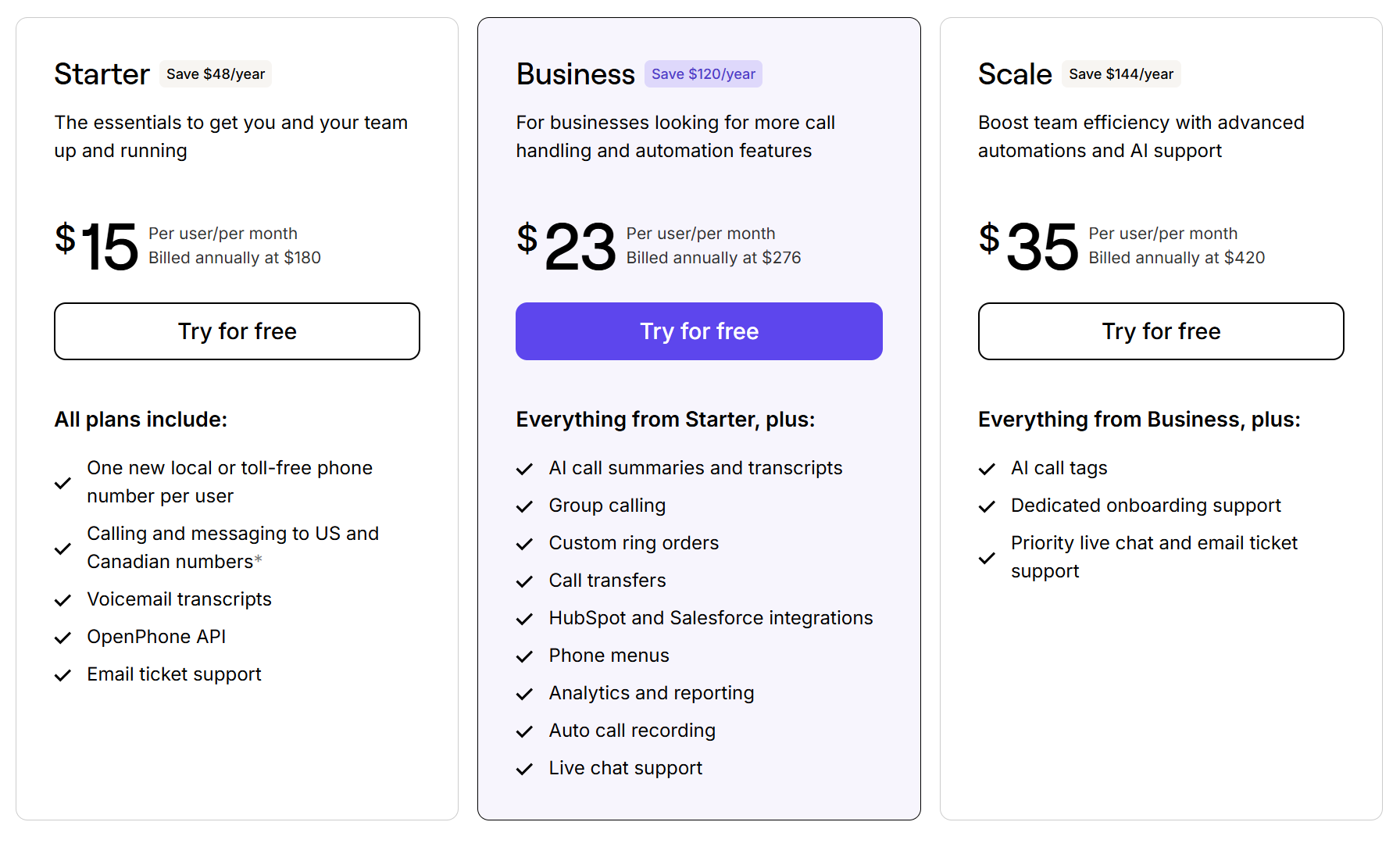
Quo starts at $15 per user per month for unlimited calling and messaging in the US and Canada. There’s no need to upgrade for outbound calling or shared numbers for texting.
Our base plan offers everything you need to start and grow your business. This includes toll-free numbers, unlimited SMS/MMS, and auto-replies. Whenever you’re ready, you can upgrade to our Business plan at $23 per user per month.

Then, you’ll have access to CRM integrations, AI call summaries and transcripts, and team analytics and reporting tools.
Speaking of analytics. . .
2. Clear insights into your team’s performance

Unlike Zoom Phone, you can access all of Quo analytics on our Business plan — no add-ons required. You’ll have everything you need to keep an eye on your system. This includes the number of incoming calls, messages, and missed calls, as well as unique conversations.
You can use Quo analytics to monitor individual user activities. For example, you can see the number of messages sent per week or the user’s percentage of answered calls. You can also tap into your number’s personalized heat map to identify the busiest days and times of the week.
Plus, you can use AI call tags to analyze customer sentiment. For example, you can create labels like “Negative sentiment” or “Happy,” and Quo will use them to tag your calls after they end. That way, your team can prioritize follow-ups or identify how you can improve your product or service.

These tools help you keep a finger on the pulse of your team so you can offer personalized feedback and suggestions.
3. Affordable AI tools that save your team time

With Zoom Phone, you need to pay for a monthly add-on to unlock the best AI tools for your business.
With Quo, AI is available on our Business plan. There are no surprises, add-on costs, or learning curves.
You can use Quo AI tools for:
- Transcribing and summarizing calls
- Providing next steps and action items
- Suggesting and adding new contacts, if they’re not already in your system
- Tagging calls by topic so it’s easier to scan and sort conversations
- Automatically answering calls and sending texts with Sona, the best AI voice agent
We also offer AI tools for AI-suggested message responses so you can easily respond to incoming conversations.
4. Team up on communications with shared numbers

With Zoom Phone, you can share a business phone number with your team, but it comes with serious limitations. You can only be a member of one shared number at a time, and texting from a shared number requires the Zoom Power Pack add-on.
Quo makes it much easier and more cost-effective to split incoming conversations with coworkers. On our Business plan, you can add unlimited members to any number or numbers, and share texts, voicemails, and call recordings with your team.

You can also tap into productivity tools such as auto-replies and scheduled texts to keep customers informed, even when you’re off the clock. Plus, we let you create snippets, so your team doesn’t have to waste time writing the same message in response to FAQs.
We also offer team chat tools so everyone on your team can share information without leaving the app. All you have to do is mention a team member in an internal thread, then leave context regarding recent calls, texts, or voicemails.
5. Easy to scale as your team grows
Quo is designed to scale with your team, so you won’t need to upgrade until you’re ready. As your team grows, you can easily add new numbers and customize them to ensure callers get routed to the right place. Additional numbers cost $5 per month, whether you get a US phone number, a Canadian number, or a North American toll-free number.
Need to add new members to your Quo account? Each user gets a free North American local or toll-free number. Plus, since our setup is intuitive, it only takes 15 minutes to get started.
During busy periods, you can switch between different call flows to handle higher call volumes. For example, you can route calls to Sona, Quo’s AI agent, which can answer FAQs, take messages, or transfer calls to the right teammate.
If you run into any issues, our email and chat support teams are standing by to help.
When should you choose Quo vs Zoom Phone?
If you’re deciding between Quo and Zoom Phone, it really comes down to what your team needs most. Zoom Phone adds calling features to a video conferencing platform, while Quo is a business phone system for growing teams that want to scale.
| Zoom Phone | Quo | |
|---|---|---|
| Focus | Video meeting platform with add-on calling features | Business phone system built to help growing teams scale |
| Ease of use | Familiar interface for existing Zoom users | Intuitive, lightweight design anyone can pick up instantly |
| Collaboration tools | Strong video and meeting tools | Seamless shared numbers, internal messaging, and SMS inboxes |
| Automation & AI | Limited AI features, mostly for meeting transcription | Advanced AI features like call summaries, tags, and Sona — Quo’s AI voice agent |
| Support structure | Standard 24/7 tech support | Fast, human support with setup help and migration guidance |
| Pricing model | Base plans with modular add-ons that can add up | Transparent pricing that scales with your team |
| Integration ecosystem | Zoom, Google, Slack, Salesforce, and Microsoft tools | Connects with HubSpot, Slack, Zapier, Make, Salesforce, Jobber, and more |
| Best for | Teams that already use Zoom for video conferencing | Small and growing businesses that want to scale |
How to choose the right business phone system
Not every phone system is designed for the same kind of work. So it helps to be clear about what your team actually needs before picking a provider.
- How your conversations happen. Different teams use their phone system in different ways. Some rely on calls and texts throughout the day. Others spend more time in video meetings. Choose a system that matches how your team communicates with each other and with clients.
- What’s included in the plan. Phone plans can vary a lot in what they offer. For example, look at the features you’ll get on the base plan, like phone numbers, unlimited domestic calling, and storage. Then, you’ll know what your team can access from the moment you sign up.
- How it supports a growing team. As more people join your team, you may need shared numbers, internal threads, and ways to answer calls after hours. It’s worth checking whether the providers you have in mind offer these tools.
- How it works in practice. Product demos are typically guided by a sales rep, who walks you through the platform’s features. In contrast, a free trial lets you explore the product on your own and see how it fits into your workflows over a set period of time.
- How it fits into your tools. Does your team use a CRM or other business tools? Your phone system should automatically sync call and message data so everything stays in one place.
See why Quo is the best virtual phone service provider

Your business phone system should help you build better relationships with your customers. That’s why many small businesses opt out of using Zoom Phone — and why they switch to providers like Quo instead.
With Quo, you can split responsibility for incoming conversations with every member of your team. You can connect with thousands of integrations, tap into AI tools like AI call tags, and set up automated workflows to get more work done in less time.
Ready to get a business phone number with Quo?
Take us for a spin with our seven-day free trial.
FAQs
Zoom Phone only offers a free trial for its US & CA Unlimited plan. This means there’s no free trial for Zoom Phone’s basic plan or its highest tiers. With Quo, you can start your free trial in minutes for any of its pricing plans.
No, Zoom Phone doesn’t charge setup fees. Once you choose a plan, you’ll just pay the monthly rate per user. Keep in mind that if you’re on Zoom’s Basic plan, you won’t get access to tickets or live chat support. That means if you run into setup issues, you might have to troubleshoot on your own — which can be time-consuming for small teams.
Zoom Phone can work for small businesses that already use Zoom for video calls. However, it’s more of an add-on than a complete business phone system. If you need AI tools and shared numbers for texting and calls, a platform like Quo might be a better fit.
Yes, Zoom Phone charges for international calls. Its Global Select plan only includes unlimited domestic calling within your selected region. While Zoom does offer an international calling add-on, it only includes around 19 countries and costs an extra $10 per user each month on top of your plan.
Google Voice for Business offers simple call routing and texting tools that work alright for small teams, but they limit your business once it starts to grow. Zoom Phone, meanwhile, was originally designed to support PBX systems so physical offices didn’t have to replace their desk phones. That legacy shows — it doesn’t keep up with modern features like AI voice agents. If you’re looking for something built for how teams work today, Quo gives you everything in one place.
If you want a full breakdown, check out our detailed comparison of Zoom Phone vs Google Voice.
Zoom Phone doesn’t charge per minute for domestic calls with its unlimited calling plan. However, once you call outside supported regions, per-minute charges apply.
Zoom Phone subscriptions start at $10 per user per month for its metered plan. From there, pricing increases based on how often you call, where you call, and which add-ons you need. While the platform lists its plans publicly, Zoom Phone’s official pricing doesn’t always reflect the extra costs for calling, texting, and more.


