Choosing the best cloud phone system can be a little overwhelming, given the number of options available.
Whether you’re moving from landlines, using your cell number for work, or already using VoIP software, we’ll help you choose the best phone system for your business.
In this guide, you’ll find a breakdown of the top 10 cloud phone providers, along with their pros, cons, features, and pricing.
But first…
What is a cloud phone system?
A cloud phone system is a type of business phone system. It uses the internet to make and receive calls, instead of landlines or the public switched telephone network, or PSTN. All you need is a laptop, phone, or desktop to reach customers anywhere with a WiFi connection.
Cloud phone services also don’t require on-site hardware, like a PBX closet or desk phones. This means they’re typically more scalable, cost-effective, and flexible compared to landlines. They also allow for more growth, with features like texting, automations, and links to tools such as Slack or HubSpot.
Finally, you don’t need to worry about managing updates, hardware, or security alone. Providers like Quo host and handle the backend technical infrastructure for you.
You may have heard cloud phone systems called:
- VoIP phone system
- Cloud-hosted phone system
- Hosted PBX system
- Hosted VoIP
- Cloud PBX
- Virtual PBX
These all mean the same thing: a cloud-based communications solution that lets you call and text through an internet connection.
💡Related: VoIP vs PBX
How does a cloud-based phone system work?

Cloud phone systems use Voice over Internet Protocol, or VoIP, to send and receive communications over the internet.
But how does VoIP work?
VoIP converts your voice into digital data packets that travel over the internet. It’s just like how email or video calls work. When you speak, your voice is broken down into small data chunks. Your internet connection transfers and reassembles these as audio on the other end.
To use VoIP phone systems, you need to sign up with a cloud-based phone system provider. Here’s how:
- You sign up online and use the equipment you already own
- You pay a monthly subscription, usually per user per month
- You choose a local, toll-free, or vanity number that works on mobile devices, laptops, tablets, and VoIP desk phones
- You download your provider’s desktop or mobile app, or use the browser version
- If you want to send texts to US numbers, you’ll also have to complete carrier registration
That’s it!
The best VoIP providers: A visual comparison
Here’s a quick breakdown of the best cloud phone systems:
| Provider | Best for | Starting price | Unlimited calls to US & Canada | SMS/MMS to US & Canada | Additional phone numbers |
|---|---|---|---|---|---|
| Quo | Small and growing businesses | $15 per user per month | ✔️ | ✔️ | $5 per number per month |
| Dialpad | Call centers with advanced AI needs | $15 per user per month | ✔️ | ✔️, international SMS requires upgrade | Requires upgrade |
| RingCentral | Desk phone rental options | $20 per user per month | ✔️ | 25 messages per user per month | $4.99 per month |
| Google Voice | Google Workspace users | $17 per user per month, requires a Google Workspace subscription | ✔️ | US customers only | Not disclosed |
| Ooma | Overhead paging and intercom | $19.95 per user per month | ✔️ | Requires upgrade | $9.95 per number per month |
| Nextiva | Teams that need Microsoft Teams integration | $15 per user per month | ✔️ | 100 messages per user per month | Contact for pricing |
| Aircall | Sales call centers | $30 per user per month, three-user minimum | ✔️ | ✔️ | $6 per number per month |
| 8×8 | Global calling | Contact for pricing | ✔️ | ✔️ | Contact for pricing |
| GoTo Connect | Sales and customer support teams | Contact for pricing | ✔️ | For US and Canadian customers only | Contact for pricing |
| Zoom Phone | Businesses already using Zoom | $10 per user per month | Requires upgrade | ✔️ | $5 per number per month |
Best cloud phone systems: A detailed comparison
Let’s start with one of the best cloud-based phone systems for small businesses:
1. Quo (formerly OpenPhone): Best cloud phone system for small and growing businesses

Pros
- Unlimited calls and texts to the US and Canada
- One free new local or toll-free number per user
- Team collaboration features like internal threads and shared numbers
- Auto-attendant functions or IVR for inbound calls
- Messaging automations, including auto-replies, templated messages, and scheduled texts
- AI features like AI voice agent, call tags, and call transcripts and summaries
- Integrations with 7,000+ apps, including Slack, Salesforce, and HubSpot
Cons
- No verification through two-factor authentication*
*Nearly all virtual phone numbers share this problem. Companies like Facebook, Uber, and Google rarely let you authenticate accounts through a virtual phone number.
Quo is a cloud VoIP phone system for small and growing businesses. Each user has access to unlimited calling and texting in the US or Canada, plus one free local US or Canadian or toll-free number per member on the account.
With Quo (formerly OpenPhone), you can communicate with customers from any internet-enabled device.
You can also route incoming calls to ring groups or specific teammates, or set up auto-attendants so callers can route themselves. There’s also our AI voice agent, Sona, to handle overflow calls and forward calls during and after business hours so you never miss customer calls. Everything is done through our call flow builder, with a drag-and-drop interface that lets you set up your system in minutes.

Want to help team members share responsibility for incoming calls? Shared numbers let all members of a number answer calls and texts together. That way, everyone can work more efficiently as a team and follow up on conversations quickly and seamlessly.
Plus, you can get call recordings and AI-powered call summaries and transcripts for easier follow-ups.

You can test Quo for yourself. Sign up for our seven-day free trial today and get set up in 15 minutes or less. Once you confirm Quo is the right fit, you can port any US, Canadian, or North American toll-free number from the web or desktop app.
Key features of Quo
- One free local US or Canadian number or North American toll-free number per user
- Free SMS and MMS support to the US and Canada
- Free calls to the US and Canada
- Shared numbers
- Call forwarding to phones and computers
- IVR or phone menus
- Text messaging workflow automations like snippets, auto-replies, and scheduled messages
- OpenPhone AI voice agent Sona
- Call recording, both on-demand and automatic
- Voicemail-to-text transcriptions
- Integrations with Slack, Zapier, Make, Google Contacts, Jobber, HubSpot, and Salesforce
- Quo API to unlock more integrations
OpenPhone pricing
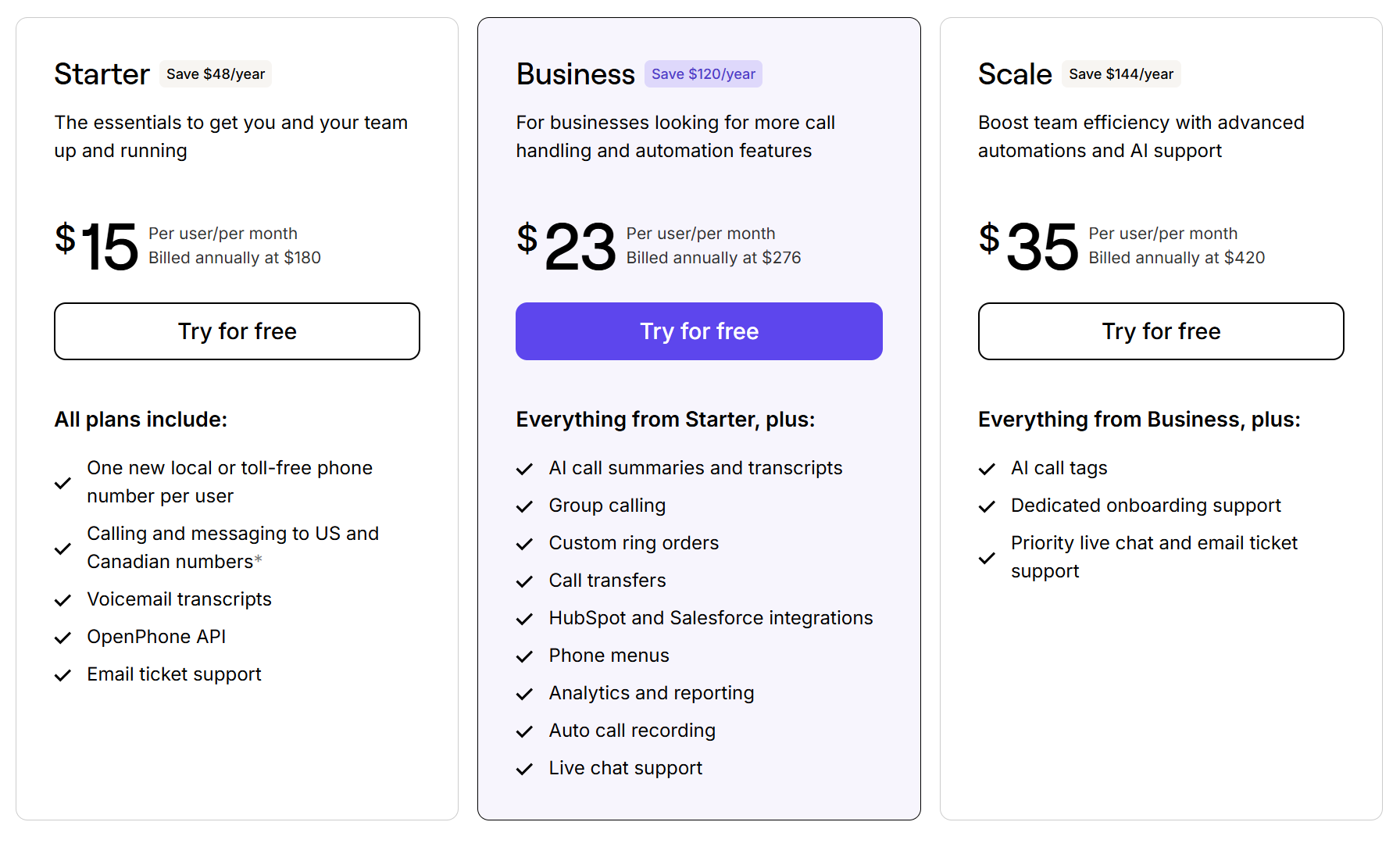
You can choose between three Quo pricing plans:
- Starter: $15 per user per month for free calls and texts to the US and Canada, texting automations, on-demand call recording, voicemail transcription, Sona, and more
- Business: $23 per user per month for phone menus, call transfers, analytics and reporting, integrations with CRMs like HubSpot and Salesforce, and more
- Scale: $35 per user per month for AI call tags, dedicated onboarding, and priority chat and email support
2. Dialpad: Best for call centers with advanced AI needs

Pros
- AI features on the base plan
- Unlimited calls in the US and Canada
- Access to collaboration tools like team messaging, file sharing, and audio chat rooms
Cons
- No additional numbers on the base plan
- User minimums are required
- Slack and Zapier require an upgrade
Dialpad is a business communications platform. It includes calling, texting, and video conferencing on every plan. The basic plan includes AI tools like real-time call transcripts and speech coaching for customer support teams. It also has unlimited calling in the US, Canada, and your home country, so you can connect with customers without per-minute pricing.
That said, several features are paywalled or require pricey add-ons. You need to upgrade to get:
- Extra numbers
- International texting
- Most third-party integrations
- More than three ring groups
Higher-tier plans also come with user limits. The Pro plan has a three-person minimum, and the Enterprise plan has a 100-person minimum. If you want essential features that are only available on higher-end plans, you might have to pay for more than you need.
Want AI features that have better bang for your buck? Check out some of Dialpad’s competitors.
Key features of Dialpad
- Unlimited calls in the US and Canada
- Unlimited SMS and MMS to the US and Canada for US and Canadian customers
- Live speech coaching
- Automated post-call summaries
- Real-time call transcriptions
Dialpad pricing

Here’s a quick breakdown of Dialpad pricing:
- Standard: $15 per user per month for unlimited calling, multi-level IVR, toll-free number support, call recording, and voicemail greetings
- Pro: $25 per user per month for international texting support, additional numbers, third-party integrations, and 25 ring groups
- Enterprise: Custom pricing for unlimited ring groups, additional integrations, and a 100% uptime guarantee
3. RingCentral: Best for desk phone rental options

Pros
- Unlimited calls in the US and Canada
- Video conferencing with an upgrade
- Desk phone rentals
Cons
- Texting is limited to 25 texts per month
- Toll-free calls are capped at 100 minutes on the Core plan
- Call recording requires an upgrade
- Storage is limited
RingCentral is a unified communications platform. It offers texting, calling, video conferencing, and AI features on select plans. If you work in a regular office, it also offers inexpensive desk phone rentals — a plus if that’s something your team still relies on.
But keep in mind that toll-free minutes and text messages are severely limited on the base plan. And even if you upgrade, there’s no way to access unlimited anything. The most expensive plan offers 200 text messages per user per month and 10,000 toll-free minutes shared between everyone on your account.
Finally, there’s no truly unlimited storage for texts, call recordings, and call histories. The first and second tiers offer limited storage only. Even RingCentral’s most expensive plan has time limits. This means you only have three to 12 months of storage before recordings disappear.
Key features of RingCentral
- Call queues
- Multi-level IVR
- Desk phone rentals
- Voicemail transcriptions
- On-demand call recording
- SMS, MMS, video meetings, and toll-free minutes with limitations
RingCentral pricing

RingCentral’s pricing includes three plans:
- Core: $20 per user per month for 100 toll-free minutes, 25 text messages per user, 100 video meeting participants, and on-demand call recording
- Advanced: $25 per user per month for 1,000 toll-free minutes, 100 text messages per user, automatic call recording, and advanced call monitoring features
- Ultra: $35 per user per month for 10,000 toll-free minutes, 200 text messages per user, unlimited storage with time-based limits, and device analytics and alerts
4. Google Voice: Best for Google Workspace users

Pros
- Free VoIP service for personal users
- Free VoIP calls to the US and Canada
- Integrates with other Google Workspace apps
- Share responsibility for incoming calls with ring groups with an upgrade
Cons
- Texting for US customers only
- User minimum on the base plan
- No toll-free numbers or desktop app
- No integrations besides Google Workspace
- Requires a Google Workspace subscription
Google Voice offers the basics you need to communicate with customers, including free calls to the US and Canada. You can also make calls from a PC via the browser app or the Google Chrome extension.
It has features for call management, like:
- Ring groups
- Auto-attendants
- Voicemail transcriptions
- Business hour settings
Otherwise, the offering is pretty bare-bones. For example, you don’t get:
- Text messaging for customers outside the US
- Buying or porting toll-free numbers
- Call recording on the base plan
- Third-party integrations
Plus, Google Voice for business can get expensive fast. The base plan is limited to 10 users max, so you’ll be forced to upgrade once you hit 11 users — even if you don’t need its upgraded features. You also need a Google Workspace account to get Google Voice. This brings the minimum total cost to $17 per user per month.
Want a phone system that genuinely scales alongside your business? Check our list of the best Google Voice alternatives.
Key features of Google Voice
- Unlimited calling and free texting to the US for US customers
- Integrations with Google Calendar and Google Meet
- Business call recordings, requires upgrade
- Mobile apps and web browser options
Google Voice pricing

Google Voice requires you to bundle two separate subscriptions.
First, you have to buy one of three Google Voice pricing plans:
- Starter: $10 per user per month for a max of 10 users, unlimited calls in the US and Canada, voicemail transcriptions, and call forwarding
- Standard: $20 per user per month for unlimited users includes ring groups, multi-level auto-attendants, and on-demand call recording
- Premier: $30 per user per month for advanced reporting and automatic call recording
Then, you’ll need to purchase a Google Workspace subscription. Prices start at $7 per user per month, although plans with more features cost $22+ per user per month.
5. Ooma: Best for overhead paging and intercom

Pros
- Unlimited calling in the US, Canada, Mexico, and Puerto Rico
- Desk phone support
- Video conferencing on higher plans
Cons
- Texting requires an upgrade
- Text messaging is capped at 250 per month on the Pro plan
- Basic features like voicemail transcriptions require upgrades
- CRM integrations are only available on the highest tier
Ooma is a legacy phone system built for small businesses in traditional office environments. For example, medical contact centers, manufacturing facilities, and K-12 school systems.
Each plan comes with features like overhead paging, intercom tools, virtual faxing, and desk phone support. This allows you to enjoy modern VoIP benefits while keeping your current on-premises setup. Plus, you won’t have to give up communication methods your team is already comfortable with, like desk phones or handsets.
But if you want tools like texting, a VoIP PC app, and voicemail transcriptions, you need to upgrade to the Pro plan. And even if you do upgrade, you’ll still be limited to 250 text messages per month.
You also can’t access CRM integrations or team chat features without upgrading to the most expensive plan. This is $10 more per user per month than the base plan, which might be frustrating if you only need one or two features out of the bunch.
Key features of Ooma
- Unlimited calls in the US, Canada, Mexico, and Puerto Rico
- Overhead paging and intercom tools
- Desk phone support
- Call recording, requires upgrade
- Text messaging, requires upgrade
Ooma pricing

There are three tiers of Ooma pricing:
- Essentials: $19.95 per user per month for unlimited calling in the US, Canada, Mexico, and Puerto Rico. Plus extension call monitoring, virtual receptionists, overhead paging, intercom tools, and access to the mobile app
- Pro: $24.95 per user per month for 25-member video calls, 250 texts per user per month, call recording, voicemail transcriptions, integrations with Microsoft Office 365 and Google, and access to the desktop app
- Pro Plus: $29.95 per user per month for CRM integrations like Salesforce, team chat, call queues, and hotdesking. Plus 100-participant video conferencing, and 1,000 text messages per user per month.
6. Nextiva: Best for teams that need Microsoft Teams integration

Pros
- Unlimited calls and video meetings in the US and Canada
- Offers priority and skills-based routing
- Can connect multiple social media accounts into one dashboard
- Microsoft Teams integration is available as an add-on or upgrade
Cons
- SMS and MMS require upgrades and are limited
- Limited toll-free minutes are available on each plan
- Basic features are paywalled
Nextiva is a customer experience tool. It’s designed to connect all your communication platforms into a single centralized platform. You can call and video conference. You can also add your social media, review sites, and teams all in one dashboard.
While they technically have plans for small businesses, Nextiva is best suited for larger companies and enterprises. For example, basic features like texting are locked beyond more expensive tiers. You’ll only get 100 messages per user per month on the first tier, and 500 messages per user per month on the second tier.
Even toll-free minutes come with strict limitations. You can get a toll-free business phone number if you buy an add-on on the base plan, but you can’t get toll-free minutes without upgrading your plan. Even if you do, you’ll be restricted to 2,000 minutes on the Engage plan. That comes out to ~33 hours of calls per month, which you might burn through quickly as your business grows.
Key features of Nextiva
- Free unlimited video calls and voice calls in the US and Canada
- Virtual fax
- Smart call routing, requires upgrade
- Microsoft Teams integration, requires add-on or upgrade
- Integrations with email, social media, web forms, and other business apps
Nextiva pricing

There are three tiers of Nextiva pricing:
- Core: $15 per user per month for voice calls, 100 text messages per user per month, team chat, voicemail transcriptions, and access to the mobile app
- Engage: $25 per user per month for the Microsoft Teams integration, 500 text messages per user per month, digital fax, voice analytics, 2,000 toll-free minutes per month, and call recording
- Power Suite: $75 per user per month for up to 100 agents. Offers skills-based routing, IVR, call transcriptions and summaries, and API integrations.
7. Aircall: Best for sales call centers

Pros
- Designed to handle high call volumes for larger teams
- Unlimited calling and SMS/MMS in the US and Canada
- Enterprise features like Power Dialer
Cons
- User minimum on every plan
- AI call summaries require a pricey add-on
- Upgrade required for unlimited call recording storage
Aircall is a remote phone system designed for global sales call centers. It lets you buy international numbers in more than 100 countries, then set up interactive voice response systems in 16+ languages.
But if you’re a growing small business without an international presence, Aircall might be too expensive for what you get. Every plan has user minimums, so you might have to pay for licenses you don’t need.
Plus, many of Aircall’s best features are locked behind add-ons or upgrades. AI call recordings, for example, require the Professional plan. It costs at least $150 per month. This doesn’t cover add-ons for:
- Analytics dashboards
- Salesforce Service Cloud integration
- CRM logging
Want similar features at a more affordable price? You may want to explore Aircall alternatives.
Key features of Aircall
- Call routing
- SMS support
- Auto-attendants
- Toll-free numbers
- CRM phone integrations
Aircall pricing

There are three levels of Aircall pricing:
- Essentials: $30 per license for three users minimum, unlimited calls in the US and Canada, and essential telephony features like call recording, click-to-dial, and SMS support
- Professional: $50 per license for three users minimum, mandatory call tagging, advanced analytics and call monitoring, and an integration with Salesforce
- Custom: Custom pricing for 25 seats minimum, unlimited worldwide calls, custom onboarding, and custom analytics
8. 8×8: Best for global calling

Pros
- Unlimited international calling on some licenses
- Microsoft Teams integration is available
- Global local number support
Cons
- Can be complex to set up
- Smaller integration library with only 74 integrations
- Must contact sales for pricing and to trial
- Outdated support articles
8×8 is an older hosted PBX provider offering international calling plans to larger contact centers. Depending on your plan, you can make unlimited calls in up to 48 countries. You can also buy local phone numbers to create a familiar presence overseas.
Finally, 8×8 offers bundled minutes rather than just per-minute rates. And if you use Microsoft Teams, you can connect it to 8×8 so everything is in one place.
Unfortunately, 8×8 doesn’t clearly explain its features, plans, and pricing online. So you’ll have to contact sales for details. Plus, it doesn’t offer many integrations compared to other providers on this list. This can silo your system and require you to switch between tools — not ideal for fast-growing brands.
If you want a cloud phone system with more transparent VoIP costs, you might want to browse 8×8 alternatives.
Key features of 8×8
- Receptionist console for exceptionally high call volumes
- Video meetings and AI meeting summaries
- High-volume messaging
- Calling and texting
- Global coverage
- Call recording
- Team chat
- Fax
8×8 pricing

At the time of writing, 8×8’s pricing isn’t listed publicly. You’ll have to reach out to their sales team and request a quote.
9. GoTo Connect: Best for sales and customer support teams

Pros
- Shared inboxes for sales teams, requires upgrade
- Video calls are included in the base plan
- Free calls to 50 countries
Cons
- No unlimited toll-free minutes on any plan
- Lack of collaboration features
- Limits on SMS and MMS
- Best integrations are locked beyond the most expensive tier
GoTo Connect is made for customer support teams that work across different regions and channels. The base plan offers phone, text, and video conferencing support, plus unlimited calling to 50+ countries. You can upgrade to the middle plan to access tools like shared inboxes. These help you manage conversations on WhatsApp, text messages, Facebook, and Instagram.
That said, many of the features on GoTo Connect’s base plan are similar to those on an average smartphone.
There are only a handful of integrations available on the base plan, like Outlook, Miro, Google Workspace, and Microsoft Teams. Plus, its contact center capabilities are reserved for the highest tier. And GoTo Connect’s plans don’t come with public pricing, so you can’t calculate costs up front.
There are also unnecessary limitations on texting and toll-free minutes. For texting, you’re limited to an undisclosed number of credits per month, after which you’ll have to pay an overage rate once you’ve used them up. You’re also stuck with 1,000 toll-free minutes no matter how much you upgrade. Everyone on your account will need to share these minutes, whether you’re a team of three or 30.
Key features of GoTo Connect
- Ring groups
- Screen sharing
- Smart call routing
- Instant response messages
- Video meetings for up to 250 participants
- Region-dependent free calling, 50 countries included
GoTo Connect pricing

GoTo Connect’s pricing isn’t currently published. You’ll have to contact sales for a quote.
10. Zoom Phone: Best for businesses already using Zoom

Pros
- Native integration with Zoom Meetings and Webinars
- SMS and MMS are available
- Desk phone compatibility on certain plans
Cons
- Unlimited domestic calling in the US and Canada requires an upgrade
- Shared numbers don’t support texting
- Can only handle four calls at the same time from a shared number
- Limited integrations
Zoom Phone is a great option for businesses already using Zoom for video calls and webinars. It has essential business phone features like:
- Inbound and outbound calling
- Shared phone numbers
- Text messaging support
But unlike other cloud phone systems on this list, Zoom Phone doesn’t offer unlimited domestic calling in the US and Canada on its base plan. You’ll have to buy a US & Canada Calling plan for $15 per user per month. Keep an eye out for other extra costs, like needing the Power Pack add-on to access analytics.
Finally, you only get a few integrations with Zoom Phone, which can mean more manual work for you as your business grows:
- Salesforce
- Slack
- Microsoft Calendar and Outlook
- Google Calendar and Gmail
- Twilio
- Five9
- Genesys
- NICE inContact
- Talkdesk
For growing small businesses looking to connect with CRMs like HubSpot, you might want to consider a Zoom Phone alternative.
Key features of Zoom Phone
- Call queues
- Call routing
- CRM integrations
- SMS and MMS support
- Advanced analytics with an add-on
Zoom Phone pricing

While they’re not easy to spot on the website, there are five Zoom Phone pricing plans to consider:
- US & Canada Metered: $10 per user per month for limited and metered domestic calling, access to international calling, and support for toll-free numbers
- US & Canada Unlimited: $15 per user per month for unlimited domestic calling, plus an add-on for unlimited calling to 19 countries
- Global Select: $20 per user per month for unlimited domestic calling in 40+ countries and territories, plus one direct-dial number or DID for each license.
You can also bundle Zoom Phone with Zoom Workplace:
- Pro Plus: $18.32 per user per month for Zoom Workplace Pro plus Zoom Phone US & Canada Unlimited
- Business Plus: $22.49 per user per month for Zoom Workplace Business, Zoom Phone US & Canada Unlimited, and visitor management
How we chose the best business phone system
We researched the best cloud phone systems on the market and found 10 solutions to be the best for various use cases.
First, we gathered a list of popular cloud phone systems and whittled it down to the highest-rated platforms based on customer reviews.
Next, we looked into each platform. We checked our findings by looking at support portals, contacting support teams, and comparing data with our team’s expertise.
Here are our selection criteria for ranking the final platforms:
- Features: These include foundational features like calling and texting. Plus premium features like auto-attendants and IVR.
- Third-party integrations: Business phone systems should connect to tools you’re already using to save time, money, and effort for your team.
- User-friendly platform: The best cloud phone systems offer easy VoIP installation and are simple to set up.
- Communication channels: At a minimum, you should have access to calling and texting on the base plan without upgrades or add-ons.
- Reliability: We looked for phone systems offering excellent call quality, high uptime, and a history of few bugs.
- Price and value: We found cloud phone systems that offer cost-effective services with plenty of value for the price.
8 features to look for in a cloud phone system
While on the hunt for a cloud phone system, be sure your provider offers these eight must-have features:
- Unlimited calling and texting: Reach local customers whenever you need to. Don’t stress over per-minute or per-message pricing.
- Shared numbers for teams: Split responsibility for calls and texts. Share context and avoid overworking individual team members.
- Flexible pricing and lack of long-term contracts: Be careful with long-term contracts. You should be able to access affordable prices on month-to-month or yearly payment plans.
- Call management features: Look for group calling, ring orders, and warm transfers. These help you direct callers to the right person without dedicated IT resources.
- CRM and app integrations: Connect with the tools you’re already using to automate repetitive tasks — like logging calls in your CRM.
- Messaging automations: Save time by scheduling texts, using templates, and setting up auto-replies.
- Call recording and transcriptions: Store audio recordings and their transcripts in one place. This lets you go back for context, coach your team, and keep a paper trail.
- Free trials: The best business phone systems offer 100% free trials so you can test them with your team without getting locked into a plan.
Quo: The best cloud phone system for modern teams

The future of business phones is in the cloud — and Quo is leading the charge.
We give you what you need to grow your small business today, like unlimited calls and texts in the US and Canada. Plus, we provide all the tools you need to scale your business tomorrow: AI voice agents, call tags, integrations with over 7,000 tools, automations, and shared numbers.
No need to take our word for it, though. Sign up for a free trial of Quo today.
FAQs
There’s no single “best” cloud-based phone provider. The right solution depends on your team size, budget, and feature needs. Small and growing businesses often find Quo to be the best option. It provides unlimited calling and texting, shared numbers, and helpful AI features that save time.
Cloud VoIP is highly reliable, with top providers like Quo offering:
– High uptime
– Multiple availability zones for redundancy
– Daily backups of all databases
– Multi-location storage across geographically distributed data centers
– Enterprise-grade cloud infrastructure
And more. Learn about security at Quo in our guide.
Reliability also depends on your internet connection. For maximum stability:
– Set up call forwarding to a backup number. Like your mobile or landline.
– Keep a backup internet source, such as a mobile hotspot
– Choose a provider with multiple data centers
On-premise phone systems rely on physical hardware installed at your office. Because of this, they’re harder to set up and more expensive. Cloud systems run over the internet using VoIP. They don’t need servers or wiring, making them easier to set up, maintain, and scale. VoIP systems are also more cost-effective, making them the perfect solution for small and growing businesses.
Some of the benefits of cloud phone services include:
– Flexibility: Make and receive calls on any device, from anywhere.
– Scalability: Add users and numbers instantly as your team grows.
– Cost-effectiveness: No upfront hardware costs and predictable monthly pricing.
– Advanced features: Access texting, automations, integrations, and AI tools.
– Collaboration: Shared numbers and call management features make teamwork easier.
PBX or Private Branch Exchange is a business phone system that routes calls between employees. It also manages incoming and outgoing calls. Traditional PBX relies on landlines and on-site equipment. But modern versions like cloud PBX use VoIP to handle calls over the internet without bulky hardware.
Most cloud-based phone systems cost between $15–$40 per user per month. Though the exact price depends on the number of users and the features you want. Quo, for example, starts at $15 per user per month with unlimited calling and texting included.