If you already use Zoom for video conferencing, you may be wondering if your business should also use their add-on service, Zoom Phone, for calling and texting customers.
We’ve put together a guide that can help. This article covers everything you need to know about Zoom Phone, including its downsides and pricing. We also list 12 of the best Zoom Phone alternatives for businesses, along with their prices, features, and limitations to help you choose the best option.
Comparing the 12 best Zoom Phone alternatives
Check out the 12 Zoom Phone alternatives below. You’ll see how Quo’s prices, features, and integrations easily compete with the rest.
| Provider | Starting price | Unlimited calling to US & Canada | SMS/MMS to US & Canada | Shared phone numbers | Additional phone numbers |
|---|---|---|---|---|---|
| Zoom Phone | $10 per user per month | Requires upgrade | ✓ | Calls only | $5 per number per month |
| OpenPhone | $15 per user per month | ✓ | ✓ | ✓ | $5 per number per month |
| RingCentral | $20 per user per month | Limited toll-free minutes | 25 messages per user per month | Calls only | $4.99 per number per month |
| Dialpad | $15 per user per month | ✓ | For US and Canadian customers only | ✓ | Requires upgrade |
| Google Voice for Google Workspace | $17 per user per month, must have Google Workspace | Unlimited calls to Canada from the US only | US customers only | Requires upgrade, ring groups only | X |
| Ooma | $19.95 per user per month | ✓ | Requires upgrade | ✓ | $9.95 per number per month |
| CloudTalk | $19 per user per month | US and Canadian customers only, excludes toll-free calls | Requires upgrade | Ring groups only | $6 per number per month |
| GoTo Connect | Contact for a quote | ✓ | For US and Canadian customers only | Shared inbox only | Varies by country |
| Aircall | $30 per month | ✓ | ✓ | ✓ | $6 per number per month |
| JustCall | $29 per user per month | ✓ | 500 segments per user per month | ✓ | Pricing varies based on plan and country |
| Nextiva | $15 per user per month | ✓ | 100 SMS per user per month | Shared call appearance only | Undisclosed fee |
| Talkdesk | $85 per user per month | X | ✓ | Ring groups only | Contact for a quote |
| Microsoft Teams | $4 per user per month | Requires an add-on and a calling plan | X | Shared calls only | Requires purchasing a calling plan |
Keep reading to learn about how they compare in detail.
1. Quo (formerly OpenPhone): Best Zoom Phone alternative for growing teams

Pros
- Unlimited SMS and MMS to the US and Canada
- Available on Windows, Mac, iOS, Android, and the web
- AI features for call transcriptions, summaries, and action items
- Local, toll-free, and vanity numbers are available
- Shared phone numbers for sharing calls and text messages
Cons
- No verification through two-factor authentication*
*Nearly all virtual phone numbers share this problem. Companies like Facebook, Uber, and Google rarely let you authenticate accounts through a virtual phone number.
Quo is an intuitive and user-friendly business phone system that makes it easier to build customer relationships. There’s a good reason we’re one of the best Zoom Phone alternatives on the market.
Every user on our Starter plan can access these key features:
- All team members get unlimited calls to the US and Canada on any Quo plan. They’ll also get one free US, Canadian, or toll-free number they can use from anywhere with an internet connection. Accessing your number(s) is a breeze with your laptop, tablet, desktop, or cell phone.
- Split responsibility for incoming calls and messages with your team using shared numbers. If you manage a team, you can jump into a shared phone number’s inbox to check for missed calls and texts. Then you can tag your coworkers in an internal comment and delegate follow-up tasks.
- Cultivate relationships with your customers through texting (SMS and MMS). Quo lets you easily set up auto-replies, schedule text messages, and save your go-to messages as templates using snippets.
- Create custom workflows to save your team time on repetitive tasks. For example, you can connect to tools you already use, like Salesforce, HubSpot, Slack, and Gong. Plus, you can use Zapier and Make to create workflows with more than 7,000+ third-party apps.
Quo lets you easily customize your phone settings to quickly build a professional image, like caller ID, voicemail greetings, and phone menus.
Want to see how your team’s performing? Quo’s analytics lets you see metrics like the volume of missed calls or the busiest times for your teams. This will let you see when call volume spikes so you can staff your business accordingly. You can also use Quo’s AI call tagging to automatically label calls after they’ve ended, making it easy to identify calls that need your immediate attention.
Worried that customers will go to competitors when your team can’t pick up the phone? Sona, Quo’s AI agent, can answer calls, respond to questions, and take messages when you’re unavailable. This helps your small business stay responsive, even when you can’t hire more reps.
One customer said, “So, I’ve tried both Skype & Zoom Phone before trying out Quo & this is the most seamless, fastest, high quality VOIP calling service out there.” – G2
Another user said, “Quo’s user interface is very easy to use, and I completely prefer this platform to our previous phone/voice provider, Zoom. Overall, I love how easy Quo makes it to seamlessly connect with our clients while also maintaining those records for future reference.” — G2
Key features of Quo
- Caller ID
- Phone menu
- API access
- Analytics
- Shared phone numbers
- HubSpot SMS and Salesforce integrations
- AI-powered call tags
Quo pricing
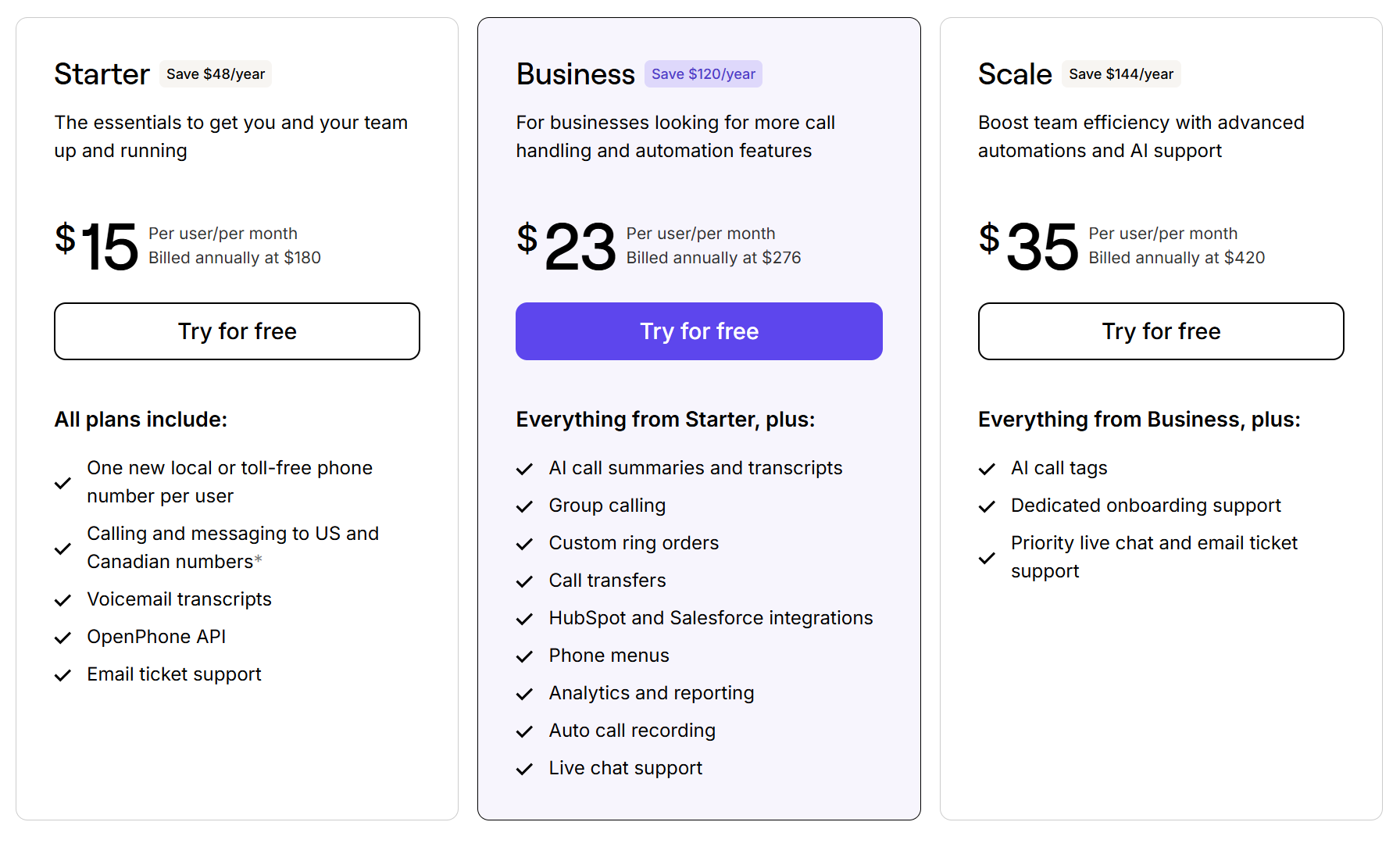
Quo’s pricing makes it easy to access new phone features as your business grows.
Here’s what you can expect with each of our three plans:
- Starter: $15 per user per month for one local or toll-free number per user, manual call recording, auto-replies, and more
- Business: $23 per user per month to access HubSpot’s CRM integration, call transfers, advanced IVR, and more
- Scale: $35 per user per month for AI call tags, priority chat and email support, and dedicated onboarding support

How to get a virtual number with Quo: The best Zoom Phone alternative
enPhone, you’ll be happy to know the process is quick and easy:
- Sign up for a Quo account.
- Fill out our two-minute port request form.
- Wait for us to get back in touch.
We’ll have your number ported to the Quo app in one or two weeks.
2. RingCentral: Best for desk phone rentals

Pros
- Desk phone support
- Visual voicemail
Cons
- Base plan includes only 25 texts per user per month
- Limited toll-free minutes on every plan
- Vanity phone numbers require a set-up fee
Launched in 1999, RingCentral is a cloud-based phone system that supports text, voice, and video. The platform lets you purchase or rent desk phones that come pre-configured for your RingCentral account. You’ll be able to choose from different models like Avaya and Cisco.
- Visual voicemail
- Team messaging (limited storage)
- File sharing (limited storage)
- Unlimited calls in the US and Canada (limited toll-free minutes)
- Local phone numbers
Unfortunately, RingCentral’s base plan only lets you send 25 texts per user per month. Even if you upgrade to the highest-tier plan, you’ll still only get 200 texts per user per month.
Want to buy a vanity phone number for your business? You can expect to pay a $30 one-time fee. Many of its other add-ons come with a hefty cost. For example, its video conferencing add-on, RingCentral Rooms, costs $39 per month.
If you want unlimited storage for your call recordings, you’ll have to upgrade to the most expensive plan. It will cost you $35 per user per month.
While RingCentral has downsides, it might still be the right Zoom Phone alternative for your business. It’s a good fit if you want your team to make and receive calls, send texts, and join video meetings without having to switch apps.
Key features of RingCentral
- Breakout rooms
- HD video
- Team messaging and file sharing
- Advanced call monitoring (requires upgrade)
- Auto attendant
RingCentral pricing

RingCentral offers three pricing plans, each with its own set of features. Here’s what you can expect to pay:
- Core: $20 per user per month for unlimited calls in the US and Canada, visual voicemail, and 25 texts per user per month
- Advanced: $25 per user per month for advanced call monitoring, hot desking, and 100 texts per user per month
- Ultra: $35 per user per month for customizable analytics and reporting, device analytics and alerts, and 200 texts per user per month
3. Dialpad: Best Zoom Phone alternative for contact centers

Pros
- AI call and voicemail transcriptions
- Unlimited video meetings on the base plan
Cons
- Slack and Zapier integrations require an upgrade
- Clunky and outdated UI
- International SMS messages require an upgrade
Dialpad is a unified communications platform that was built for contact centers. For example, it provides sales training tools like its AI Coaching Hub. It lets you rank conversations from low to high quality and allows you to set up customizable leaderboards.
The platform offers three solutions: Dialpad Connect, Dialpad Support, and Dialpad Sell. Dialpad Connect is its phone system, and the base plan includes:
- AI call and voicemail transcriptions
- Unlimited video meetings (max 150 participants)
- Google Workspace integration
Dialpad’s calling and texting features are significantly weaker than its competitors. For example, you can’t purchase multiple numbers for your account unless you upgrade to the second tier. Plus, you’re only able to send SMS (not MMS) messages internationally — and again, only if you upgrade.
Want to integrate Dialpad with Slack or Zapier? You’ll need to upgrade to its Pro plan, which costs $25 per user per month. On top of that, its UI is known to be clunky and outdated, which can slow reps down.
Ultimately, Dialpad will be the best Zoom Phone alternative if you need basic calling features that let you monitor reps to provide coaching opportunities.
Key features of Dialpad
- File sharing
- Team sharing
- Hold queues (requires upgrade)
- Call forwarding to other devices
- Three-way calling
Dialpad pricing

Dialpad offers three pricing plans to pick from:
- Standard: $15 per user per month for SMS, MMS, and team messaging, Google Workspace integration, and real-time analytics and reporting
- Pro: $25 per user per month with a 3-user minimum for multiple phone numbers on the same account, Microsoft Teams integration, open APIs, and webhooks
- Enterprise: Custom quote with a 100-user minimum for 100% uptime, priority support, and unlimited ring groups
4. Google Voice: Best Zoom Phone alternative for Google Workspace users

Pros
- Call forwarding
- Mobile apps
Cons
- No auto-replies
- No toll-free numbers
- No integrations outside of Google Workspace
Google Voice is a VoIP provider available for personal and business use. Although the personal plan is free to use, it’s not made for businesses. You can only have one phone number, and business features like phone menus aren’t available. You can access these features on its paid plan — Google Voice for business. Voice plans start at $10 per user per month. You’ll also need a subscription to Google Workspace (starting at $7 per user per month).
The basic Google Voice plan includes:
- Voicemail transcriptions
- Call forwarding
- A web browser and a mobile app
Keep in mind that Google Voice doesn’t offer integrations outside of Google Workspace. This can be helpful if you use Google Calendar and Gmail, but it’s limiting if you use a CRM like HubSpot. Plus, Google Voice may not always work — customers frequently cite issues with poor call quality and slow customer support.
Want to use toll-free phone numbers so your customers can call your business for free? You can’t with Google Voice, as it doesn’t support toll-free numbers. Google Voice also doesn’t support auto-replies, so your customers may have to wait to hear back from you.
Google Voice has its obvious limitations. But if Google apps are already part of your workflow and are the only tools you wish to integrate, it could be an OK Zoom Phone alternative.
Key features of Google Voice
- Ring groups (requires upgrade)
- Auto-attendant (requires upgrade)
- SIP link (requires upgrade)
- Unlimited text messaging in the US
- Desk phone support (requires upgrade)
Google Voice pricing

You have three options with Google Voice’s pricing plans:
- Starter: $10 per user per month with a 10-user limit for unlimited calls in the US and Canada, business SMS, and voicemail transcriptions
- Standard: $20 per user per month for unlimited users, ring groups, and on-demand call recordings
- Premier: $30 per user per month for automatic call recording, international user support, and advanced analytics
*Remember to factor in an additional $7 per user per month for Google Workspace.
Find out more about how Google Voice and Zoom Phone compare in our Zoom Phone vs Google Voice guide.
5. Ooma Office: Best Zoom Phone alternative for teams that need overhead paging

Pros
- Supports overhead paging
- Base plan provides over 100 features
Cons
- Base plan doesn’t support text messages
- Salesforce integration requires an upgrade
- Call recording requires an upgrade
Ooma is another legacy virtual phone platform that serves residential and commercial customers. The platform offers overhead paging support and virtual receptionists, which is handy if your business uses them.
Need to make unlimited calls to numbers in the US, Canada, Mexico, and Puerto Rico? Then Ooma Office is a strong Zoom Phone alternative — as those countries are included in its base plan.
While Ooma’s base plan has over 100 standard features, you can’t access call recordings or make calls from the desktop app without upgrading. Business texting is also locked behind the Pro plan. Even if you do upgrade, you can only send 250 texts per month. Plus, you won’t be able to access CRM integrations, like Salesforce, unless you pay for the most expensive tier.
Key features of Ooma Office
- Scheduled messages (requires upgrade)
- Messaging templates (requires upgrade)
- Team chat (requires upgrade)
- Call transfer
- Virtual fax
Ooma Office pricing

Ooma has three pricing options to choose from:
- Essentials: $19.95 per user per month for unlimited calling in the US, Canada, Mexico, and Puerto Rico, desktop app without calling, and extension dialing
- Pro: $24.95 per user per month for video conferencing with up to 25 participants, desktop app with calling, and business texting with 250 text messages
- Pro Plus: $29.95 per user per month for call queuing, hot desking, and integrations with CRMs
6. CloudTalk: Best for global calling

Pros
- SMS support on the base plan
- International numbers in over 160 countries
Cons
- Unlimited call recording storage requires an upgrade
- API access requires an upgrade
- MMS messages require an upgrade
CloudTalk provides cloud-based call center software that helps growing brands reach global customers. You can use phone numbers from more than 160 countries right from your desktop or mobile device. CloudTalk’s first tier, the Lite plan that costs $19 per user per month, includes features like:
- Unlimited inbound and intracompany calls (toll-free excluded)
- Call recording
- Business SMS
Like Ooma, many of CloudTalk’s best features are locked behind higher tiers. You can’t access helpdesk integrations, call tagging, or API access unless you’re willing to pay for the second tier. And that’ll cost you $29 per user per month.
Key features of CloudTalk
- Ring groups
- Business SMS
- Call recording
- Phone menu (requires upgrade)
- Call tagging (requires upgrade)
CloudTalk pricing

Once your 14-day trial expires, you can select from one of four CloudTalk pricing plans:
- Lite: $19 per user per month for click-to-call, call recording, and international number access
- Essential: $29 per user per month for access to 24/7 live agent support, phone menus, and call tagging
- Expert: $49 per user per month for Salesforce integrations, callback, and single sign-on
- Custom: Custom price for a custom plan with custom reporting and custom onboarding
7. GoTo Connect: Best Zoom Phone alternative with a conference bridge

Pros
- Free calls to 50+ countries
- SMS and MMS on the base plan
Cons
- Shared inbox requires an upgrade
- Limited toll-free minutes
- Limited SMS
GoTo Connect, offers a voice, video, and chat platform as an option for businesses that want to make free calls to over 50 countries. However, it comes with a few caveats. For one, texting is only available to customers in the US and Canada. And if you use a toll-free number, you’ll only get 1,000 free minutes shared across your account on any plan.
Their base plan includes:
- Ring groups
- Smart call routing
- Call recording
While the feature set is more robust than the average platform, GoTo Connect still falls short on collaboration. For example, shared inboxes and CRM integrations such as Zendesk are only available if you upgrade.
Key features of GoTo Connect
- AI call transcripts and summaries (requires upgrade)
- Emoji and audio reactions
- Breakout rooms
- Automated SMS messages
- Auto attendant
GoTo Connect pricing

GoTo Connect’s pricing isn’t listed publicly, but here are the features you can expect to get on each plan:
- Phone system: Free calls to 50 countries, unlimited auto attendants, dial plans, call routing, and queues
- Connect CX: Shared inbox, enhanced reporting and analytics, and a Zendesk integration
- Contact Center: AI chat analysis, supervisor analytics, and real-time and historical reports
8. Aircall: Best for seamless integrations

Pros
- International call packages are available
- 100+ integrations on the base plan
Cons
- Expensive add-ons
- User minimums across plans
- Mandatory call tagging requires an upgrade
Aircall was designed to support call centers and customer service teams with virtual phone solutions. Their biggest claim to fame is unlimited international calls, although this is only available with a Custom plan. The basic plan will give you:
- Call recording
- Business SMS and MMS (MMS is only available for US, Canadian, and Australian numbers)
- 100+ integrations and API access
- IVR
Aircall is one of the few Zoom Phone alternatives that offers shared inboxes and internal call commenting. However, this comes at a high price. Aircall’s cheapest plan starts at $30 per user per month and requires a minimum of three users per plan. That means the least you can pay for an Aircall plan is $90 per month.
Key features of Aircall
- Call coaching (requires upgrade)
- Call whispering (requires upgrade)
- Analytics data
- Business hours
- Call queuing
Aircall pricing

Aircall offers three plans, two of which have public prices:
- Essentials: $30 per user per month with a three-user minimum for unlimited calls within the US and Canada, SMS and MMS texts, and unlimited simultaneous outbound calls
- Professional: $50 per user per month with a three-user minimum for the Salesforce integration, advanced analytics, and live call monitoring
- Custom: Custom price with a 25-user minimum for unlimited global calls, custom onboarding, and API developer support
9. JustCall: Best for international numbers

Pros
- Local phone numbers are available in more than 70 countries
- 100+ CRM and data integrations
Cons
- Limited SMS segments
- Pricing plans have a user minimum
- One-time fee to port numbers into JustCall
JustCall is designed for customer service teams with a global customer base. The platform lets you buy phone numbers in more than 70 countries. You can also access business features on its base plan, like call recording, basic analytics, and the Slack integration.
However, JustCall comes with drawbacks. Be prepared to pay a one-time fee of $10 to port in your number. JustCall also caps texting segments on every plan except the highest tier. For example, the Team plan only offers 500 segments per user per month, which will run out quickly. After that, you’ll be charged $0.01 per-message.
Unlike Zoom Phone, JustCall offers a power dialer feature that lets outbound sales reps automatically dial phone numbers. This means not wasting time manually entering digits. And if efficiency matters, this might be the Zoom Phone alternative you’ve been searching for.
Key features of JustCall
- Live call monitoring (requires upgrade)
- Queue callback (requires upgrade)
- Intelligent call routing (requires upgrade)
- SIP desk phone
- Caller ID
JustCall pricing

JustCall has four pricing plan options:
- Team: $29 per user per month with a two-user minimum for unlimited calls to the US and Canada, local numbers in 70+ countries, basic analytics, and the Slack integration
- Pro: $49 per user per month with a two-user minimum for power dialer, bulk SMS campaigns, and queue callback
- Pro Plus: $89 per user per month with a two-user minimum for coaching comments, AI call scorings, and sentiment analysis
- Business: Custom price for unlimited calling and SMS, enterprise-grade SLA, and single sign-on (SSO)
10. Nextiva: Best for teams that use Microsoft products

Pros
- Team messaging
- 24/7 support on the base plan
Cons
- Customer-to-team SMS messaging requires an upgrade
- Toll-free number and minutes require an upgrade
- Microsoft Teams integration requires an upgrade
Nextiva is a legacy platform established in 2006 that supports omnichannel sales and customer service teams. It lets you route all your messaging apps like Facebook and Instagram into one inbox, so no inquiries slip through the cracks. The platform also offers team messaging on its mobile and desktop apps, making it easy for your team members to keep in touch if they’re on the go.
The biggest downside of Nextiva is it doesn’t provide toll-free numbers or minutes on the base plan. This means you need to pay $25 per user per month for the Engage plan if you want your customers to call you for free.
Plus, if you want to use its Microsoft Teams integration, you need to upgrade to the Engage plan as well.
Overall, Nextiva may be a Zoom Phone alternative if you’re looking for an omnichannel customer service solution
Key features of Nextiva
- Unified digital user Inbox
- Team chat
- Unlimited audio conferencing
- Microsoft Teams integration (requires upgrade)
- Google Contacts integration
Nextiva pricing

Nextiva’s pricing offers three different plans:
- Core: $15 per user per month for inbound and outbound voice calls, business SMS, and video meetings
- Engage: $25 per user per month for customer-to-team SMS messaging, toll-free number and minutes, and the MS Teams integration
- Power Suite: $50 per user per month for advanced priority and skills-based routing, supervisor dashboard, and a unified team interface
11. Talkdesk: Best for large-scale operations

Pros
- API access is available on the base plan
- Mobile app is available on the base plan
Cons
- Expensive for small businesses
- Screen recording requires an upgrade
- Complicated pricing
Talkdesk is a global cloud contact center leader that lets you connect with customers via voice, SMS, email, and social channels.
It provides AI-powered add-ons that help large-scale business operations handle a large volume of calls. For example, its Talkdesk Autopilot add-on provides AI virtual assistants that can have conversations with your customers in over 59 languages. Unfortunately, Talkdesk doesn’t publicly list the cost of some of its add-ons, so you’ll need to contact the platform for a quote.
Talkdesk is expensive for most small business owners. For example, its base plan costs $85 per user per month, and its highest-tier plan costs $165 per user per month. This is significantly more than most VoIP providers, including Zoom Phone.
Key features of Talkdesk
- Customer surveys
- Screen recording (requires upgrade)
- Automated appointment reminders (requires upgrade)
- IVR
- API access
Talkdesk pricing

Talkdesk has three pricing plans:
- CX Cloud Digital Essentials: $85 per user per month for routing flows, API access, and a mobile app
- CX Cloud Voice Essentials: $105 per user per month for 70 integrations and access to its Workspace Designer that lets you build custom interfaces for every role in your contact center
- CX Cloud Elite: $165 per user per month for custom reporting and automated SMS notifications like order confirmation texts
12. Microsoft Teams: Best for internal communication

Pros
- Online meetings (calling and video) are available on the base plan
- Team meeting recordings with transcripts
Cons
- Custom business email requires an upgrade
- Breakout rooms require an upgrade
- File storage is limited to 10GB per user on the base plan
Microsoft Teams is a collaboration platform that enables teams to work together in real time using voice, video, and more.
The platform lets you merge and transfer calls to other reps, making it easier to route clients to the correct department or person. Want to send SMS texts to external contacts? You can with Microsoft Teams, though you’ll need to pay for its Teams Phone add-on and a calling plan. This will cost you at least $13 per user per month. The platform also supports desk phones, which is convenient if your business still uses them.
Keep in mind that if you want a custom business email address, you’ll need to upgrade to the Microsoft 365 Business Basic plan.
If your team needs a stronger internal communication system, Microsoft Teams might be your Zoom Phone alternative. You can call, chat, and meet without switching apps, so it’s easier to keep projects moving and avoid missed communication.
Key features of Microsoft Teams
- Webinars with attendee registration and reporting (requires upgrade)
- Online meetings with calling and video
- Live captions in meetings
- Noise suppression in calls
- Over 250 integrated business apps for Teams
Microsoft Teams pricing

Microsoft Teams offers three different plans:
- Microsoft Teams Essentials: $4 per user per month for chat, call, and video conferencing, 10 GB of cloud storage per user, and real-time collaboration with file sharing
- Microsoft 365 Business Basic: $6 per user per month for user management for up to 300 employees, spam and malware filtering, and one TB of cloud storage per user
- Microsoft 365 Business Standard: $12.50 per user per month for desktop, web, and mobile versions of Word and video editing and design tools with Microsoft Clipchamp
Why businesses move on to Zoom Phone alternatives

Zoom is a business communication tool primarily focused on video conferencing. The platform comes with an add-on phone service called Zoom Phone. It lets you call or text customers around the globe from a US, Canadian, or international phone number.
Zoom Phone may seem like a convenient VoIP solution if you already use their video conferencing tools. However, when you look at the features included, you’ll quickly see why it might not be the right fit for your small business.
Texting limitations
Do you have international customers and want to send them MMS messages? You can’t do that with Zoom Phone. The platform also doesn’t let you send video files, which limits the type of support you can offer customers. Plus, you can only schedule texts if you pay for the Zoom Phone Power Pack, which will cost you an extra $25 per user per month.
Confusing setup and limited support
The most common complaint customers have about Zoom Phone is its hard-to-navigate interface. It may be difficult to check or update your settings and customize the UI to your liking.
Just check out these recent reviews:
“The back end user experence could be improved and be more usuer friendly and innovative.” – G2
“The setup process was confusing, call routing and other functions [are] very unclear and hard to set up, customer service [is] completely non-existent.” – Capterra
Difficult to work as a team
Zoom Phone doesn’t let you send or receive texts from a shared phone number, which means you can’t collaborate with teammates to solve customer queries over text.
What’s more, Zoom Phone only lets up to 10 team members share a phone number on a single plan. And they can only handle up to four phone calls at a time. If you have a growing customer base, you may need to seek an alternative that gives you more flexibility over call handling.
Zoom Phone pricing

Adding a phone plan to your Zoom subscription could save some time and effort, but it might not save you money. There are five Zoom Phone price plans to choose from. Let’s take a look at the first three:
- US & Canada Metered: $10 per user per month for metered domestic US and Canadian calling, metered international calling, and SMS and MMS
- US & Canada Regional Unlimited: $15 per user per month for unlimited domestic US and Canadian calling and an optional add-on for unlimited calling to international countries
- Global Select: $20 per user per month for unlimited domestic calling in 40+ countries and territories and a direct dial number (DID) for each license
Its next two plans bundle its Zoom Phone US and Canada Unlimited plan with Zoom Workplace:

- Pro Plus: $18.33 per user per month for Zoom Phone US and Canada Unlimited (BYOC, 3rd Party PBX, and VDI excluded) and Zoom Workplace Pro (includes unlimited meetings and AI Companion)
- Business Plus: $22.49 per user per month for Zoom Phone US and Canada Unlimited, Zoom Workplace Business, and visitor management
There are also a few add-ons to consider:
- Additional phone numbers: $5 per number per month for toll-free, local, or international premium numbers
- International calling: $10 per month, and can only be purchased with an unlimited calling plan to make unlimited international calls to more than 15 countries and regions
- Hardware as a Service: Starts at $3.99 per month per device for rental terms of 12-26 months
- Zoom Phone Power Pack: $25 per month per license for enhanced call queue analytics and historical insights for call center teams
The bottom line for Zoom Phone
Zoom Phone’s collaboration limitations and lack of support are deal-breakers for most businesses. Plus, the high cost of bundling with your existing Zoom plan could use up your business budget.
If you’re in the market for a cloud-based phone service that lets you communicate with customers and team members more effectively, check out Zoom Phone alternatives.
Quo: The best Zoom Phone alternative

Zoom Phone is an add-on VoIP service that lacks the advanced features businesses need to maintain their growth. There are lots of alternatives on the market, but it’s clear that Quo rises above them all.
Quo is a business phone system focused on collaboration first. You can give your team more context to work together and follow up with customers using shared numbers. Plus, we never expect you to pay extra to unlock the option to make international calls or texts.
And unlike Zoom Phone, you can take Quo for a spin by signing up for a seven-day free trial.