Maybe 3CX felt like the right fit at first — flexible setup, free plan, lots of control. But over time, things can get frustrating. The interface feels dated. Basic features like voicemail transcriptions or call flows require upgrades. And unless you’re a technical expert, managing SIP trunks and licenses can quickly become a full-time job.
If you’re running into these issues, this guide walks you through the nine best 3CX alternatives to consider in 2025.
Let’s dive in.
How the 9 top 3CX alternatives compare side by side
Here are the fast facts on all nine 3CX alternatives:
| Provider | Starting price | Unlimited calling to US & Canada | SMS, MMS to US & Canada | Shared phone numbers | Additional phone numbers |
|---|---|---|---|---|---|
| 3CX | $0 per user per month | Depends on SIP trunk | Depends on SIP trunk | ✓ | x |
| OpenPhone | $15 per user per month | ✓ | ✓ | ✓ | $5 per number per month |
| RingCentral | $20 per user per month | Limited toll-free minutes | 25 messages per user per month | Calls only | $4.99 per number per month |
| Vonage | $13.99 per number per month for up to four users | ✔️ | Local US and Canadian numbers only | Requires upgrade | Cost varies |
| Zoom Phone | $10 per user per month | Requires upgrade | ✓ | Calls only | $5 per number per month |
| Nextiva | $15 per user per month | ✓ | 100 SMS per user per month | Shared call appearance only | Undisclosed fee |
| GoTo Connect | Contact for a quote | ✓ | For US and Canadian customers only | Shared inbox only | Varies by country |
| 8×8 | Contact for a quote | ✔️ | ✔️ | ✔️ | Contact for a quote |
| Dialpad | $15 per user per month | ✓ | For US and Canadian customers only | ✓ | Requires upgrade |
| Yeastar | Contact for a quote | X | ✓ | ✔️ | X |
Now that you’re familiar with each alternative, here’s a deep dive into everything you should know — starting with the #1 business phone solution on G2.
1. Quo (formerly OpenPhone): The best 3CX alternative for growing teams

Pros
- Unlimited SMS and MMS to the US and Canada
- AI-powered features like call summaries, transcripts, call tags, and an AI voice agent are available
- Local, toll-free, and vanity numbers are available
- International calls and texts at affordable rates
- Shared phone numbers
- Integrations with 7,000+ third-party apps, including HubSpot and Salesforce
Cons
- No verification through two-factor authentication*
*Nearly all virtual phone numbers share this problem. Companies like Facebook, Uber, and Google rarely let you authenticate accounts through a virtual phone number.
Quo is a virtual phone system built for small and growing businesses. You can get a local US, Canadian, or toll-free number from almost anywhere in the world. Then, you can make or take phone calls from anywhere with a WiFi connection.
Quo offers far more flexibility for your team than 3CX. You’re never required to purchase new equipment (like SIP trunks) to install on your own. Instead, your team can call and text from the devices they already own, including computers, laptops, and smartphones.
Quo also makes it easier to share responsibility for incoming calls. With 3CX, a team of 10 can only be on up to four calls simultaneously. Using Quo’s shared numbers, an unlimited number of users can call and text from a single phone number with our Business plan.
Plus, Quo makes it easy for reps to work together to solve customer issues. You can tag teammates inside contact threads to assign tasks or ask colleagues questions.
Looking to manage your team more effectively? With Quo (formerly OpenPhone), you can see who on your team has been in touch with specific customers. Plus, you can listen to call recordings to identify opportunities where you can provide coaching to reps.
You can also take advantage of Quo’s latest AI tools to save time and stay organized. Every call is automatically transcribed, so you can quickly review what was said without listening to full recordings. AI-generated call tags label conversations by topic, making it easier to organize past conversations. And if you never want to miss a call, you can add Sona — our AI voice agent. It automatically picks up the phone, answers FAQs, and takes messages that you can review when you’ve time.
Quo’s SOC 2-compliant platform helps you build better relationships with your customers in multiple ways. For example:
- Your team can save time texting with scheduled messages, auto-replies, and snippets.
- You can connect your tech stack with your business phone number to automate routine tasks. We integrate with CRMs like Salesforce and HubSpot and can help everyone on your team stay in the loop through Slack.
- Want to automate even more daily tasks? With Zapier and Make, you can connect Quo to 7,000+ other platforms and create workflows that run while you sleep. For example, you can send automated appointment reminders when customers fill out a form on your website. You can also push data to your HubSpot CRM when you add a new contact on Quo.
But the biggest benefit in the Quo (formerly OpenPhone) vs 3CX debate isn’t a feature at all — it’s clear pricing upfront. You can see what you’ll pay on our pricing page and can calculate monthly costs in minutes. Plus, you can set up OpenPhone in 20 minutes without getting bogged down by technical documentation or needing IT support.
Quo is the easiest way to communicate with customers as you grow. But you don’t have to take our word for it — just check out our user reviews:
“The alternative of a phone within a phone, that is able to accurately record and summarize a phone conversation with the assistance of AI technology is quite the game-changer. The numbers which were chosen were implemented the same day, as well as a standard written voicemail, which was then recorded as a standard in, or out-of-office greeting. The availability of customer support thru 24/7 chat, allows for a very easy and supportive experience.” — G2
Quo has been a game-changer for managing my business communications. It provides a simple, intuitive platform that makes it easy to separate personal and professional calls — all from one device.” — G2
You can try all of Quo’s features with our seven-day free trial. Just pick a new number (or use it temporarily while you move your existing one over to Quo) to get started.
Quo key features
- Unlimited calls in the US and Canada
- Free SMS and MMS to US or Canadian numbers
- Phone menu and interactive voice response (IVR) options
- One new phone number per user on your account
- Shared phone numbers
- Texting automations (snippets, scheduled messages, and auto-replies)
- Call recording
- 7,000+ integrations
Quo pricing
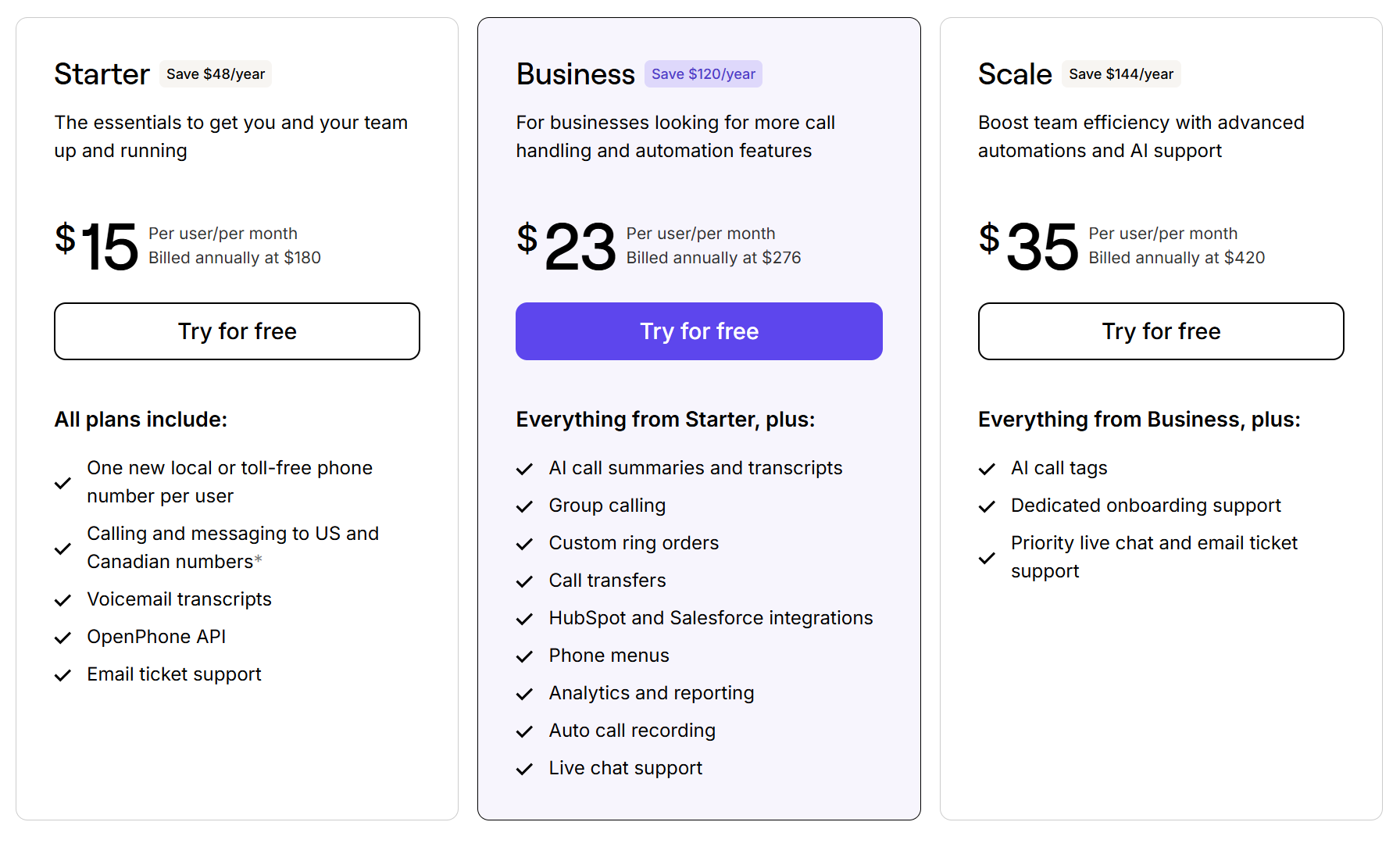
Quo’s pricing provides three different plans:
- Starter: $15 per user per month for unlimited calls in the US and Canada, SMS and MMS, automatic and on-demand call recording, and more
- Business: $23 per user per month for analytics and reporting, call transfers, custom ring orders, and more
- Scale: $35 per user per month for AI call tags, dedicated onboarding, and priority chat and email support

How to get a virtual number with OpenPhone
Getting a new phone number from almost anywhere in the world is a simple process when you choose Quo as your virtual phone number provider.
Follow these three steps:
- Create an account with OpenPhone (when you sign up, you get a free, seven-day trial).
- During signup, choose your city or area code in the US to select your preferred phone number.
- Once the signup process is complete, you’re all set to use your new virtual phone number!
2. RingCentral: Best for reducing background noise

Pros
- Unlimited calling to the US and Canada
- On-demand call recording
Cons
- Limited SMS on every plan
- Call recordings are deleted after 90 days
- Limited toll-free minutes
RingCentral is a unified communications platform that provides calls, texts, and video tools on the same plan. With RingCentral, you can use AI tools to automatically transcribe video meetings or reduce background noise that may affect call quality.
But the actual features you get on RingCentral’s base plan are limited. It only includes up to 25 SMS messages per user per month. For any text messages beyond that, you’ll pay $0.013 per message.
You also can’t access hot desking or automatic call recording unless you move to the middle tier, which costs $25 per user per month. Plus, upgrading may not be enough to support your team as it grows. For example, you’ll be limited to 10,000 toll-free minutes and 200 SMS messages per user on the most expensive plan, which costs $35 per user per month.
Perhaps the most frustrating limitation of RingCentral’s platform is its storage:
- You can’t keep more than 5,000 SMS messages per user.
- Recorded calls are only kept in call logs for up to 90 days.
- You can’t have more than 100,000 call recordings per account. Older records get erased when you record new material.
- Even if you upgrade to Ultra for ‘unlimited’ storage ($35 per user per month), you’re still subject to time-based deletion schedules.
Want a business phone solution that doesn’t force you to upgrade for storage? You should look into other 3CX alternatives instead.
RingCentral pricing

RingCentral’s pricing lets you choose from three different plans:
- Core: $20 per user per month for 25 SMS messages per user, on-demand call recording, and IVR
- Advanced: $25 per user per month for 100 SMS messages per user, automatic call recording, and unlimited internet fax
- Ultra: $35 per user per month for 200 SMS messages per user, up to 200 video participants, and device analytics and alerts
3. Vonage: Best alternative with APIs

Pros
- Communication APIs
- Automatic call recording (requires paid add-on)
Cons
- On-demand call recording requires a paid add-on
- AI call transcriptions require a paid add-on
Vonage is a VoIP provider that offers pre-built plans with access to over 50 basic business phone features.
Rather code your own calling solution? The platform also provides communication APIs that let you build custom workflows. For example, you can use its Verify API to add two-factor authentication (2FA) for secure logins. It asks them to verify their identity with an additional step — like a code sent to their phone. This helps prevent unauthorized access..
Keep in mind that Vonage’s APIs aren’t open source, so you’ll need to pay to use them. Pricing varies depending on the service.
Vonage’s pre-built plans come with their own limitations. For example, more than 18 of their features require paid add-ons, including:
- Automatic call recording: $49.99 per month for 500 hours of recording time
- Conference bridges that let you support up to 30 people on one call: $14.99 per month and a $0.03 per-minute usage fee for every person outside your company who joins
- On-demand call recording: $4.99 per month for 15 hours of call recordings
- AI transcription for on-demand call recordings: $2.99 per extension, and you must purchase the on-demand call recording add-on
Not all of Vonage’s features are available in all countries. If you’re based in the Asia-Pacific (APAC) or Europe, Middle East, and Africa (EMEA) regions, you can’t access paperless fax or toll-free numbers.
Vonage gives you plenty of options to customize your communication tools — but only if you have the time and technical support. When you add up the costs of hiring a developer or handling code yourself, this 3CX alternative may require more work than your team can manage.
Vonage pricing

Vonage’s prices depend on your team’s size. This means SMBs with fewer users have to pay more per user for the same service.
Here’s what Vonage costs for teams of one to four users:
- Mobile: $13.99 per user per month for unlimited calls and texts in the US and Canada, SMS and MMS, and desktop and mobile apps
- Premium: $20.99 per user per month for unlimited video meetings, team messaging, and the ability to connect with IP desk phones
- Advanced: $27.99 per user per month for visual voicemail, call groups, and on-demand call recording with 15 hours max
4. Zoom Phone: Best for existing Zoom users

Pros
- Supports legacy PBX systems
- Unlimited international calling (requires upgrade)
Cons
- Users cite privacy concerns
- Metered calling on the base plan
- Can’t send video files to customers
Zoom is a video communications tool with a separate platform specifically for VoIP. There are two distinct plans where you can get calling features: Zoom Phone and Zoom Workplace + Phone bundles.
Zoom Phone includes calling features only and doesn’t come with Zoom’s premium video conferencing tools. Although internal calls are always unlimited, outbound calls are metered unless you upgrade.
With the Zoom Phone + Workplace bundles, you get access to business calling features with video conferencing. But unlike Zoom Phone, not every bundle supports legacy PBX systems. Only the Business Plus bundle — $22.49 per user per month — keeps that compatibility. That means if your team still uses an office phone system but wants to make and receive calls over the internet, you have to pay for the most expensive bundle.
If you’re migrating away from 3CX due to security concerns, Zoom Phone may not provide you with much peace of mind. Several users have cited concerns about the issue:
“I have begun to get random emojis popping up during confidential Zoom meetings. These pop-ups are not generated by me nor my clients. I now have significant privacy concerns.”
Zoom Phone pricing

To get Zoom Phone, you can choose from five different plans. The first three only provide access to Zoom Phone:
- US & Canada Metered: $10 per user per month for metered domestic US and Canadian calling, metered international calling, and SMS and MMS support
- US & Canada Regional Unlimited: $15 per user per month for unlimited domestic US and Canadian calling and an optional add-on to make international calls to 15 countries
- Global Select: $20 per user per month for unlimited domestic calling in 40+ countries and territories and a direct dial number (DID) for each license

Zoom Phone’s pricing also offers two bundled plans that include Zoom Phone and Zoom Workplace.
- Pro Plus: $18.33 per user per month for Zoom Phone US & Canada Unlimited (BYOC, 3rd Party PBX, and VDI excluded) and Zoom Workplace Pro
- Business Plus: $22.49 per user per month for Zoom Phone US & Canada Unlimited, Zoom Workplace Business, 15GB of cloud storage, and unlimited US & CA fax
5. Nextiva: Best for omnichannel communication

Pros
- Unlimited calling within the US and Canada
- MS Teams integration (requires upgrade)
Cons
- Toll-free numbers and minutes require an upgrade
- Only 100 SMS messages per user per month on the base plan
- Salesforce and HubSpot integrations require paid add-ons
Nextiva is a VoIP service provider that bundles calling, texting, and video calling. It also lets you bring messages from social media apps like WhatsApp and Instagram into one inbox, so your team can manage everything in one place.
Many of Nextiva’s previous customers say they outgrew the base plan within a matter of months. It’s not hard to see why: there’s no way to access toll-free numbers or minutes unless you upgrade to the Engage plan. Plus, the base plan limits your team to just 100 SMS texts per user per month.
Unlimited SMS is locked behind the most expensive plan. And no matter how much you upgrade, integrations with CRMs like Salesforce and HubSpot require a paid add-on. If you want to find out how much this costs, you’ll need to reach out to Nextiva’s sales team.
Nextiva pricing

Nextiva’s pricing provides three different plans that you can pick from:
- Core: $15 per user per month for unlimited calling within the US and Canada, video meetings, and call routing
- Engage: $25 per user per month for customer-to-team SMS messaging, toll-free number and minutes, and advanced reporting
- Power Suite: $50 per user per month for priority and skills-based routing, unified team interfaces, and supervisor dashboard
6. GoTo Connect: Best for sales and customer support teams

Pros
- Shared inboxes (requires upgrade)
- Free calls to 50 countries
Cons
- Limited SMS and MMS
- Limited toll-free minutes across all plans
- No public pricing
GoTo Connect offers call management software that lets your business make and receive calls over the internet. Its base plan lets you make free calls to 50 countries, which is handy if you have a global customer base.
However, you should know that you’ll only get access to shared inboxes if you upgrade to the Connect CX plan. With GoTo Connect, your team will never have unlimited text messaging. Plus, the number of SMS and MMS credits you’ll receive varies by region.
You’ll also be capped at 1,000 pooled minutes for toll-free numbers, which is just 16.5 hours of call time per month for everyone on your plan. Every additional minute costs $0.019 — which can add up fast if you’re only using a toll-free number.
GoTo Connect offers decent features. But with its lack of public pricing and limited SMS and toll-free minutes, you may need to find another 3CX alternative.
GoTo Connect pricing

Like so many 3CX alternatives on this list, GoTo Connect’s pricing isn’t listed publicly. Here’s what you can expect to get on each plan:
- Phone System: Free calls to 50 countries, unlimited auto attendants, team chats, SMS, and MMS
- Connect CX: Shared inbox, real-time analytics, AI call summaries, and Zendesk integration
- Contact Center: Intelligent call routing, auto queue callback, and auto dialer
7. 8×8: Best for online payments

Pros
- Secure payment processing
- Video meetings
Cons
- No public pricing
- Call recording storage is limited to 30 days
- Toll-free numbers don’t support texting
8×8 is a cloud phone system that offers voice, video, and chat tools. Businesses of all sizes are eligible to use the platform, although you won’t know if it’s in your budget since its pricing isn’t publicly available.
With 8×8, you can combine your existing office phone system with contact center tools to make phone calls over the internet. You’ll also get access to secure payment processing so your customers can pay their invoices online.
Compared to other 3CX alternatives, you should know 8×8 significantly limits the amount of storage you’ll get. For example, if you want more than 30 days of call recording storage, you must pay for an add-on. Again, the pricing isn’t listed publicly, so you’ll have to contact its sales team to find out how much it’ll cost.
8×8 pricing

8×8’s pricing isn’t publicly available. Here’s what you can expect to get on each plan:
- Contact Center: Omnichannel routing, supervisor workspace, high-volume messaging, and secure payment processing
- CX Beyond the Contact Center: Advanced queue management, team lead analytics, global coverage, and analytics
- Communication APIs: High-volume SMS, voice, video, authentication, and fraud prevention
- Unified Communications: Receptionist console, system analytics, global coverage, and integrations
8. Dialpad: Best for contact centers

Pros
- Unlimited calling in the US and Canada
- Internet fax (requires paid add-on)
Cons
- Additional phone numbers require an upgrade
- Extensions are only available on the most expensive plan
- Slack and Zapier integrations require an upgrade
Dialpad launched in 2011 as a cloud-based business communications platform. It’s built to help teams handle calls, texts, and meetings in one place.
All plans come with unlimited calling in the US, Canada, and your home country. That way, your contact center can connect with customers without worrying about per-minute charges.
You can also send internet faxes through Dialpad, but only if you pay for an add-on. And if your team needs a way to communicate internally, Dialpad includes built-in team messaging to help you stay on the same page.
That said, there are a few limitations to be aware of. You can only purchase extra phone numbers if you upgrade to the Pro plan, which costs $25 per user per month. The same goes for integrations with tools like Slack and Zapier — those are only available on higher tiers.
And while email and chat support are included, phone support is only offered if you upgrade.
Dialpad pricing

Dialpad’s pricing gives you three different plans to choose from:
- Standard: $15 per user per month for unlimited calling in the US and Canada, multi-level auto-attendant, visual voicemail, and custom call routing
- Pro: $25 per user per month for additional phone numbers, hold queues, international SMS, and quality-of-service reports
- Enterprise: Contact for a quote for unlimited ring groups, single sign-on (SSO), priority routing, and service level agreement (SLA)
9. Yeastar: Best for hotels

Pros
- Microsoft Teams integration on the base plan
- Call recording on the base plan
Cons
- Central message inbox requires an upgrade
- Drag-and-drop call flow builder is only available on the highest-tier plan
- Pricing isn’t public
Yeastar is one of the oldest business phone systems on the market, founded in 2006. It’s designed to support all types of business communication, with some niche features for the hospitality industry. For example, it includes wake-up call scheduling and tools to manage room and housekeeping status — which are helpful if you’re running a hotel.
You can also monitor live calls using features like whisper and barge-in. That way, managers can coach reps in real time without your customers hearing.
Yeastar also includes a Microsoft Teams integration on its base plan. This means you won’t have to upgrade just to connect your phone system to your team’s messaging app.
But many features still require an upgrade. If you want to make video calls or chat with teammates during a meeting, you’ll need to be on a higher-tier plan. The same goes for HD audio quality. Without it, your calls might be unclear — and that could affect how customers perceive your business.
One more thing to note: Yeastar doesn’t list its pricing online. You’ll need to book a sales call to find out how much you’ll pay per user or minute.
Yeastar pricing

Yeastar’s pricing isn’t listed publicly. Here’s what you can expect to get on each plan:
- Standard: Call forwarding, call transfer, IVR, ring groups, caller ID, and call recording
- Enterprise: Advanced skill-based routing, queue callback, auto dialer, schedule callback, and central message inbox
- Ultimate: Drag-and-drop call flow builder, single sign-on (SSO), auto extension assignment for new users, and video conferencing
How we ranked the best 3CX alternatives
Our team trialed dozens of major VoIP platforms to choose the most effective 3CX alternatives. First, we identified and removed platforms with weaker reviews from the list. Then, we evaluated the remaining alternatives based on six major criteria:
- Customer support: How responsive is their support team?
- Cost-effectiveness: What’s the value for the price you pay?
- Features: Does it come with features like shared call inboxes and AI voice agents that business owners need?
- Integrations: Can you connect other tools in your tech stack (like CRMs)?
- Scalability: Can you easily add new users and phone numbers?
- Ease of use: Does it provide a user-friendly interface and intuitive reporting dashboard?
We also used reviews from TrustPilot and G2 to better represent what customers had to say (like pricing problems, security issues, and other limitations).
Why teams move onto 3CX alternatives

3CX is a cloud-based PBX system available to call centers and support teams. You can opt to sign up for their hosted plan, which means 3CX manages the technical side on your behalf. Or you can take matters into your own hands with a self-hosted plan and manage everything yourself.
Keep in mind, you’ll run into a few limitations if you choose 3CX as your business phone system. Let’s take a closer look.
3CX requires a SIP trunk
Although you can use 3CX to take calls on your phone or laptop, you still need to set up a SIP trunk to get started. Unfortunately, this is harder than it sounds:
- First, you have to pick a SIP trunk provider and model. Keep in mind that not all models work with 3CX’s features (like SMS messages and faxing).
- Next, you must install your SIP trunk around your office. Don’t have a physical building? You’ll need to figure something out.
- Not all phone models are compatible with 3CX. Plus, none of their mobile apps are standalone tools — they’re meant to complement 3CX V20, which is their desktop softphone system.
No matter what 3CX plan you’re on, you have to purchase and configure the SIP trunk system yourself. Worried about needing help or getting lost? Unfortunately, technical support is only available if you pay extra. For example, five support tickets will cost you $555 on the 3CX Pro plan. This can be frustrating and disappointing to small business owners with limited time and money to spare.
Complicated pricing
3CX is known for its complicated pricing plans. Although they advertise a free plan for a max of 10 users, basic features most businesses need like voicemail transcriptions and CRM integrations, are missing.
Even if you move to a paid plan, things don’t get much simpler. Pricing isn’t per user. Instead, you pay one flat annual fee based on how many simultaneous calls you expect to handle. This can be hard to predict unless you’re already tracking call volume.
AI features are locked behind the highest tier
3CX does offer AI tools — but only if you’re willing to pay extra. For example, AI call transcriptions and call analytics aren’t available unless you upgrade to the highest-tier plan.
So if you want to scan transcripts or review trends in your team’s calls, you’ll need to pay a minimum of $675 per year.
The bottom line: 3CX is confusing to use and has complicated pricing. Plus, security concerns may have your team looking for another solution. And if you’re like thousands of business owners scouting for a 3CX alternative, Quo is likely your best option.
Quo is the best 3CX alternative for growing teams

SMBs don’t have time to navigate confusing business communication solutions with a complicated pricing model. But that’s what you get when you partner with 3CX. That’s why growing teams have migrated to Quo, where there’s no learning curve — and your colleagues can work together to provide a better customer experience.
Quo is the easiest way to scale your business communications without relying on outdated on-premises PBX systems. You don’t have to buy SIP trunks or desk phones to get started — all you need is your desktop, Android, or iOS device, and an internet connection. You can have as many users as you’d like on any of our plans and only upgrade when you’re ready for more features. Plus, you can access advanced features that modern businesses need from the basic plan and get a few cherries on top, like snippets, an API, and auto-replies.
You can ramp up a business phone system through Quo in 15 minutes or less. Just sign up for the seven-day free trial to test the platform. Then port in your number(s) when you’re ready.
FAQs
3CX can feel limiting if you’re not tech-savvy. You’ll need to manage your SIP trunks and security updates — which means more complexity and fewer built-in features than other providers.
Only if you keep it very basic. You’ll need to pay extra for features like third-party integrations or voicemail transcriptions. Without them, it’s harder to stay efficient and keep your team focused on work that matters.
Traditional PBX systems rely on physical hardware that can be expensive to install and maintain. 3CX is a software-based system that uses VoIP, but you’re still responsible for setup and upkeep — which can slow you down if you don’t have IT support.