


If you run a pest control business, you’re probably managing incoming customer calls by yourself. When you’re just getting started, it might seem like the logical thing to do. But now, your phone keeps ringing when you’re on an extermination job. Or maybe you’re losing new clients when you’re on the phone coordinating with your team. Homeowners dealing with an active bed bug infestation don’t wait around. If nobody picks up, they call the next business in their search results and go from there.
That’s why you need a dedicated pest control phone system. These tools let you share your business number with your team, call and text customers at the same time, and track updates to every job across your tools.
We researched nine of the best pest control phone systems you should consider for your business. We tried these options ourselves and spoke to teams that have used them in the past. We also surveyed their public customer reviews. Based on this research, here’s what we found:
- For most growing pest control teams: Quo is the best pest control phone system.
- For solo pest control operators: Google Voice and Grasshopper are good options.
- For businesses that use a call center for their customer service: Dialpad offers features that support larger call centers.
Scroll down to read our in-depth comparison of every phone system you should check out.
9 Best pest control phone systems
We compared the top phone systems in the pest control industry for pricing, core features, and the types of teams they work best for. Here’s a quick look at how they stack up.
9 Best pest control phone systems compared
| Provider | Starting price | Standout feature | Best for |
|---|---|---|---|
| Quo | $15 per user per month | Shared numbers for teams, 24/7 AI receptionist with built-in lead qualification | Growing pest control teams that want 24/7 lead qualification without a separate tool |
| RingCentral | $20 per user per month | Desk phone rentals | Offices that prefer physical desk phones |
| Voice for Pest | Custom quote | Incoming call pop up screen | Pest businesses running FieldRoutes or PestPac as their main CRM |
| Google Voice | $10 per user per month | Google Workspace integrations | Solo operators already using Gmail and Google Calendar |
| Ooma | $19.95 per user per month | Desk phone features like analog fax and overhead paging | Teams that prefer landline phone features in a VoIP system |
| Vonage | $13.99 per user per month | Automatic call and text logging via Microsoft Dynamics | Teams already running on Microsoft 365 |
| Grasshopper | $14 per month | Multi-digit phone extensions | Solo inspectors who need a second number on their personal phone |
| Nextiva | $15 per user per month | Single dashboard for calls, texts, emails, and web chat | Omnichannel communications |
| Dialpad | $15 per user per month | AI call scorecards for support teams | Large contact centers handling high call volumes |
1. Quo: Best pest control phone system for fast-growing businesses

Pros
- 24/7 AI voice agent that qualifies incoming leads over calls and text
- AI call tags to automatically categorize calls
- Shared numbers to distribute incoming calls and messages across your team
- AI-generated call summaries and transcriptions
- 9,000+ integrations, including Jobber, DripJobs, and HubSpot
- Mac, Windows, Android, iOS, and web apps are available
Cons
- Two-factor authentication not supported*
*This is a common limitation across virtual phone numbers. For security reasons, platforms like Facebook, Uber, and Google typically don’t allow account verification through them.
Quo is a virtual phone system designed for teams to manage customer communications at scale. It runs over an internet connection, so your technicians can work from the devices they already have. Personal numbers stay private, and customer calls come through our mobile and desktop apps.
Shared numbers are where Quo makes the most difference for pest control teams. Any team member can pick up, whether they’re at the office, driving between jobs, or wrapping up an extermination. Multiple team members can handle incoming calls on the same number simultaneously. This way, you can handle your call volume without having to add headcount.
SMS and MMS messaging keeps your team connected with customers between visits. Send photos and videos to customers as proof of service. Notify homeowners when a technician is on the way to cut down on miscommunication. Connect Quo to 9,000+ apps with our Zapier and Make integrations. For example, text clients right after they fill out a form on your website.
Quo also connects directly to your pest control management software. You can log calls, texts, and voicemails automatically in Jobber or HubSpot. Plus, you can keep track of what your customers need with automatic call recording and AI call summaries and transcripts. You can also gather insights on your call trends quickly with your favorite AI tool. With our Claude and ChatGPT integrations, simply ask your AI chatbot about your call and text data. You’ll get a detailed and accurate response that can help you make business decisions faster.
Want to handle incoming calls after business hours? With Sona, Quo’s 24/7 AI pest control answering service, you can do just that. Sona can answer questions, take down messages, and even send booking links to your customers. You can train it on custom qualification scripts and set up home service call flows to handle different types of calls. Every Sona conversation shows up in your Quo workspace. You can also send Sona call summaries and transcripts to your CRM.
Join thousands of home service businesses building stronger customer relationships with Quo. Try Quo free for seven days.
Key features of Quo
- Ring groups and warm transfers for faster call handling
- IVR phone menus with visual call flow builder
- Call quality metrics and analytics
- Collaboration features like internal threads
- Appointment scheduling with Sona
Quo pricing
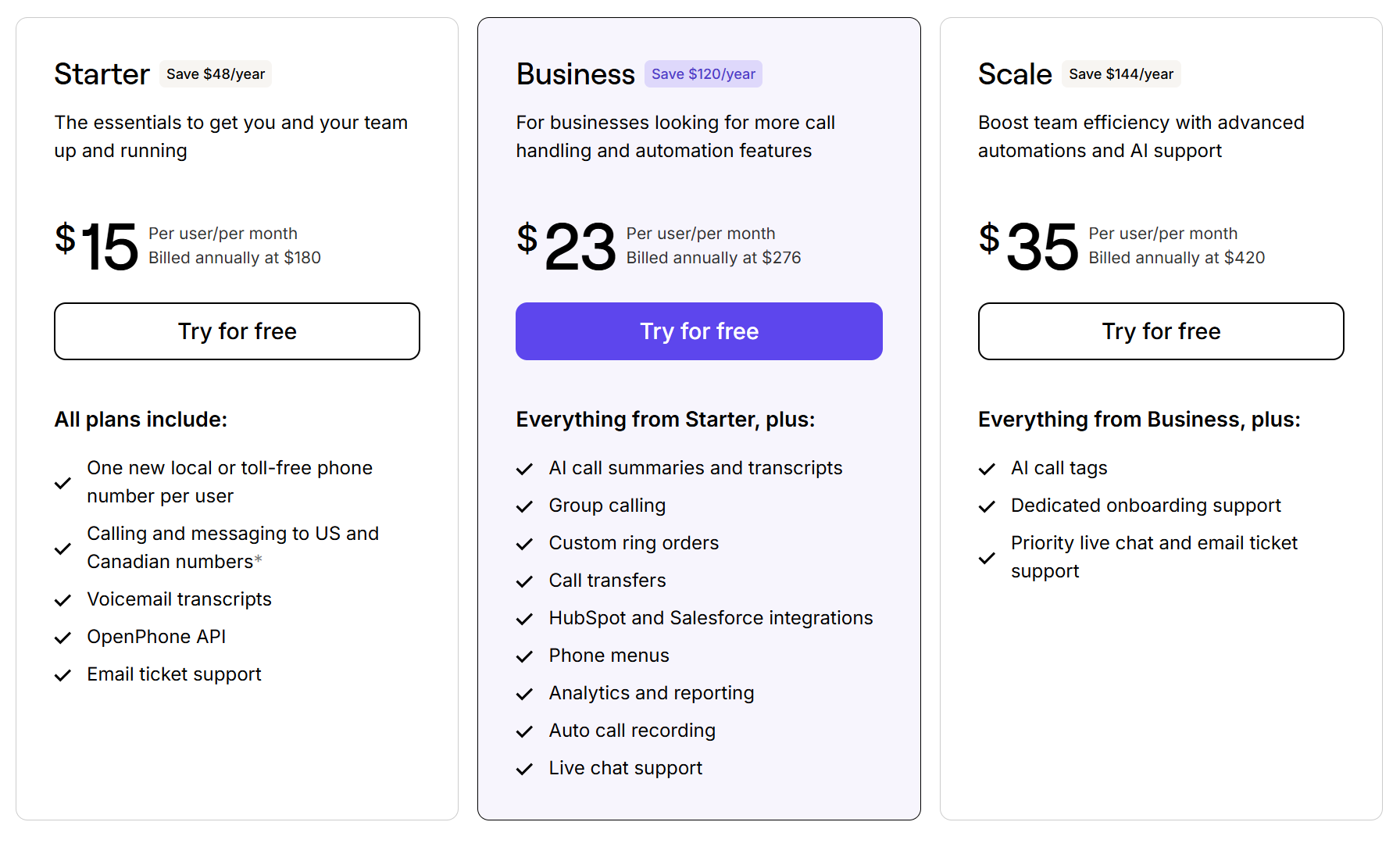
Quo offers three plans for pest control businesses:
- Starter: $15 per user per month for unlimited calling to US and Canadian numbers, one local or toll-free number per user, shared numbers, voicemail transcripts, and more
- Business: $23 per user per month for group calling, call transfers, automatic call recording, AI call transcripts, and integrations with Jobber, HubSpot, and Salesforce, and more
- Scale: $35 per user per month for AI call tags, dedicated onboarding, inbound phone support, and priority chat and email support
2. RingCentral: Best for desk phone rentals

Pros
- Multi-level IVR for urgent call routing
- Native support for a dozen desk phone brands
Cons
- Strict SMS limits on every plan
- Add-on features increase plan pricing
- Slow TCR registration for SMS
RingCentral is a well-known virtual phone alternative to traditional landline-based business phone setups. Its biggest draw is support for a wide range of desk phone brands, letting you deploy hardware from Poly, Cisco, and others with ease.
SMS is where RingCentral falls short for pest control teams. The Core plan caps outbound texts at 25 per user per month. Its higher-tier plans cap texts at 200 texts per user per month. A five-person team sending service reminders, ETA texts, and quote follow-ups will hit that limit fast. In contrast, providers like Quo offer unlimited SMS on every plan. You don’t have to worry about hitting SMS limits and paying overage fees every month.
There are also a few other things to know before you sign up:
- Slow TCR approval. TCR registration for business SMS with RingCentral can take months. Until it clears, your team can’t text customers from a registered number, leading to missed opportunities with urgent leads.
- Paid AI tools. RingCentral’s AI lead qualification is a paid add-on that starts at $59 per month.
- Rigid contracts. RingCentral has strict annual contracts that can be hard to break without paying termination fees.
If you want a user-friendly phone system built for a mobile pest control team, you’re better off looking elsewhere.
Key features of RingCentral
- Two-way SMS and MMS with clients
- Automatic call recording
- Mobile app for field technicians
- Call queues with hold music
- Auto-attendant that routes calls to scheduling, billing, or emergencies
- AI Receptionist for 24/7 appointment booking
RingCentral pricing

RingCentral offers three plans plus a custom Customer Engagement Bundle:
- Core: $20 per user per month for unlimited US and Canada calling, voicemail-to-text, call queues, auto-attendant, AI live transcription, video meetings up to 100 participants, and 25 texts per user per month
- Advanced: $25 per user per month for automatic call recording, call monitoring with whisper and barge, and 300+ CRM integrations, including HubSpot, Salesforce, and Zendesk
- Ultra: $35 per user per month for 10,000 toll-free minutes and unlimited storage for files and recordings
- Customer Engagement Bundle: Contact sales for a quote for Ultra, Business SMS Booster, and Call Queues Booster
3. Voice for Pest: Best for pest control CRM integrations

Pros
- Integrations with pest control CRMs like FieldRoutes, PestPac, and ServSuite
- Customer caller ID is available
Cons
- Pricing not available
- Outdated user interface
- No public user reviews
Voice for Pest is a dedicated phone system built exclusively for the pest control industry. It integrates directly with major field service platforms, including FieldRoutes, PestPac, and ServSuite. When a customer calls, your team gets an instant screen pop with their account history before they even pick up.
But existing customers we interviewed report consistent issues with Voice for Pest’s core functionality. Many say the mobile app is glitchy and unreliable, with bug reports going unresolved. Others say the platform is heavily reliant on hardware and requires technical assistance to set up and maintain.
There’s no public pricing or independent reviews. You won’t know what to budget until you speak to a sales rep, and there’s no way to verify real-world performance before signing up.
Voice for Pest isn’t the right fit for fast-growing teams that want an easy-to-use phone system. If you want transparent pricing and a modern app experience, another provider might suit you better.
Key features of Voice for Pest
- Branded Caller ID for outbound technician calls
- Auto-dialer with Do Not Call filtering
- Queue callback during peak hours
- AI call summaries synced to CRM accounts
Voice for Pest pricing
Voice for Pest does not publicly list its pricing. You won’t find any plans or per-user costs on their website. The only way to learn about pricing is to request a demo, where they send a customized quote based on:
- Team size and number of users
- Which pest CRM you integrate with
- Which add-ons you prefer
- Contract length
4. Google Voice: Best for existing Google Workspace users

Pros
- Integrations with Google Workspace apps
- Voicemail transcription on every plan
Cons
- No toll-free numbers
- No integrations outside the Google ecosystem
- No call summaries and transcriptions
Google Voice is an affordable option for pest control teams already on Google Workspace. It integrates with Gmail, Calendar, Meet, and Contacts. You can navigate seamlessly across all your Google apps.
But if you’re looking for a phone system that can handle your business’s growth, Google Voice will fall short. There are no third-party integration capabilities. You can’t send call and text data to platforms like FieldRoutes or Jobber. Calls, texts, and voicemails also live in separate tabs, making it difficult to quickly gather context on a customer.
Google Voice also doesn’t have the AI features that modern pest control businesses rely on. You don’t get AI call summaries or call tags, forcing your team to log every interaction manually. You can’t set up an AI voice agent to handle after-hours calls, which means you’ll risk losing new leads. You also can’t integrate Google Voice with any AI chatbots. It’s much harder to analyze your call and text data and find trends from what customers share with you.
If you want a phone system that connects with your other tools, consider these Google Voice alternatives.
Key features of Google Voice
- Three-way calling and call transfers
- Auto-attendant and ring groups on higher-tier plans
- Voicemail transcription by email or mobile
- eDiscovery, SIP Link, and BigQuery export on higher-tier plans
Google Voice pricing

There are four Google Voice plans to choose from. If you have more than one person on your team, you’ll need to have a Google Workspace subscription starting at $7 per user per month in addition to the paid plan:
- Starter with Voice only: $10 per user per month for one user, free calls in the US and Canada, and access to mobile and web apps
- Starter: $10 per user per month for calls to the US and Canada, voicemail transcriptions, and Google Workspace integrations
- Standard: $20 per user per month for on-demand call recordings, ring groups, and phone menus
- Premier: $30 per user per month for automatic call recordings and advanced reporting
5. Ooma Office: Best for legacy business phone features

Pros
- No contracts are required to add or remove users
- Built-in spam call blocking
- Analog desk phone support with no complex IT setup
Cons
- No shared inboxes
- Desktop app is locked behind Pro and above
- Number porting costs $39.99 per line on top of activation fees
- CRM integrations are only available on Pro Plus
- Text messaging caps can add unexpected fees
Ooma is a business VoIP option for pest control businesses replacing an AT&T or Verizon landline. Its roots are in selling hardware boxes to home users, and that legacy still shows in the product. If you need desk phones, virtual fax, and overhead paging, Ooma delivers all of that for teams working out of a physical office.
Ooma might feel too limiting for pest control teams that want to grow quickly. It doesn’t offer shared inboxes, so you can’t see the conversations colleagues are having with customers. It has a monthly cap on texting for each account, not just each user. And if you want to access their recently released AI receptionist, you’ll have to pay an add-on and additional calling fees.
Ooma suits the solo termite inspector or two-person pest shop that wants a setup that looks and feels like a landline. But if you want to grow your business quickly, Ooma may not be the right choice for you.
Key features of Ooma Office
- Virtual receptionist with after-hours emergency routing
- Call queuing with hold music
- Bulk messaging for appointment reminders and client notifications
- Voicemail transcription
- AirDial POTS replacement product for offices still running copper lines
- Jobber CRM integration
Ooma Office pricing

Pest control companies can choose from three Ooma pricing plans, plus a custom Enterprise tier:
- Essentials: $19.95 per user per month for unlimited calling in the US, Canada, Mexico, and Puerto Rico, virtual receptionist, ring groups, mobile app, and virtual fax
- Pro: $24.95 per user per month for the desktop app, call recording, video meetings, voicemail transcription, and texting capped at 250 messages per month
- Pro Plus: $29.95 per user per month for call queuing, hot desking, CRM integrations, including HubSpot and Salesforce, and texting capped at 1,000 messages per month
- Enterprise: Contact sales for pricing for the only tier that unlocks Ooma’s AI virtual agent and HIPAA compliance
All plans have a $29.95 one-time activation fee. You’ll also pay $9.99 per month for each additional phone number beyond your user count.
6. Vonage: Best for integrating with Microsoft 365

Pros
- SMS and MMS are available
- Free integrations with Microsoft 365 and Microsoft Dynamics
Cons
- Call groups require an upgrade
- Call recording requires an upgrade
- Advanced texting requires API customization
Vonage is a solid option for pest control teams already running on Microsoft 365 and Dynamics. If you use Dynamics, call and text data is logged in your workspace automatically. Your team has the full customer history on-screen before they say hello.
But the shortcomings show up early. Vonage forces teams to upgrade to a higher-tier plan to access basic features like call recording and call groups. Advanced texting — like scheduled appointment reminders — requires complex API access. Unless you’re familiar with coding, you’ll likely need to hire a developer and pay ongoing API fees to keep things working.
If you want a turnkey phone system with similar features, consider looking into Vonage alternatives.
Key features of Vonage
- SMS and MMS with clients
- Call queuing to eliminate missed calls
- On-demand call recording
- CRM integrations for instant customer lookup
- Videoconferencing is available
Vonage pricing

The exact cost of a Vonage pricing plan depends on the size of your team. Here’s what you’ll pay for up to four users:
- Mobile: $13.99 per user per month for unlimited domestic calling, SMS and MMS, desktop and mobile apps, multi-level IVR, and voicemail-to-email
- Premium: $20.99 per user per month for team messaging, video meetings, desk phone support, and access to the VBC App Center for third-party integrations
- Advanced: $27.99 per user per month for on-demand call recording up to 15 hours per extension, call groups, and visual voicemail with transcriptions
7. Grasshopper: Best for multi-digit extensions

Pros
- Unlimited users with no per-seat fees
Cons
- Simultaneous call handling requires upgrade
- Call recording requires an upgrade
- No third-party integrations
Grasshopper is a virtual phone provider for business owners who need a second business number. You can assign multi-digit extensions to your team, but you’ll have to upgrade if you want unlimited users and unlimited extensions.
If you want to connect Grasshopper to the rest of your tech stack, you’ll be disappointed. Grasshopper keeps your calls, texts, recordings, and voicemails siloed in its own workspace. There’s no way to connect them to your CRM or field service software, leaving your team to enter call notes manually after every conversation. And if you want essential business phone features like simultaneous ring and IVR, you’ll have to upgrade to access them.
You also don’t get advanced texting features like scheduled texts or message snippets. Plus, if a lead submits a form on your website, you can’t automatically send a text using apps like Zapier and Make. You’ll have to reach out manually, which makes it far easier for new leads to slip through the cracks.
Grasshopper works as a starting point for a solo operator. For any team looking to integrate with their field service platform, you’ll likely need a different phone solution.
Key features of Grasshopper
- SMS and MMS with clients
- Unlimited calls in the US and Canada
- Voicemail-to-text for office staff
- Custom greetings with vanity numbers
Grasshopper pricing

Grasshopper lets you pick from three plans:
- True Solo: $14 per month for one user, one phone number, one extension, unlimited domestic calling and texting, voicemail transcription, and mobile and desktop apps
- Solo Plus: $25 per month for unlimited users, one phone number, three extensions, simultaneous call handling, and voicemail transcription
- Small Business: $80 per month for unlimited users, five phone numbers, unlimited extensions, and shared numbers for team collaboration
Additional phone numbers can be added to any plan for $9 per month.
8. Nextiva: Best for omnichannel communication

Pros
- Manage customer interactions across multiple channels in the same dashboard
Cons
- No unlimited texting
- Call recording requires an upgrade
- CRM integrations are only available as add-ons
Nextiva is a modern virtual phone platform that helps you manage communications across multiple channels. You can manage calls, texts, voicemails, and even social media conversations in a single dashboard.
While Nextiva offers a convenient omnichannel solution, it also limits basic phone communication for teams. The base plan includes unlimited calls but caps texts at 100 messages per user per month. For a team sending daily dispatch updates and reminders, that fills up fast. If you run over, you’ll pay per-message overage fees that can quickly add up.Call recording, toll-free numbers, and CRM integrations all require plan upgrades or add-ons. And if you don’t have a dedicated office manager, higher-tier plans may be more than your team needs. Advanced dashboards and routing tools are typically overkill when you’re running a lean operation.
If you want a dedicated phone solution that doesn’t cap your texts or charge you for features you don’t need, you should look at a Nextiva alternative.
Key features of Nextiva
- Call routing
- AI receptionist, only available as an add-on
- Video meetings
- Social media integrations
- Digital fax, with an upgrade
Nextiva pricing

Nextiva pricing breaks down into three tiers:
- Core: $15 per user per month for the mobile app, voicemail transcriptions, team chat, voice calls, and 100 text messages per month
- Engage: $25 per user per month for Microsoft Teams integration, 2,000 toll-free minutes, digital fax, voice analytics, call recording, and 500 text messages per month
- Power Suite CX: $75 per user per month for API integrations for up to 100 agents, skills-based routing, IVR phone menus, and call transcriptions and summaries
9. Dialpad: Best for large contact centers

Pros
- Live AI transcriptions during calls
- Auto-generated call summaries after every call
- Real-time script prompts for pricing and contract objections
Cons
- Additional numbers require an upgrade
- Higher-tier plans require a minimum number of users
- Slack, Zapier, and CRM integrations are only available on higher tiers
- Not user-friendly
Dialpad is a virtual phone system built for large enterprise contact centers. It brings calls, texts, and video meetings into one platform. It also offers autonomous AI agents you can add to your business phone plan separately.
What makes Dialpad unique for contact center teams is its AI features. It offers real-time call transcription and AI playbooks and scorecards. But these features aren’t available in their business phone system. You’ll have to sign up for their adjacent product offerings.
For small pest control teams, Dialpad can be out of their budget. If you want more than one phone number, you have to upgrade to a higher-tier plan. But when you upgrade, you have to pay for a minimum number of users, which inflates your costs.
Past Dialpad users have also complained their interface isn’t easy to navigate. There are dozens of menus to comb through to set up a new account. If you’re operating with limited resources and want a phone system that doesn’t break the bank, you should look elsewhere.

Key features of Dialpad
- Unlimited domestic phone calls
- Call forwarding
- iOS and Android apps for mobile devices
- Voicemail-to-email transcription
- Salesforce phone integration, with an upgrade
Dialpad pricing

There are three Dialpad pricing plans to choose from:
- Standard: $15 per user per month for unlimited calling in the US and Canada, AI-powered call transcriptions, voicemail transcriptions, Dialpad SMS and MMS, and Google Workspace and Microsoft 365 integrations
- Pro: $25 per user per month for a minimum of three users for additional phone numbers, international texting, auto-replies, and CRM integrations, including Salesforce, HubSpot, and Zendesk
- Enterprise: Contact sales for a quote for a minimum of 100 users for 100% uptime, unlimited locations and ring groups, and SSO integrations
Why should you get a pest control phone system?
Pest control phone systems offer a bridge between your customers and your team. They help you connect with customers faster and build meaningful relationships at scale. Here are a few reasons why you should get one:
1. Reduce missed calls and lost leads
A dedicated pest control phone system keeps you responsive even when your hands are full. With features like shared numbers, your whole team can monitor and respond to incoming leads from one number. They also help during peak season from June to October when call volume spikes.
But what happens when everyone on your team is occupied or when calls come in after hours? That’s where an AI voice agent can make the difference. For example, 24/7 AI answering services like Sona can handle your calls when your team is off the clock. They can answer questions, take down messages, and even qualify leads for you. If you receive an emergency call after hours, Sona can transfer it to an on-call technician.

2. Nurture customer relationships as you grow
As your customer list grows, remembering every detail becomes an impossible task. Quo lets you save custom properties and contact notes for each customer. Save information like pet details so you can use pet-friendly insecticides. Whoever is assigned to the next job can quickly review these notes to get the full picture. You’ll be able to improve your customer satisfaction by personalizing every conversation.
Keep your customer information up to date across all your tools. With Quo’s CRM integrations, your calls and texts automatically sync to your HubSpot or Salesforce account. With HubSpot’s bidirectional sync, updates flow in both directions, so nothing gets missed. You can also set triggers between your CRM and Quo using our Zapier and Make integrations. For example, when past customers need regular pest management services, you can send automatic texts based on their CRM status.
3. Communicate with flexibility and scalability
Your team rarely works from one place. Most days, they’re split between the office and the field. A VoIP phone system like Quo lets your exterminators take calls and manage communications from a job site, on the go, or at home.
Quo offers apps for every major platform, so your technicians don’t have to switch to tools they don’t know. You can also add local, toll-free, and vanity numbers from one centralized dashboard. As your pest control business grows, scaling up is as simple as adding a number for each new hire.
4. Save money on your business phone costs
No pest business likes spending more than it has to on a phone system. If you’re still running on a traditional landline setup, you’re likely paying for hardware and maintenance you no longer need. When call volume drops in winter, you’re still locked into paying for every line you added during peak season.
VoIP systems like Quo eliminate those costs. You don’t need to pay for custom hardware, equipment, or maintenance. We handle all your technical needs in the cloud, so you don’t have to worry about it.
Key features you should look for in a pest control phone system
Not every phone system is built for pest control businesses. Here’s what to look for when choosing one:
- Custom call routing. It’s common for pest control businesses to receive multiple urgent calls at once. Look for a phone system that can route callers to the right technician using IVR menus and ring groups.
- After-hours coverage. Missing a call after hours often means losing the job. Look for phone systems that offer time-of-day routing, SMS auto-replies, and call forwarding workflows. An after-hours answering service like Sona can also handle calls and help customers book inspections when your staff is offline.
- Automated business texting. Meet your customers where they are with business SMS and MMS. For pest control teams, sending appointment confirmations and reminders, as well as proof-of-service texts, helps maintain smooth operations. Prioritize phone systems that offer comprehensive texting features.
- Team collaboration features. Your office staff and field techs need to be on the same page for jobs to run smoothly. A phone system with shared inboxes, call transfers, and internal messaging helps them stay aligned.
- Third-party integrations. Your phone system should talk to your pest control software. Check if it integrates with tools like Jobber so you can pull up past service history when a customer calls. Plus, new client calls in Quo can automatically create Jobber requests, eliminating another administrative step for your team.
- Self-serve appointment booking. Not every customer wants to call in to book or reschedule. A phone system with self-serve booking lets them schedule or cancel inspections on their own. Your business can grow faster as your staff gets more time to focus on revenue-generating work.
Get started with a pest control phone system today

Pest control businesses lose jobs every day to missed calls and slow follow-ups. Thankfully, AI pest control tools are changing that.
Quo offers shared numbers, AI-powered call summaries, and Sona for 24/7 after-hours coverage. It works on the devices your team already uses and connects directly to Jobber and HubSpot. With 9,000+ integrations, you can also automate follow-ups, appointment reminders, and more.
Stop losing leads to the next pest company on Google. Start your seven-day free trial with Quo today.
FAQs
A pest control phone system is the infrastructure that provides your phone numbers, call routing, and texting services. A pest control answering service is the AI or human layer that picks up calls when your team is busy or offline. Quo combines both since Sona is built directly into our platform, eliminating the need to stitch two vendors together.
Pest control phone system costs vary based on the number of users and features you need. A VoIP system like Quo starts at $15 per user per month, billed annually. Some providers bundle in features most pest control businesses never use, like overhead paging and virtual fax. Others charge extra for desk phone rentals. In any case, VoIP providers like Quo give you the essential features at a predictable monthly cost.
Quo gives you three ways to handle calls after hours and over the weekend:
• 24/7 call handling with Sona. Connect Quo with Sona to answer calls around the clock and qualify urgent pest emergencies. If you’re on a job and can’t pick up, Sona will pick it up for you and log the details in your CRM.
• Call forwarding. Use time-based routing to make sure late-night and weekend calls reach your team. You can route to an on-call technician first, then route to Sona as a backup option.
• Voicemail with callback. Send non-urgent calls to an after-hours mailbox. Quo transcribes the audio to text, so your team can screen messages and follow up the next morning.
Working with a call center makes sense if you’re a large business operating across multiple locations. For smaller pest control teams, the arrangement can be expensive and difficult to maintain. In most cases, you only need a phone system that helps you manage incoming calls and keep your whole team aligned on customer interactions.
No. Avoca AI is an AI voice agent that sits on top of your existing phone system, which means you still need a separate provider for business numbers, calling apps, and team collaboration. Avoca handles call answering and CRM booking, but it doesn’t replace your phone infrastructure.
Avoca is known for its CRM integrations with pest control CRMs. It connects natively with FieldRoutes, GorillaDesk, ServiceTitan, and Housecall Pro. When a homeowner calls about an urgent infestation, Avoca checks your schedule and books a service window. You can also connect it to broader platforms like HubSpot and GoHighLevel to manage leads and follow-ups.
The downside is that Avoca lives outside your main phone system, so customer context ends up split across two platforms. Your team has to open two tools just to get the full picture, which slows down response times and makes urgent leads harder to convert.
If you want AI call answering without the extra complexity, Sona comes built into Quo. Calls, texts, and AI summaries live in one place, and call transcripts flow into your field service software automatically when each call ends.
Yes, a modern pest control phone system can easily integrate with third-party field service tools. Quo connects directly with Jobber and links to FieldRoutes and PestPac via Zapier. Once set up, a caller’s name, phone number, and pest issue are automatically logged into your CRM the moment a call is completed.


