


Electrical job sites don’t leave much time to manage phone calls. You and your team may be crawling through attics, running wiring, or testing panels to make sure circuits aren’t breaking. When your personal phone is also your business number, managing communications gets even harder. Calls go unanswered when you’re at job sites, and context is spread across multiple tools. Meanwhile, clients are frustrated at having to repeat themselves.
With a dedicated electrician phone system, all your context stays in one place. You and your team can handle incoming calls 24/7 and track your projects every step of the way.
In this article, we’ll break down the best electrician phone systems to consider for your electrical contracting company.
5 Best phone systems for electricians you should know
While there are dozens of options out there for electricians, let’s start with the top five for fast-growing contractors.
5 Best electrician phone systems compared
First, let’s compare each provider side by side:
| Provider | Starting price | Free calling to the US & Canada | SMS/MMS to US & Canada | Shared numbers |
|---|---|---|---|---|
| Quo, formerly OpenPhone | $15 per user per month | ✓ | ✓ | ✓ |
| Nextiva | $15 per user per month | ✓ | 100 texts per user per month | ✓ |
| RingCentral | $20 per user per month | ✓ | 25 texts per user per month | Calls only without an add-on fee |
| Ooma Office | $19.95 per user per month | ✓ | Requires upgrade | ✓ |
| Google Voice | $10 per user per month | Unlimited calls to Canada from the US only | US customers only | Requires upgrade, ring groups only |
Now, let’s take a deep dive into each phone solution.
1. Quo, formerly OpenPhone: Best electrician phone system for fast-growing contractors

Pros
- Unlimited calling and messaging in the US and Canada
- Local and toll-free numbers
- Shared numbers to split responsibility for incoming calls and messages
- Call recording is available on every plan
- AI-generated call summaries and transcriptions
- 24/7 AI voice agent to answer calls automatically
- 8,000+ integrations, including Jobber, HubSpot, and Salesforce
- Mac, Windows, Android, iPhone, and web apps are available
Cons
- Can’t verify accounts through two-factor authentication*
*Nearly all virtual phone numbers share this problem. For safety reasons, companies like Facebook, Uber, and Google rarely let you authenticate accounts through a virtual phone number.
Quo, formerly OpenPhone, helps electrical contractors stay accessible to clients without sacrificing time. It uses Voice over Internet Protocol, or VoIP technology, so you can make calls and send texts over your internet connection.
Each Quo plan comes with unlimited calls in the US and Canada, so you’ll never pay per-minute fees. You also get one free local or toll-free number for every person on your plan. Turn these into shared numbers to distribute responsibility for incoming calls and texts. That way, any available team member can handle client conversations.
Quo is designed to help your team communicate with customers easily. Our apps are available on every major platform, so your team can use their existing devices to make calls and send texts. Your technicians can easily see which calls are work-related vs personal, so they know which calls to prioritize in the field.
If your team isn’t available to take incoming calls, you can set up a 24/7 AI receptionist to handle them before and after business hours. With Sona, our AI voice agent, you’ll never miss an incoming call again. Train Sona on your company knowledge and provide custom scripts based on different caller needs. Then, let Sona answer FAQs, take messages, and qualify leads. It can even text links to clients so they can schedule appointments.
Quo also integrates with dozens of field service management tools to help make running your team easier, including Jobber. This allows you to log calls, texts, voicemails, and call summaries and transcripts so that you don’t lose a single client detail.
Easily collaborate with your team via internal threads in Quo’s mobile and desktop apps. No need to jump between a customer text and your team chat. With Quo, you can leave comments, tag members, and delegate work inside your contact’s conversation threads.
Send unlimited SMS and MMS messages to US and Canadian numbers with Quo. With MMS messaging, you can send photos and videos showing proof of service to customers. You can also automatically reply to clients when they text you with SMS auto-replies. You can create templated messages using our snippets feature. You can also create automated text workflows to send messages to your customers when they take certain actions. For example, when they submit a form on your website. Simply use our Zapier or Make integrations or set up a custom integration with the Quo API.
No need to take our word for it, though.
See how Quo helps Pink’s Windows stay personal while scaling to 75+ locations.Then, confirm Quo is a fit for your electrical business by signing up for a seven-day free trial.
Key features of Quo
- Automatic and on-demand call recording
- Custom business hours and work schedules
- Auto-attendant with IVR
- Drag and drop call flow builder
- AI contact suggestions
- AI-generated call summaries, transcripts, and action items
- Business app integrations with Slack, Zapier, Google Contacts, and email on the base plan
Quo pricing
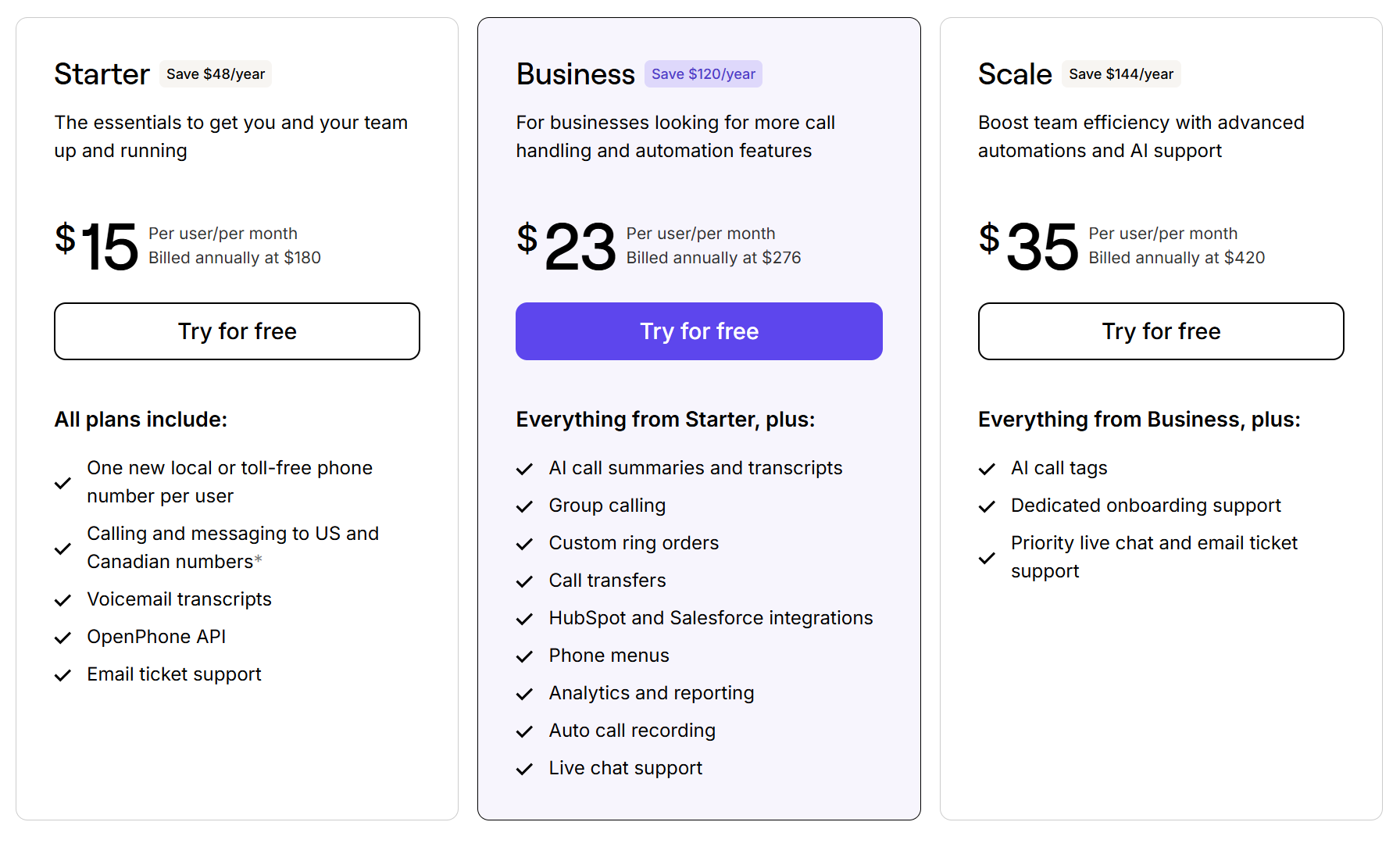
Pick from one of three Quo pricing plans to scale alongside your business:
- Starter: $15 per user per month for unlimited calls to US and Canadian numbers, one local or toll-free phone number per new user on your account, voicemail transcriptions, and access to Quo’s AI voice agent, Sona
- Business: $23 per user per month for call transfers, group calling, phone menus, CRM integrations like HubSpot and Salesforce, and AI call summaries and transcripts
- Scale: $35 per user per month for AI call tags, dedicated onboarding, priority chat and email support, and inbound phone support
2. Nextiva: Best for omnichannel communication

Pros
- Manage customer interactions across multiple channels in the same dashboard
Cons
- No unlimited texting
- Call recording requires an upgrade
- CRM integrations are only available as add-ons
Nextiva is a communication tool that brings channels like web chat and social media conversations into one place. It also offers review management tools. This makes it easier for electricians to spot negative reviews and respond to them quickly.
Nextiva’s base plan offers unlimited phone calls, but it limits texts to 100 messages per user per month. If you run over, you’ll need to pay per-message overage fees that can quickly add up. And if you want features like call recording, toll-free numbers, and CRM integrations, you’ll need to upgrade again or purchase an add-on.
If you don’t have an in-house office manager, higher-tier Nextiva plans might be overkill for you. You’ll end up paying for features you don’t yet need. For example, you need to upgrade to the Power Suit CX plan to access AI call summaries and transcripts. However, that plan also comes with ACD Call Back, which your company may not need.
Key features of Nextiva
- Call routing
- AI receptionist, only available as an add-on
- Video meetings
- Social media integrations
- Digital fax, with an upgrade
Nextiva pricing

Nextiva’s pricing has three tiers:
- Core: $15 per user per month for access to the mobile app, voicemail transcriptions, team chat, voice calls, and 100 text messages per month
- Engage: $25 per user per month for access to the Microsoft Teams integration, 2,000 toll-free minutes, digital fax, voice analytics, call recording, and 500 text messages per month
- Power Suite: $75 per user per month for API integrations for up to 100 agents, skills-based routing, IVR phone menus, and call transcriptions and summaries
3. RingCentral: Best for traditional desk phone rentals

Pros
- Supports traditional office phones
Cons
- Major texting and storage limits
- Toll-free calling limits
- Advanced texting features require upgrades
- No unlimited storage
RingCentral is a legacy phone service provider that offers old-school desk phone rentals if you’re not ready to switch to mobile phones. With it, you get access to unified communications: calls, texts, and video calls with clients and team members.
But while this sounds good on paper, RingCentral imposes major limitations on most of these channels. For example:
- RingCentral limits customers to 25 SMS messages per user per month on its base plan. You can’t get access to unlimited text messages on any plan.
- RingCentral limits call recording storage to 90 days unless you upgrade to the Ultra plan. This makes it more difficult to pull up conversations later if a customer disputes what was said or agreed to during a phone call.
- You only get 100 toll-free minutes per month on the base plan. Even if you upgrade, you’re limited to just 1,000 minutes per month.
Plus, some features that come standard on other VoIP systems cost extra in RingCentral. Shared texting and text templates require the Business SMS Booster add-on, which costs an extra $25 per month.
Key features of RingCentral
- Multi-level auto attendant and IVR
- Hot desking, with an upgrade
- Three-way calling
- Advanced call monitoring, such as whisper and barge
RingCentral pricing

Curious about RingCentral pricing plans? Here’s what you can expect at each tier:
- Core: $20 per user per month for 25 text messages, on-demand call recording, 100 toll-free minutes, and HD meetings up to 100 users
- Advanced: $25 per user per month for 100 texts, automatic call recordings, CRM integrations, and 1,000 toll-free minutes
- Ultra: $35 per user per month for unlimited storage, 200 text messages, 10,000 toll-free minutes, and access to device analytics
Keep in mind this doesn’t include add-ons like:
- Business SMS Booster: $25 per month for shared texting, compliance, and company reply templates
- Call Queues Booster: $35 per month for smart routing and real-time analytics on service calls
- AI Receptionist: $39 per month for an AI voice receptionist that answers common questions and schedules appointments on your behalf
Looking for a plan that has all these features? You might get confused searching for one. That’s because RingCentral offers five other service options in addition to its starter business phone plans.
4. Ooma Office: Best for virtual fax and overhead paging

Pros
- Paging and intercom features for physical offices
Cons
- Essential features require upgrades
- Upgrade required for CRM integrations
- No calls from the desktop app without upgrading
Ooma is an electrician phone system that provides legacy features such as overhead paging and virtual fax. Like RingCentral, it supports desk phones. This may be useful if you have a physical office with a lot of people working behind desks.
But for most fast-growing businesses, Ooma Office may not scale well outside of the office. Most of its best features — think texting, recording, and voicemail transcriptions — require the Ooma Office Pro plan.
Plus, its best third-party integrations require an upgrade. Ooma’s Jobber, HubSpot, and Salesforce phone integrations require the Pro Plus plan, which starts at $29.95 per user per month. This may also force you to pay for features you don’t need, like online whiteboarding and auto-dialing.
Key features of Ooma
- Call handling, such as call park
- Number extensions
- Team chat, with an upgrade
- Video conferencing, with an upgrade
- Online booking and scheduling services, with an upgrade
Ooma pricing

Here’s a quick look at Ooma’s pricing:
- Essentials: $19.95 per user per month for unlimited domestic calls, 500 minutes of incoming toll-free calls, virtual receptionists, call forwarding, IP phone and overhead paging, and access to the mobile app
- Pro: $24.95 per user per month for call recording, 250 text messages, dynamic caller ID, and video conferencing
- Pro Plus: $29.95 per user per month for 1,000 text messages, limited CRM integrations, Ooma Meetings recording, and call queues
- Enterprise: Custom pricing for integrations with Microsoft Teams, advanced analytics, “advanced customer experience features,” and “call center features.” You must contact sales for more details on the last two
This doesn’t include add-ons for:
- Toll-free minutes: Starts at $15.00 per month
- Additional business text messages: Starts at $20 per month
- IP phones: Starts at $59 per device
5. Google Voice: Best for existing Google Workspace users

Pros
- Cost-effective for solo electrical contractors
Cons
- No shared numbers
- No third-party integrations outside the Google ecosystem
- No advanced messaging features
- Requires a Google Workspace subscription
Google Voice is a decent starter business phone, but it won’t scale with your business. The paid business plans let you call and text customers in the US and Canada. It also offers three-way calling, which is useful if you need to hop on a call with a contractor and the client.
But apart from a few other bare-bones features like call transfers and on-demand call recording, there isn’t much else you can get with Google Voice. It’s actually missing many of the features you can get with more modern VoIP systems, like:
- Shared numbers
- Third-party integrations outside the Google ecosystem
- Advanced messaging features that save your team time, like snippets and auto-replies
If you’re running an electrical business on your own, you can try out Google Voice’s Starter plan without a Google Workspace subscription. However, if you have additional team members, you need to sign up for Google Workspace. Depending on your tier, this costs an extra $7 to $22 per user per month. That means the total starting price for a Google Voice team subscription is $17 per user per month.
Key features of Google Voice
- Desk phone support
- Three-way calling
- Call transfers
- Automatic call recording, with an upgrade
Google Voice pricing

There are four tiers of Google Voice pricing:
- Starter without Workspace: $10 per month, limited to one user, offers call recording, three-way calling, voicemail transcription, and mobile and web apps
- Starter: $10 per user per month, with a 10-user maximum, for calls and texts in the US, call forwarding, and SLAs
- Standard: $20 per user per month to access on-demand call recordings, ring groups, and phone menus
- Premier: $30 per user per month to access automatic call recordings and advanced reporting
For plans with more than a single user, you’ll also need to pay for a Google Workspace subscription. This starts at $7 per user per month.
Benefits of VoIP vs personal cell numbers for electrical businesses
For most electrical contractors, personal cell numbers simply aren’t scalable. Let’s take a closer look at how VoIP vs personal cell numbers compare:
1. Provide mobility and flexibility to your team
VoIP systems help electricians take calls from anywhere with a WiFi connection. They can also use VoIP apps on their existing devices to stay in touch while on the go.
But with personal numbers, you can only make calls andsend texts on a single phone. You also won’t be able to use your laptop if needed. As call volume scales, your phone will be bombarded by incoming calls. You can’t route these calls to your team so you can tackle them at the same time.
2. Reduce missed calls and lost leads
Shared numbers can help teams tackle incoming calls and texts together. By reducing missed calls and unanswered messages, they can also improve customer satisfaction and cut down on lost leads.
On the other hand, most personal numbers don’t provide shared calling or texting. If you’re not available to pick up whenever the phone rings, you might lose potential customers to competitors. And the longer you take to respond to customer texts, the more it affects their experience with your business.
3. Separate work vs personal calls
Most VoIP providers separate business calls from personal calls, so you know whether you’re getting a work call or not. But with a personal number, you can’t differentiate between a work call and a personal call. That means you can’t always prioritize or answer calls appropriately.

VoIP services can also help you set business hours, work schedules, and choose when you don’t want to be disturbed. That way, you can quickly respond to service calls and still be able to switch off at home.
4. Improve your team’s efficiency
The best VoIP phone systems automate everyday administrative tasks for your team. For example, you can use features like:
- AI call summaries and transcriptions to get context quickly and follow up after calls faster
- Third-party integrations so you can sync data between platforms you already use
- Automated text workflows, like sending confirmation messages after customers book appointments
Plus, VoIP phones provide collaboration features like internal threads and team chat. That way, your team can stay in touch without toggling between different platforms.
But personal cell numbers offer none of these automation and collaboration features. Over time, this can slow down your electrical business.
5. Save thousands of dollars every month
VoIP implementation is much more cost-effective than buying individual cell phones with numbers. You pay a monthly fee per user and can use devices you already own. Your service provider will also handle maintenance and updates on your behalf. Quo’s pricing, for example, starts at $15 per user per month.
Traditional phone services are generally more expensive since you can typically have only one number per phone. You pay for the phone and a monthly service bill. Doxo found that most Americans pay $121 per month, or $1,452 per year, for personal cell numbers. That’s nearly eight times more expensive than VoIP providers like Quo.
6. Keep the conversation going with a 24/7 AI agent
Electrical work often requires your full attention — and both of your hands. But new leads, emergency calls, and follow-ups don’t stop just because you’re on a ladder or testing a panel.
AI answering services can help you stay responsive by answering the phone when your team can’t. AI agents like Sona can answer common questions and gather details for service requests so team members can follow up later.
Plus, electrical issues don’t always wait for business hours. If a customer calls after hours and reaches voicemail, there’s a good chance they’ll try the next electrician on their list. With Sona, you can set up home service call flows that route emergency calls to active members. That way, customers get the help they need without disrupting your sleep or trying a competitor.
Want to see examples of Sona in action? See how Sona performs as an electrician answering service.
Essential features for electrician phone systems
How do you decide which provider is right for you?
The best place to start is by looking for these seven essential features:
- Shared phone numbers: These allow you to share incoming calls and texts as a team. You can reduce missed calls and respond to customers faster.
- Call recording: Save time on customer calls by speaking instead of taking notes without losing context. Plus, you can keep records of past conversations for legal, quality assurance, or compliance purposes.
- SMS and MMS messaging: You can’t run a home service business without text messaging to coordinate appointments with your customers. Use text messaging for on-site appointment scheduling, then show proof of service with MMS.
- AI electrician tools like call summaries and transcripts: Quickly gather context from past conversations with call summaries. Save full call transcripts to review customer needs and to resolve potential legal disputes.
- 24/7 AI answering service: Avoid missed opportunities with an AI service that picks up the phone when clients call after hours. This AI answering service should also be able to send texts while you’re on the phone, like links to your service policies or client-facing job portals. If you get emergency calls, the AI can transfer them to your on-call team.
- Internal threads: Coordinate work requests and troubleshoot customer issues in real time. You can also leave comments and assign work tasks or follow-ups without leaving your business phone system.
- Third-party integrations: Keep your customer data in one place by connecting your phone system with your CRM or other software for your electrical business. For example, when a new client calls your Quo number, you can automatically create a new lead in Jobber.
Power your electrical service with Quo

Quo is for service businesses looking to grow quickly by building strong customer relationships. Our flexible phone system works from anywhere and keeps every conversation organized. It lets you stay accessible to customers while protecting your privacy and doing your best work.
Quo gives you everything you need to manage electrical contracting from anywhere:
- Make calls and send texts from your existing devices, with no overage fees
- Share a business number with your team to reduce missed calls
- Handle more calls and review them faster with AI call summaries, transcripts, and Sona, our voice agent
- Integrate with your field service software and automate job creation and management
See why Quo is the best phone system for electrical contractors by signing up for a seven-day free trial.
FAQs
Electrician phone systems are business phones that help contractors communicate with their customers. These phone systems use VoIP technology to make phone calls and send texts using the internet. You can answer customer inquiries from your phone or computer using a WiFi connection. Providers like Quo also offer electrician-friendly features, like integrations with Jobber and work scheduling.
Setting up a virtual phone number with Quo takes three steps:
1. Create a Quo account to get a free seven-day trial.
2. Choose your city or area code in the US to select a preferred phone number.
3. Invite your team to your account.
That’s it! You’re all set to use your new virtual phone number. You can continue setting up your account by importing contacts and configuring your settings. However, these three steps are all you need to start calling your customers.
You’ll need to register your phone number for A2P 10DLC compliance to start texting customers due to regulations pushed for by the major US cell carriers. This process usually takes 5–7 days. You can complete this process in your Quo account.
Answering services are typically features of phone systems. But standalone answering services don’t always come with features like calling and texting. If you don’t already have a business phone system, you can sign up with Quo to access a phone answering service on every plan.


