Are you juggling personal calls and business calls on the same number? Do you wish your team could answer your calls when you’re busy? A VoIP business phone number app can help you solve these issues. Business features like shared numbers, SMS auto-replies, integrations, and call transferring help you grow your business.
While the benefits of VoIP apps are clear, picking the right one can be challenging, especially considering how many options there are.
This article will help you make the right choice by showcasing the top eight business phone number apps in 2025. We’ve tested each one for reliability, time-saving features, and integration capabilities that connect to your existing workflow.
If you’re ready to find your next business phone app, you’ve come to the right place.
The best business phone number apps compared
Curious how our app picks match up? Get a high-level breakdown of our top eight best business phone number apps in this comparison chart:
| Provider | Starting price | Best for | Unlimited calling to US & Canada | SMS/MMS to US & Canada | Shared phone numbers | Additional phone numbers | Average G2 rating |
|---|---|---|---|---|---|---|---|
| Quo | $15 per user per month | Growing teams that need collaboration and automation tools | ✅ | ✅ | ✅ | $5 per number per month | 4.7 out of 5 |
| Google Voice | $10 per user per month | Teams using Workspace | Unlimited calls to Canada from the US only | US customers only | Requires upgrade, ring groups only | X | 4.1 out of 5 |
| Grasshopper | $14 per month | Teams that need multi-digit extensions | ✅ | MMS messaging for local numbers only | Requires upgrade | $9 per number per month | 3.9 out of 5 |
| Nextiva | $15 per user per month | Teams that use Microsoft products | ✅ | 100 texts per user per month | ✅ | Undisclosed fee | 4.5 out of 5 |
| Zoom Phone | $10 per user per month | Teams that need video integration | Requires upgrade | US, Canadian, and Australian numbers only | ✅, calls only | $5 per number per month | 4.5 out of 5 |
| Dialpad | $15 per user per month | Contact centers needing call monitoring features | ✅ | US and Canadian customers only | ✅ | Requires upgrade, then $5 to $15 per month | 4.4 out of 5 |
| RingCentral | $20 per user per month | Teams needing desk phone rental options | ✅, limited toll-free minutes | 25 texts per user per month | ✅, calls only | $4.99 per number per month | 4.1 out of 5 |
| Ooma | $19.95 per user per month | Teams that need legacy features like overhead paging | ✅ | Requires upgrade | ✅ | $9.95 per number per month | 4.6 out of 5 |
Here’s a detailed breakdown of how these virtual phone services stack up, ranked from highest to lowest based on their price, functionality, and integrations.
1. Quo: The best business phone number app for growing teams

Pros
- Unlimited calls and texts to the US and Canada
- Local and toll-free virtual numbers are available
- Available on iOS, Android, desktop, and the web
- Internal threads, contact notes, and call recordings for team coordination
- IVR auto-attendant for inbound calls
Cons
- Can’t verify accounts through two-factor authentication*
*Nearly all virtual phone numbers share this problem. For safety reasons, companies like Facebook, Uber, and Google rarely let you authenticate accounts through a virtual phone number.
Quo, formerly OpenPhone, is a collaborative VoIP system that scales with your business. Since Quo operates over an internet connection, you can manage all your business calls and texts on any existing computer, smartphone, or tablet. There’s no need to invest in a desk phone or expensive hardware. Plus, every plan includes the essentials like call recording and voicemail transcripts.
Quo helps your team collaborate with shared numbers, simultaneous ring, contact notes, and internal threads. With these features, your customers won’t wait long on hold or have to repeat themselves when they reach a new rep. Any of your customer service representatives can read notes from previous calls and get up to speed.
You can also expedite your team’s next steps and action items by using Quo’s AI transcriptions, call summaries, and suggested message responses. We also let you connect your favorite tools like Slack, Salesforce, HubSpot, Jobber, Make, and Zapier with our integrations.
Quo is the best business phone number app for small businesses and growing teams, but you don’t have to take our word for it. Try Quo with our seven-day free trial.
Key features of Quo
- Free calling and texting in the US and Canada
- Call recording
- Auto-attendant
- Desktop, web, and mobile apps
- Options to get a US, Canadian, or North American toll-free business number
- Voicemail transcriptions
- AI-suggested text responses
- Texting automation with snippets and auto-replies
- AI-generated call summaries, transcripts, and action items
Quo pricing
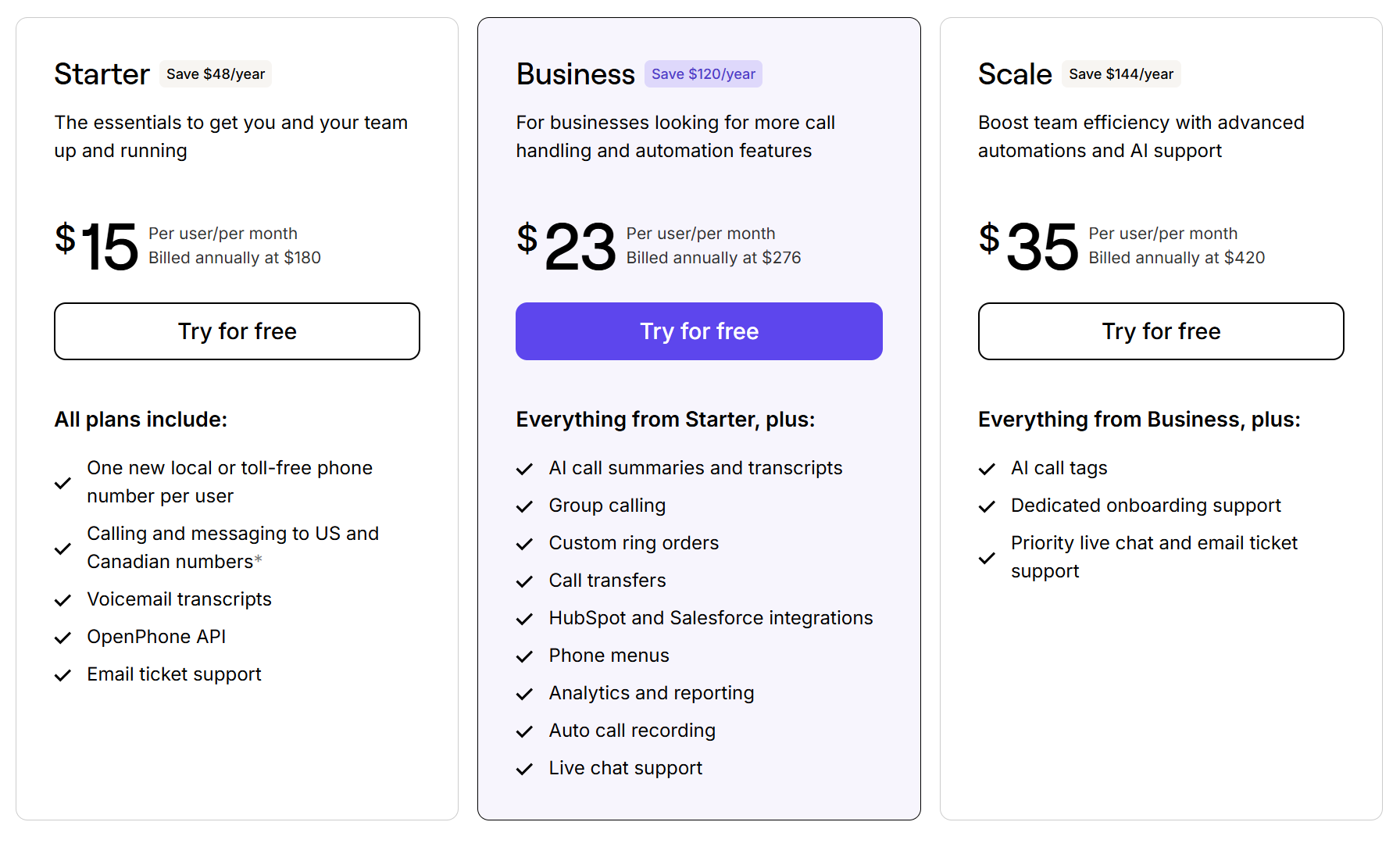
Quo’s pricing has three affordable options:
- Starter: $15 per user per month for shared phone numbers, internal threads, contact notes, voicemail transcriptions, scheduled messages, auto-replies, manual call recording, Sona AI agent, and more
- Business: $23 per user per month for automatic call recording, group calling, AI call summaries and transcripts, phone integrations with HubSpot and Salesforce
- Scale: $35 per user per month for AI call tags, dedicated onboarding, priority live chat support, and inbound phone support

How to get a business number with Quo
Getting a new phone number from almost anywhere in the world is a simple process when you choose Quo as your virtual phone number provider. Follow these three steps:
- Create an account with Quo. When you sign up, you get a free, seven-day trial.
- During signup, choose your city or area code in the US to select your preferred phone number.
- Once the signup process is complete, you’re all set to use your business phone number!
2. Google Voice: Best business phone app for Google Workspace users

Pros
- Make free calls to the US
- Integrates with other Google Workspace apps
Cons
- Texting is available in the US only
- Costs more than other business phone system providers
- No integrations outside Google Workspace
If you’ve ever Googled ‘VoIP,’ you’ve no doubt run into Google Voice. This is one of the most popular business solutions on the market.
Google Voice integrates with Google Workspace apps, making it a popular draw for businesses that already use Gmail, Google Sheets, and Google Docs.
Keep in mind, though, it doesn’t offer toll-free numbers, auto-replies, or differentiation between personal phone calls and your second number.

During testing, we also noticed every voicemail message, text, or call is organized in separate inboxes. This made it harder to get overviews of conversations with customers and respond quickly.
Key features of Google Voice
- Free unlimited calling to the US from anywhere and to Canada from the US
- SMS in the US
- Mobile phone and web apps
- Google Calendar and Google Meet integrations
- Auto-attendant and ring groups with upgrade
Google Voice pricing

Google Voice’s pricing plans give you four options to choose from:
- Starter with Voice only: $10 per user per month for one user, free calls in the US and Canada, access to mobile and web apps, and voicemail transcriptions
- Starter with Workspace: $10 per user per month for up to 10 users, free calls in the US and Canada, access to mobile and web apps, and voicemail transcriptions
- Standard: $20 per user per month to unlock unlimited users, on-demand call recordings, ring groups, and phone menus
- Premier: $30 per user per month to unlock automatic call recordings and advanced reporting
An additional $7 per user per month for Google Workspace is required to use Google Voice for business, except on the individual Starter plan.
3. Grasshopper: Best business phone number app with multi-digit extensions

Pros
- Unlimited calling to the US and Canada
- Auto-attendant phone menu with extensions
Cons
- $500 deposit to make international calls
- No shared phone numbers
- No Slack, Zapier, or CRM integrations
Grasshopper is one of the oldest virtual business phone number apps with unlimited calling in the US and Canada. One of its standout features is single-digit extensions for departments and multi-digit extensions for employees.
Compared to other providers in this article, their platform is relatively bare-bones with basic features like voicemail greetings and transcriptions. Even when they go the extra mile and offer auto-replies, they can only go out to first-time callers.
You have to upgrade your plan to get access to auto-attendant, call recording, and call transfers.

During testing, we noticed that the process to set up an auto-attendant was clunky. To many business owners, the platform will feel dated.
Key features of Grasshopper
- Unlimited calls to Canada and the 48 continental states
- Android and iOS mobile apps
- Vanity numbers
- Call transfers with upgrade
- Voicemail to text
Grasshopper pricing

Grasshopper’s pricing offers three plans. Here’s what you can expect to get with each:
- True Solo: $14 per month for one user, one phone number, and one extension
- Solo Plus: $25 per month for unlimited users, one phone number, three extensions, auto-attendant, simultaneous call handling, call transfers, and call recording
- Small Business: $55 per month for unlimited users, four phone numbers, unlimited extensions, and everything in Solo Plus
4. Nextiva: Best business phone app for teams using Microsoft

Pros
- Unlimited calling within the US and Canada
- Video calling features
- Microsoft Outlook integration comes standard
Cons
- Toll-free numbers and minutes require an upgrade
- Microsoft Teams integration requires an upgrade
- Usage-based call transcripts and summaries
Nextiva launched in 2006 as a basic business phone number app. Today, it brands itself as a customer experience company, with options to add channels like live chat, social media, and email.
Companies using Microsoft products can connect Nextiva to Outlook on the base plan, but will need to purchase an add-on or upgrade for the Teams integration. Unlike with other providers, reps can only send 100 texts each per month unless you upgrade. For cost reasons alone, many small businesses seek out Nextiva alternatives.
Key features of Nextiva
- Virtual fax services with add-on or upgrade
- Integration with Google Contacts comes standard
- Unlimited voice and video conference calling
- Voicemail transcriptions
- Toll-free number support with upgrade
Nextiva pricing

Nextiva’s pricing offers three plans to its customers:
- Core: $15 per user per month for inbound and outbound voice, limited business SMS, video meetings, and call routing
- Engage: $25 per user per month for customer-to-team SMS messaging, toll-free number and minutes, advanced reporting, and MS Teams integration
- Power Suite CX: $75 per user per month for inbound sales and service call center, priority and skills-based routing, unified team interface, and supervisor dashboard
5. Zoom Phone: Best business phone app for video integration

Pros
- Offers calling, texting, and video conferencing
- Integrates seamlessly with Zoom Workplace, Scheduler, Rooms, and Events & Webinars
- Desk-phone compatible
Cons
- Outbound calling requires an upgrade
- Additional cloud storage costs extra
- Limited integrations
If your small business already uses Zoom to meet with clients, Zoom Phone can be a viable VoIP option. In-call controls let you switch to a video meeting, transfer calls, and record calls — all without leaving the interface. As your business grows, you can also host large webinars and use Zoom to schedule appointments.
The downside with Zoom Phone is that it can get expensive for small teams. Outbound calling is only available on higher-tier plans, and useful AI features like team SMS summaries require an upgrade. Past users have also reported issues with international calling restrictions and a clunky interface.
Key features of Zoom Phone
- Metered international calling
- AI call summaries with upgrade
- Shared phone numbers for calling
- Voicemail transcription
- Call transfers
Zoom Phone pricing

You can choose from five different Zoom Phone pricing plans:
- US & Canada Metered: $10 per user per month for metered domestic calling, SMS and MMS in the US and Canada, auto-attendant, and Zoom meetings
- US & Canada Unlimited: $15 per user per month for unlimited outbound calls in the US and Canada, metered international calling, and AI call summaries
- Pro Plus: $18.32 per user per month for access to Zoom Workplace Pro plus everything in the Unlimited plan
- Global Select: $20 per user per month for unlimited calling in 40+ countries, a direct dial number, and everything in US & Canada Unlimited
- Business Plus: $22.49 per user per month for access to Zoom Workspace Business, visitor management tools, real-time reporting dashboards, and access to international calling add-ons
6. Dialpad: Best business phone number app for AI call monitoring features

Pros
- Real-time AI-powered call coaching on higher plans
- Unlimited calling to the US and Canada
- Shared phone numbers
Cons
- No international texting on the base plan
- Auto-replies require an upgrade
- Additional numbers require an upgrade
What makes Dialpad unique is its AI call coaching and call sentiment tracking. It can tell you when your team members are speaking too fast or slow, and let team leaders correct reps on live calls. However, these features are only available on Dialpad Support and Sales plans.
On Dialpad’s business phone plan, the features are fairly standard: shared numbers, multi-level auto-attendant, and call recording are included. If you want more than one phone number, to text internationally, and integrations beyond Google Workspace, you’ll have to upgrade.

During testing, we found the admin settings to be time-consuming and clunky to set up.
Key features of Dialpad
- AI-powered call transcriptions and summaries
- Fax, SMS, and MMS available for US and Canadian customers only
- Unlimited video meetings
- Salesforce, MS Teams, ServiceNow, Zendesk, and more integrations with upgrade
Dialpad pricing

There are three pricing tiers with Dialpad. Each provides one local number with unlimited US and Canadian calling, up to 250 SMS and MMS messages, and video meetings.
Here are the options:
- Standard: $15 per user per month for AI-powered call and voicemail transcriptions, Dialpad SMS, and Google Workspace integrations
- Pro: $25 per user per month for the option to have additional numbers, international texting, auto-replies, and CRM integrations with a required minimum of three users
- Enterprise: Call for a quote and get 100% uptime, unlimited locations and ring groups, SSO integrations, and live agent support with a required minimum of 100 users
7. RingCentral: Best business phone app for desk phones

Pros
- Desk phone support
- Multi-level auto-attendant
Cons
- Call recordings automatically deleted after 90 days
- Base plan only includes 25 texts per user per month
- Limited toll-free minutes
RingCentral is a legacy business communications platform that was founded in 1999. It supports desk phones, which is handy if your business still uses them.
But RingCentral isn’t without its drawbacks. For example, you’ll need to pay a one-time setup fee of $30 for vanity phone numbers. Plus, you only get more than 100 pooled toll-free minutes per month if you upgrade. Text messaging is also capped at 25 messages per user per month, which might not be enough for your business.
Key features of RingCentral
- IVR
- SMS and MMS support
- Shared voicemail
- Voicemail transcripts
- Unlimited calls in the US and Canada
- Shared numbers
RingCentral pricing

RingCentral’s pricing plans give you three different options to choose from:
- Core: $20 per user per month for unlimited domestic calling, business SMS and MMS, IVR call menu, and HD video meetings with 100 participants
- Advanced: $25 per user per month for auto call recording, advanced call monitoring and handling, connecting multiple sites, and unlimited internet fax
- Ultra: $35 per user per month for customizable analytics and reporting, 12 months of analytics and reporting history, HD video meetings with 200 participants, and unlimited storage for files and recordings
8. Ooma Office: Best business phone for teams that need fax and paging support

Pros
- Unlimited calling in the US, Canada, Mexico, and Puerto Rico
- Texting in the US and Canada
- Compatible with desk phones
Cons
- Limited toll-free minutes
- Texting requires an upgrade
- Call recording requires an upgrade
Ooma is a business phone number app with useful features for teams that still work in a physical location. You can access virtual faxing, overhead paging, intercom calling, and connect to desk phones. If you have a hybrid team, you can also use features like CRM integrations, calling on the desktop app, and videoconferencing — but only on higher plans.
Unlike other providers on this list, Ooma doesn’t have unlimited texting. After you upgrade to access it, you’ll still only have 250 free messages per user per month. Users have also reported reliability issues like messages not being received and calls not being forwarded. Unless you need in-office legacy features, you may want to find an Ooma alternative.
Key features of Ooma
- Simultaneous ring
- Mobile and desktop apps
- Video conferencing
- Team chat with upgrade
Ooma pricing

There are three different pricing plans for Ooma.
- Essentials: $19.95 per user per month for auto-attendants, call forwarding, and overhead paging support
- Pro: $24.95 per user per month for call recording, voicemail transcriptions, video conferencing, analytics, SMS, and access to Ooma’s desktop app with calling
- Pro Plus: $29.95 per user per month for call queuing, CRM integrations, hot desking, and advanced call flows
How we ranked the best business phone number apps
We personally tested each app since we know how frustrating dropped calls, hidden fees, and dated software can be as a growing business. We determined the top options after reviewing the following key factors across each app:
- Reliability: Does it work when you need it to? Call drops and system outages aren’t just inconvenient — they can cost you customers. In fact, research shows 68% of customers will move to a competitor after poor business communication. We prioritized apps with clear call quality and stable connection for this list.
- Business value: What problems does it solve? What value does the app generate for your business? The cheapest option is usually not the best app. You need a system that saves your team time and has predictable monthly costs. For example, we prioritized apps with shared phone lines, call transcripts, and other features that help businesses work more efficiently.
- Integration capabilities: Does it connect to your existing workflow? Speaking of saving time, integrations can help your team cut repetitive tasks from their daily responsibilities. We looked for apps with popular CRM and other integrations that automatically log calls, sync data, and eliminate time-consuming manual data entry. These become especially important as your business grows.
- Ease of setup: How hard is it for your team to get started? Customizing your phone settings and getting team members up and running shouldn’t take hours. The best business number apps have intuitive interfaces that aren’t taxing to operate if you’ve ever used a smartphone. We didn’t include apps that require an IT person and weeks to set up.
- Support quality: Do they help when things go wrong? If questions come up and you don’t see your question addressed in the Help Center, you need a responsive customer support team. We looked for business phone systems that offer reliable, fast support through different channels like phone and live chat.
- Pricing: Are there hidden fees? We looked beyond the pricing page to find the actual costs for each provider. That way, you know how much to budget for before getting locked into a contract.
How to choose a business phone number app by company size
If you’re ready to move beyond using a personal number for business, you need an app to keep things professional. But how can you choose which one is right for you without overpaying? Here’s a quick breakdown:
For solo entrepreneurs
If you’re a team of one, look for an app that gives you a second phone number on your existing cell phone. You’ll also want basic features like voicemail transcription and customizable business hours. At this stage, you don’t need team features — just professional call handling without extra hardware.
Keep in mind: While many people choose low-cost providers like Google Voice at this stage, you may run into issues if you ever plan to add team members.
For small teams of 2-10 people
As a growing team, you need an app with shared inboxes so your team can see all calls and texts to a number, leave internal notes, and assign follow-ups. This stops things from falling through the cracks, which helps you prevent a poor customer experience.
What works well: Quo’s Starter plan is a great way to get shared inboxes and other key features like auto-replies at an affordable price. You’ll also have the option to easily add numbers, users, and features once you’re ready to upgrade.
For fast-growing companies of 10+ people
At this stage, you should look for a system that can grow with you. Prioritize features like IVR phone menus to route calls to the right department, CRM integrations, and analytics to see how your team is performing.
At this scale: Providers like Nextiva, RingCentral, and Quo all offer these advanced features, but differ in their approach. Consider whether you need traditional call center tools like call monitoring and skills-based routing, or collaboration features like internal threads and AI call summaries.
Which features do you actually need? Skip the bloat
Here’s a quick breakdown of features you’ll likely need based on your team size:
| Feature | Solo | Small team | Growing company | Why it matters |
|---|---|---|---|---|
| Call forwarding | ✅ Essential | ✅ Essential | ✅ Essential | Never miss a lead |
| Shared inbox | ❌ Skip | ✅ Essential | ✅ Essential | Prevents duplicate responses |
| IVR/Auto-attendant | ❌ Skip | ⚠️ Nice to have | ✅ Essential | Professional routing at scale |
| Call recording | ✅ Essential | ✅ Essential | ✅ Essential | Training + compliance |
| CRM integration | ⚠️ Nice to have | ✅ Essential | ✅ Essential | Automatic call logging |
| Video calling | ❌ Skip | ❌ Skip | ⚠️ Nice to have | Use Zoom/Teams instead |
Grow your team with the best business phone number app: Quo

If there’s one thing we’re not at Quo, it’s limited. With transparent price plans, dozens of features, and integration options that make life easier, we’re always looking for new ways to add value.
Ready to see Quo in action? Sign up for a seven-day free trial to test Quo, or drop by for a demo to see why thousands of happy small business owners use us.
Frequently asked questions about business phone apps
Business phone systems typically cost $15 to $50 per user per month, depending on the features you need:
1. Basic VoIP plans: $10 to $15 per user per month. Get a professional business line, voicemail, and basic calling. Good for solo entrepreneurs who need to separate business and personal calls.
2. Mid-range VoIP plans: $25 to $30 per user per month. Includes team collaboration, integrations with your CRM, call recording, IVR systems to route incoming calls, and AI features. Better for growing teams that need to work together and track customer interactions.
3. Higher-end VoIP plans: $35 to $50 per user per month. Includes priority phone and chat support, dedicated onboarding, advanced AI features, and call monitoring. Best for larger teams that need a more sophisticated level of coordination.
If you want to learn more, check out our breakdown of business phone system costs.
Yes, if you run a solo business in the US and don’t need to have colleagues access your phone system, Google Voice is a solid free business phone number app option.
But as your team grows, Google Voice isn’t going to cut it. And there isn’t any other free business phone app that offers shared numbers for teams. If you also want auto-replies, integrations, and other features that take more work off your plate, you’ll have to subscribe to a paid app.
Want to use one number on two phones? Just download your VoIP provider’s mobile app on your cell phone:
1. Sign up for a business VoIP provider.
2. Choose a local or toll-free number for your business based on your preferred area code.
3. Verify your account with an existing phone number and a credit card.
That’s it! You can easily change your number or add more if needed.
The best small business phone system depends on your specific needs. Some businesses need a simple setup with features like call forwarding, shared phone numbers, and the option to make and receive calls from a different number. Others need advanced features like call routing to get calls to the right person or department, third-party integrations to connect to your tech stack, and AI call tags to quickly sort and review calls.
You should choose a business phone system like Quo that gives you the flexibility to upgrade and downgrade your plan as your business evolves.
You can easily separate your work and personal lives. For example, Quo’s mobile app lets you set up business hours, so you only receive work-related calls and texts when you’re on the clock. Plus, it allows you to share your business phone number with your team members, record calls, and more.
A regular phone service just gives you a number to make and receive calls and texts. Aside from voicemail transcription, you won’t get business features.
A business phone app is a complete communication platform. It offers features like shared inboxes for team collaboration, call recording for training, automated call routing to direct customers, and integrations with other tools. It turns your phone into a powerful tool for growing your business.
It’s simpler than you think:
1. Choose a provider and sign up for a plan based on your team size and which features you need. Some providers like Quo have trials so you can test the platform.
2. Invite your team members via email. They can download the app on their phones or computers and log in.
3. Assign them to a shared number or give them their own direct line.
Most business phone apps are intuitive, so your team can be up and running in minutes, not days.