For home service businesses, every phone call is a potential job.How you manage those calls directly impacts your ability to book work and deliver customer support. Many teams still use personal phones, old landlines, or disconnected tools. This can cause missed calls, poor communication, and slower response times.
Modern VoIP services are a better choice because they can help you prevent missed calls that leave money on the table. They give you tools like call logs, call routing, and a shared mobile app so your team can respond from anywhere.
In this article, we’ll cover the best phone systems for home service businesses, their main features, pricing, and how to choose the right option for your team.
6 Best phone systems for home service businesses
Your business phone system directly affects how fast you respond, route inquiries, and deliver reliable customer support. Modern VoIP services offer a more flexible, cost-effective way to handle communication, with features like call routing and mobile apps.
Here’s what you can expect from the six best phone systems for home services businesses:
| Providers | Annual price | Free texting US/CA | Shared phone lines | Free trial |
|---|---|---|---|---|
| Quo | $15 per user per month | ✔ | Shared phone numbers up to 10 paid users | ✔ |
| Nextiva | $15 per user per month | 100 texts per user per month | ✔ | ✗ |
| RingCentral Core | $20 per user per month | 25 texts per user per month | Calls only without paid add-on | ✔ |
| Grasshopper | $15 per user per month | MMS messaging for local numbers only | Requires upgrade | ✔ |
| Google Voice | $10 per user per month | US customers only | Requires upgrade, ring groups only | ✗ |
| Zoom Phone — US & Canada Metered | $10.50 per user per month | US, Canadian, and Australian numbers only | Calls only | ✗ |
1. Quo: Best for home service teams that need to collaborate and respond fast

Quo is a VoIP phone system built for fast-growing home service businesses. It supports unlimited calling and texting in the US and Canada and includes a local or toll-free number for each user.
Quo makes it easy to turn any number into a shared business number so your team can split responsibility for incoming calls and texts. Any team member who has access can respond. Getting up to speed is easy with all conversations, including calls, voicemails, recordings, and transcripts in a single view. If no one is available to answer, Quo helps you stay responsive. You can set up auto-replies for missed calls, texts, and voicemails to keep customers informed and set expectations.
For additional coverage, Quo also offers a 24/7 AI voice agent, Sona. Once trained on your business, Sona can answer calls when your team is unavailable, qualify leads, take messages, and handle routine questions. You can customize its responses and test it with demo calls before going live so it fits your workflow from day one.
Many of our customers also use Quo so the business owner doesn’t have to be involved in every task. For example, residential cleaning company Chery Maids uses Quo to manage communication across two locations with team members in multiple countries. Their owner, Jacques Bastien, can be hands-off, thanks to shared inboxes and automated follow-ups. His team now saves roughly 20 hours a week across two locations. Get started with a free seven-day trial today.
Key features of Quo
- Voicemail transcriptions
- Drag-and-drop call flow builder
- Email, Slack, and Google Contacts integrations
- Custom ring groups
- IVR phone menus
- AI call summaries and transcripts
- On-demand and automatic call recording
Quo pricing
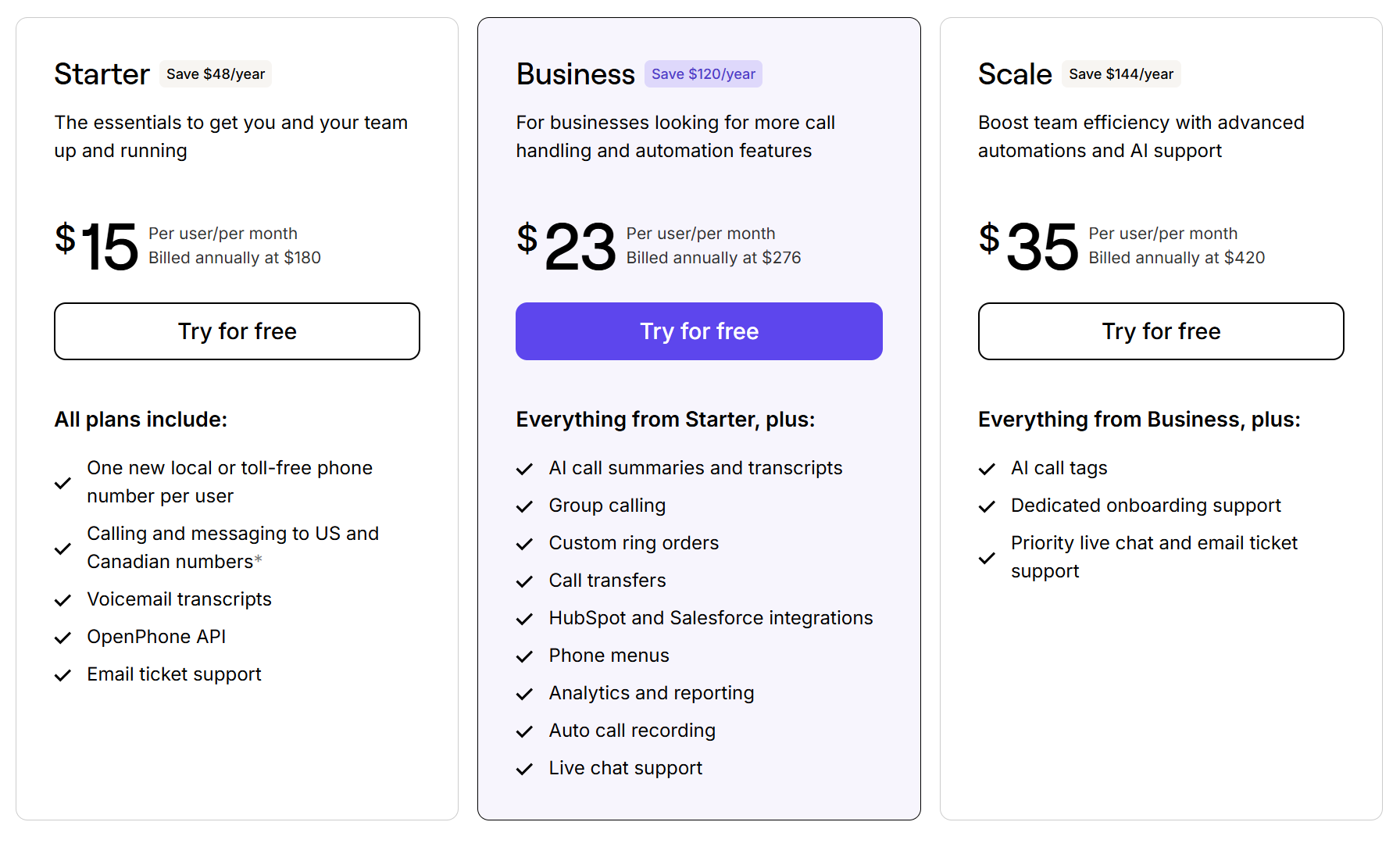
Quo offers transparent pricing and some of the best rates in the industry for must-have business phone features.
- Starter: $15 per user per month for shared phone numbers, voicemail transcriptions, free calls and texts in the US and Canada, and dozens of ways to streamline your business’s phone communication
- Business: $23 per user per month for IVR auto-attendant, call transferring, CRM integrations, analytics, and more advanced features
- Scale: $35 per user per month for AI call tags, dedicated onboarding, inbound phone support, and priority chat and email support
2. Nextiva: Best for omnichannel communication

Nextiva is a VoIP phone service that lets you call people in the US and Canada. It works well for businesses that already use systems like Oracle Sales Cloud or Microsoft Dynamics. It offers more advanced features than basic systems, including video calling and omnichannel communication. However, those features are spread out across different plans, which can make the platform expensive as your needs grow.
Keep in mind that you’re limited with how many SMS and MMS messages you can send. Video call recording is only available if you upgrade. Also, many integrations require extra fees. For some home-service businesses, these limitations can make it difficult to access everything you need without significantly increasing costs.
Key features of Nextiva
- Social media integrations
- SMS support
- Voicemail transcriptions
- Team chat
- Mobile app
Nextiva pricing

You can choose from three different Nextiva pricing plans:
- Core: $15 per user per month to access inbound and outbound voice calls, SMS/MMS up to 100 messages, voicemail transcriptions, and a simple IVR
- Engage: $25 per user per month to access call recording, a toll-free number and 2,000 toll-free minutes, 500 SMS/MMS, video meeting recording, and Microsoft Teams integration
- Scale: $75 per user per month for the inbound sales and service call center, priority and skills-based routing, supervisor dashboard, unlimited texting, up to 10,000 toll-free minutes, and automatic call distribution callback
3. RingCentral: Best for desk phone rentals

RingCentral is a business phone system that supports both traditional desk phones and modern desktop and mobile apps, making it a fit for teams that rely on a mix of devices.
However, several limitations can impact day-to-day use. Texting and call recording come with strict usage limits. For example, the base plan includes just 25 SMS messages per user per month, and shared texting or templates require the Business SMS Booster add-on. Call recording storage is also capped at 90 days unless you upgrade to a higher-tier plan.
There are also challenges with the texting setup. RingCentral’s TCR registration process can take weeks or even months. Some users report delays or repeated rejections when applying. For busy home service businesses, these texting limits, storage restrictions, and upgrade requirements can make it hard to consistently manage customer communication.
Key features of RingCentral
- Basic call management
- Unlimited calls within the US and Canada
- Voicemail-to-text
- Team messaging
- Document sharing
RingCentral pricing

RingCentral’s pricing has three tiers:
- Core: $20 per user per month for unlimited domestic calling, 25 texts per user per month, and 100 pooled toll-free minutes
- Advanced: $25 per user per month for auto-call recording, app integrations like Salesforce and Zendesk, 100 texts per user per month, and 1,000 pooled toll-free minutes
- Ultra: $35 per user per month includes unlimited file sharing for recordings, HD video whiteboards and messaging, 200 texts per user per month, and 10,000 pooled toll-free minutes
If you want to access features like shared texting, compliance, and company reply templates, you’ll need to purchase their Business SMS Booster at $25 per month. You can also access these features in RingCentral’s Customer Engagement Bundle.
4. Grasshopper: Best for multi-digit extensions

Grasshopper is a virtual phone system designed for solo business owners with flat monthly pricing based on the number of lines and extensions. The base plan includes one number, one extension, and unlimited calling and texting in the US and Canada.
However, it has clear limitations as your team grows. Shared calling and call recording require an upgrade, and even then, Grasshopper doesn’t offer true collaboration features. You can’t assign follow-ups within Grasshopper, share context, or work together on customer conversations in real time.
It also lacks third-party integrations. In other words, you can’t connect Grasshopper with CRM or field service tools. This makes it more difficult to keep your team on the same page as conversations get siloed. These gaps can make it easier to miss details.
Key features of Grasshopper
- Call forwarding
- Voicemail to email
- Additional extensions, with an upgrade
- Simultaneous call handling, with an upgrade
- IVR, with an upgrade
Grasshopper pricing

Grasshopper’s pricing plans are as follows:
- True Solo: $14 per month for one user, one phone number, and one extension
- Solo Plus: $25 per month for unlimited users, one number, and three extensions
- Small Business: $55 per month for unlimited users, four numbers, and unlimited extensions
Keep in mind that additional numbers cost $9 per month.
5. Google Voice: Best for existing Google Workspace users

Google Voice is a business phone system built into the Google Workspace ecosystem. It allows you to route after-hours calls to voicemail using Google Calendar and send missed calls and text notifications to Gmail.
But Google Voice doesn’t support shared numbers, which makes team collaboration difficult. It also lacks third-party integrations outside the Google ecosystem, so you can’t connect it to tools like your CRM or field service software.
Texting is also limited, with no built-in ways to save time through shared workflows or automation. For multi-user teams, Google Voice requires a Google Workspace subscription, which adds at least $7 per user per month to your overall cost. For growing home service businesses, these limitations can make it harder to stay organized, collaborate, and scale communication effectively.
Key features of Google Voice
- Unlimited calls in the US and Canada
- Voicemail transcriptions
- Connected to Gmail and Google Calendar
- Three-way calling
- Call recording
Google Voice pricing

Google Voice pricing includes four plans:
- Starter without Workspace: $10 per month, limited to one user, for call recording, three-way calling, voicemail transcription, and mobile and web apps
- Starter: $10 per user per month, with a 10-user maximum, for calls and texts in the US, call forwarding, and SLAs
- Standard: $20 per user per month to access on-demand call recordings, ring groups, and phone menus
- Premier: $30 per user per month to access automatic call recordings and advanced reporting
Besides the first plan listed above, the other Google Voice plans require a Google Workspace subscription, which starts at $7 per user per month.
6. Zoom Phone: Best for existing Zoom users

Zoom Phone is a business phone service that’s part of the Zoom platform. It lets teams call and text from US, Canadian, or numbers based in other countries. Zoom Phone doesn’t support international MMS or video messaging, and features like scheduled texts and shared SMS require the $25 per user per month Power Pack add-on.
Collaboration is also limited. You can’t send or receive texts from a true shared business number. Team members must manually release conversations. There are also limits on how many users can share a number and how many calls can be handled at once.
Finally, the platform can be difficult to navigate. Users report a confusing setup, limited support, and inconsistent features, like call recording and transcription. For home service teams that handle high call volume, these limitations can make it more difficult to respond quickly and work together effectively.
Key features of Zoom Phone
- SMS and MMS
- AI call summaries
- Unlimited calls in the US and Canada, with an upgrade
- Voicemail transcriptions, with an upgrade
- Integration with Zoom video meetings, with an upgrade
Zoom Phone pricing

Adding a phone plan to your Zoom subscription could save some time and effort, but it may not save you money. There are five Zoom Phone pricing plans to choose from:
- US & Canada Metered: $10.50 per user per month for pay-as-you-go calling, AI post-call summaries, and SMS and MMS
- US & Canada Unlimited: $16 per user per month for unlimited domestic calling, voicemail transcriptions, and SMS and MMS
- Global Select: $25 per user per month for unlimited calling in 40+ countries and direct dial numbers
- Pro Plus: $20.50 per user per month for everything in Unlimited plus Zoom Workplace Pro
- Business Plus: $24.50 per user per month for visitor management tools, real-time reporting dashboards, and international calling add-ons, plus Zoom Workspace Business
How to choose the best phone system for your home service business
Choosing the right phone system comes down to how your team works. For home service businesses, that means handling phone calls on the go, staying organized across jobs, and making sure no opportunity is missed.
Here’s what to focus on:
1. Consider your potential costs
Trying to figure out what you can realistically spend? Start by asking yourself a few questions:
- Are you planning to buy new devices for your team, or will they use their existing phones?
- Do you want to pay a monthly rate, or are you considering an annual plan?
- Will your team need to make international calls, or mostly local ones?
Traditional landline or carrier-based systems often come with higher upfront costs. You may need to purchase hardware, pay for installation, and manage ongoing maintenance.
With most VoIP services, you can skip the hardware entirely. Your team can use their existing devices, and you can manage everything through an app. Many providers also offer virtual numbers. These numbers let your team make and receive calls from a business number without needing a separate phone.
It’s also worth thinking about how your costs will scale. As your team grows, you want to be able to add users, numbers, or service areas without completely reworking your setup.
2. Define how much oversight you need
Next, think about how much visibility you want into your team’s communication.
If you’re managing multiple technicians or office staff, you may want to:
- Review call logs to see who’s responding and when
- Listen to call recordings to improve how your team handles customers
- Track performance across team members
With personal cell numbers, this can be difficult. Calls, texts, and voicemails are stored on individual devices, which makes it harder to see the full picture. With VoIP services like Quo, you can retain all your contacts and conversation histories in the same intuitive inbox. That way, if something gets missed, you can step in, follow up, and keep things moving without losing context.
3. Map out how your team uses phones in the field
Your phone system should reflect how your team communicates throughout the day.
Start by asking:
- Are technicians responsible for calling customers when they’re on the way?
- Or is someone in the office handling scheduling and updates?
From there, think about how your team uses their devices:
- Are they relying on a mobile app on a smartphone or tablet?
- Do they need access across different mobile devices, including Android and iOS?
You should also consider how you communicate with customers. Some situations require voice calls. Others can be handled over SMS, like quick updates or appointment confirmations.
Another important factor is how calls are distributed. If calls go to only one person, you risk missing opportunities when they’re unavailable.
Systems with shared numbers allow anyone on your team to answer incoming calls. That flexibility is what helps you respond faster and book more jobs.
4. Identify features that support your team’s growth
Start with features that help you scale. As your team expands, you should be able to quickly add or remove users and numbers without disrupting your workflow. Tools like custom call flows or phone menus with ring order help manage increasing call volume and ensure every call reaches the right person. These features directly impact response time, helping you capture more jobs and avoid missed opportunities.
Next, look for features that give back time to your team. VoIP call forwarding ensures coverage during busy periods or after hours, while voicemail transcription and voicemail-to-email make it easier to follow up quickly. Auto-replies for missed calls and messages help you stay responsive even when your team is unavailable. Together, these features reduce manual work and ensure fewer inquiries slip through the cracks.
Finally, consider how your team will stay aligned as it grows. Shared phone numbers and inboxes allow team members to manage conversations together, while a full call and message history gives everyone the context they need. Call transfers with context help keep communication seamless, so customers don’t have to repeat information. These features improve transparency and make it easier for your team to collaborate as your business scales.
6 Essential phone system features for home service businesses
As you know, running a home service business means managing calls, texts, and job details while your team is constantly on the move. The right phone system should do more than handle calls. It should help you respond faster, stay organized, and make sure no opportunity slips through the cracks.
Here are the features that matter most:
1. Collaborative shared inboxes
When your team is in the field, calls and messages can’t rely on one person. A shared business phone number allows multiple team members to answer calls and send texts from the same number. Calls can follow a set ring order, while texts live in a shared inbox that everyone can access. This makes it easier to split responsibility and keep response times fast, even during busy periods.
Internal threads help your team collaborate on internal communication without your customers being able to see it. You can leave comments next to any customer interaction and tag team members for visibility or to assign tasks. Team members benefit from internal threads because they get the context they need without having to ask colleagues or check their email or Slack.
2. Call recordings and transcripts
No matter your trade, missing a detail can lead to delays or missed opportunities. Call recordings and transcripts give your team a clear record they can reference later without having to manually take notes.
With Quo, calls are automatically logged and stored in a searchable history so your team can quickly find past conversations, confirm details, and improve follow-ups. Call logs also provide insight into missed calls, response times, and team activity. With voicemail transcription, your team can respond faster without listening to every recording.
3. SMS and MMS messaging
Phone calls aren’t always the most efficient way to communicate. Many customers prefer a quick text, especially for simple questions. Your team also likely can use SMS for confirmations, arrival updates, reminders, and follow-ups. MMS takes it a step further. With MMS, you can send photos, videos, PDFs, and job details. Customers can share images before a visit, and your team can send proof of work after the job is complete.
With a provider like Quo, calls and texts between your team and contacts can live in one place. That way, your team gets a clear, centralized view of every interaction without spending a ton of time catching up on conversations.
4. Custom call routing
As your business grows, managing incoming calls manually becomes harder. Call routing directs calls to the right person or team based on rules like business hours, availability, or call type.
Modern systems built for home service teams include features like simultaneous ring, where everyone is notified at once to prevent missed calls. You can also create custom ring groups that send incoming calls to your team in a set sequence. This works well for shared numbers, allowing front-line staff to answer first, with backup coverage if they’re unavailable.
Phone menus take this a step further by letting callers route themselves based on their needs. Customers can select options like “Press one for bookings” or say “Booking” to reach the right team. This reduces transfers, shortens wait times, and improves the overall experience. You can also set up different phone menus based on the time of day. For example, during business hours, calls can be directed to specific departments. After hours, calls can be directed to an on-call team member.
5. 24/7 answering
Not every customer calls during business hours. If no one answers, that opportunity is lost. A 24/7 answering solution helps you stay responsive at all times. While live answering services are one option, they can be costly and harder to scale. AI answering solutions offer a more flexible approach that’s always available.
Some business phone systems, like Quo’s AI agent Sona, act like a virtual receptionist using conversational AI to engage callers, qualify leads, and route urgent calls. Calls are automatically recorded, transcribed, and summarized so your team can quickly catch up later.
6. Integrations
Your phone system should help you save time on repetitive communication-related tasks. Think automatic logging or texts that go out immediately to someone once they fill out a form on your website.
With tools like Quo, integrations can go a step further. You can use Quo’s Claude connector to automatically analyze how your team handles calls and surface opportunities to follow up with contacts you haven’t heard from.
Get started with the best phone system for home service businesses

Choosing the right phone system can make a direct impact on how quickly you respond, how well your team stays organized, and how many jobs you book.
Quo is a VoIP phone system built for home service teams, like HVAC, plumbers, electricians, cleaners, and landscapers, who need to manage calls and customer communication on the go. It works on the devices you already use. That way, your team can stay connected without relying on desk phones or separate systems.
Here’s how Quo helps manage customer communications from anywhere:
- Use shared business phone numbers or assign numbers to individual team members.
- Keep every call, text, and voicemail organized with call recording, AI summaries, and transcripts.
- Respond to customers anytime with automated workflows and 24/7 answering.
- Sync conversations with your CRM and other tools to streamline communication.
The result is faster response times, better visibility across your team, and fewer missed opportunities. See why Quo is the best phone system for home service companies by signing up for a seven-day free trial.
FAQ
To stop missing calls on the job, consider using a business phone system like Quo that doesn’t rely on one person to answer every call. Features like call forwarding and shared numbers let calls route to the next available team member, so nothing goes unanswered while you’re on site. You can also use Quo’s AI voice agent, Sona, to take calls and qualify leads when your team is unavailable to pick up.
The best phone system for your business depends on your team size, workflow, and how you handle customer communication. Most home service businesses benefit from VoIP systems like Quo that offer mobile access and shared visibility across calls and messages.
For most home service businesses, a VoIP phone system is the better option. It’s more flexible, cost-effective, and works on the devices your team already uses. Traditional landlines require hardware and installation, making them harder to scale. VoIP systems are built for mobile teams, allowing you to manage calls from almost anywhere.
Yes. With business phone systems like Quo that support shared numbers, multiple team members can call and text from the same business number. This allows anyone on your team to answer incoming calls or texts from the same number.
A VoIP phone system lets you make and receive phone calls over the internet instead of a traditional landline or cell phone. It works by changing your voice into digital data, sending it over the internet, and changing it back into audio on the other end in real time. VoIP systems are more flexible, cheaper, and easier to scale than traditional phone systems because they run on devices that connect to the internet.
Start by choosing a business phone system that fits your team’s needs and how you handle calls. From there, set up your business phone numbers and add users, then configure basics like call routing, business hours, and voicemail. Most modern VoIP systems don’t require hardware. With most VoIP solutions, your team can start making and receiving calls right away using a mobile app or desktop.