Ooma first launched as a ‘VoIP-in-a-box’ designed to help homeowners make cheaper calls on their landline phones. Since 2008, it’s expanded to offer VoIP apps and desk phones to small businesses and homeowners.
While enterprise brands may find value in Ooma, smaller teams often find its hidden fees and limited features make it less appealing.
So, is Ooma worth it? In this guide, we’ll cover Ooma pricing for businesses, features, limitations, and additional fees you might miss. Plus, we explore an alternative that could be a better fit.
TL;DR
- Ooma’s plans come with usage limits, including pooled texting caps and outbound calling thresholds that aren’t always obvious upfront.
- As your team grows, you may need to upgrade plans or pay for add-ons to unlock features that other providers include on their base plan.
Ooma Office pricing plans at a glance

There are four business phone plans available with Ooma:

Let’s take a closer look at each Ooma pricing plan, side-by-side:
| Feature | Essentials | Pro | Pro Plus | Enterprise |
|---|---|---|---|---|
| Price | $19.95 per user per month | $24.95 per user per month | $29.95 per user per month | Custom pricing |
| Best for | Solopreneurs and micro businesses that only need basic business calling | Small businesses with video conferencing and limited texting needs | Large outbound sales teams needing auto-dialers and CRM integrations | Larger businesses that use Microsoft Teams |
| Text messaging | X | Up to 250 messages per month | Up to 1,000 messages per month | Not publicly listed |
| Toll-free minutes | 500 minutes of inbound calls per month | 500 minutes of inbound calls per month | 500 minutes of inbound calls per month | Not publicly listed |
| Voicemail transcription | X | ✓ | ✓ | ✓ |
| Shared voicemail boxes | X | X | Up to 10 users | Up to 10 users |
| Call recording | X | On-demand/automatic | On-demand/automatic | On-demand/automatic |
| Conference calling | Up to 10 participants | Up to 25 participants | Up to 100 participants | Not publicly listed |
| Video conferencing | X | Up to 25 participants | Up to 100 participants | Not publicly listed |
| Call and text analytics | X | ✓ | ✓ | ✓ |
| Auto-dialer | X | X | ✓ | ✓ |
| CRM integrations | X | X | ✓ | ✓ |
| Jobber Integration | X | X | ✓ | ✓ |
| Scheduled texts | X | ✓ | ✓ | ✓ |
Office Essentials plan
The Essentials plan costs $19.95 per user per month, with no annual plans available to reduce the price. It’s best for solopreneurs and micro businesses that don’t anticipate scaling their setup anytime soon.
It comes with “50 standard features” — but is still missing basic business tools. Here are the features you can expect to get:
- Unlimited calls in the US, Canada, Mexico, and Puerto Rico
- Mobile app for Android + iOS
- Toll-free number with 500 minutes of inbound calls per month
- Music on hold
- Call logs
- Ring groups
- Call forwarding
- Call blocking
- One-bridge conference calling so team members and clients have a direct dial number to easily join your conference calls
- IP phone paging
- Analog and virtual fax support
💡Bottom line: The basic plan is missing desktop calling, call recording, and texting. These are basic features most Ooma competitors include at this price point.
Office Pro plan
The Pro plan costs $24.95 per user per month, and like the Essentials plan, there’s no annual pricing available. This tier is best for teams that need to host video calls with clients.
But you’ll notice the Pro plan still lacks key features that other business phone systems offer on their base plans.
Here are the tools you’ll get access to:
- Desktop app with calling
- Video conferencing
- Voicemail transcriptions
- Caller ID
- Call recording
- Enhanced call blocking
- Integrations with Microsoft Office 365 and Google Calendars
Texting with 250 messages shared across your entire account
💡Bottom line: The mid-tier Ooma pricing plan adds desktop calling and text messaging. However, there’s no way to push call data to your CRM since it still lacks CRM integrations. Video calls are capped at 25 participants per call. It also only includes up to 250 messages per month across your account.The kicker? You’ll need to upgrade your plan again if you plan on sending more per month.
Office Pro Plus plan
The Pro Plus plan costs $29.95 per user per month, with no annual pricing available. It’s ideal for outbound sales teams, since it comes with an auto dialer.
Here are the features you can expect to get if you choose Pro Plus:
- CRM integrations with apps like Zoho CRM and Salesforce
- 1,000 text messages per month for your entire account
- 100-person video conferences
- Call queues
- Hot desking
- Team chat
- Zapier integration
- Advanced text messaging with shift-to-text that lets callers switch to text by pressing a key on their phones
- Video meeting recordings
- Call screening
- Auto dialer
Bottom line: The Ooma Office Pro Plus plan still doesn’t offer anything truly unlimited. Text messaging is capped at 1,000 per month across your account. Plus, outbound toll-free calls still come with the same limitations as the Pro plan.
Ooma Enterprise plan
Ooma’s pricing plan for enterprise businesses comes with custom pricing, so you’ll need to contact sales for a quote. It’s designed for larger organizations that use Microsoft Teams.
Here are the features you can expect to get:
- SIP trunking support so you can keep your existing office phone system, but route calls through the internet instead of traditional phone lines
- Microsoft Teams integration
- Advanced analytics
- Custom VoIP implementation to help you get up and running
💡Bottom line:The Enterprise plan doesn’t publicly list how many text messages or toll-free minutes are included. Keep in mind that no matter how much you upgrade, you’ll never have access to certain features growing teams need. This includes basic tools like texting auto-replies and AI call transcriptions.
Additional costs that come with using Ooma
Here are some other costs that add to Ooma pricing you should know about before signing up:
- Directory assistance, or 411: Want to research local brands, freelancers, or prospects? That’ll cost $0.99 per call.
- Activation fee: No matter which plan you choose, you’ll pay a one-time activation fee of $29.95.
- Texting limits: You need to upgrade to the Pro plan to unlock SMS. However, this limits you to 250 text messages for your entire account, plus $0.0095 per message over the limit. You can upgrade to the Pro Plus plan for up to 1,000 text messages per month, but you may still end up paying extra. You can also purchase message bundles — for example, 3,000 additional messages cost $20.
- Toll-free calling: You only get 500 included toll-free minutes per month. If you want more, you have to purchase a separate toll-free plan for $15.99 per month to get 1,000 extra minutes. Plus, you’ll also have to pay $.029 more for each minute overs your limit.
- Toll-free numbers: You can have up to 20 toll-free numbers per account, and each additional toll-free number costs $9.95 a month.
- Additional local numbers: These cost $9.95 per number per month. Double what competitors like Quo, formerly OpenPhone, charge for the same feature.
- International calling: The cost of reaching overseas customers depends on the country you’re trying to call. Ooma already includes the US, Canada, Mexico, and Puerto Rico, but prices for other countries range from $0.02 to $0.48 per minute or more.
- Extended warranty: This costs $39.99 per year for equipment like desk phones.
- Hardware: Ooma IP desk phones start at $59.99 and are a one-time purchase.
Quo: A more effective alternative to Ooma
Smaller business owners need a business phone system that’s flexible enough to suit their changing needs. That’s why they turn to Quo instead of Ooma — a platform built by and for small and growing business owners.
Let’s take a closer look at how Quo compares:
1. Business-friendly pricing
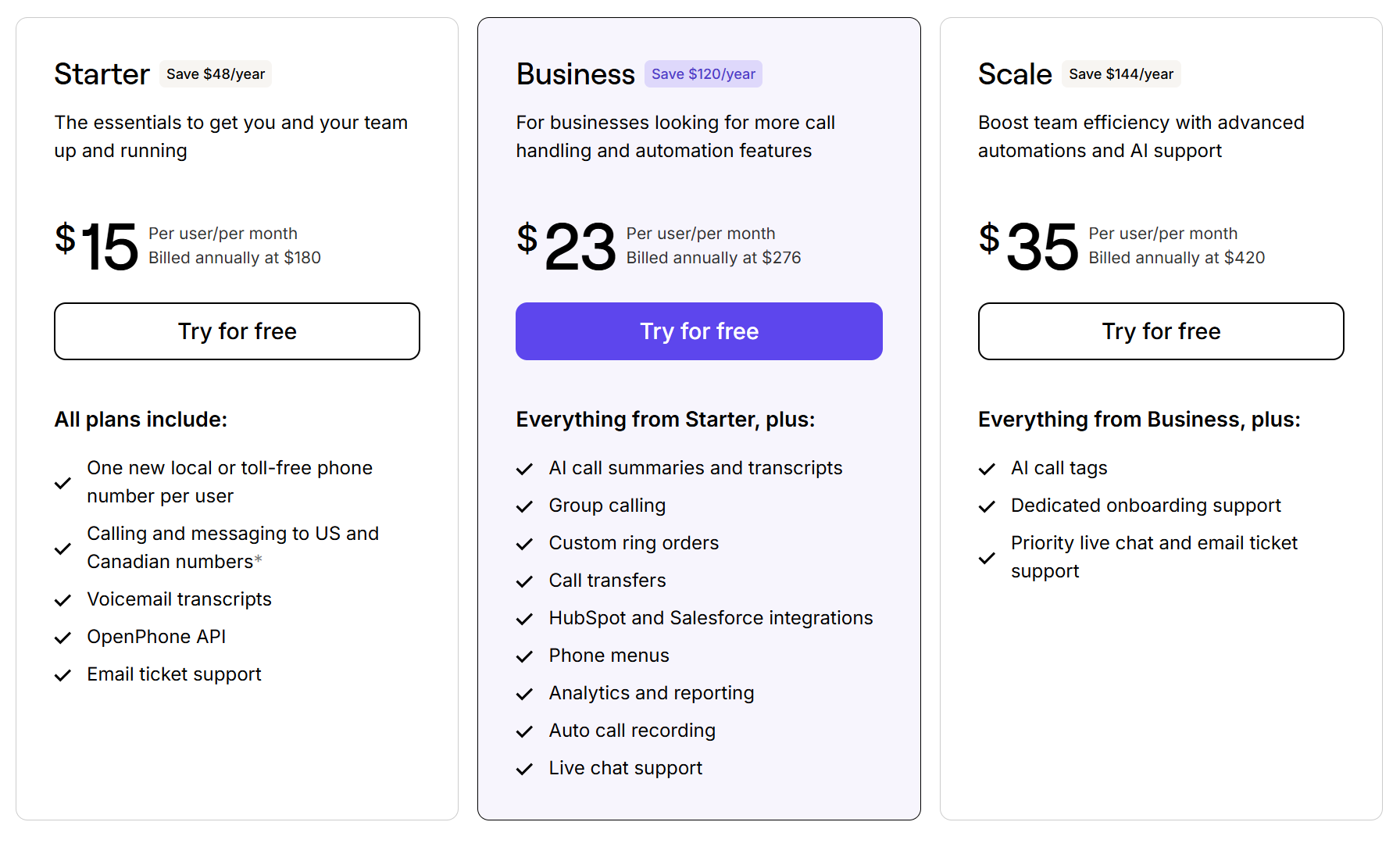
Quo’s transparent pricing starts at $15 per user per month, with no hidden fees. We’ve listed everything you’ll need directly on our pricing page so you can compare your options at a glance.
The best part? Integrations are available on every tier, unlike Ooma.
2. Easy to connect with your existing tools
Quo seamlessly integrates with the tools you already use, reducing work for your team and improving efficiency. We connect to more than 8,000 third-party apps, so you can put more work on autopilot.
Our Zapier and Make integrations, which can help you create automated workflows, are available on our Starter plan. You can also integrate with email, Slack, and your Google contacts or set up webhooks if you need more flexibility.
Ready to connect with your CRM? Upgrade to the Business tier to unlock HubSpot, Salesforce, Pipedrive, Attio, and Gong integrations. It’s still more affordable than Ooma’s Pro Plus plan — and a lot easier to set up.
3. Get clear insights into your team’s performance

It’s not easy to get visibility and context using Ooma. With Quo, however, you can do so on every plan.
We make it easy to:
- Track messages, calls, unique conversations, and time on calls in our analytics dashboard
- Tap into AI call transcripts and summaries to get context more quickly
- Check heat maps of popular call times to identify high call volume dates or times
- Automatically label calls based on what the conversation was about with AI call tags, so you can quickly identify trends or negative sentiment without listening to entire recordings
You can even export these analytics to a CSV file at any time.
4. Get unlimited calling and messaging
Every Quo plan comes with truly unlimited calls and texts — not just ‘unlimited’ in the marketing sense. We never limit toll-free minutes or the amount of numbers you buy. Additional local US, Canadian, and North American toll-free numbers cost $5 per number per month.
Plus, you’ll notice our base plan includes features Ooma’s base plan lacks. For example, you’ll get access to on-demand call recording and a desktop app that lets you place calls.
There’s another big difference when it comes to sending texts. Ooma only lets you complete A2P 10DLC registration if you’re a registered business in the US or Canada. That means you’ll need an Employer Identification Number or a Canadian federal or provincial business tax number. If you don’t have one, you can’t text US customers.
That’s not the case with Quo. You can register as a business if you’re based in most other countries in the world if you have business tax identification. Alternatively, we let you complete the US registration process without business tax identification. Just keep in mind if you register without business tax identification, you’ll need either a US or Canadian cell number as part of the verification process.
5. Collaborate to reply faster and provide better service

Ooma requires multiple upgrades to unlock collaboration features. With Quo, you can split responsibility for incoming conversations on every plan.
We offer team collaboration tools that let you:
- Set up custom contact fields to track customer-specific information
- Use internal threads and mentions to delegate tasks among coworkers
- Tap into productivity tools such as auto-replies and put routine tasks on autopilot
Plus, our shared phone numbers let you work together as a team. Everyone can see who has responded to incoming calls and texts, which helps you maintain visibility and keep all your ducks in a row.

6. Work faster and smarter with AI-powered tools

Looking to work more efficiently and automate tasks with AI? Quo delivers advanced AI capabilities like:
- AI call summaries and transcripts. Save time taking notes and following up with searchable transcripts that include post-call action items.
- AI contact suggestions. Quo can automatically save contacts for you based on your conversation history and voicemail.
- 24/7 virtual answering service. Acquire customers you would otherwise lose out on if your team doesn’t pick up the phone. Sona can automatically handle common questions whenever your team is unavailable, send SMS messages during live calls, and more.
How Quo pricing compares to Ooma pricing
So, is Ooma worth the investment? For large enterprises or traditional offices, it might be. But for growing businesses with remote or international teams, Ooma’s pricing and outdated features may not be the best fit.
In contrast, Quo is designed for growing and small businesses that want to scale — without losing the personal touch. We’re also trusted by more than 90,000 companies — from startups to Fortune 500s — and rated #1 in customer satisfaction on G2.
Take a look at how Quo compares to Ooma below:
| Features | Quo | Ooma |
|---|---|---|
| Price | $15 per user per month | $19.95 per user per month |
| Unlimited calling | ✓ | 5,000-minute limit for outbound calling per month |
| SMS, MMS to US & Canada | ✓ | Requires upgrade |
| Additional phone numbers | $5 per number per month | $9.95 per number per month |
| Call recording | ✓ | Requires upgrade |
| Shared phone numbers | ✓ | Requires upgrade |
| Call transcriptions and summaries | ✓ | X |
| Auto-replies | ✓ | X |
| Text message templates | ✓ | Requires upgrade |
| Slack integration | ✓ | X |
| iOS and Android apps | ✓ | ✓ |
| Desktop-based apps | ✓ | Calling requires upgrade |
Pros and cons of Ooma Business pricing plans
Ooma works well for businesses with physical locations that rely on desk phones and pagers. However, it may not be ideal for small or distributed teams that need advanced features to support virtual phone numbers.
Pros
- Cross-border calling support: With Ooma, you can get outbound calls to the US, Canada, Mexico, and Puerto Rico.
- Overhead paging: If your team runs a brick and mortar retail store, you can access overhead paging and intercom tools.
- Move calls to text: Give your callers the option to switch from a live call to text messaging. It helps reduce call volume and frees up your team to handle conversations that need a personal touch.
Cons
- No unlimited minutes: You’re limited to a max of 5,000 outbound minutes per month with Ooma.
- No unlimited texts: You can only send a max of 1,000 pooled text messages per month on the most expensive plan, which costs $29.95 per user per month.
- Limited integrations: You have to upgrade multiple times to unlock CRM integrations.
- Limited desktop app: You can’t make calls with the desktop app unless you upgrade to the Pro plan.
See why Quo is the best business phone service provider

Ooma might be a match for enterprise companies with desk phones, but for most business owners, it doesn’t keep up with the times. Add that sentiment to its high prices and additional fees, and you’ll see it’s a deal breaker in more ways than one.
The good news is that Quo was designed to grow alongside your business. This means you’ll have access to advanced features like virtual receptionists and call transcriptions. You’ll also get truly unlimited calls and texts in the US and Canada, starting at $15 per user per month.
No need to take our word for it, though.
Test Quo today with our seven-day free trial and see why we’re rated the #1 business phone solution for small business owners.
FAQs
Ooma is a residential and business VoIP provider designed to replace plain old telephone systems with your internet connection. You can use Ooma’s system on desk phones, laptops, or cell phones. This allows you to make calls, send texts, and hold video conferences — as long as they fall within Ooma’s strict limits.
Ooma has several disadvantages. For example, it has limited integrations, and most are only available on the top-tier plans. Its basic business features, like call recording and texting, are also locked behind expensive upgrades. This makes it a poor fit for small and growing businesses.
Ooma’s business pricing appears fair initially, but it isn’t scalable due to extra fees and limited features. Alternative business phone systems like Quo give you features that support your business’s ability to grow with fewer limitations on each plan.
Ooma’s Office plans start at $19.95 per user per month for Essentials, $24.95 for Pro, and $29.95 for Pro Plus. The Enterprise plan comes with custom pricing, so you’ll need to contact sales for a quote. Keep in mind these base prices don’t include add-ons like extra toll-free minutes and additional texting bundles. Depending on your usage, your actual monthly cost can end up being higher than the advertised rate.
It depends on what you need. If you’re a very small team looking for basic service and don’t need to access third-party integrations, Ooma may work. But if you need to scale your business, you’ll find Ooma restrictive — especially as your call and message volume grows.
Yes, Ooma offers a 30-day free trial for its Office plans.
Not sure if Ooma is the right fit for your team? Ask yourself these questions:
– Do you send a lot of texts? Ooma’s messaging features can feel restrictive, especially if your team sends regular appointment reminders, conducts follow-ups, and has two-way conversations. Review messaging limits and potential overage costs carefully.
– Do you host video meetings with your team and clients? Video calls aren’t available on the base plan.
– Do you want to save time reviewing calls? Without AI call transcriptions, call summaries, or call tags, your team will spend a lot of time manually reviewing conversations.
– Do you need to call from your computer? With Ooma, you can’t place calls from the desktop app unless you upgrade.