How Cloud925 modernizes law firms with Quo

Cloud925 Services helps law firms modernize the way they work. That can mean choosing a better tech stack, building automations, implementing new tools, or even creating custom software for a firm from scratch.
If you ask their founder and CEO, Rachel Huff, what Cloud925 Services does, her short answer is that they help law firms figure out technology and implement it. The long answer is in the details of each implementation.
Sometimes it means helping an Operations Lead within a firm decide the best place to focus their attention next. Sometimes it means setting up tools like Clio and Quo. Sometimes it means building a custom system that replaces off-the-shelf practice management software altogether. Often it’s a combination of all three.
Cloud925’s recent in-person event provides a good example of how they work not just to advise firms, but to help them take action.
Go to just about any legal technology conference today, and you'll hear about AI in virtually every single session. Why you should use it, how you’re being left behind if you don’t. What you won’t find much of is hands-on work that helps you put it to use in your practice after you leave.
Rachel wanted something different. So she started an in-person event with the goal of making it just as valuable as her company’s consultation.
When she hosted their first in-person event, she didn't want law firm owners to spend two days hearing about everything AI could do, only to return to their busy work lives with no time to do any of it. She wanted everyone to build something at the event they could use immediately, and learn enough that they could continue to work with more advanced tech in the real world of their practice.
So on the event’s final day, Cloud925 gave attendees two hours to create a new app, AI skill, or workflow for their firm from scratch. Rachel and her team walked around helping everyone build, then each person presented what they'd made, letting everyone in attendance learn from each other’s experience.
This captures Cloud925's approach to technology. They don't just suggest new tools for law firms to use and then walk away while they struggle to get it going; they help them put those tools to work.
For Rachel, that increasingly means helping firms connect the conversations happening in their phone system to everything they can now do with AI.
As Cloud925 works with law firms on everything from choosing their tech stack to building custom software, Rachel’s team encounters many different phone systems along the way. Most are out of date, some of them so much so that they wouldn’t be out of place in an old John Grisham novel.
“A lot of people are on more outdated systems that don’t really work with AI and don’t work with automations and aren’t friendly to integrate with,” Rachel says.
That was fine when all your phone could do, no matter how modern or old it is, was let you talk on the phone. Now it’s a big problem.
Every call into a law firm contains potentially useful information. A new prospect explains their case during intake. A client calls with a question. An attorney commits to a specific follow-up. A front office employee answers the same question for the fifth time that week.
The phone system has all of this valuable context because it’s there for all of these conversations. But in most systems, that context is lost the moment the call ends. Imagine if every time you sent or received an email, it disappeared after you read it, and you could never search for it or get that context again unless you quickly took notes or paid for some sort of email transcription company to do so for you. That wouldn’t be acceptable. It’d be ridiculous. So why is it acceptable for equally as valuable phone conversations?
For Cloud925, a modern phone system needed to do more than make calls. It needed to be something the rest of a firm's technology could actually work with, and be able to power a lot of what they do.
That's one reason Rachel now recommends Quo.
“Quo is the first tool I tell people to look into when we start talking about phone systems and modernizing their communication.”
Quo had native integrations with tools like Zapier and Make, along with a full API Cloud925 could use to build its own workflows.
Then Quo’s MCP gave Rachel another way to put all that conversation data to work: connect it directly to AI without any extra steps.
But that leaves the question: what exactly can you do when you “connect it directly to AI”?

Founder, Cloud925
Let’s use intake as an example. Experienced attorneys aren't on intake calls, and even the most perfectly written script in the world won’t ensure an employee handles them in the best possible way. Real conversations can go in a thousand different directions.
So when Rachel recently helped a law firm hire a new employee to handle intake, she wanted to give that employee a faster way to onboard and a way to grade their own calls so they could improve quickly.
Using Quo's Claude connector, Cloud925 pulled transcripts from all the firm’s recent intake calls. Then they built a small app in Claude that analyzed those conversations and graded them based on how well the conversations went.
Just like that, the firm had its own AI intake coach, built around its actual calls. It could give the new employee tons of examples of the best calls and generate best practices for them to follow. It could then grade each of her calls and suggest improvements for the next one.
This all only took a couple of hours.
Rachel had seen a standalone SaaS product advertising something similar at a conference the year before, selling for hundreds and hundreds of dollars a month.
“I remember looking at that, and I was like, ‘I feel like I could rebuild that. And I could! With Quo and Claude’s native connector, it took us maybe a couple hours to build a coach that was fully custom to this firm.”
This intake coach is just one example of the kind of action-based analysis Rachel can help firms do.
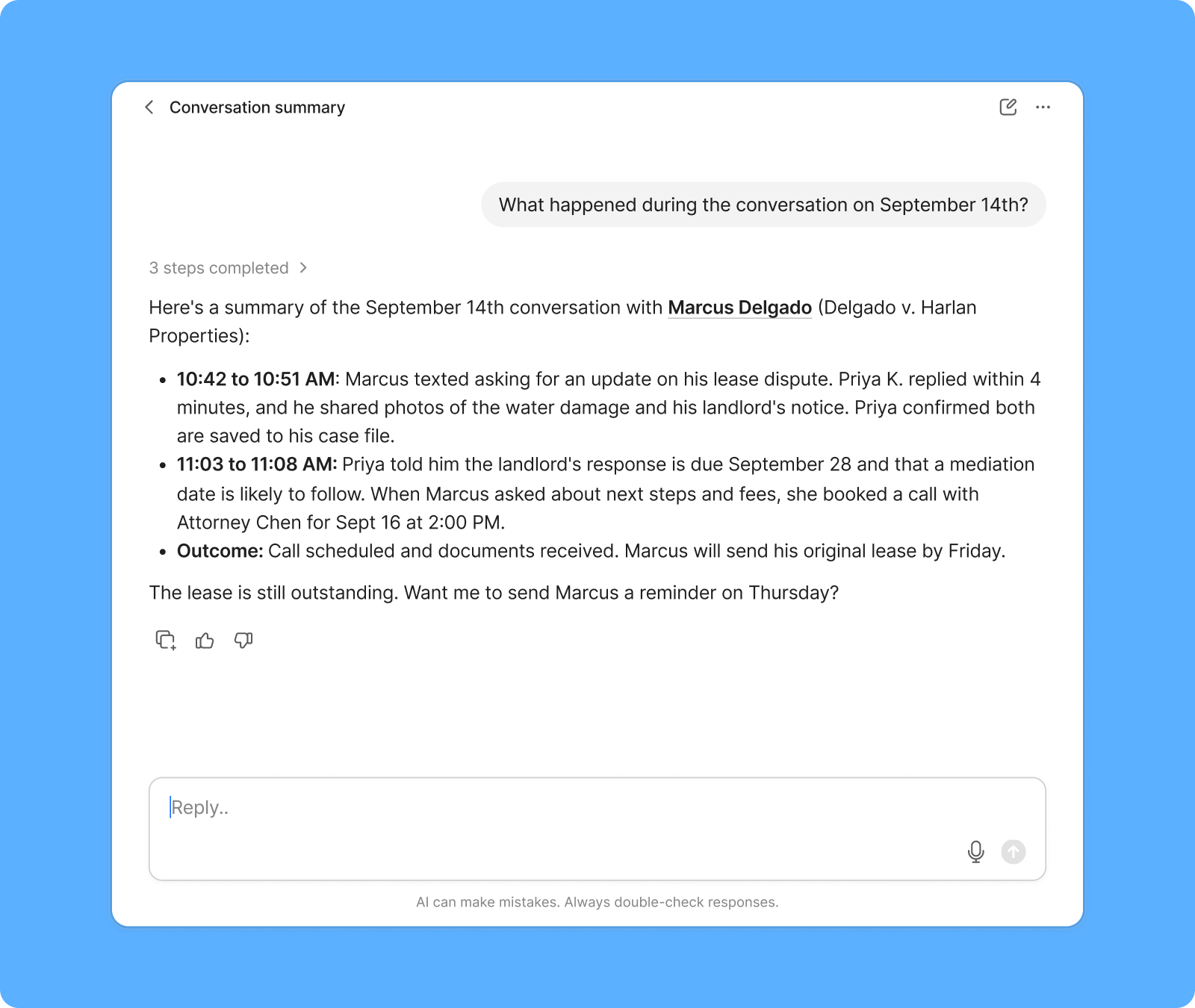
When did this client last call? What happened during the conversation on the 14th?
No digging through call logs. No exporting a spreadsheet. No complicated setup just to get started.
“We just show people how to use it, and it’s so easy,” Rachel says. “I’m just like, ‘Okay, go on there and just start asking questions.’”
The phone system quickly changes from a way to have conversations to a database of all the key knowledge shared and built in those conversations.
The same phone system that lets Rachel build an AI intake coach also has to work for the person who just needs to answer the phone and simply benefit from all the new stuff that’s being built around them.
Rachel got a good test of that when she helped move her mom's law firm to Quo.
One of the firm's receptionists is in her 70s and spends much of her day answering calls. She was nervous about switching away from the phone system she'd gotten used to.
By the end of her first week, that concern was gone.
“She was like, ‘This was so easy.’ She likes how she can have it up on her screen. And she likes how it looks new, like her iPhone.”
Rachel estimates it took less than an afternoon to get the entire firm up and running on Quo.
That combination is why Quo has become the phone system she usually recommends when Cloud925 is helping a law firm modernize its stack.
An employee can open Quo and know what to click. An attorney can answer calls and keep up with conversations wherever they are. A manager can see how all the work is going.
And when a firm is ready to do more, Cloud925 can connect those same conversations to automations, custom software, and AI.
For Rachel, that's what modern software should look like: easy enough that you don't need to think about it, but open enough that you're never boxed in by it.
“You can tell, when you’re just on the platform, that it’s built by someone who also wanted a better solution.”