How Rebody Health cut patient response time from an hour to minutes



Median first response to patients, down from about an hour.

Routine patient fixes handled on the Quo API, with no one on the team stepping in.

$70,000 saved by not needing to hire someone for support.
Rebody Health is a telehealth company offering prescription peptide therapy online, with treatments for energy, sleep, recovery, libido, and skin. Patients complete an online visit, a licensed clinician reviews their health history, and when a prescription is appropriate, a licensed U.S. pharmacy fills it and ships it to their door.
A patient had just checked out on Rebody Health's website. Their card had been charged, but nothing else seemed to be happening. As co-founder George Ezenna remembers it, their angry message boiled down to: “When am I going to get tracking? What's happening?”
Rebody wrote back fast. In their reply, they apologized, pointed the patient to an email that should already be in their inbox, and gave them a number to call with any other questions. The patient's tone shifted immediately. Everything had been approved, they realized, and they thanked Rebody for its “impressively responsive customer service.”
“In that case, we didn't really do anything,” George says. “We just kind of responded to their frustration.” That alone, he adds, was enough for the patient to think, “Oh, wow, this is a brand that's responsive.”
George has been a frustrated patient himself. He spent years with chronic GI trouble that forced him to slow down at work. He saw alternative and functional medicine doctors and dietitians until he found a clinician who let him explore different treatments “in a reasonable way.”
His co-founder, Nick Locascio, a friend from college, was on a similar path. Before Rebody, George started CloudTrucks, a trucking software company. Together they founded Rebody, a telehealth company, because they saw “a lot of noise in this space” and wanted to offer a clinician-guided experience that's more humane.
Rebody started in May 2026 and began seeing patients over the summer. It’s still just George and Nick, working with a team of clinicians. They have around 200 patients so far, and when the phone rings, it goes through to one of them.
George and Nick knew from the start to avoid putting a personal number on their website, so Nick got a Google Voice number. Calls rang only on his phone. If he couldn't answer, there was no way to route the call to George, who had to be near Nick's phone to see anything. Nobody could see who called or why, and there were no transcripts to hand off to an LLM. That was with only “five or 10 customers.” Once he and Nick wanted automation, George says, “it was like, okay, we need an actual product here.”
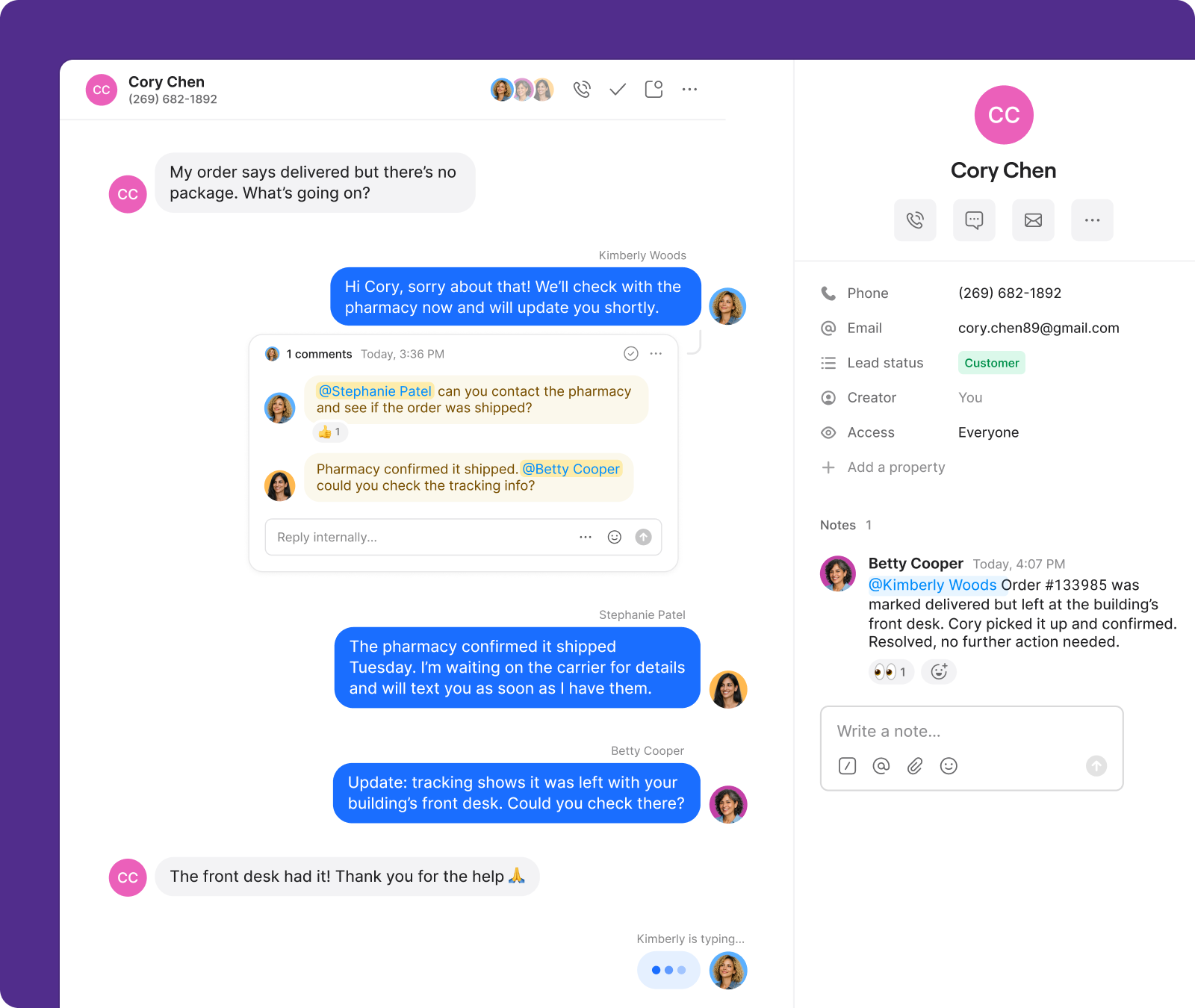
Most customer requests at Rebody can't be solved on a single call. If a patient says their medication shows as delivered and asks what's happening, George has to hang up to call the pharmacy or a provider. A text follow-up usually comes next, so how fast Rebody replies completely shapes how the patient feels and can impact retaining them as a customer.

Co-founder and CEO
George first heard about Quo from our co-founder Daryna Kulya around the time we rebranded from OpenPhone. He liked how she was thinking about automation, and building a product that's friendly for developers.
“Nick and I are both very technical, and being dev friendly is key to how we make vendor decisions,” he says.
His first question for Daryna was whether Quo signs business associate agreements, BAAs, which HIPAA requires of vendors that may handle patient information. Plenty of startups with impressive automation don’t, which made them “a non-starter,” George says. Rebody signed its BAA with Quo and was up and running about a week after George's first conversation with Daryna. Some vendors only offer the agreement on an enterprise plan, and getting it signed can take a couple of weeks of back and forth. “For a small brand like us, that’s just a time sink,” George says.
Quo conversations are intended to stay logistical: delivery and tracking questions, pricing, order status. Clinical questions stay between patient and their partnering providers in Rebody's portal.
A normal ecommerce company could look up a package for anyone who calls. But the package in this case is medication, so they first confirm they’re talking to the right person. Rebody doesn't start support until it's been verified, and it steers people to the online portal since logging in confirms a customer’s identity. “Even product information can be health information,” George says.
Rebody has three Quo numbers, but one does nearly all the work: the Sales line. It handles intake, sales, and order questions, including from people partway through the intake form who suddenly wonder, as George puts it, “What are all these questions?” The other two numbers barely get used. Order confirmation and refill texts go out through the Quo API.
Early on, they were swamped by spam calls. Rebody asked the Quo team what to do. The fix was a phone menu that makes callers press a key. “A lot of the spam is not super sophisticated,” George says. “You add a phone menu and it doesn't go through.”
The founders worried a menu would make Rebody feel impersonal, since “a lot of people are sensitive to anything that feels like a rigid phone tree.” But, says George: “It hasn't been an issue at all, and it's massively reduced the spam.”
Even when neither founder can pick up, nothing falls through the cracks. Every text and call reaches Rebody's custom ops dashboard through the Quo API, including missed calls and voicemails. “Ideally, we pick up every call,” George says, “but it’s critical that we’re just not losing context.”
Summer, Rebody's own tool built on top of Quo, reads every incoming message and gives it an urgency level. Then it opens a case, looks into it across Rebody's orders, pharmacy partners, and telehealth providers, and proposes a fix. A recent order that doesn’t have tracking details yet can probably wait. An older order that still hasn’t arrived gets flagged as high urgency.
Summer handles routine fixes, like texting a tracking link, by itself. If it’s more complex, like an ongoing problem at a pharmacy, Summer may misread it, so the founders step in. George also texts plenty of fixes himself from the Quo mobile app, his “primary entry point,” without sitting down at a computer.
“Quo is the phone layer,” George says, “and Summer is what keeps patients, pharmacies, and providers in sync.”
Quo also shows when a teammate is reading or typing a message, which matters when two founders share one inbox. They’re both so quick to jump in to help that this has saved them “from a number of hiccups.”
Before, three or four basic requests, like a password reset, had to be handled one at a time. “The context switching hurts,” George says. “Now we can see a bunch of similar issues together and fix the underlying issue” before replying to everyone it affected.
Sometimes the underlying issue is the website itself. Callers kept asking how to pause a subscription while traveling. The website didn’t offer it, so Rebody added it. The phone greeting now points callers there, though George and Nick are still happy to help out over the phone. The founders talk to everyone who calls, on purpose, because “it might just be something broken with the site or something broken with our communication,” George says. “We’re very much in an understanding phase.”
Before, replies waited until he or Nick could stop and work through everything that had come in. Now incoming messages are triaged right away, so the simple ones get answered quickly. Median first response time is down from about an hour to about five minutes, by George’s estimate.
In late October, Rebody turned on Summer’s auto-run, which lets it carry out routine fixes without sign-off. Since then, about 95% of the fixes it’s run needed no one on the team to step in.
Rebody also hasn’t hired anyone for support. “Quo and Summer cover what that hire would have done,” George says.
Patients have noticed Rebody’s speed. The patient from the checkout mix-up was one of two who recently wrote in to praise their support. Both, George says, were surprised to get a quick reply from a person.
The hours George and Nick spend on the phone haven't dropped since switching to Quo, but that’s only because Rebody has grown a lot, and the founders want to ensure more automation doesn't make Rebody feel impersonal. “I'm always surprised at how much people call and text, ‘cause I don't call businesses myself,” George says.
Next, George wants to automate the follow-up work that patient questions create. Today, when a question needs a pharmacy or a clinician, George or Nick has to step away, make that call themselves, then text the patient an update. Some pharmacies can only be reached by leaving a message. George wants those calls, messages, and texts to happen automatically, triggered by the conversation Rebody is already having with the patient in Quo.
George's advice to a telehealth founder still using a personal cell is to get off it. “I would not put my personal cell on the internet,” he says. It's easy to fall for “the illusion of, man, I only have like 10 calls a day,” he adds, but those numbers can go up quickly, and a platform lets you spot patterns before the calls pile up.
Even “I don't know just yet” or “we're still looking into it” feels good to a patient when it arrives fast, George says, because they know, “Okay, we're top of mind. This company hasn't forgotten about us even though this thing hasn't been resolved yet.”
Co-founder and CEO