So you’ve outgrown the days of free calling apps or relying on your personal number to run your business. Congrats! Now you’re thinking of upgrading to a true business phone system — and you’ve got your eye on hosted PBX providers.
But with so many options, where do you even start? And how do you tell which trade-offs come with each? You can use this guide to compare the best hosted PBX phone systems, including who they’re best for, top features, pricing, and what reviewers say.
What is a hosted PBX provider?
A hosted PBX (Private Branch Exchange) provider, also called virtual PBX, lets you make calls and send texts through your internet connection. It doesn’t use traditional landlines like on-premises (traditional) PBX phone systems. Instead, you can use Voice over Internet Protocol (or VoIP) technology to get calling features without physical hardware.
Here’s how a hosted PBX service works:
- You sign up for an online account, like you would for Netflix or Amazon.
- You pay a monthly subscription, usually per user. Some providers offer additional integrations and features as add-ons so you can customize the platform to your business needs.
- You choose your business phone numbers (local, toll-free, or vanity). Depending on the provider, you might also be able to port existing business numbers. Quo lets you do this by filling out a two-minute form in app.
- You and your team download an app or use the browser. Now, you can make and receive calls, texts, and voicemails on your laptop, tablet, or mobile phone.
Your hosted PBX provider handles all the headaches in the backend — like maintenance, updates, and security — so all you need is a laptop, a mobile phone, and WiFi to get started.
How the top hosted PBX solutions compare
Here’s a visual breakdown of the best hosted or cloud PBX providers and how they stack up:
| Provider | Best for | Starting price | Additional number cost | G2 rating |
|---|---|---|---|---|
| Quo | Small and growing businesses | $15 per user per month | $5 per number per month | 4.7/5 |
| RingCentral | Desk phone rentals | $20 per user per month | $4.99 per number per month | 4.1/5 |
| DialPad | AI-based agent training | $15 per user per month | $5-$15 per number (requires upgrade) | 4.4/5 |
| 8×8 | Global calling needs | Must contact for pricing | Must contact for pricing | 4.0/5 |
| Nextiva | Enterprise unified communications | $20 per user per month | Undisclosed fee | 4.5/5 |
| Grasshopper | Basic second phone number | $14 per user per month | $9 per number per month | 3.9/5 |
| Google Voice | Integrating with Google Workspace | $17 per user per month | Requires upgrade (ring groups only) | 4.1/5 |
| Phone.com | Companies that need HIPAA-compliant video calling | $15 per user per month | $4.99 per number per month | 3.5/5 |
Of course, there’s really no such thing as the “best” hosted PBX provider — only a provider that makes the most sense for your business. But it’s true that some offer better features for small businesses, while others make more sense for enterprise brands.
Let’s start with a service provider designed for and by growing teams:
1. Quo (formerly OpenPhone): Best for small and growing businesses

Pros
- No hardware required
- Free calls and texts to the US and Canada
- Productivity and collaboration features on every plan
- Texting automations on every plan
- Shared phone numbers
- AI functionalities like transcriptions, call tags, call summaries, and next steps
- 7,000+ third-party integrations via Zapier and Make
Cons
- No two-factor authentication*
- Currently only serves North America
*Nearly all virtual phone numbers share this problem. For safety reasons, companies like Facebook, Uber, and Google rarely let you authenticate accounts through a virtual phone number.
Quo is a cloud PBX system specifically designed for service-based small and growing businesses. Each plan comes with free calls and texts to the US and Canada. Plus one local US, Canadian, or toll-free number for each team member on your account.
You can add extra numbers for $5 per month to give everyone their own caller ID. You can make any number a shared phone number by quickly inviting teammates. This lets you split responsibility for incoming calls and collaborate on conversations in shared inboxes.
Here’s how more than 58,000 businesses have used Quo to scale business communications without losing their personal touch:
- Collaborate on conversations in internal threads by tagging teammates below call recordings, voicemails, and text messages to quickly ask questions or delegate tasks
- Put messaging on autopilot with snippets (templated messages), auto-replies for missed calls and texts, and scheduled texts that queue up in the recipient’s time zone
- Save time on after call work with automatic call tags, call transcriptions, and summaries of key points and action items
- Never miss a call with our AI agent, Sona, which can answer questions and take messages when you’re busy

Of course, we’re biased. But here’s what real customers on Reddit have to say:
“We’re having a good experience with Quo, and I do recommend it. So much better than RingCentral or Google Voice, both of which we used with issues. Setup was a breeze, we can all share one phone number, it’s less than $30/mo, and it integrates with Slack (and has auto call recording).” — Reddit
“…if one of our paralegals is out sick, I don’t need to chase them down to ask, “Hey, what did you say to so-and-so client on Thursday?” You just jump into the channel, and you can see the whole history with the client. Calls, voicemails, texts – everything in one stream, right at your fingertips.” — Reddit
Try Quo free for seven days and test our hosted PBX features with your team. Then, once you confirm it’s a great fit, if you have an existing US, Canadian, or toll-free number, you can easily port your number over inside the Quo app.
Key features of Quo
- Free calls and texts to anyone in the US and Canada
- One free US, Canadian, or toll-free number per user
- Shared phone numbers
- SMS and MMS messaging
- Auto-attendant (IVR)
- Text message automations (snippets, schedule messages, and auto-replies)
- Internal threads
- Voicemail transcriptions
- Call recording and transcription
- 7,000+ business app integrations (Slack, Zapier, Google Contacts, webhooks, and email come standard)
- AI call summaries and transcripts
- Sona (Quo’s AI agent)
- Warm transfer, ring order, and group calling
OpenPhone pricing
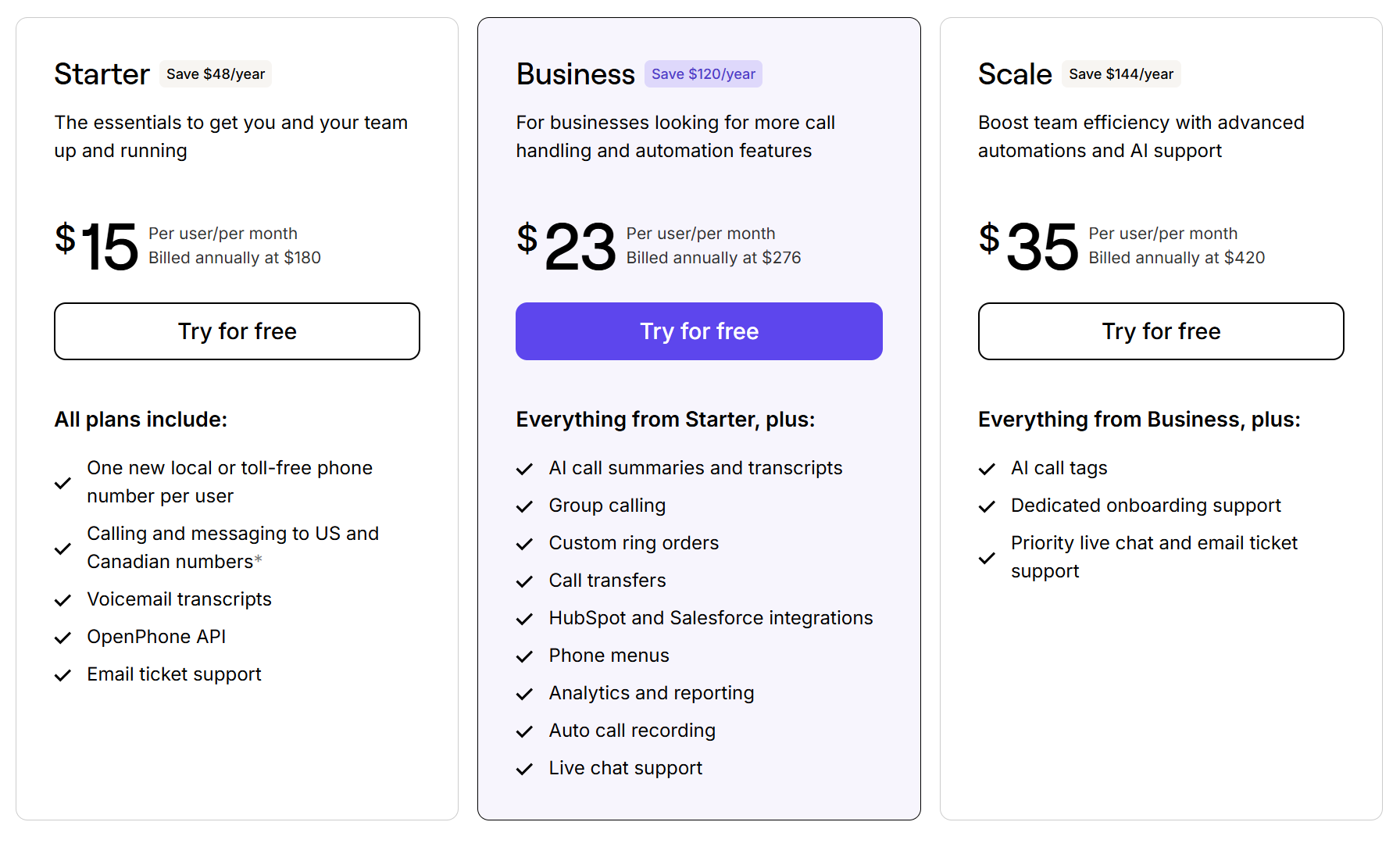
Quo’s pricing provides three different plans for you to choose from:
- Starter: $15 per user per month for unlimited calls and texts in the US and Canada, shared numbers and inboxes, collaboration features like internal threads and snippets, voicemail transcriptions, on-demand call recording, and more
- Business: $23 per user per month for automatic call recording, advanced call forwarding, phone menus, call transfers, analytics and reporting, and more
- Scale: $35 per user per month for conditional call routing, AI call tags, priority live chat, and onboarding support
2. RingCentral: Best for desk phone rentals

Pros
- Video conferencing
- Online fax service
- Desk phone rentals
Cons
- Built-in limits for texting, toll-free minutes, and recording storage
- AI receptionist requires manual call forwarding and doesn’t offer dynamic backups
- Expensive for small businesses
RingCentral is a unified communications provider that also connects with on-premises landlines. If you need SIP trunking for your call center, RingCentral offers desk phone rentals starting at $5 per phone per month, but only if you sign a multi-year contract.
RingCentral’s best hosted PBX features include business texting, toll-free numbers, and automatic call recording. But you’ll only get 25 texts, 100 toll-free minutes, and 1 GB of storage per user on your account unless you upgrade to the most expensive plan ($35 per user per month).
RingCentral also offers an AI phone answering service, but it comes with limitations. For example, it can’t automatically pick up a call if it goes unanswered. You have to actively route calls to it every time. And it may not be the most accurate tool, as one review mentions:
”When I did my onboarding, I was told that there were “no rules” (or guidance) for what info can/should be entered into a CSV file to upload to the knowledge hub, but even after 2 weeks, the AI is not able to correctly respond to information I’ve uploaded to the knowledge hub.” — RingCentral Forums
If you’re looking to scale your existing telephony equipment, RingCentral could be a solid option. But if you’re more interested in getting scalable features (like unlimited toll-free minutes and text messages), you might want to hunt for a RingCentral alternative.
Key features of RingCentral
- Call captioning and transcriptions
- Unlimited domestic calling (toll-free minutes are limited)
- Basic integrations with Google and Microsoft
- Shared voicemail
- Deskphone and conference phone rentals
- Video meetings (participant limitations apply)
RingCentral pricing

RingCentral’s hosted PBX cost depends on the number of users you have, the plan you want, and the add-ons you need.
Here’s what to expect for a team of one to five users when paid annually:
- Core: $20 per user per month for 100 toll-free minutes, 25 business SMS, manual call recording, limited storage, basic call queues, and the AI Assistant for phone and video
- Advanced: $25 per user per month for 1,000 toll-free minutes, 100 business SMS, automatic call recording, advanced call queues, call monitoring tools, and the AI Assistant for real-time notes and team message summaries
- Ultra: $35 per user per month for 10,000 toll-free minutes, 200 business SMS, unlimited storage, 200-participant video meetings, and the AI Assistant for SMS
3. Dialpad: Best for AI-based agent training

Pros
- AI is available on every plan
- Desk phone rentals are available
- Support for local numbers in 70+ countries
Cons
- User minimums when upgrading
- Texting limits (250 messages per user per month)
- Toll-free numbers not included (plus $0.02 per minute for calling)
- Additional numbers require an upgrade
Dialpad offers four separate suites, like Dialpad Sell (specifically for sales teams) and Dialpad Support (tailored to support departments). Each suite offers a different set of features; you need to look at them carefully to find out which one has the majority of the features you need.
For example, Dialpad Sell comes with features like AI coaching. However, you’ll end up paying for things you don’t use if you don’t need tools like power dialers or call barging.
See for yourself:
“I’m a solo practitioner (EP, Business, Real Estate, Municipal) and have been practicing for roughly 13 years. I use Dialpad as my office phone line, and I’m embarrassed to say this, but I’m overwhelmed with the amount of functions Dialpad has and am unsure how to utilize them in my practice.” — Reddit
Additionally, basic features on Dialpad Connect (which is the closest fit for small businesses), like additional numbers and integrations, require an upgrade to the Pro plan. But since there are required user minimums (three-user minimum for Pro plans), you might be forced to pay for extra users you don’t have.
Key features of Dialpad
- SMS, MMS, and team messaging
- Online fax (add-on)
- Additional numbers (available on higher-tier plans)
- Custom call routing and IVR
- File sharing
- Desktop and phone screen-sharing
- Call and voicemail transcription
- Call recording
- Live speech coaching
Dialpad pricing

There are three plans available for Dialpad Connect:
- Standard: $15 per user per month for unlimited phone calls in the US and Canada, business texting and team messaging, AI call and voicemail transcriptions, real-time analytics, and one phone number per account
- Pro: $25 per user per month for access to additional numbers, CRM integrations, international texting, international number support, 25 ring groups, and access to the Dialpad API
- Enterprise: Custom pricing for unlimited ring groups, dial-by-extension, 99.9% uptime, data retention policies, and priority live agent support
For a breakdown of other products (like Dialpad Sell, Support, and Meetings), check out our guide to Dialpad pricing.
4. 8X8: Best for businesses with global calling needs

Pros
- Unlimited international calling on some licenses
- Video conferencing
- Global local number support
Cons
- Can be complex to set up
- Smaller integration library (74 integrations)
- Must contact sales for pricing and to trial
8×8 is another hosted PBX with roots going back to the 1980s. Today, it offers four different plans for contact centers, as well as communication APIs for those who want to build their own solution.
You can use 8×8 to make calls and texts outside the US and Canada. It offers multiple licenses that let you reach between 14 and 48 countries included in your plan, plus local phone numbers worldwide so you can pick a familiar area code for international markets.
But 8×8’s pricing, plans, and features aren’t clearly explained online, so you’ll have to get in touch with sales if you want a straight answer. The system can also be complex to configure if you’re not familiar with legacy systems.
Just check out what past users had to say:
“I have never written a bad review, but the 8×8 user experience is very poor, overly confusing, and focuses too much on the customer resolving their own issues.” — Trustpilot
“Our end users require use of both the softphone and the contact center. Having both options running causes users to [misuse] the platform after many many attempts at training them, and it is still confusing to many. If there was a proper way to combine both platforms, or to possibly have a desktop version of the VCC, I believe our users would have a better experience.” — G2
Key features of 8X8
- Calling and texting
- High-volume messaging
- Video meetings and AI meeting summaries
- Team chat
- Toll-free numbers
- Call recording
- Fax
- Receptionist console for exceptionally high call volumes
- Global coverage
8×8 pricing
8×8’s VoIP costs aren’t publicly available. For a custom quote, you’ll have to contact sales.
5. Nextiva: Best for enterprise unified communications

Pros
- Calling, texting, and video support
- Omnichannel platforms (like live chat and Messenger)
Cons
- Calling, texting, and toll-free numbers require an upgrade
- Integrations require add-ons
- Too costly for smaller businesses
- Slow customer support
Nextiva is a hosted phone system that connects customer touchpoints beyond calls and texts. You can connect your phone system to other channels — think video, social media, and chat — then track customer sentiment with customizable reports and dashboards.
But you won’t get any phone features on Nextiva’s base plan. Instead, you’ll need to upgrade to the Core plan ($30 per user per month) to make and receive calls. And you’ll still have to worry about the required add-ons for integrations, including Salesforce, HubSpot, and Microsoft Teams.
Texting and toll-free numbers are also limited unless you spring for the Power Suite plan ($60 per user per month), which includes unlimited SMS and up to 10,000 toll-free minutes. But considering other hosted PBX providers offer these at one-fourth the cost, it’s hard to justify the price unless you’re after Nextiva’s full customer experience suite.
Customer reviews on Reddit also mention hidden fees, confusing pricing plans, and slow support. Users say they felt trapped in expensive contracts and couldn’t reach help when it mattered most.
“I tried to contact Nextiva for support, but no matter how hard I tried, there was no way to contact anyone. If I sent emails or called, I did not receive any response back. I was losing contact with our customers.” — Reddit
Key features of Nextiva
- All-in-one communication channels
- SMS (100 per user per month on second cheapest plan)
- Messaging applications
- VoIP conference calling
- Social and review management
- Native social media and review management platform integrations
- Simple IVR (on second cheapest plan)
- Live chat (add-on)
- 24/7 support (support channel unclear)
- Call recording (add-on)
Nextiva pricing

There are four plans you can get with Nextiva:
- Digital: $20 per user per month for communication integrations with email and social media messaging platforms
- Core: $30 per user per month for voice calling (inbound and outbound), 100 texts per user per month, access to the toll-free number add-on, video conferencing, and custom call routing
- Engage: $40 per user per month for call queues, detailed reporting, Microsoft Teams integration, 2,000 toll-free minutes per month, and 250 texts per use per month
- Power Suite: $60 per user per month for unlimited texting, advanced IVR, intelligent call routing by team skill, 10,000 toll-free minutes, real-time supervisor dashboards, and AI-powered call transcription and summaries
6. Grasshopper: Best if you need a basic second phone number

Pros
- Pricing is based on numbers, not users
- Unlimited extensions (with upgrade)
- Simple to use and set up for forwarding
Cons
- No shared phone numbers
- Complicated international calling
- No third-party integrations
- Texting limitations
Grasshopper isn’t really a hosted VoIP, but it still works well as a virtual number-forwarding service. It comes with features like custom greetings, business voicemail, and extensions, which works ok for the solopreneur who only wants a basic solution.
But Grasshopper might be a little too simple for a growing business. For starters, you can’t integrate with third-party apps at all. There are also some frustrating text restrictions, like no support for international texting or MMS support for toll-free numbers.
You also don’t get any shared phone numbers. This means you can’t collaborate on texts and calls as a team, and calls will go to voicemail if someone’s not around to pick up the phone. If you need extra numbers, they cost $10 more per month.
Finally, you’ll have to contact support and pay a $500 deposit to make international calls. FYI, Alaska and Hawaii count as “international,” so prepare to pay up if you have customers there.
If all you want is a professional presence, Grasshopper’s price point might be hard to beat. But if you need a solution that scales with you, you might want to look for Grasshopper alternatives.
“Grasshopper sounds great on paper, but in reality… yeah, not so much. Spotty service, clunky interface, and if something goes wrong? Good luck getting support.” — Reddit
Key features of Grasshopper
- Unlimited users per plan (with upgrade)
- Call forwarding
- Mobile and desktop apps
- Voicemail
- Virtual fax
- Custom greetings
- Inbound call control (set business hours)
- Simultaneous call handling (requires upgrade)
Grasshopper pricing

Grasshopper’s prices are based on the number of phone numbers and extensions you want.
There are three plans to choose from:
- True Solo: $14 per month for one user, one phone number, voicemail, fax, custom greetings, and reporting
- Solo Plus: $25 per month for unlimited users, access to additional extensions, call recording, call transfers, and simultaneous call handling
- Small Business: $55 per month for four phone numbers and unlimited extensions
7. Google Voice: Best for integrating with Google Workspace

Pros
- Connects with Google Workspace
- Familiar interface
- Unlimited text messaging (US only)
- Free calls to the US and Canada
Cons
- Starter plan is only available for up to 10 users
- Limited features on the Starter plan
- Lacks features for team collaboration
- No toll-free numbers
Google Voice integrates seamlessly with other Google apps and comes with unlimited calling to the US (if you’re based in the US).
But like anything else, you get what you pay for. There are no additional or shared numbers available, no integrations outside of Google Workspace, and a very limited Starter plan (even on-demand call recording requires an upgrade).
You’ll also need a Google Workspace subscription, meaning the $10 per user per month pricing is actually $17. This and some of the other drawbacks mentioned here lead many users to migrate or at least reconsider their options.
Take a look:
“If I’m honest with myself about how Google Voice has absolutely languished in the last 10 years, I think I’d have to admit that there’s really only a couple reasons I use Google voice instead of just my carrier. [First,] access to calling/texting from my PC. I [also] have my text conversation history for the last 15 years…. Otherwise I’d just use my carrier with access to superior texting apps and actual RCS support, as well as not running into the occasional service that doesn’t let you use a Google voice number to sign up for things.” — Reddit
Google Voice offers a decent starting place for solopreneurs. But if your business plans to grow in the future (and what business doesn’t?), you may eventually need to change providers.
Key features of Google Voice
- Activity reporting
- Voicemail transcriptions
- Unlimited text messaging (US only)
- Web and mobile apps
- Integrations with Google Calendar and Google Meet
Google Voice pricing

There are three tiers of Google Voice pricing:
- Starter: $10 per user per month for up to 10 users, unlimited calls to the US, unlimited texts to the US (only for US users), voicemail transcriptions, Google Workspace integrations, call forwarding, and access to the web and mobile apps
- Standard: $20 per user per month for unlimited users, access to SIP link, on-demand call recording, ring groups, multi-level call recording, and desk phone support
- Premier: $30 per user per month for automatic call recording and advanced reports through BigQuery
8. Phone.com: Best for companies that need HIPAA-compliant video meetings

Pros
- HIPAA compliant
- Video calls are available on all plans
- Basic call routing functions
Cons
- Call recording is available as an add-on or on the most expensive plan
- Texting requires an upgrade
- Calling minutes are limited to 500 per month unless you upgrade
- One phone number per account on the Basic plan
Phone.com is a legacy phone service offering cloud-based calls, texts, and video conferencing. Its biggest benefit is HIPAA-compliant voice and video calling, which is available to users on every plan.
Phone.com is also budget-friendly — if you don’t need unlimited calling, that is. Basic users only get 500 minutes each which is shared between everyone on your account. So a team of three would have 1,500 minutes altogether. Unless you have a big team, you’ll probably run out of minutes quickly.
Take a look:
“I received a note stating that “unlimited minutes” didn’t really mean that if I looked at the fine print and that I would have to upgrade to a plan that was more than double of what I was paying if I wanted to receive this same level of service I had been receiving for more than two years.” — Capterra
You should also know that Phone.com’s best features are locked behind more expensive plans. There’s no access to texting or voicemail transcriptions without upgrading multiple times. Considering most VoIP services offer these features on every plan, it might not be all that cost-effective unless you desperately need a HIPAA-compliant platform.
Key features of Phone.com
- Call forwarding and call routing
- Video conferencing (10 participants on Basic plan)
- HIPAA-compliant voice calls for healthcare businesses
- Auto-attendant and voicemail-to-email
Phone.com pricing

Phone.com lets you mix and match plans depending on the users you want on your team. There are three tiers to choose from:
- Basic: $15 per user per month for 500 call minutes per user, one phone number per account, mobile and web apps (Android and iOS), IVR, and video conferencing
- Plus: $22.50 per user per month for IP phone compatibility, one number per user added to your account, voicemail transcriptions, business texting, and access to AI-Connect Answering (AI call routing)
- Pro: $33.33 per user per month for automatic call recording, call analytics, CRM integrations, and 10 years of data retention
Keep in mind there are cost savings available if you have at least five users on the Basic plan and at least one user on the Plus and Pro plans.
Hosted PBX vs traditional PBX providers
Why do small businesses prefer hosted PBX to traditional PBX providers?
TL;DR: it comes with core features businesses need without the complexity, bloat, or high price tag of legacy systems. Here’s a quick breakdown of VoIP vs traditional PBX:
| Feature | Traditional PBX | Hosted PBX |
|---|---|---|
| Cost-effectiveness | High upfront and ongoing costs | Monthly subscription |
| Hardware requirements | On-site servers and phones | Can use existing devices (phone, laptop, tablet) |
| Mobility | Limited remote options | Use anywhere with internet |
| Texting capabilities | Voice only | SMS and MMS |
| Setup | Tech install | Sign up and download the app |
| Maintenance & installation | Manual updates and IT help | Provider takes care of setup and updates |
| Scalability | Technician visits needed for upgrades | Add users/numbers in clicks |
| AI-powered features | Not available | Call summaries, transcriptions, call tags, and more |
How to choose your hosted PBX provider
Let’s go over some pitfalls to know before committing to a provider:
- Pay special attention to contract terms: Some providers offer a low monthly rate — as long as you lock into an annual contract or have a minimum user count. Keep an eye out for early termination fees, surprise taxes, or limits on basic features (like SMS or call recording) unless you upgrade.
- Test the platform’s ease of use, not just features: Lots of features won’t matter if your team hates using them. During your trial, see how easy it is to forward calls, set up phone menus, access voicemail, and make changes without support.
- Check how support works: Don’t assume “24/7 support” means real-time help. Some providers only offer chatbots or email outside business hours, while others limit live support to higher-tier plans.
- Consider growth (and exit plans): You want a system that can scale with you but won’t lock you in if things change. Double-check that it’s easy to add users, upgrade features, or port numbers out if you move providers.
Quo: The best hosted PBX system for growing teams

No two hosted PBX providers are exactly alike — and choosing the wrong one can leave you stuck with hidden fees or tools you don’t need. This means the best provider on this list is the one that’s easiest to manage, works on any device, and has core features your team will actually use.
Quo offers that “just right” solution with purposeful features specifically designed for growing teams (without the bloat). The Starter plan has everything you need to build customer relationships at $15 per user per month.
This includes:
- Call recording
- Shared numbers
- Unlimited calling and messaging to US and Canadian numbers
- One free toll-free, local US, or Canadian number per user on your account
- 7,000+ integrations
- Productivity and collaboration tools like auto-replies, snippets, scheduled messages, and internal threads
- Essential call forwarding
Test Quo free for seven days and see why we’re the leading option for thousands of brands.
FAQs
A cloud-hosted PBX is a business phone system that lets you make calls over the internet using your computer, tablet, or mobile device. SIP trunking, on the other hand, is a patch for legacy hardware that connects an on-site phone system to the internet instead of telephone networks.
Both let you call over the internet without switching devices. But cloud systems let you skip physical equipment altogether. SIP trunking just keeps legacy systems on life support (which can cost much more in the long run).
Traditional PBX systems route calls through physical phone lines, like the public switched telephone network (or PSTN). Cloud PBX systems do the same thing but over the internet, so you can make and receive calls from anywhere with a WiFi connection. These internet-based calls run on VoIP (Voice over Internet Protocol), which is the technology that powers online calling.
TL;DR: Traditional PBX uses phone lines, cloud PBX uses the internet, and VoIP makes cloud PBX possible.
Learn more in our guide to hosted vs on-premises phone systems.
VoIP costs anywhere from $15 to $40 per user per month. More expensive plans usually come with more hosted VoIP features like call routing, auto-attendant, call recording and transcripts, softphone, IVR (phone menus), free SMS, MMS, and calling to the US and Canada, CRM integrations, and collaboration features like internal threads and shared inboxes.