Running a small business means you’re always juggling multiple things at once. From customer calls to invoices to marketing campaigns, you handle it all with too few hours in the day.
The right tools for startups and small businesses change that. They help you respond to customers faster, close more deals, and stay organized without hiring extra staff or burning people out.
This guide covers the 26 best startup tools you can use across every part of your business. You’ll see top recommendations across communication, sales, scheduling, marketing, and HR. Each one is built for lean teams, with pricing that won’t break the bank.
26 Best startup tools compared + pricing
Here’s a quick look at every tool for startups in this guide, what it does, and what it costs to get started.
| Tool | Category | Best for | Starting price |
|---|---|---|---|
| Quo | Customer communication and management | Business phone system for small teams | $15 per user per month |
| Lyro AI | Customer communication and management | AI chatbot for web-based customer support | Free, then $32.50 per month for 50 conversations |
| Zendesk | Customer communication and management | Ticketing and customer support | $19 per agent per month |
| Buffer | Customer communication and management | Social media management | Free |
| Calendly | Scheduling | Simple meeting scheduling | Free |
| Square Appointments | Scheduling | Booking for service-based businesses | Free |
| HubSpot | Sales | CRM for small and growing businesses | Free |
| HubSpot Breeze AI | Sales | AI-assisted prospecting | $45 per month |
| noCRM | Sales | Lightweight CRM for sales-focused teams | $13 per user per month |
| Lavender AI | Sales | Email writing and coaching | Free |
| ChatGPT | Marketing | Writing assistance and ideation | Free |
| Canva | Marketing | Branded visuals and image generation | Free |
| Mailchimp | Marketing | Email marketing | Free |
| Notion | Internal operations | Knowledge management and documentation | Free |
| Google Drive | Internal operations | Cloud storage and file collaboration | Requires Google Workspace, $7 per user per month |
| Trello | Internal operations | Project management for early-stage teams | Free |
| Asana | Internal operations | Project management for complex needs | Free |
| Slack | Team communication and collaboration | Internal team messaging | Free |
| Google Meet | Team communication and collaboration | Video calls | Free |
| Zapier | Automation | Simple no-code automations | Free |
| Make | Automation | Complex, cost-effective automations | Free |
| QuickBooks Online | Accounting and finance | Invoicing and financial tracking | $19 per month |
| Stripe | Accounting and finance | Payment processing | 2.9% + 30¢ per transaction |
| Upmetrics | Accounting and finance | AI-assisted business planning | $14 per month |
| Gusto | Payroll and human resources | All-in-one payroll and people management | $49 per month + $6 per person |
| Zoho People | Payroll and human resources | Affordable HR for small teams | Free |
Best customer communication and management tools
Let’s start with some of the best communication platforms for small businesses. These tools help your team stay responsive, keep customers informed, and manage every conversation in one place.
1. Quo, formerly OpenPhone: Best business phone system for small businesses

Pros
- Unlimited calls and texts to anyone in the US and Canada
- Local and toll-free number options are available
- Shared numbers so your whole team can handle incoming calls and messages together
- AI-generated summaries and transcriptions for every call
- 24/7 AI voice agent that picks up when your team can’t
- 8,000+ integrations, including Slack, HubSpot, and Salesforce
- Available on Mac, Windows, Android, iPhone, and the web
Cons
- Can’t use two-factor authentication, or 2FA, to verify accounts*
*Most virtual phone numbers have this problem. For security purposes, companies like Uber, Facebook, and Google rarely allow you to authenticate accounts with a virtual phone number.
Quo is a business phone system built for startups and small businesses that brings calls, texts, and customer info into one shared space. This keeps teams aligned, speeds up response times, and ensures you never miss a customer.
Here’s how Quo helps you move faster:
- Shared numbers and visibility. Incoming calls and messages are handled by everyone on the same number, not trapped in one person’s inbox. Plus, every customer’s communication lives in their own dedicated thread. Anyone on the team can see the thread, pick up where the last person left off, and quickly help a customer.
- Automated texting. Send the right message at the right time. Use auto-replies for after-hours contact or schedule texts to be sent to customers based on their time zones. You can even automate workflows via Make and Zapier, like appointment reminders to reduce no-shows.
- Customizable call routing. With phone menus and ring groups, you can route calls by team member, need, or availability. This way, customers reach the right person quickly, and fewer calls bounce around.
- AI summaries. Quo summarizes calls and voicemails so your team can get context fast and respond quickly, even if they missed the call.

Need to quickly see which conversations need attention first? Use call views to filter by missed calls, voicemail, and unresponded. You can also filter by date range or team member to zero in on a specific time window or review what a specific person handled.

On the Business and Scale plans, the analytics dashboard gives you more oversight and trend reporting. This includes stats like call volume, teammate activity over time, and peak hours so you can plan staffing and improve coverage.
When your team is unavailable, Sona — Quo’s 24/7 AI voice agent — handles incoming calls automatically. Sona can:
- Answer common questions, like your business hours and services
- Take detailed messages to simplify follow-up
- Transfer calls to your team or an emergency number when needed
- Provide support in English, Spanish, and French
- Text callers during calls with important information, like links to your booking page
- Reference previous conversations to prevent asking repeat questions

Setup takes minutes, not days. And Quo works on the devices your team already uses, so no extra hardware is required. Start solo and add teammates as you grow.
💡More than 90,000 businesses run on Quo. Try it free for seven days.
Quo pricing
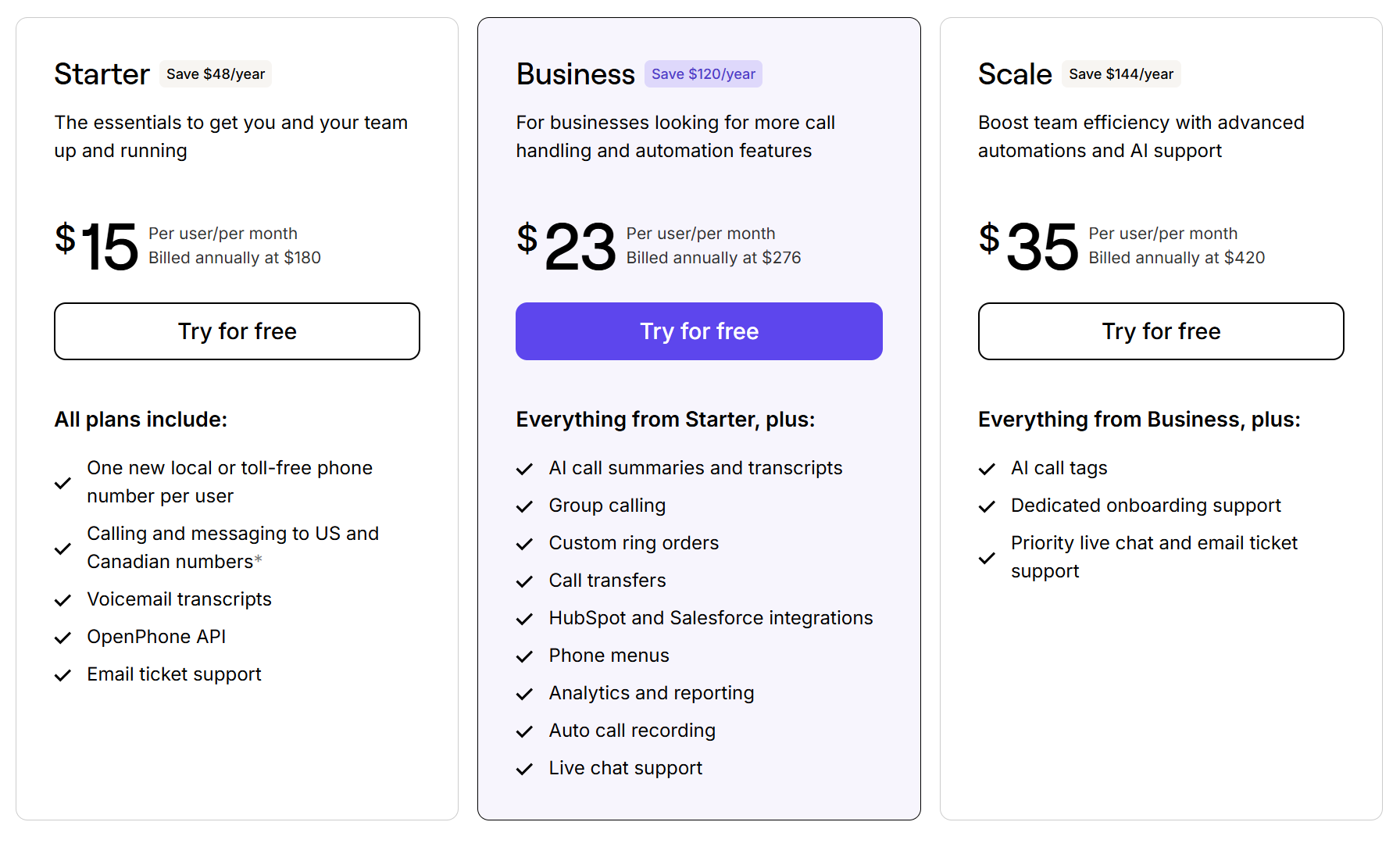
Quo offers transparent per-user pricing with no hidden costs:
- Starter: $15 per user per month for shared phone numbers for up to 10 teammates, unlimited calling and texting in the US and Canada, one free number per user, voicemail transcriptions, Sona, and more
- Business: $23 per user per month for auto attendants, group calling, call transcriptions, AI call summaries, phone menus, CRM integrations with HubSpot and Salesforce, and more
- Scale: $35 per user per month for AI call tags, dedicated onboarding, inbound phone support, and priority chat and email support
2. Lyro AI: Best AI chatbot for web-based customer support

Pros
- Easy to set up with no coding needed
- Connects to tools like Shopify and Mailchimp
- Can perform tasks like refunds and order updates
Cons
- Costs add up quickly if you rely on it heavily
- Base plan only supports up to 1,000 AI conversations
Tidio is customer service software that combines live chat, chatbots, and ticketing. It lets you handle messages from your website, email, and social media in one place so you don’t have to jump between tabs to keep up with customers.
Lyro AI is Tidio’s built-in chatbot. It reads your existing FAQs, help articles, and website content to answer customer questions on its own.
This AI communication tool can handle tasks like checking order status and processing refunds. If a question falls outside what it knows, it hands the conversation to a human rep with full context.
Tidio’s Lyro AI pricing

Lyro AI Agent offers four plans to choose from:
- Free: 50 AI conversations, up to 10 users, FAQ upload, and website scraper to train the AI on your existing content
- Core: $32.50 per month for 50–1,000 AI conversations, up to 10 users, product recommendations, and automated customer actions
- Plus: $749 per month for 300+ AI conversations, integration with Zendesk and Salesforce, custom AI name, and real-time knowledge updates
- Premium: Custom pricing for guaranteed 50% resolution rate, AI insights, and pay-per-resolution billing
3. Zendesk: Best for ticketing and customer support

Pros
- Base plan covers everything small teams need
- Supports email, chat, WhatsApp, and social in one place
- Over 1,000 integrations available
- Highly scalable
Cons
- Some users find the learning curve steep
- Pricing jumps significantly as you add features
Zendesk is a digital customer service platform. It pulls conversations from email, chat, phone, and social media into one workspace. Its built-in AI Agent uses generative AI to handle routine questions and route complex issues to the right person. Automated ticketing assigns requests to the right agent, and internal notes let teammates share context on any ticket.
Zendesk pricing

Zendesk offers four plans. The base plan covers small team essentials, but costs can add up if you need AI features or phone support. The pricing plans include:
- Support Team: $19 per agent per month for email, ticketing, Facebook, and X support, ticket routing, pre-written response macros, customizable automations, and 1,000+ integrations
- Suite Team: $55 per agent per month for AI agents, generative replies, live chat, phone support, call routing, and social messaging on Instagram and WhatsApp
- Suite Professional: $115 per agent per month for customizable reporting with real-time insights, skills-based routing, CSAT surveys, and AI writing assistance for agents
- Suite Enterprise: $169 per agent per month for custom agent roles, sandbox environment, and advanced reporting tools
4. Buffer: Best tool for social media management

Pros
- Centralized dashboard for scheduling, posting, and engagement
- Affordable pricing plans
- Free plan for up to three channels
- Mobile app available
Cons
- Costs add up quickly as you add more channels
Buffer is a social media management tool for small businesses. It lets you schedule posts, engage with customers, and track performance across:
- TikTok
- X
- Google Business Profile
- YouTube
And more. The built-in AI assistant helps generate content ideas and rewrite posts to fit each platform’s style.
There’s also Buffer Engage, a tool for staying on top of social media conversations. With it, you can see comments and messages from all your channels in one inbox. Filter by unanswered or negative comments to prioritize conversations. Then use the suggested response or draft your own to stay connected with your audience.
Buffer pricing

Buffer’s pricing depends on the number of channels you connect:
- Free: Connect up to three channels with 10 scheduled posts per channel, 100 ideas, AI assistant, and basic analytics with a 30-day history
- Essentials: Starts at $10 per month for two channels for unlimited scheduled posts, advanced analytics, hashtag manager, and first comment scheduling
- Team: Starts at $20 per month for two channels for unlimited team members, access levels, and content approval workflows
Note: The Free plan doesn’t include engagement features like the community inbox, so you’ll need at least the Essentials plan for that.
Best scheduling tools for small businesses
These tools for growing businesses handle booking, reminders, and payment collection to make scheduling simpler for your business.
5. Calendly: Simplest scheduling tool

Pros
- Offers a free plan with basic features
- Easy to set up and use
- Syncs with Google Calendar and Outlook
- Handles time zones automatically
Cons
- Need to upgrade to connect more than one calendar
- Appointment reminders require a paid plan
Calendly converts your availability into a self-service booking page clients can access at any time. Connect your calendar, set your hours, and share a link. Calendly manages scheduling and time zones automatically.
You can create different event types — a 30-minute discovery call or a one-hour onboarding session. Each event type lets you set buffer time between meetings and cap your daily bookings to keep your schedule manageable. Pair it with Zoom or Google Meet, and Calendly automatically adds the video link to the confirmation.
Calendly pricing

Calendly’s pricing includes four plans:
- Free: One user, one event type, one calendar connection, video conferencing integrations, and the mobile app
- Standard: $10 per user per month for unlimited event types, multiple calendar connections, HubSpot and Mailchimp integrations, Zapier and PayPal integrations, and automated scheduling reminders
- Teams: $16 per user per month for Salesforce integration, round-robin meetings, and lead routing
- Enterprise: Starts at $15k per year for Microsoft Dynamics integration, dedicated account support, and SSO
6. Square Appointments: Best for service-based businesses

Pros
- Allows customers to pay using platforms like Cash App and credit cards
- Works on mobile, desktop, and Square Register devices
- Offers a free plan
Cons
- Limited options for customizing the booking interface
- Need to upgrade for Google Calendar sync
- Doesn’t integrate with iCloud or Outlook calendars
Square Appointments is a scheduling app for service-based businesses. It’s particularly well-suited to beauty, health and wellness, and home services. Set up your booking page and let your customers book directly through your website, Instagram, or Facebook. Square Appointments syncs with your calendar immediately to prevent double bookings.
You can also collect payment at booking and set cancellation fees to protect against no-shows. If you already use Square for payment processing, Appointments connects to your point-of-sale system. You can go from booking to checkout without switching apps.
Square Appointments pricing

Square Appointments offers three main plans plus custom pricing for high-volume businesses:
- Free: Up to two locations, online booking, appointment reminders, unlimited calendars, and invoicing. Processing fees are 2.6% + 15¢ in person and 3.3% + 30¢ online.
- Plus: $49 per month per location for cancellation policies, multi-staff appointment booking, and waitlists. Processing fees are 2.5% + 15¢ in person and 2.9% + 30¢ online.
- Premium: $149 per month per location for future booking reports, service cost tracking, and resource management. Processing fees are 2.4% + 15¢ in person and 2.9% + 30¢ online.
Custom pricing is available to businesses that process over $250,000 per year.
Best small business and startup tools for sales
Let’s look at some tools that help you track leads, reach the right prospects, and close more deals without adding headcount.
7. HubSpot: Best CRM for small and growing business

Pros
- Free CRM supports unlimited users and contacts
- Integrates with 2,000+ third-party apps
- Modular pricing lets you only pay for products you need
Cons
- Too many features can make it confusing to navigate
- Sales analytics and forecasting are only available on higher tiers
- Unclear pricing; need to reach out to sales for a quote
HubSpot is a customer service platform that offers a free CRM for small and growing businesses. The CRM lets you centralize customer information, communication history, and sales pipeline. As you grow, you can add tools for marketing, sales, or customer service based on what your business needs.
HubSpot also integrates with your communication tools to help log customer interactions. For example, syncing Quo automatically logs calls, texts, and voicemails to the matching contact record. This helps your teams stay aligned on customer history and answer with the right context.

HubSpot pricing

HubSpot’s CRM has a free plan and two paid tiers.
- Free: Includes contact management, deal tracking, basic reporting, live chat, and a meeting scheduler
- Professional: Starts at $45 per seat per month for custom reporting, duplicate management, shared inbox, Slack integration, teams, and calculated properties
- Enterprise: Starts at $75 per seat per month for custom objects, field-level permissions, custom user permissions, and custom events
Note that the prices shown are starting estimates. HubSpot’s sales team told us that for an exact quote, it’s best to get in touch with them.
8. HubSpot Breeze AI Prospecting Agent: Best for prospecting

Pros
- User-friendly interface
- Built directly into the HubSpot platform
- Automatically enriches contact and company data
Cons
- Still early-stage with limited capabilities
- Can’t be used as a standalone tool
HubSpot Breeze is an AI assistant built directly into the HubSpot platform. It monitors your contacts for buying signals, like a funding round or a leadership change. When it identifies a sales opportunity, Breeze scrapes recent news and company filings to provide a detailed briefing. It also tracks their email interactions and intent and will alert you when it’s the right time to reach out.
Breeze then drafts a personalized email using your CRM data. Review it before it goes out or switch to autopilot once you’re comfortable. It also updates your CRM records, so your team always has the latest context on every prospect.
HubSpot Breeze pricing

HubSpot Breeze’s core assistant is free for all users. The Breeze Prospecting Agent is available on the Sales Hub Professional and Enterprise plans:
- Professional: $90 per seat per month for 3,000 HubSpot credits, the Breeze Prospecting Agent, AI Meeting Assistant, call transcription and coaching, sales analytics, forecasting, and sequences
- Enterprise: $150 per seat per month for 5,000 HubSpot credits, conversation intelligence, deal journey analytics, pipeline approvals, and lead form routing
If you need more credits, HubSpot offers three packages, starting at $45 per month for 5,000 credits.
9. noCRM: Best lightweight CRM

Pros
- Focuses entirely on sales
- Includes quoting, invoicing, and task tracking with an upgrade
- Creates leads directly from LinkedIn and WhatsApp
Cons
- Limited features compared to HubSpot
- Customization lags behind more established CRMs
- Not made for complex, large-scale operations
noCRM is a lightweight CRM that skips the heavy setup and data entry so you can focus on closing deals. You can create leads in seconds by scanning a business card, importing from LinkedIn, or adding contacts from WhatsApp. Then the platform quickly prompts you to set a next action with a deadline. This ensures no lead sits idle without a follow-up plan.
That said, noCRM isn’t as feature-rich as HubSpot. The analytics are fairly basic and the invoicing is lightweight. But for small teams that want to manage leads without the admin work, it’s a solid choice.
noCRM pricing

noCRM offers three paid plans:
- Starter: $13 per user per month for 500 leads in one pipeline, quick lead capture, notes and reminders, and a mobile app
- Expert: $26 per user per month for unlimited leads and pipelines, quotes and invoices, advanced performance tracking, and 3,000+ integrations
- Dream: $39 per user per month for WhatsApp and VoIP integrations, email integration, team management, and automations
10. Lavender AI: Best email writing assistant

Pros
- Free for solo entrepreneurs and bootstrapped founders
- Sits directly inside your email inbox
- Pulls recipient data in to improve personalization
- Gives managers email insights for coaching
Cons
- Can slow down your email app
- Limited features on the free plan
Lavender AI is an AI email coaching tool that helps you write better outreach emails. It analyzes your email as you write and gives you a score out of 100, along with specific suggestions for improvement.
It flags what to fix — like a subject line that’s too long or an opener that lacks personalization. You can also see how your emails stack up against top performers in your industry. Users appreciate how easy Lavender is to use and how it improves personalization.
Lavender AI pricing

Lavender offers four plans for businesses:
- Basic: Free to analyze and personalize up to five emails per month, core email coaching features, works with Gmail and Outlook 365
- Starter: $27 per month for unlimited email analysis and personalization, an AI email writer, mobile optimization, real-time coaching suggestions, and multi-inbox support
- Individual Pro: $45 per month for advanced personalization, communication style matching, detailed analytics, priority support, and integrations with HubSpot, Outreach, and Salesloft
- Team: $89 per seat per month for a manager coaching dashboard, team-wide email analytics, shared template libraries, human-led coaching programs, and a dedicated customer success manager. The Team plan itself has three sub-plans: Starter, Growth, and Enterprise.
Best startup tools for marketing
These tools help you create content, grow your audience, and stay visible without a full marketing team.
11. ChatGPT: Best AI tool for writing assistance and ideation

Pros
- Offers a free plan
- Highly versatile
- Low learning curve
- Remembers your preferences across sessions
Cons
- Can generate inaccurate or fabricated information
- Depending on your prompt, outputs could feel generic
- Potential for sensitive data to be exposed, such as inputs that are used for training
ChatGPT is one of the most popular AI tools for small businesses that want to create content and brainstorm ideas faster. Here are a few ways you can use it for marketing:
- Generate blog posts, social media content, and email campaigns in your brand voice
- Repurpose one piece of content across multiple channels, from a blog post to social, email, and ads
- Build customer personas, analyze competitor messaging, and brainstorm campaign angles
Just keep in mind that your employees could feed confidential data into ChatGPT. Many plans use your data to train the model by default. If that’s a concern, you need to opt for the Team plan, which you can set up to not use your data for model training.
ChatGPT pricing

ChatGPT has six pricing tiers:
- Free: $0 per month for limited access to GPT-5.3, basic image generation, limited deep research, and limited memory
- Go: $8 per month for more messages, uploads, image creation, and longer memory, but may include ads
- Plus: $20 per month for advanced reasoning models, expanded image generation, deep research and agent mode, projects, tasks, custom GPTs, Codex agent, and Sora video generation
- Pro: $200 per month for Pro reasoning with GPT-5.4 Pro, unlimited GPT-5.4 and file uploads, unlimited image generation, maximum deep research and agent mode, maximum memory and context, and priority-speed Codex agent
- Business: $25 per user per month for a dedicated workspace, SAML SSO, admin controls, 60+ app integrations, including Slack, Google Drive, and GitHub, and your data is not used to train OpenAI’s models by default
- Enterprise: Custom pricing for an expanded context window, enterprise security controls, custom data retention policies, and support for data residency in 10 regions
12. Canva: Best free tool for customizable image generation

Pros
- Easy to use with no design experience
- Thousands of templates and stock images
- Offers a free plan with limited AI credits
- Direct social media scheduling
Cons
- Best features are locked behind paid plans
- Not meant for highly complex images and designs
- Can lag with large or video-heavy projects
Canva is a free design platform that helps small teams create branded visuals, social posts, and marketing assets. You can start from scratch or reuse one of thousands of pre-made templates. You could also prompt the AI to generate an image for you. Although at the time of writing, the AI designs aren’t very sophisticated.
Once you have your design, you can remove a background, resize for Instagram or LinkedIn, or swap out elements with a few clicks.
Canva pricing

Canva offers four pricing plans:
- Free: Basic design tools, 1.6M+ templates, 4.7M+ stock photos, videos, audio, one brand kit, limited AI tools, and 5 GB of cloud storage
- Pro: $120 per person per year for 3.6M+ templates, 141M+ premium stock assets, five brand kits, image resizing, background remover, translation tools, social content planner, bulk design creation, expanded AI access, and 100 GB of cloud storage
- Business: $200 per person per year for 100 brand kits, extensive AI access, team admin tools, including reports and approvals, data connectors, 500 GB of cloud storage, with a minimum of three users
- Enterprise: Custom pricing for 1,000 Brand Kits, SSO and SCIM provisioning, custom integrations, priority support, and 1 TB of cloud storage
13. Mailchimp: Best tool for email marketing

Pros
- Offers a free plan
- User-friendly drag-and-drop editor
- 250+ pre-built email templates; access to advanced templates requires an upgrade
- Integrates with Shopify and WooCommerce
- Detailed analytics on opens and clicks, requires an upgrade
Cons
- Free plan only offers email support for the first 30 days
- Costs scale quickly as your list grows
- No automation on the free plan
Mailchimp is an email marketing platform built for startups focused on growing their audience. It comes with audience segmentation, a drag-and-drop email builder, and automated customer journeys.
There’s a free plan for one user that covers up to 250 contacts and 500 emails a month. On paid plans, you can set up automation flows that send relevant messages based on how customers interact with your brand.
For example, you can use Mailchimp automations to:
- Create a welcome series for new subscribers
- Set up a follow-up email when someone abandons a cart
- Run a re-engagement campaign for customers who haven’t bought in awhile
Mailchimp pricing

Mailchimp has a free plan and three paid tiers, with pricing based on your number of contacts:
- Free: Up to 250 contacts and 500 emails per month for one user, basic templates, landing pages, and forms
- Essentials: Starts at $13 per month for up to three users, email scheduling, A/B testing, and basic automation
- Standard: Starts at $20 per month for up to five users, advanced automation, predictive segmentation, and send-time optimization
- Premium: Starts at $350 per month for unlimited users and emails, multivariate testing, phone support, and dedicated onboarding
Best small business tools for internal operations
Here are some top tools to help you manage projects, document processes, and keep your team aligned.
14. Notion: Best for knowledge management and internal documentation

Pros
- Free plan available for personal use
- Extensive template library to get started quickly
- Handles docs, wikis, tasks, and databases without extra tools
- Real-time collaboration and document commenting
Cons
- Easy to lose structure without clear organization habits
- Slow to load with large databases or complex pages
- AI features require a paid subscription
Notion is a flexible all-in-one workspace for docs, wikis, databases, and project management. It packs everything your team needs to manage projects and internal ops into one straightforward system.
Here are a few ways you can use it:
- Build SOPs and onboarding templates so new hires have everything they need from day one
- Create a searchable company wiki to store meeting notes, how-to guides, and technical documentation
- Track internal requests like budget approvals and IT tickets, with clear ownership and status at every step
Eligible startups can get one to six months free of Notion’s Business Plan, which includes full access to Notion AI.
Notion pricing

Notion offers a free plan for individuals and three paid plans for teams:
- Free: Basic databases, Notion Calendar, Notion Mail, and a trial of Notion AI
- Plus: $10 per user per month for custom forms and sites, unlimited charts, collaborative blocks, and file uploads with basic integrations for Slack and Gmail
- Business: $20 per user per month for Notion Agent, AI meeting notes, private teamspaces, and enterprise search across connected tools like Google Drive and email
- Enterprise: Custom pricing for advanced security, audit logs, and dedicated support
15. Google Drive: Best cloud storage for small businesses

Pros
- Simple, familiar interface most teams already know
- Real-time collaboration across Docs, Sheets, and Slides
- Search works inside images and PDFs to make it easier to find what you need
Cons
- Customer support is hard to reach on lower-tier plans
- Free 15 GB fills up quickly when Gmail and Photos are included
Google Drive is a cloud storage and productivity platform that comes with Docs, Sheets, Slides, and Meet built in. You can get started for free with 15 GB of personal storage or upgrade to a Google Workspace plan as your team grows.
Since many people already use Gmail and Google Docs in their personal lives, there’s little to no learning curve for new hires. And because everything lives in one ecosystem, you’re not paying for or managing multiple tools from different vendors. Google’s infrastructure is known for its reliable uptime with fewer outages than most alternatives.
Google Drive pricing

To use Google Drive for your team, you’ll need a Google Workspace subscription. Here’s the standard pricing for the four plans:
- Starter: $7 per user per month for 30 GB of storage per user and video meetings for up to 100 participants
- Standard: $14 per user per month for two TB of storage per user, appointment booking pages, eSignature with docs and PDFs, and video meetings with recording and noise cancellation for up to 150 participants
- Plus: $22 per user per month for five TB of storage per user and video meetings for up to 500 participants
- Enterprise: Contact sales for five TB of storage per user with the ability to upgrade for more, in-domain live streaming for up to 1,000 participants, and enhanced support for faster response times
16. Trello: Best project management tool for early-stage teams

Pros
- Kanban layout is easy to pick up and use
- Connects with Slack, Google Drive, and many other tools
- Free plan covers the basics for very small teams
Cons
- Struggles with complex or large-scale projects
Trello is a Kanban-style project management tool that lets you organize tasks using drag-and-drop boards and cards. You can set up visual boards to track projects across stages like “To Do,” “In Progress,” and “Done.” Add detailed information to each card, including checklists and comments, to keep your team aligned.
Trello’s free plan covers up to 10 users with unlimited cards and lists. You can manage a product roadmap, run a content calendar, or track a launch without paying anything upfront.
Paid plans give you more boards, advanced checklists, and additional views like timeline and calendar. But Trello isn’t made for complex projects. If you have a large project with multiple subtasks and dependencies, you might need to look at a different platform.
Trello pricing

Trello offers four pricing plans:
- Free: Up to 10 collaborators, unlimited cards, unlimited integrations, and 250 automation runs per month
- Standard: $5 per user per month for unlimited boards, advanced checklists, custom fields, unlimited storage, and 1,000 automation runs per month
- Premium: $10 per user per month for project views, including calendar, timeline, table, dashboard, and map, plus workspace-level table and calendar views, unlimited automation runs, read-only guest access, and Atlassian AI
- Enterprise: $17.50 per user per month for unlimited workspaces, public board management, multi-board guests, and free SSO and user provisioning
17. Asana: Best project management tool for more complex needs

Pros
- Flexible project views, including list, board, and timeline
- Automates routine tasks to save time
- Extensive integration library
Cons
- Mobile app is slow and lacks desktop functionality
- Some users report a steep learning curve
- More expensive than other competitors
Asana is a visual project management platform built for teams running complex projects. It comes with native task dependencies, cross-functional workflows, and multi-project progress tracking. The tool also lets you view your work across Kanban boards, Gantt-style timelines, lists, and calendars.
On paid plans, you get a no-code workflow builder to automate routine tasks. You can use it to:
- Automatically assign new tasks to the right team member based on category
- Move a task to “Ready for Review” the moment it’s marked complete
- Notify stakeholders instantly when a milestone is reached
- Adjust due dates or priorities automatically when project parameters change
Asana pricing

Asana offers four pricing plans to choose from:
- Personal: Free for up to two users, unlimited tasks, projects, and storage, plus list, board, and calendar views, time tracking, and 100+ integrations
- Starter: $10.99 per user per month for AI features, timeline and Gantt views, workflow automation, reporting dashboards, unlimited free guests, and custom fields
- Advanced: $24.99 per user per month for goals, unlimited portfolios, and native time tracking
- Enterprise: Custom pricing for capacity planning, advanced security, and 24/7 support
Best team communication and collaboration tools
These tools keep your team connected, whether you’re in the same office or spread across time zones.
18. Slack: Best for internal team messaging

Pros
- Free plan is sufficient for small teams
- Clean interface that’s easy to navigate
- Supports text, audio, and video in one place
- Connects with over 2,000 apps
Cons
- Customer support is only available over chat
- Communication history is deleted after 90 days on the free plan
Slack is a real-time messaging platform that organizes team conversations into dedicated channels. You can share files, send audio messages, and start one-on-one voice or video calls directly in the app.
Slack also connects with thousands of apps to keep your existing tools in one place. With Quo’s Slack integration, you can get notifications about missed calls, texts, and voicemails directly in Slack. You can also send messages from Quo to dedicated Slack channels so your team is always up to date.
Slack pricing

Slack offers four plans to businesses:
- Free: 90 days of message history, one-on-one huddles, and up to 10 app integrations
- Pro: $8.75 per user per month for unlimited message history, unlimited integrations, group huddles with AI notes, thread and channel summaries, workflow builder, and canvases and lists
- Business+: $18 per user per month for Slackbot personal AI agent, AI search, daily recaps, file summaries, AI workflow generation, SAML-based SSO, and user management
- Enterprise+: Custom pricing for unlimited workspaces, 24/7 priority support, and advanced security controls
19. Google Meet: Best for video calls

Pros
- Familiar interface
- Free to use with no time limits on one-on-one calls
- Runs in a browser with no installation needed
- AI-powered noise cancellation on most plans
Cons
- Recording requires a paid plan
- Free tier caps meetings with more than two participants at 60 minutes
- No waiting room or lobby control
Google Meet is a budget-friendly option for hosting video calls and team meetings. It runs directly in your browser so anyone you invite can join instantly. With a free Google account, you can host up to 100 participants for up to 60 minutes, which is 20 minutes more than Zoom’s free plan.
For mobile calls and 1:1s, there’s no time limit. If you need larger meetings or additional features, you’ll need a Google Workspace subscription starting at $7 per user per month.
Google Meet pricing
Google Meet is part of Google Workspace and offers five plans. Here are the standard prices:
- Free: Meetings up to 60 minutes, 100 participants, and basic security
- Business Starter: $7 per user per month for extended meeting duration, 30 GB cloud storage, and basic Gemini AI features
- Business Standard: $14 per user per month for meeting recordings, breakout rooms, noise cancellation, and AI meeting summaries
- Business Plus: $22 per user per month for attendance tracking, 5 TB storage, and enhanced security
- Enterprise: Custom pricing for larger organizations
Best automation platforms for startups
Let’s look at tools that connect your apps and handle repetitive tasks automatically, so your team spends less time on admin.
20. Zapier: Best for simple automations

Pros
- Connects with over 8,000 apps
- Offers an AI copilot to help set up automations using natural language
- Free plan available for basic use
Cons
- No support on the free plan
- Multi-step automations use up your task limit faster, and costs rise quickly when upgrading
- Potentially complex troubleshooting
Zapier is a no-code automation tool that connects your apps and automates repetitive tasks. You can use it to send follow-up emails, update spreadsheets, and sync data between platforms. The free plan lets you run up to 100 automated tasks per month.
Zapier also integrates with Quo to connect your phone system to the tools you already use. Here are a few examples of Zapier integrations you can set up:
- Calendar + phone system: Sync Quo with Calendly to send appointment reminders and confirmations via text. It helps reduce no-shows and keeps customers informed.
- Phone System + review management: Link Quo with Google Reviews to send follow-up texts after service calls. Set up instant alerts for negative reviews so you can respond quickly.
- Forms + project management: Connect Typeform or Google Forms to Trello or Asana. New client inquiries automatically show up as tasks, complete with the client’s inquiry and contact details.
Here are a few ideas to use Zapier for your growing business:

Zapier pricing

Zapier offers four plans based on how many automated tasks you run each month:
- Free: One user, 100 tasks, unlimited Zaps, two-step automations, tables, forms, and up to 400 agent activities per month
- Professional: Starts at $19.99 per month for multi-step Zaps, unlimited app integrations, webhooks, AI fields, AI by Zapier, conditional form logic, filters and paths, and unlimited Copilot
- Team: Starts at $69 per month for up to 25 users, shared Zaps and app connections, folder permissions, and premier support
- Enterprise: Custom pricing for unlimited users and advanced admin controls
Zapier’s AI tools, including agents, chatbots, and canvas, are available on all plans. Free users get 400 agent activities per month, with higher limits on paid tiers.
21. Make: Best cost-effective automation tool

Pros
- Handles more complex automations at a lower cost than Zapier
- Visual interface makes advanced workflows easier to map out
- Provides detailed step-level information for each run, making troubleshooting easier
- Make Academy offers hands-on courses to get up to speed
Cons
- Fewer app integrations than Zapier
- Can be too complex for beginners
Make is a visual automation platform with a drag-and-drop workflow builder like Zapier. The difference is that it’s easier to use when designing sophisticated automations.
Two features that help with that are Filters and Routes. Filters set conditions that data must meet before the automation proceeds. Routers split your workflow into separate branches so different actions can happen based on the outcome.
Make also shows you a live visual map of your data as it moves through a scenario. When something breaks, you can see where it happened and fix it without having to re-run the whole workflow.
The platform connects with over 3,000 apps, from Google Workspace and Slack to more niche tools and custom APIs. You can also connect Make to Quo to automate texts, log calls, and sync customer conversations with your other tools.

Make pricing

Make offers five plans based on how many steps your automations run each month:
- Free: 1,000 operations, two active scenarios, and 3,000+ app integrations
- Core: $9 per month for unlimited active scenarios, one-minute scheduling intervals, increased data transfer limits, AI fields, and Make API access
- Pro: $16 per month for priority execution, custom variables, relation trees, and full-text execution log search
- Teams: $29 per month for team roles, shared scenario templates, and high-priority dedicated support
- Enterprise: Custom pricing for advanced security, audit logs, and 24/7 support
AI tools, including Agents, AI Web Search, and AI Toolkit, are available across all plans.
Best tools for accounting and finance
These tools help you track money in and out, get paid faster, and stay on top of your finances.
22. QuickBooks Online: Best for invoicing and financial tracking

Pros
- Intuitive and easy to navigate
- Allows for credit card payments
- Live bookkeeping support is available
- Connects with 750+ third-party apps
- AI handles repetitive bookkeeping tasks in the background
Cons
- Some users find the solution expensive
- Some users report struggling with customer support
- Plans require user minimums
QuickBooks Online is the industry-standard accounting software for small and growing businesses. It handles invoicing, expense tracking, tax preparation, and financial reporting. You can access it from any device and connect your bank accounts to import transactions automatically.
On higher plans, Intuit Assist — QuickBooks’ built-in AI — helps automate routine bookkeeping tasks. It drafts invoice reminders and picks up on how you categorize expenses, so there’s less to review over time. It can also flag unusual transactions before you close the books.
Just know that some necessary features are locked behind more expensive plans. Inventory tracking and project budgeting, for example, are only available on the Plus and Advanced plans.
QuickBooks pricing

There are four QuickBooks plans to choose from:
- Simple Start: $19 per month for one user to manage income and expenses, invoicing and quotes, customer management, automated bookkeeping, AI-powered bank feeds, and tax deduction tracking
- Essentials: $37.50 per month for up to three users, the Accounting Agent, recurring invoices, bill management, time tracking, lead management, appointment scheduling, and multiple currencies
- Plus: $57.50 per month for up to five users, project management, project profitability tracking, inventory tracking, purchase orders, contract upload with e-signature, budgeting, and AI-powered anomaly detection
- Advanced: $137.50 per month for up to 25 users, revenue recognition, forecasting, workflow automation, custom report builder, data sync with Excel, and custom user permissions
23. Stripe: Best for payment processing

Pros
- User-friendly interface
- Supports 135+ currencies for international payments
- Scales well as your business grows
- Payment links for faster transactions
Cons
- Higher fees compared to other solutions, especially for cross-border transactions
- New accounts wait 7–14 days for their first payout
Stripe is a payment processor great for startups building online payment systems into their products. It supports over 135 currencies and 100+ payment methods, making it easy to sell internationally from day one. It also offers built-in fraud protection via Stripe Radar.
Stripe doesn’t follow a monthly subscription model. Instead, it charges you 2.9% + 30¢ per transaction — you only pay when you make a sale. This is helpful for early-stage businesses with unpredictable revenue.
Stripe also handles subscriptions, recurring billing, and invoicing. If you want to collect a deposit, create a payment link and send it directly to your customer. You can also set up a payment plan to collect the remaining balance over time.
Stripe pricing

Stripe uses pay-as-you-go pricing with no setup fees or monthly fees. Their standard pricing includes:
- Online payments: 2.9% + 30¢ per successful transaction for domestic cards. Additional fees apply for international cards, currency conversion, and manually entered cards.
- ACH Direct Debit: 0.8% per transaction, capped at $5.
- In-person payments: 2.7% + 5¢ per transaction. Card readers range from $59 to $299.
- Instant Payouts: Access funds within minutes for a 1.5% fee, available to eligible accounts.
For high-volume businesses, Stripe offers custom pricing with volume discounts and interchange-plus rates.
24. Upmetrics: Best AI tool for business planning

Pros
- Affordable compared to similar business planning tools
- AI assistant helps draft and adjust business plans quickly
- Builds out financial forecasts, like P&L and cash flow, automatically
- 400+ industry-specific templates to start from
Cons
- Base plan only covers one workspace
- Financial tools lack depth for complex or specialized modeling
Upmetrics is an AI-powered business planning tool for startups. It helps you build financial projections and prepare investor-ready pitch decks. Enter your sales, expenses, and funding data, and it automatically generates your cash flow, profit and loss, and balance sheet.
You can use Upmetrics to:
- Run what-if scenarios to see how a change in revenue or costs affects your numbers
- Use strategic planning templates to map out your business goals and models
- Generate a pitch deck in one click from your plan data
- Sync with QuickBooks and Xero to import financials and measure them against your projections
Upmetrics pricing

Upmetrics offers two plans for business planning:
- Premium: $14 per month billed annually for one workspace, AI plan writing and assistance, up to 7-year financial forecasts, AI pitch deck builder, up to five team members, and multi-lingual support
- Professional: $37 per month billed annually for three workspaces, up to 10-year financial forecasts, custom templates, and client management
You can also add extra workspaces for $5 per month and additional team members for $3 per month.
Best payroll and Human Resources tools
As your team grows, these apps help automate payroll, simplify admin work, and handle compliance requirements.
25. Gusto: Best all-in-one people management tool

Pros
- User-friendly
- Automatically handles US federal, state, and local taxes
- Live expert support available for payroll questions
- Contractor-only plan available for businesses without employees
Cons
- Gets expensive as your team grows
- Users report limited customization for complex payroll needs
- Direct deposit can take up to four days on basic plans
Gusto is an HR and payroll platform that handles employee payments, benefits, and onboarding in one place. The base plan includes:
- Basic team management tools like an employee directory, onboarding checklists, and PTO tracking
- Full-service payroll
- Automatic federal, state, and local tax filings
- Health, life, and disability benefits
- Invoices and bill pay
You can use Gusto to manage a growing team, pay yourself compliantly as an S corp, or pay 1099 contractors through the Contractor Only plan.
Gusto pricing

Gusto offers three plans:
- Simple: $49 per month plus $6 per person for single-state payroll, unlimited payrolls, tax filings, direct deposits, employee self-onboarding, document storage, health insurance administration, invoicing, and bill pay
- Plus: $80 per month plus $12 per person for multi-state payroll, next-day direct deposit, time tracking, scheduling, expenses and reimbursements, workforce cost reports, talent acquisition, and applicant tracking
- Premium: $180 per month plus $22 per person for performance and compensation management, custom reports, dedicated service advisor, access to certified HR experts, and priority support
There’s also a plan for businesses with contractors:
- Contractor Only: $35 per month plus $6 per contractor for domestic contractor payments, 4-day pay, and 1099 creation and filings
26. Zoho People: Most affordable HR tool

Pros
- Highly affordable with a free plan for up to five users
- Covers time tracking, attendance, leave, and performance management
- Integrates with other Zoho tools like Zoho CRM
Cons
- Some users report the interface isn’t intuitive
- Payroll features lag behind dedicated payroll systems
- Mobile app is slower and less reliable than the desktop version
Zoho People is an HR platform that covers the core needs of small teams. It’s one of the most affordable options in this category, with a free plan for up to five users and paid plans starting at $1.25 per user per month.
You can use Zoho People for:
- Time tracking
- Attendance
- Leave management
- Shift scheduling
- Performance reviews
It also integrates with other Zoho tools like Zoho CRM, which is useful if you’re already in that ecosystem. Just know that some users find the initial setup takes time to configure. Another common complaint is that its payroll features aren’t as mature as dedicated payroll systems like Intuit or ADP.
Zoho People pricing

Zoho People offers five plans to choose from:
- Free: Up to five users with a basic employee database and leave management
- Essential HR: $1.25 per user per month for onboarding and offboarding, document management, time-off management, HR reports, and the Zia AI bot
- Professional: $2 per user per month for attendance management, timesheets, and roster management
- Premium: $3 per user per month for performance management, compensation management, employee engagement, and advanced HR analytics
- Enterprise: $4.50 per user per month for the HR help desk, learning management system, and sandbox access
Quo: Helping smaller teams work smarter

You don’t need an enterprise budget to run a tight operation. The tools in this guide cover every part of your business, from closing deals to paying your team to managing the customer experience.
And communication sits at the center of it all. If customers can’t reach you or your team doesn’t have the context to respond well, everything else suffers.
That’s where Quo comes in. It gives your team shared visibility into every call, text, and voicemail, so you never miss customers. Set up routing to make sure calls reach the right person and use AI summaries to stay on top of follow-ups. When your team is busy, Sona handles calls automatically — all from the devices you already own.
Try Quo free for seven days and see how a lean team can deliver a big-business customer experience.
FAQs
Picking the right tools comes down to knowing what your business needs and what you can afford. Here’s a simple process to follow:
1. Identify your business needs: Start by pinpointing your biggest bottlenecks. Whether it’s missed customer calls or chaotic project management, choose a tool that addresses that problem first.
2. Estimate your budget: How much are you willing to spend? Most small businesses prioritize customer-facing tools that directly drive revenue. For internal tasks like document management, affordable options often do the job.
3. Evaluate your options: Review different SaaS options in each category. Compare features, pricing, and integrations with the rest of your stack. Make sure the tool offers a smooth user experience and can scale as you grow.
4. Check out reviews and ratings: See what actual customers are saying on sites like G2 or Capterra. Look for feedback from businesses similar to yours.
5. Trial different tools: See how each tool performs for yourself. Most providers offer seven- or 14-day trials. If there’s no free trial, make sure to request a demo.
The best app for a small business depends on your specific needs. If you’re looking for a business phone system, Quo is the best option for shared team visibility and unlimited calls, SMS, and MMS. For accounting, QuickBooks Online automates bookkeeping, tracks expenses, and scales with your business as it grows. Trello works great for visual project management. HubSpot offers a free CRM for managing leads and customer relationships.
The best market research tool for startups depends on the kinds of insights you need. For example, IdeaProof is ideal for instant AI-powered market analysis. If you need industry data and statistics, Statista offers comprehensive reports. Semrush shows you the keywords your competitors rank for, and Google Trends tracks how search interest in a topic changes over time.
Generative AI tools use large language models to create content from a simple text prompt. You can use them to write articles, create images, and generate code. Some popular examples of generative AI tools include ChatGPT and DALL-E.
The best startup tools for managing remote teams depend on what you need to streamline. Here are some top options:
– Quo helps remote teams stay aligned by bringing calls, texts, and customer contexts into one shared inbox. This way, anyone can pick up conversations without chasing details.
– Slack is great for instant, organized messaging that keeps conversations out of email
– Asana helps to track projects, set goals, and keep everyone accountable
– Google Workspace is perfect for real-time document editing and file sharing
The best startup tools for productivity and growth are ones that save you time and help you work smarter. For example, Notion lets you organize docs and collaborate with your team in one place. Zapier makes it easy to connect your apps and automate tasks that would otherwise eat up your day. With Calendly, you can skip the back-and-forth emails and let clients book meetings on their own. Quo keeps customer conversations in a single workspace with shared calling and texting, making it easier to support and sell as you scale.