Have you been in this situation before? Your business is growing fast, but so are your bottlenecks. With so many calls coming in, your team is overwhelmed because they’re not sure who to prioritize during sales call planning. Meanwhile, your most promising prospects are getting tired of waiting. As a result, they start reaching out to more responsive competitors.
If this sounds familiar, it might be time to invest in lead qualification software. These are tools that can help you decide which leads to prioritize in your pipeline..
This article gathers the 11 top lead qualification tools so you can pick the best fit for your team. We also explain which features to prioritize and how to choose the right platform for your needs.
If you’re looking for the TL;DR:
- The best phone-based lead qualification software is Quo.
- The best lead qualification management software is Default.
- The best lead qualification software for data collection and enrichment is Apollo.io.
That said, you should know there’s no all-in-one lead qualification software solution. Each provider has a core focus, so it’s best to pick qualification tools based on your specific needs.
What is lead qualification software?
Lead qualification software helps sales and marketing teams evaluate and prioritize potential customers. This makes it easier to decide who to call back, and when, based on how likely someone is to convert into a paying client.
Lead qualification software is a broad collection of different qualification tools. These software platforms can be categorized into four focus areas: :
- Data collection and enrichment. This group of tools helps you learn more about prospects, like company size and contact information.
- Marketing funnel management. This group of solutions helps you design and manage your pipeline of prospects. Your team can log interactions with prospects and update colleagues on deal progress. CRM software like Salesforce and HubSpot falls into this category.
- Intent signals. When a lead performs specific actions, this group of tools can share that information with your sales team. This gives you a better idea of when someone’s just browsing versus when someone wants to speak with the sales team immediately.
- Channel-based qualification. How you qualify leads depends on which channel they use to enter your pipeline. With this category of tools, you can qualify leads based on specific channels. For example, with tools like Chili Piper, you can automatically qualify leads that come in through web chat.
Why do you need a lead qualification software platform?
Here are four major benefits to using lead qualification software:
1. Faster speed to lead
Lead qualification tools can engage with leads, ask screening questions, and route callers to the right team when they call. This increases your speed to lead.
2. Improve lead conversion
With lead qualification tools, you can help your teams identify which prospects to focus on. This means they’ll spend the bulk of their time engaging with the highest intent leads. When you engage with your best-fit leads, you can automatically increase your lead conversion over time.
3. Save time by focusing on the right leads
Without lead qualification, every lead has the same priority. By focusing on the right leads, small teams can ignore leads that aren’t a fit. . Lead qualification tools can also save time for other tasks, like crafting sales closing questions.
4. Qualify leads without increasing headcount
Unlike traditional manual methods, software can help qualify leads at scale. You don’t have to add more staff members to generate more leads. And according to Gartner, sellers who effectively partner with AI tools are 3.7x more likely to meet their quota.
11 Lead qualification software tools compared
Here’s how the best lead qualification software stacks up side-by-side:
| Provider | Starting price | Standout feature | Best for |
|---|---|---|---|
| Quo | $15 per user per month | 24/7 phone-based lead qualification with an AI voice agent | Small businesses that qualify leads over the phone |
| Zoho CRM | $14 per user per month | AI-powered lead scoring at a lower price point than comparable CRMs | Small businesses that want CRM and lead scoring without enterprise pricing |
| Default | $750 per month + $45 per user per month | Visual step-by-step lead qualification workflow with enrichment, routing, and booking in one place | Growth-stage B2B companies with dedicated revenue or marketing staff |
| HubSpot CRM | $9 per user per month | Combined marketing and sales tools in a single platform | Growing teams that want to manage the full lead funnel without separate marketing and sales software |
| Apollo.io | $49 per user per month | Database of 230 million+ verified B2B contacts with 65+ search filters | B2B sales teams that need to build and engage prospect lists at scale |
| Clay | $167 per month | Waterfall enrichment across 150+ data providers in a single workspace | Go-to-market teams running high-volume outbound campaigns that need broad data coverage |
| Attio | $29 per user per month | Flexible custom data models with AI-powered automations for lead matching | B2B teams that need a CRM they can tailor to their own scoring and routing logic |
| Chili Piper | $1,250 per month | Automatic qualification, routing, and calendar booking the moment a web form is submitted | B2B teams of 15+ using Salesforce or HubSpot that handle high volumes of inbound web leads |
| Pipedrive | $14 per user per month | Visual drag-and-drop pipeline with a dedicated leads inbox for qualifying new contacts | Small and growing sales teams that want a clean, visual way to manage leads and deals |
| Typeform | $28 per month | AI-generated conditional survey logic with automatic response enrichment and lead scoring | Teams that want to qualify leads through surveys and forms before routing them to a CRM |
| Nutshell | $13 per user per month | Predictive lead scoring combined with built-in email marketing and pipeline management | Small teams that want CRM, lead scoring, and email marketing in one place without stitching together separate tools |
1. Quo: Best phone-based lead qualification software for fast-growing businesses

Pros
- 24/7 AI voice agent that automatically qualifies incoming leads over calls and text
- AI call tags to automatically categorize your calls
- Shared numbers to distribute incoming calls and messages across your team
- AI-generated call summaries and transcriptions
- 8,000+ integrations, including Jobber, DripJobs, and HubSpot
- Mac, Windows, Android, iOS, and web apps are available
Cons
- Two-factor authentication not supported*
Quo is the best lead qualification software for small and growing businesses managing leads over the phone. Each plan comes with unlimited calls and texts in the US and Canada. No need to spend extra on per-minute or per-message fees.
Quo helps your team stay in sync with your customers. Split responsibility for incoming calls and texts with shared numbers. Your team can reduce missed calls and qualify more leads faster. Teammates can also review past calls in a shared inbox so that everyone can see the full history, whether that contact is a lead or a customer who needs help.
Want to work with your team to convert a lead? Use sales collaboration features like internal threads to leave messages and delegate tasks. You can comment right next to any customer interaction and loop in your colleagues. No need to switch to another platform to decide on a plan of action.

Every Quo plan also comes with Sona, Quo’s 24/7 AI voice agent. Sona can answer common questions, take messages, and qualify leads for your team. It can handle multiple calls simultaneously, so it’s always available, even when your team is busy.
To set up Sona for lead qualification, create custom lead qualification scripts that it can follow. Then review interactions for yourself. Sona’s calls and texts are logged in your workspace when a conversation ends, so you can review calls quickly.

As your call volume grows, it can get harder to filter your calls by priority. That’s where AI call tags come in. Quo’s AI call tags let you create custom labels to track calls at scale. For example, you might create tags like “New lead” or “Existing customer” so you can filter for those labels in your Quo call views. Or you can choose the keywords and phrases that indicate high intent from your leads. AI will automatically identify them in conversations and tag leads for you to review later.
As you move leads through your pipeline, Quo’s calls and texts can be logged directly in your CRM software. Connect directly to platforms like HubSpot or Jobber. You can also connect Quo to 8,000+ platforms with our Zapier and Make integrations. Need to connect with a custom platform in your tech stack? Create your own custom integrations with the Quo API. See how Quo can help you save time nurturing and closing leads by signing up for our free seven-day trial.
Key features of Quo
- Unlimited SMS and MMS messaging to US and Canadian numbers
- Custom ring groups
- IVR phone menus
- Warm transfers
- Visual call flow builder
- Call quality metrics
- Call analytics
Quo pricing
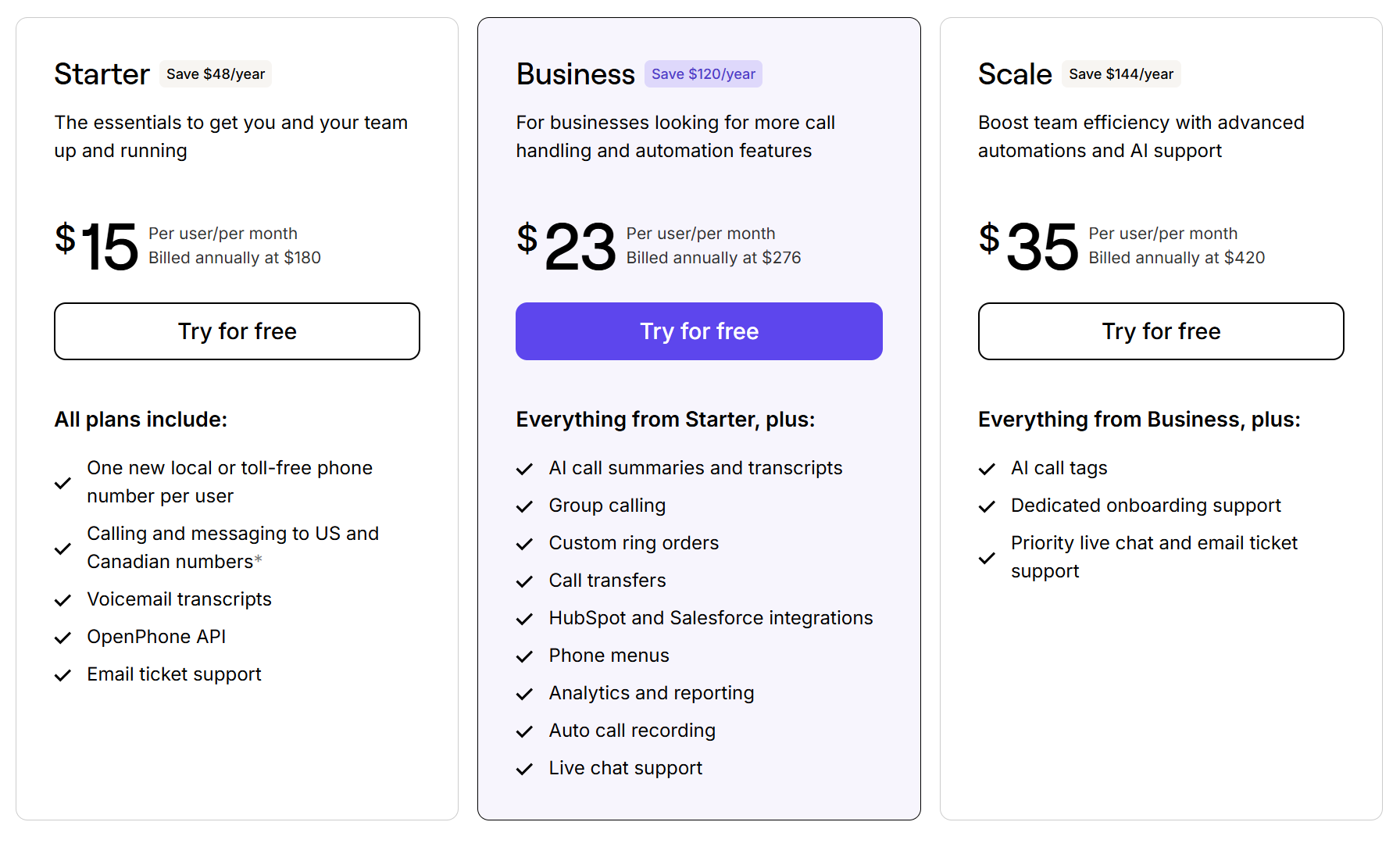
Quo offers three plans for businesses:
- Starter: $15 per user per month for unlimited calling to US and Canadian numbers, one local or toll-free number per user, voicemail transcripts, and more
- Business: $23 per user per month for group calling, call transfers, Jobber, HubSpot, and Salesforce integrations, AI call transcripts, and more
- Scale: $35 per user per month for AI call tags, dedicated onboarding, inbound phone support, and priority chat and email support
Sona is available as an add-on to any Quo plan. You can choose from these pricing tiers to easily scale based on your team’s needs:
| Tier 1 | Tier 2 | Tier 3 | Tier 4 | Tier 5 | |
|---|---|---|---|---|---|
| Sona tiers | Free | $25 per month | $49 per month | $99 per month | $199 per month |
| Included credits | 1,000 credits/10 calls | 4,000 credits/40 calls | 10,000 credits/100 calls | 25,000 credits/250 calls | 60,000 credits/600 calls |
| Overage rate per credit | $0.01 | $0.01 | $0.01 | $0.01 | $0.00 |
| Overage rate per call | $1.00 | $0.75 | $0.65 | $0.55 | $0.45 |
Keep in mind each call is worth 100 credits. Also, calls under 15 seconds don’t count towards your usage.
2. Zoho CRM: Best for AI-powered lead scoring

Pros
- AI-powered lead scoring and automation are available at lower price points compared to other CRMs
- Extensive Zoho integrations are available
Cons
- Steeper learning curve for new teams
Zoho is a cost-effective CRM for small businesses. It offers lead scoring, automation, and multichannel lead capture at lower costs than Salesforce or HubSpot.
For example, rules-based lead scoring starts at $14 per user per month on the Standard plan. AI-powered predictive scoring via Zia is available at $40 per use per month on Enterprise. Both of these are significantly cheaper than comparable features from Salesforce or HubSpot.
Zoho also offers native integrations with Zoho Campaigns, SalesIQ, Desk, and Analytics. This lets small teams build full lead-to-customer pipelines without stitching together third-party tools.
You can pair this with Quo’s native Zoho integration, which automatically logs calls and texts in your Zoho records. Plus, Zoho contact data seamlessly syncs with your Quo workspace. This lets you keep important information in one place, without jumping between multiple tools.
If you’re already using other Zoho products or planning to grow into a full business suite, Zoho CRM is an easy pick for your business. But keep in mind, Zoho is a full CRM, so the learning curve can be steep.. Past users say that configuring scoring rules, workflows, and modules takes quite a bit of setup. If you’re a team of just three to five people, you may not have the time or resources to set it up by yourself.
Key features of Zoho CRM
- Automated lead assignment rules
- Blueprint workflow automation that enforces a consistent qualification process across reps
- Multichannel lead capture from web forms, social media, Google Ads, live chat, and events
- Zia best-time-to-contact recommendations and email sentiment analysis, requires an upgrade
- Free plan for up to three users for small teams
Zoho CRM pricing

Zoho CRM offers five plans, including a free option:
- Free: $0 for up to three users with leads, deals, workflows, reports, and a mobile app
- Standard: $14 per user per month for workflows, assignment rules, AI agents, multichannel cadences, reports and dashboards, sales forecasting, and self-service kiosks
- Professional: $23 per user per month for CPQ and quote management, AI email intelligence, process automation with Blueprints, third-party widgets, inventory management, and Google Ads integration
- Enterprise: $40 per user per month for Zia AI sales assistant, journey orchestration, territory management, custom functions, wizards, and customer portals
- Ultimate: $52 per user per month for enhanced feature limits, bespoke consulting, migration assistance, custom AI/ML model building, and data preparation tools
3. Default: Best for building lead qualification workflows

Pros
- Lead monitoring, routing, and scheduling in one platform
- Data enrichment from multiple providers simultaneously
- Visual workflow builder
Cons
- Base plan starts at $750 per month
- Designed for high-volume B2B revenue operations, not for small businesses
Default is a workflow automation platform that handles the full lifecycle of inbound leads. What makes it unique is its visual, step-by-step lead qualification workflow. This lets you enrich, qualify, route, and book discovery calls with prospects all in one system.
Just keep in mind, Default was designed for growth-stage B2B companies with dedicated revenue or marketing staff. Pricing starts at $750 per month, plus $45 per user per month, with no free tier. So, for a solo operator, a small home services company, or a two-person law firm, Default is likely overkill for your needs.
Key features of Default
- Round robin lead routing
- Lead-to-account matching
- Website visitor identification
- Native integrations with Salesforce, HubSpot, and Marketo
Default pricing

Default offers three plans:
- Startup: $750 per month plus $45 per user per month for one workflow, basic enrichment from Clearbit and Apollo, 10,000 enrichment credits per year, and email support
- Growth: Custom pricing plus $45 per user per month for up to 10 workflows, premium enrichment from multiple providers, 20,000 enrichment credits per year, Slack support, and website intent data
- Enterprise: Custom pricing with custom users for unlimited workflows, unlimited enrichment credits, dedicated support, migration services, and custom integrations
4. HubSpot CRM: Best option with both marketing and sales tools

Pros
- Combined marketing and sales tools in one platform
- User-friendly interface
- 1,600+ integrations in the HubSpot App Marketplace
Cons
- Lead scoring is only available on higher-tier plans
HubSpot is a user-friendly CRM that’s a popular option with growing teams. Unlike most CRMs, HubSpot lets teams manage the full lead funnel by capturing leads through ads, forms, and landing pages. That way, you can score, route, and close leads without needing separate marketing and sales software.
Quo also offers a HubSpot integration that automatically logs calls and texts in your HubSpot records. HubSpot contact data also seamlessly syncs with your Quo workspace. That way, you don’t need to switch between your phone system and marketing hub.

Just know lead qualification with HubSpot requires a larger investment. You’ll need the Professional plan at $90 per user per month for:
- Lead scoring
- Automated lead rotation
- Email sequences
- Workflow automation
That’s $270 per month for a three-person team, plus a one-time $1,500 onboarding fee. Compared to more affordable CRMs like Zoho, this is a considerable expense.
Key features of HubSpot CRM
- AI agent for web chat and email support
- Landing page builder and ad management
- Meeting scheduling
- Sales automation workflows
HubSpot CRM pricing

HubSpot offers four plans for its Sales Hub CRM:
- Free: $0 per month for up to two users with contact management, one deal pipeline, meeting scheduler, email tracking, and basic chatbot functionality
- Starter: $9 per user per month for two deal pipelines, 500 calling minutes per month, unlimited email notifications, conversation routing, HubSpot Payments, and task queues
- Professional: $90 per user per month for unlimited deal pipelines, 3,000 calling minutes per month, email sequences, 300 custom workflows, revenue forecasting, and custom reporting
- Enterprise: $150 per user per month for 12,000 calling minutes per month, 1,000 custom workflows, custom objects, predictive lead scoring, conversation intelligence, and advanced permissions
Also, the Professional plan requires a one-time $1,500 onboarding fee, and the Enterprise plan requires a one-time $3,500 onboarding fee. All prices reflect annual billing.
5. Apollo.io: Best for data sourcing

Pros
- Database of over 230 million verified B2B contacts
- 65+ search filters for building prospect lists
- Combines prospecting, outreach, and lead scoring in one platform
Cons
- Its credit-based pricing system can become expensive and unpredictable
- Built for B2B outbound prospecting, not for small teams with phone-based leads
Apollo.io is a sales intelligence and engagement platform for teams. Its core strength is helping teams identify high-fit leads from its massive database of more than two million profiles. Once you’ve identified leads that best fit your needs, you can engage them through:
- Automated email sequences
- Phone calls
- LinkedIn outreach
You can also use Apollo to generate AI lead scores based on your team’s prospecting history and ICP criteria. It rates every contact and company on a scale of zero to 100. Your reps can instantly filter for the best-fit prospects.
But while Apollo’s pricing looks affordable at the plan level, its credit-based model can add up quickly. Plus, you should know that credits expire monthly, with no way to retrieve them if your usage isn’t high enough.
If you’re a small and growing business, you might be paying for more credits than you actually need.
Key features of Apollo.io
- AI assistant to help with prospecting and outreach
- Workflow automation engine to automate lead management based on intent signals
- Chrome extension to reveal contact details while browsing
- Salesforce, HubSpot, Outreach, SalesLoft, and Marketo integrations
Apollo.io pricing

Apollo offers four plans for sales teams:
- Free: $0 per user per month for 900 credits per year, basic contact and account data, API access, one intent topic, and an AI assistant with a five-chat limit
- Basic: $49 per user per month for 30,000 credits per year granted upfront, automated CRM enrichment, CSV and waterfall enrichment, job change enrichment, six intent topics, and AI lead scoring
- Professional: $79 per user per month for 48,000 credits per year granted upfront, unlimited lead scores, analytics and pre-built reports, and unlimited email sends
- Organization: $119 per user per month with a three-user minimum for 72,000 credits per year granted upfront, 12 intent topics, customizable reports and dashboards, and SSO
6. Clay: Best for go-to-market data management

Pros
- Access to 150+ data providers through a single marketplace
- Unlimited users on all plans
- Visual no-code workflow builder
Cons
- Credit-based pricing can be complex and unpredictable
- CRM integrations are only available in Clay’s Growth plan
Clay is a data enrichment and workflow automation platform.
You can use Clay to pull data from multiple providers into a single workspace. This is also referred to as its “waterfall enrichment” feature. With it, you can assess multiple data providers and fill in any gaps that may be left out of one provider. That way, your team can research, score, and qualify leads in a single place.
Clay also offers dozens of integrations with third-party tools to help you collect lead data and communicate with your leads. For example, Quo’s integration with Clay lets you sync Clay leads to Quo and message leads instantly.

Just know that Clay uses a credit-based pricing model. This means monthly costs can be unpredictable and fluctuate over time.
Because Clay is a flexible, open-ended tool, it requires more setup time than other tools. Most teams spend weeks building their first workflows — not ideal for growing businesses.
Last but not least, Clay focuses on high-volume outbound B2B outreach. This means it’s often overkill for small and growing teams. If you’re a relatively small business mostly handling leads on the phone, Clay may not be the best lead qualification platform for you.
Key features of Quo
- AI research agent that surfaces companies and prospects based on natural language prompts
- First-party and third-party outreach sequences
- Signals and intent changes for lead tracking
- Ad audience syncing to LinkedIn, Meta, and Google
Clay pricing

Clay offers four plans for go-to-market teams:
- Free: $0 per month for unlimited users and tables, 100 data credits, 500 actions, multi-provider waterfalls, Claygent AI enrichment, Clay sequencer for email, and up to 200 rows per table
- Launch: $167 per month billed annually for 30,000 data credits per year, 180,000 actions per year, phone number enrichment, job change and signal tracking, email campaign integrations, and up to 50,000 rows per table
- Growth: $446 per month billed annually for 72,000 data credits per year, 480,000 actions per year, CRM auto-sync and enrichment, HTTP API and webhook integrations, web intent signals, one ads audience, and priority support
- Enterprise: Custom pricing with annual commitment for 100,000+ data credits, 200,000+ actions per month, data warehouse syncs, SSO, role-based access control, unlimited Audiences, two ads audiences, and a dedicated growth strategist
7. Attio: Best option for a CRM with a flexible data model

Pros
- AI-powered automations for automatic lead matching
- Custom data objects and attributes for teams
- Free plan for up to three users available
Cons
- Teams have to set up lead scoring manually
- Email sequences and video call intelligence require an upgrade
Attio is an AI-powered CRM that offers customizable data models to B2B teams. This can help build your own scoring and routing logic. That way, you can manage qualified leads based on custom parameters.
For example, you can use Attio to set up automations that automatically classify new leads based on your ideal customer profile. You can also use data from email interactions to track your ICPs.
But you should know Attio doesn’t have built-in lead scoring features. It also doesn’t offer meeting scheduling and phone-based qualification out of the box. You’ll either have to customize Attio for these capabilities or use separate tools like Quo alongside it.
The good news is, Quo offers an Attio integration that logs calls and texts directly into your Attio records. Attio’s contact data also syncs with your Quo workspace. That way, you can keep everyone on your team up to date on new or important leads.

Key features of Attio
- Natural language AI for navigating your CRM
- Automatic data enrichment for companies and people
- Communication intelligence tracks customer interactions automatically
- Custom integrations with API and MCPs are available
Attio pricing

Attio offers four plans for CRM users:
- Free: $0 per user per month for up to three users, real-time contact syncing, automatic data enrichment, up to three objects, 50,000 records, and 200 emails per month
- Plus: $29 per user per month for unlimited users, private lists, enhanced email sending, up to five objects, 250,000 records, 1,000 emails per month, and basic access permissions
- Pro: $69 per user per month for Call Intelligence and sequences, advanced permissions, up to 12 objects, 1,000,000 records, unlimited emails, priority support, and up to 10 teams
- Enterprise: Custom pricing billed annually for unlimited objects, unlimited teams, advanced security and admin, SSO, custom record limits, dedicated migration service, and a dedicated Slack support channel
8. Chili Piper: Best for qualifying inbound web form leads

Pros
- 24/7 AI chat agent for teams
- Automatic lead qualification and routing with web forms
- Seamless sales rep to account executive handoff
Cons
- Expensive pricing for small teams
- Requires an existing Salesforce or HubSpot subscription
Chili Piper is a lead qualification and routing platform for teams of 15 members or more. It focuses solely on inbound web leads, which means it qualifies prospects who come through your website.
When a prospect submits a demo request or contact form on your site, Chili Piper will:
- Qualify them based on form data and CRM data
- Route them to the correct rep using rules like account ownership, territory, or round-robin
- Create a booking on the rep’s calendar so the prospect can book a meeting without waiting for a follow-up email
There’s also an enrichment feature that auto-fills prospect information from data providers. That way, you can keep your lead forms short and sweet while still collecting the data you need for qualification.
But remember: Chili Piper focuses on web leads exclusively. If your business primarily handles leads that come in via phone calls, then it’s not the right fit for you.
Plus, it follows an expensive pricing model. Chili Piper charges per-user fees and AI credits based on the amount of qualification you need. But pricing for the AI credits isn’t public, so you’ll need to contact sales for a quote.
You should also know Chili Piper was specifically designed to work with Salesforce and HubSpot. Past users say it can be frustrating and time-consuming to set up another CRM.
Key features of Chili Piper
- Automatic lead round-robin routing
- AI meeting prep agent
- Scheduling embed tools for marketing emails
- Automatic sales handoffs
Chili Piper pricing

Here’s the breakdown of Chili Piper’s pricing:
- Routing & Scheduling: $1,250 per month for up to 15 users, automated chat journeys, routing and assigning Salesforce objects, SDR-to-AE handoffs, smart scheduling links, inbound lead qualification, and round-robin assignments
- Experiences: $3,500 per month for up to 30 users, 24/7 AI lead qualifier, router, and converter, re-engagement flows, and account identification and ABM targeting
- Chili Data Platform: Custom pricing for unlisted features
9. Pipedrive: Best for visual pipeline management

Pros
- Visual drag-and-drop interface
- Filters for unqualified leads vs active deals
- 500+ third-party integrations
Cons
- Workflow automation requires an upgrade
- Web forms and live chat are only available with an add-on
Pipedrive is an accessible CRM for small and growing teams. It offers a clean, visual lead tracking system, with more efficient qualification features as you upgrade.
The Leads Inbox is the primary qualification feature on lower-tier Pipedrive plans. With it, new leads show up in a separate inbox rather than cluttering your existing deal pipeline. Reps can review lead details, add labels, and decide whether to convert a lead into a deal or archive it.
Lead scoring is available for teams on the Premium plan, which starts at $59 per user per month. You can also unlock features like web forms and live chat with the LeadBooster add-on, starting at $32.50 per month.
But Pipedrive doesn’t offer any phone-based lead qualification tools. You’ll need a dedicated phone system like Quo to qualify them automatically.The good news is, Quo already has a Pipedrive integration. Just sync your Pipedrive contacts in Quo, then push Quo calls and texts to your Pipedrive records automatically.
Key features of Pipedrive
- Visual dashboards
- Deal reports
- Real-time sales feed
- Internal team tagging and mentions
Pipedrive pricing

Pipedrive offers four plans for sales teams:
- Lite: $14 per user per month for lead, calendar, and pipeline management, AI-powered report creation, a real-time sales feed, 500+ integrations, and personalized onboarding
- Growth: $39 per user per month for full email sync with open and click tracking, automations and nurturing sequences, subscription and forecast reports, a meeting scheduler, and live chat support
- Premium: $59 per user per month for lead generation and routing, custom scoring, company data enrichment, AI-powered email tools, contracts with e-signatures, and enhanced team permissions
- Ultimate: $79 per user per month for fortified account security with access restrictions, phone and email data enrichment, a sandbox testing account, extended phone support, and partner discounts on PandaDoc, CloudTalk, and Surfe
10. Typeform: Best for survey-based lead qualification

Pros
- AI-generated lead qualification questions for surveys
- Conditional logic for custom surveys
- Automatic survey response enrichment
Cons
- Focuses only on surveys
- Expensive for small teams
Typeform is a lead capture and qualification tool designed to work alongside your CRM. It’s not necessarily a standalone platform, but it works well for lead qualification when paired with your existing software.
Each Typeform plan comes with a lead qualification AI solution. With it, you can narrow your business profile and ideal prospect information. This lets you trigger form logic based on scoring rules you customize yourself. You can even make enrichment variables for things like marketing qualified leads, or MQLs. Now, with branching logic, you can set up calls in Calendly, send notifications via Slack, and trigger email campaigns in Mailchimp.
But keep in mind that Typeform is only a survey-based lead qualification tool. It cannot help with:
- Sales pipeline management
- Routing leads to specific reps
- Handling phone-based qualification
This means it cannot and does not replace a CRM.
You should also know Typeform can get expensive fast. Want more than 1,000 survey responses per month? You’ll have to upgrade to the Plus plan, which is double the cost of the Basic plan.
Key features of Typeform
- AI form builder
- Automated lead routing and lead scoring
- HubSpot, Pipedrive, and Slack integrations
- Accept payments via Stripe
Typeform pricing

Typeform organizes its pricing into three categories: Core, Growth, and Talent. Here’s the breakdown of each plan, with annual billing:
Core plans:
- Basic: $28 per month for one user, 100 responses per month, unlimited forms and questions, AI-powered form builder, and standard email support
- Plus: $56 per month for three users, 1,000 responses per month, custom subdomain, remove Typeform branding, and premium themes
- Business: $91 per month for five users, 10,000 responses per month, drop-off analysis, conversion tracking, priority support, and live chat
- Enterprise: Custom pricing for tailored response limits and users, SSO, custom domains, HIPAA and GDPR compliance, preferred data center selection, and a dedicated outcomes manager
Growth plans for marketing teams:
- Growth Pro: $266 per month for five users, 10,000+ responses per month, 1,500 enrichments per month, video questions and answers, Salesforce integration, Google Analytics, multi-language forms, and automated lead scoring
- Growth Custom: Custom annual pricing for 20,000+ responses per month, 3,000 enrichments per month, unlimited viewer seats, SSO, custom domain, and a dedicated customer success manager
Talent plans for HR teams:
- Talent: $119 per month for three users, 3,000 responses per month, video questions and answers, reCAPTCHA, multi-language support, and AI-powered clarification questions
- Enterprise: Custom pricing for VIP support and a dedicated outcomes manager, SSO, and HIPAA and GDPR compliance
11. Nutshell: Best option for combining CRM and email marketing

Pros
- Predictive lead scoring
- Sales pipeline management
- High-priority lead tags
Cons
- SMS features cost extra
- Meeting scheduler requires an upgrade
Nutshell is a CRM platform that combines email, texting, and live chat marketing automations. For example, you can use Nutshell’s one-click AI email builder to craft specific messages to leads with buying intent. Then, you can create, send, and track emails as they go out to your leads. You can track conversion rates and other data points directly inside the Nutshell dashboard.
Just note that most of these features require the Pro plan, at $42 per user per month. Plus, you may need to purchase specific email add-ons, like additional contacts and advanced reporting, for $5 to $49 per month.
This high pricing extends to Nutshell’s SMS messaging as well. Not only is it an add-on, but it charges credits for every message sent. It’s also unclear what advanced texting features are available with its SMS feature. Even Nutshell’s AI features charge customers on an “outcome” basis, which means you can quickly rack up AI costs over time.Want to use a lot of SMS and AI features in your business? You’re better off using a dedicated business phone platform like Quo and integrating it with Nutshell.
Key features of Nutshell
- 24/7 AI chatbot
- Automated lead assignment
- Web form builder
- Drag-and-drop lead board
Nutshell pricing

Nutshell offers five CRM plans:
- Foundation: $13 per user per month for unlimited contacts and storage, email and calendar sync, AI Chatbot, form builder and landing pages, and 10 AI outcomes per month
- Growth: $25 per user per month for activity reports, sales quotas, lead assignment rules, and 20 AI outcomes per month
- Pro: $42 per user per month for five custom pipelines, advanced reporting, sales automation, AI lead recaps and next steps, and meeting scheduler
- Business: $59 per user per month for 10 custom pipelines, advanced meeting scheduler, audit log and changelog, email templates from Gmail and Outlook, and additional teams and territories
- Enterprise: $79 per user per month for unlimited pipelines and custom fields, Enterprise SSO, SQL data access, phone support, and 150 AI outcomes per month
Which lead qualification software features should you prioritize?
As mentioned before, there’s no one platform that’ll fulfill all your qualification needs. You’ll need a mix of tools to meet leads where they’re at and qualify them. These are the lead qualification features you should look for:
1. Lead capture
Accurate qualification starts with getting the right information from leads. For this reason, prioritize tools that offer multichannel lead capture.
Quo, for example, helps you capture leads through both voice and text. This makes it easier to connect with leads through their communication channel of choice.
If you’re running paid ads, you need a reliable lead capture tool. Once leads come in through your ads, your lead forms have to be easy to fill out. Otherwise, you’ll be wasting your ad budget on clicks that don’t convert into actual leads.
2. Lead data enrichment
Once leads come through the door, you have to enrich existing data to help qualify them. That way, you can quickly decide which leads to prioritize for follow-up calls.
There are many different data sources available to lead qualification tools, including:
- Demographic
- Firmographic
- Third-party intent data
You’ll want a tool that can verify these data sources and make sure they’re up to date and accurate. Providers like Apollo, for example, source and clean data from over two million sources.
Keep in mind this feature is more applicable to businesses that offer B2B products and services. If you’re a business offering a consumer service, you don’t really need data enrichment before your first call with a customer.
3. Lead scoring
After you collect and enrich leads, you have to score them against your customer priorities. The best providers offer AI with scoring models, which assign different weights to your lead criteria. This helps automatically identify your highest-priority leads.
Prioritize providers that offer predictive lead scoring on lower-tier plans. That way, it’s easier to set up and optimize your business’s specific sales process.
Lead scoring is right for large sales teams that have to manage their pipeline during multi-step sales cycles. But service businesses don’t need complex lead scoring because their sales cycles are shorter.
4. Lead routing
Which team members will take ownership of incoming leads? With lead routing, you can automatically distribute leads to your team and split responsibility for high call volumes.
Make sure to choose tools that let you easily schedule follow-up calls whenever leads reach out. Quo’s AI agent, Sona, can automatically text your team’s calendar link so leads can choose a time that works for them.
5. CRM integrations
For teams that require lead qualification to manage their pipeline, CRMs tend to be their single source of truth. That’s why you should choose a lead qualification platform that integrates directly with your CRM.
You can update lead information in your CRM after they’ve been qualified. Most CRM platforms offer automatic syncs with third-party platforms. Updates that happen outside their systems carry over into their platform. This saves time for your team so they can focus on moving leads through your pipeline instead of managing administrative tasks.
How to choose the right lead qualification software for your business
With so many lead qualification tools available, it can be hard to choose the right one. Here are a few things to consider as you choose a lead qualification software platform:
- Start with your lead channel. Each software option specializes in different channels. Choose a platform that matches the channel your business uses to gather and qualify leads. For example, if your leads primarily come in on your business phone, you should choose a platform that can help you qualify them on their first call.
- Ease of use. How easy is it to set up and use your lead qualification platform? Choose a platform that lets you get started without coding knowledge or complex onboarding.
- Flexibility. Can you customize your lead scoring models? Select a platform that you can adjust to your business needs.
- Integrations. How well does your preferred platform play with the rest of your tech stack? Go for options with the most third-party integration capabilities. That way, you can keep your data consistent across tools instead of creating multiple silos.
- Pricing. How cost-effective is one platform compared to another? Opt for a lead qualification platform that scales with your business. Avoid platforms that charge hefty monthly fees that aren’t tied to the value they provide your team.
- Ratings and reviews. See what actual customers say about each platform. Check out their G2 and Trustpilot pages to browse recent customer feedback.
Start qualifying your leads today

Not every lead is worth your time — and the faster you can tell, the more time you can spend closing the right ones. Lead qualification software ensures your team doesn’t chase dead ends or let great prospects slip through the cracks.
That said, the right tool depends on where your leads come from. If they often come through web forms, a tool like HubSpot might be the right fit. Like many small businesses, if your leads come in over the phone, you likely need a phone qualification tool.
Quo’s business phone system can help qualify leads from the moment they call, even when you’re not available to pick up the phone. Each plan comes with Sona, our 24/7 AI voice agent, which answers calls, asks questions, and logs conversations for you to follow up later. You’ll also have access to features like unlimited calls and texts, AI call tags, call summaries, and internal threads.
Sign up today for Quo’s seven-day free trial and start qualifying leads over the phone with your team.
FAQs
Lead qualification assists with both marketing and sales.
For marketing teams, it helps with lead nurturing and knowing which marketing materials to share with which leads.
For sales teams, it helps with lead targeting and conversion, including knowing who to prioritize based on buying signals.
Yes, AI can help marketing and sales teams qualify leads faster. Quo’s Sona, for example, can automatically qualify leads 24/7 for businesses. Teams can see what leads are looking for, then customize their pitch so leads are more inclined to convert.
Lead qualification helps determine whether a prospect is likely to become a customer. Lead scoring, on the other hand, helps teams determine which leads to pursue first by ranking them in order of priority. Lead scoring is technically part of lead qualification.
Yes, it’s possible to qualify leads over the phone. You can do this by asking qualifying questions stored in your business phone workspace. Or you can rely on an AI voice agent to ask qualifying questions on your behalf.
Each software platform has a different setup time. Quo can be set up in minutes to qualify leads calling in to your business. Here’s how:
• Sign up for a seven-day free trial
• Purchase or port local, toll-free, or vanity numbers to your account
• Onboard your coworkers to start qualifying leads together as a team
Note that it can take one to two weeks to set up Quo for SMS, because it requires A2P 10DLC registration.