Blog

Call recording disclosure: The cost of non-compliance

Call recording disclosure

We’re used to our data being collected all the time, right? Between social media, website cookies, and Siri listening to our every word, it’s a privacy free-for-all.

Or is it? Recording phone calls is common practice for businesses. But doing so without having explicit consent can expose you to criminal charges, civil lawsuits, and hefty fines. 

A call recording disclosure is a simple, effective way to legally record phone calls. It keeps you on the right side of the law and builds trust with customers.

This guide walks you through call recording laws across the US, Canada, the EU, and the UK. We also share some call recording disclosure scripts, along with how to implement them in your business.

DISCLAIMER: This article is for informational purposes only and shouldn’t be considered legal advice. Be sure to consult with an attorney or legal expert to ensure you comply with the call recording disclosure requirements and laws in your area. 

What is a phone call recording disclosure?

A call recording disclosure is a notification to all parties on a call that the conversation is being recorded. Various laws and regulations enforce what a compliant disclosure for call recording should look like. But generally, it should include:

  • That you’re recording the call
  • The purpose of the recording, like quality assurance or recordkeeping. You could also be making a sales call recording for training purposes, for example.
  • How to opt out if they don’t consent 

You can deliver the disclosure as an automated message before the conversation starts. Your team members can also read out a call recording disclosure script before the customer starts talking.

There are two main types of consent: 

  • Active, explicit consent. One time you need to get active permission is when you start recording mid-call. For example, if you didn’t start recording at the start of the call but then asked if it’s okay to record. 
  • Passive, implied consent. Consent is implied when you inform a caller that you are recording and they stay on the call. This is common with automated disclosures, where the notification happens before any conversation takes place. Generally, depending on the situation and jurisdiction, implied consent may be enough to satisfy the law. For example, according to the Office of the Privacy Commissioner of Canada: “If the customer proceeds with the call knowing that the conversation is being recorded and why, their consent is implied.”  But it’s best to consult a legal professional about your particular situation.

Why should you never forget call recording disclosures 

Failing to disclose call recording and to get informed consent from the caller is against the law in many jurisdictions. In the US, the Electronic Communications Privacy Act, or the ECPA, regulates this. It’s an update on the Federal Wiretap Act of 1968 and prohibits: 

“…the intentional actual or attempted interception, use, disclosure, or “procure[ment] [of] any other person to intercept or endeavor to intercept any wire, oral, or electronic communication.”

Basically, if you record a call without giving the required notice or getting the required consent, you may violate federal law.

Failing to meet regulatory compliance can mean criminal penalties, including fines and imprisonment. For example, the statute allows imprisonment of up to five years for certain willful violations. Depending on the case, you may also be fined at least $500 per violation.

Finally, recordings made without proper disclosure generally can’t be used as evidence in court. So if you ever get into a legal dispute with a customer, you might not be able to prove your side of the story. A documented, consistent disclosure process is your paper trail if you’re ever challenged.

That said, the rules around disclosure depend on where you and your caller are located. Specifically, it depends on whether you’re in a one-party or two-party consent jurisdiction.

One-party vs two-party consent

Laws on call recording consent differ based on location. Let’s say you and your customers are based in the US. Depending on the state, you need either:

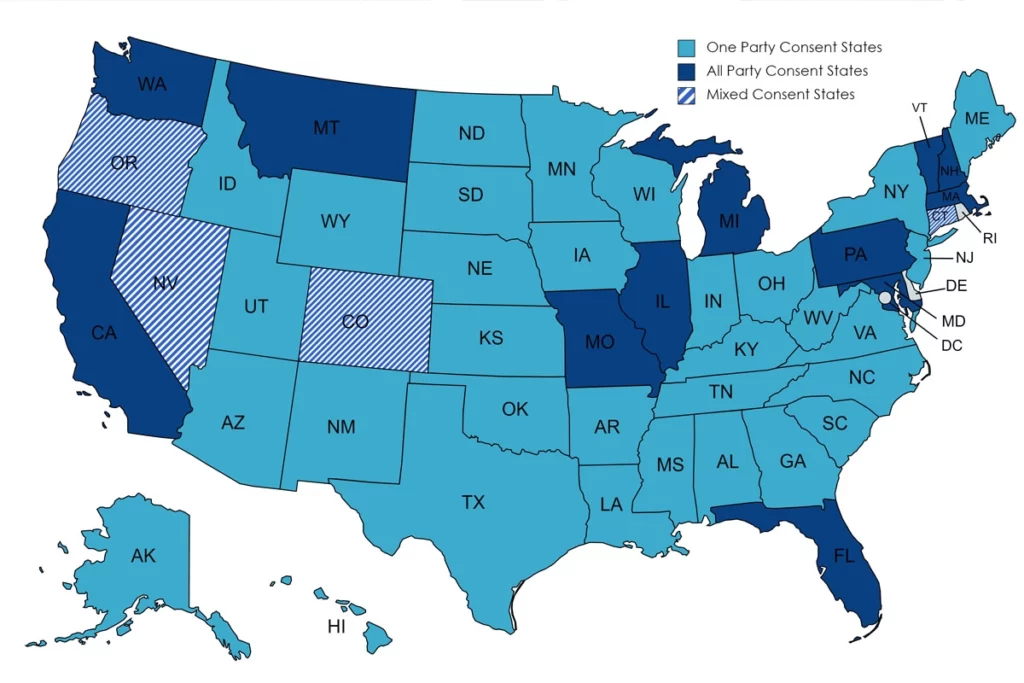
  • One-party consent. Only one person on the call needs to be aware of and consent to the recording. This means you can record your own calls without having to inform the other person. Most US states have one-party consent laws. See the full list of one-party consent states
  • Two-party consent. Also called all-party consent, this requires everyone on the call to give their permission to be recorded. This is the most transparent practice. Check out the list of two-party consent states here.

Some states have additional restrictions around one-party and two-party consent. For instance, while Wisconsin is a one-party consent state, two-party consent is required for the conversation to be used in court

Laws can also change regularly. So stay up to date on your state’s recording laws and consult a legal professional when necessary.

⚠️Important: If you’re calling customers in a different state, play it safe by respecting the more restrictive law. There have been cases where a person in a one-party consent state has gotten in trouble for recording a call with someone in a two-party consent state without informing them. More on this soon.

So, how do you tell customers you’re recording the call?

Compliant inbound call recording disclosure 

Use this script when you record your automated call recording disclosure. You can have it play as an audio before a call connects or even as a phone menu greeting. Alternatively, you can give this script to your reps to read before every conversation.

Here’s an example of a call recording disclaimer script you can use:

“Thank you for calling [business/department]. This call may be recorded for customer service quality assurance and training purposes. If you do not wish to be recorded, please hang up now and contact [email] for support.”

With Quo, you can get automatic call recording and set up an automatic call recording disclosure for inbound and outbound calls.

  1. In your phone number settings, toggle on Auto-record calls and Call recording notifications for your inbound and outbound calls. 
  2. Choose between a voice-based or an audio tone notification. An audio tone notification is a beep reminder for the rep to manually notify the caller of the recording.
Call recording disclosure settings on Quo

💡Note: Quo users are responsible for their jurisdiction’s requirements regarding call recording compliance. Quo’s call recording notifications feature also doesn’t account for international law variations on call recording requirements. 

Compliant outbound call disclosure

If you or a team member is making the call, keep the disclosure short and sweet.

Here’s a simple “this call is being recorded” script you can use:

“Hey [name], this is [your name] calling from [company]. Just a heads-up: this call is being recorded for quality and training purposes. If you’d prefer not to be recorded, just let me know, and I’ll turn it off. 

Call recording laws by jurisdiction

Let’s break down call recording compliance by region. Keep in mind that recording laws can be complex and subject to change. You should consult legal counsel or refer to the most recent state statutes for the most accurate and up-to-date information.

US states requiring one-party consent

Most US states, and Washington, DC, are one-party consent states. Here’s the full list of states with one-party consent laws to record phone calls:

  • Alabama
  • Alaska
  • Arizona
  • Arkansas
  • Colorado
  • District of Columbia
  • Georgia
  • Hawaii¹
  • Idaho
  • Indiana
  • Iowa
  • Kansas
  • Kentucky
  • Louisiana
  • Maine²
  • Minnesota
  • Mississippi
  • Missouri
  • Nebraska
  • New Jersey
  • New Mexico³
  • New York
  • North Carolina
  • North Dakota
  • Ohio
  • Oklahoma
  • Oregon
  • Rhode Island
  • South Carolina
  • South Dakota
  • Tennessee
  • Texas
  • Utah
  • Vermont⁴
  • Virginia
  • West Virginia
  • Wisconsin
  • Wyoming

¹Hawaii provides for one-party consent, but there’s a specific law that applies to private spaces.

² Maine is a one-party consent state, but there’s a separate law regulating recordings made in private places

³New Mexico is a one-party consent state for phone calls on landlines, but the “wording of the statute suggests that it may not apply to cell phone conversations.”

⁴Vermont doesn’t have a clear rule for consent to recording. Federal law applies.

US states requiring two-party consent

Other US states are two-party consent states. This means everyone on the call needs to give their consent before you record a phone call.

Here’s a list of two-party consent states:

  • California
  • Connecticut⁵
  • Delaware⁶
  • Florida
  • Illinois
  • Maryland
  • Massachusetts
  • Michigan⁷
  • Montana⁸
  • Nevada
  • New Hampshire
  • Pennsylvania
  • Washington

⁵Connecticut imposes civil liability for recording phone calls without all-party consent. But it’s a one-party consent state for criminal liability purposes.

⁶Delaware has conflicting laws that create legal ambiguity. It features a wiretapping statute that permits one-party consent and a privacy statute that points to all-party consent. Because of this unresolved split, it’s best to respect the more restrictive law and treat Delaware as an all-party consent state to avoid risk. 

⁷Michigan’s law indicates all-party consent. But some courts have interpreted it to mean that if you’re part of the conversation, you’re not “eavesdropping,” so you can record without everyone’s consent. However, this hasn’t been confirmed by the state’s Supreme Court, so it’s not fully settled. 

⁸Montana is an all-party knowledge state. This means you need a disclosure, but callers don’t have to consent.

Canada’s laws for recording phone calls

Canada’s Personal Information Protection and Electronic Documents Act, PIPEDA, requires all-party consent. You can learn more about the specifics by visiting the official site of the Office of the Privacy Commissioner of Canada.

The European Union’s laws

In the EU, users’ data is protected under  the GDPR, or General Data Protection Regulation. You can only legally record calls under the GDPR if you have all-party consent.  

According to GDPR Article 13, when reading or playing an automated call recording disclosure, you have to tell callers:

  • The purpose of the processing, like quality assurance for customer service recordings
  • How long the data will be stored
  • Who it’ll be shared with
  • Their right to withdraw consent

Callers also need a way to opt out. It should be “as easy to withdraw as it is to give consent.” You also can’t punish a customer for withdrawing consent by denying a service that doesn’t actually depend on it. An example of that would be the right to equal, efficient access to customer support.

United Kingdom laws

In the UK, call recording is governed by three main regulations: 

Businesses must have a lawful basis for recording telephone calls. This is typically a legitimate interest or legal obligation. They should also inform callers that the call is being recorded and why. 

You can do this through an automated message at the start of the call or a verbal statement from the person taking the call. Unlike the US, UK law doesn’t require explicit consent before recording begins, but transparency is mandatory. For the most current guidance, refer to the ICO’s UK GDPR resources

Best practices for compliant call recording disclosure

Here’s how to write a call recording disclosure:

  1. Be clear and concise. Let callers know when you plan on recording and what you plan to do with the audio. Cover all your bases, but don’t overdo it. No one wants to sit through a legal monologue.
  1. Automate call recording disclosures. If your business handles higher call volumes, you might want to leverage automated disclosures. This will protect you if a team member forgets to disclose that they’re recording a call.
  2. Regularly check for compliance. Regulations can change frequently. Set a regular reminder to check your state laws and those of your customers if they’re different. For example, you can review the laws with your legal team every quarter. You should also re-evaluate call recording compliance policies after certain triggers, like expanding to other states or adopting new AI recording and transcription tools. 
  3. Decide on the timing of the recording disclosure. You can have it play as a part of the phone menu greeting or have team members disclose the recording before the conversation starts. You can also have it play as an audio file before a rep picks up.
  4. Stay consistent. Keep the same process for inbound and outbound calls, and follow the strictest law, which would be two-party consent, regardless of your or the other person’s state. Better safe than sorry.
  5. Regulate storage and access. Encrypt stored recordings and implement role-based access controls so only authorized staff can retrieve or listen to them. 

💡How do you regulate storage and access to call recordings? It depends on your business phone system. With Quo, you have three workspace roles: Owner, Admin, and Member. Unless they’re in a shared inbox, Members can only see their own call activity. They can’t access recordings from phone numbers they haven’t been given access to.

The security framework also includes access controls and audit logging for oversight. This is especially important if you need HIPAA-compliant call recording as a healthcare provider. Finally, use phone number access controls to control who can access a specific phone number and its recordings. Only number owners, workspace Owners, or Admins can manage these settings. This lets you limit recording access to authorized staff.

How to implement call recording disclosures in your business

Now that you know what’s required for call recording compliance, here’s how to put it into practice.

1. Create a phone call recording disclaimer policy

A well-documented call recording policy reduces the risk of employees recording calls illegally. At a minimum, your policy should cover:

  • Purpose. Why you record calls.
  • Consent procedure. How and when employees must inform customers. Include approved scripts for inbound and outbound calls.
  • Storage and access. How long you keep recordings, where you store them, and who can access them.
  • Consequences. What happens if an employee records a call without proper disclosure.

Make the policy easy to find, like in a shared drive or your internal wiki. 

Don’t forget to review your policy regularly, like every quarter. That said, if your default practice is to always notify customers and obtain consent, you’re less likely to need adjustments.

Lay the foundation with this customer service quality assurance checklist.

2. Train your employees

Walk new hires through the policy during onboarding and have them acknowledge it in writing. Then schedule training at least once a year, as well as whenever regulations change or you expand into a new market. Sessions should cover:

  • What consent means and how requirements differ across the states or countries you serve
  • How to deliver a disclosure, like whether through an automated message or a verbal customer service script
  • What to do if a caller withdraws consent mid-call
  • The consequences of non-compliance for the business and the individual employee

If your team delivers disclosures verbally, incorporate role-playing into training. This helps reps feel confident about handling real scenarios. 

If you use a customer service scorecard, make obtaining consent a scored item to keep compliance visible and accountable. Need a starting point? Use this customer service scorecard template.

3. Conduct regular audits

Regularly monitor customer service and sales call recordings to ensure reps are following your policy.

Want to make sure reps are following a script before pressing record? 

With Quo, you can easily set up call shadowing using group calling. You can listen in on another employee’s phone call in real time. Just make sure you inform the caller that someone else is on the call for compliance purposes.

If you’re using a pre-recorded disclosure on your phone menu, check to make sure it works when callers dial in. 

Call recording compliance in the age of AI

Many business phone systems now come with built-in AI features, like automatic transcription, call summaries, and sentiment analysis. These tools are useful, but they may add a layer of compliance responsibility that standard call recording doesn’t fully cover.

Recording consent governs the capture of a call. What happens to that data afterward is a separate legal question. Once a call is transcribed, you’re dealing with personal data, like names, addresses, payment details, and service issues. That may fall under state privacy laws. 

In California, for example, the CCPA governs how that data can be stored, accessed, and used. The regulations cover AI systems as they process personal information. Your state may have its own equivalent.

AI-specific privacy legislation is also emerging across the country, and this space is moving fast.

You can take a few practical steps if you use AI call features:

  • Update your disclosure script and privacy notice. Mention AI transcription or analysis where applicable.
  • Store recordings and transcripts only as long as necessary for their stated purpose.
  • Check your phone provider’s data handling practices, specifically whether they use your call data to train their AI models.

Consult a legal professional to understand the specifics of your business and location.

Case studies on non-compliant call recording disclosure 

Non-compliance with call recording disclosure laws has real consequences. Here are two cases that show what’s at stake. 

1. LoanMe vs. Smith

In October 2015, a LoanMe employee recorded an 18-second call with Jeremiah Smith without his consent. Three seconds into the call, LoanMe played a beep tone to signal that the call was about to be recorded. But the representative never disclosed it verbally.

Smith sued, arguing the recording violated California Penal Code section 632.7. California recording laws require the consent of all parties. LoanMe’s defense rested on two arguments: 

  1. The beep tone constituted adequate notice.
  2. Section 632.7 only applied to third-party eavesdroppers, not to parties on the call themselves.

The case reached the California Supreme Court. It ruled 7-0 that the statute applies to parties as well as nonparties. This means that a business recording its own calls without proper disclosure can be in violation.

2. CapitalOne

Cardholders across multiple states filed a class action lawsuit against Capital One after outbound customer service calls were recorded without their consent. The consolidated suit alleged Capital One violated each state’s privacy statutes. Capital One settled for $3 million. No admission of wrongdoing was made, but the financial and reputational cost of the litigation made the point clear enough.

Automate call recording disclosures with Quo

Quo apps

A clear and compliant call recording disclosure protects your business from legal risks. It also builds customer trust and ensures smooth communication without disrupting your team’s work. The best part is that you can do this easily with Quo. It takes less than 15 minutes to customize your call recording settings.

You’ll get plenty of other perks with a Quo account. Think unlimited recording storage, on-demand and automatic call recording, and call recording notifications.

All that’s left is to test it for yourself.

Sign up today for a seven-day free trial.

FAQs

What are the consequences of not providing call recording disclosure?

Failing to disclose call recording can result in criminal charges, civil lawsuits, and fines. In some states, violations carry penalties per call, which can add up quickly in a class action scenario. Recordings made without proper disclosure may also be inadmissible as evidence. This can work against you if a dispute goes to court. The exact consequences depend on your jurisdiction and the applicable laws.

How do you handle consent for cold calls?

Rules for cold calls vary significantly by country and depend on whether the call is live or automated.
United States. The TCPA focuses primarily on automated and pre-recorded calls. These require prior express written consent before contacting a cell phone. Live manual calls have fewer restrictions. But you must still honor the National Do Not Call Registry and maintain your own internal do-not-call list. The FTC’s Telemarketing Sales Rule also requires you to identify yourself and state your purpose. You can’t misrepresent your offer.
– Canada. Under the CRTC’s Unsolicited Telecommunications Rules, you have to check the National Do Not Call List before calling. You also have to respect any direct objection and comply with calling hours and caller ID requirements. Calls are allowed if there’s express consent or an existing business relationship.
Always consult a legal professional for guidance specific to your business.

What is an example of a call recording disclosure?

A call recording disclosure is a spoken or automated message. It informs callers their conversation is being recorded, why it’s being recorded, and how they can opt out.
Here’s a simple call recording disclosure script example for an inbound automated message:
“Thank you for calling [company name]. This call may be recorded for quality assurance and training purposes. If you’d prefer not to be recorded, please hang up now. You may reach customer support at [email].”
For an outbound verbal disclosure:
“Hi [name], this is [your name] from [company]. Just a quick heads-up, this call may be recorded for quality and training purposes. If you’d prefer not to be recorded, just let me know.”

Do you have to disclose that you’re recording a call?

That depends on where you live. In the US, someone always has to give consent if you’re recording conversations. In most states, you’re legally the only one who has consent. In a few states, everyone who’s part of the conversation has to give their consent to be recorded. It’s a good idea to follow two-party consent and let the other person know you’re recording so you know the law is on your side.

What are the regulatory requirements for call recording?

Call recording regulations vary by location and are governed by a mix of federal, state, and international laws.
In the US, federal law requires at least one-party consent. But some states have stricter laws. California, Florida, and Illinois are among those states. If you’re calling across state lines, the safest approach is to follow the more restrictive law.
In Canada and the EU, all-party consent is generally required. In the EU, GDPR also governs how recorded data is stored, accessed, and used.
Beyond consent, some jurisdictions have additional requirements for data storage — think how long recordings can be kept, who can access them, and how they must be secured. 
If your phone system uses AI features like transcription or call summaries, that processing may trigger additional obligations, depending on where your callers are located.
Laws in this area are evolving quickly, particularly around AI. Always consult a legal professional to understand the specific requirements that apply to your business.

Do I need consent from all parties to legally record a call or meeting?

The legal requirements depend on the state. You’ll want to consult a reputable source to determine state-specific laws regarding how to legally record phone calls and obtain consent from all parties.

How do FCC rules differ from state-specific call recording laws?

The Federal Communications Commission “has no rules regarding recording of telephone conversations by individuals. But some state laws prohibit this practice.” Always stay up to date on your and your customers’ state laws regarding call recording.

How long does Quo retain call recording data?

Quo retains your data for as long as you maintain your account. If you cancel your subscription, we’ll keep your data for a 30-day grace period. After that, it will be permanently deleted. You can also permanently delete your data upon request.