Finally. You’ve decided you can’t afford to miss any more calls. Great!
Call handling is exactly what you need if your team is overwhelmed by high call volume but wants to provide better service. And it’s worth the effort. Fifty-eight percent of US customers are willing to pay more when a brand offers a better customer experience.
Let’s make sure your calls reflect that.
In this guide, you’ll learn the basics of call handling, along with how to do it well. You’ll also learn about five call handling tools, along with pros, cons, pricing, and top features.
What is call handling?
Call handling is the process of receiving, directing, and managing all business phone calls — inbound and outbound. This can apply to customer services, sales, or any other team that takes calls.
The purpose of call handling is to capture more leads and improve the customer experience. It also helps make your business look more credible and organized.
How does call handling work?
Call handling starts the moment a customer dials your business number. Whether a person or an automated system answers it, the goal is the same: to get the caller what they need as quickly and professionally as possible.
Here’s how the process typically works:
- A call comes in: A human or automated system, like an interactive voice response system or AI voice agent, picks up.
- Assess the caller’s needs: The responder asks questions or uses prompts to figure out why the person is calling. At this stage, they can also screen the call to filter out irrelevant or spam calls.
- Route the call: Based on the issue, they send the caller to the right person or department.
- Resolve the issue: The team member resolves the issue or transfers the call if it needs to go elsewhere.
- Log the outcome of the call, or call disposition: The team or system completes after-call work. This means recording the details to make follow-ups and customer callbacks easier.
You can handle calls passively and actively:
- Active Call Handling involves direct human intervention throughout the call process. This includes live call transfers, real-time problem-solving, personalized customer interactions, and immediate decision-making. Active handling is ideal for complex inquiries and sensitive issues.
- Passive Call Handling relies on automated systems to guide callers and route calls. This includes IVR systems and AI voice agents. Passive handling reduces call volumes and allows for 24/7 availability.
Depending on your team size and call volume, you can opt for mostly human call handling, mostly automated, or a mix of both.
What are the key components of call handling?
For call handling to work well, you need the right tools and systems on the backend. These components include:
| Component | Description |
|---|---|
| Call routing | Directs incoming calls to the right rep based on skills, availability, department, or caller history. |
| IVR or phone menus | Automated menu system with voice prompts and keypad options. It helps callers reach the right departments on their own. |
| AI voice agents | Smart automated assistants that can handle basic questions and tasks like transfers. |
| Call transfer | Connects live calls to another rep, department, or external number. Transfers can be warm or cold. |
| Call screening | Filters out spam calls and identifies callers’ needs to route them properly. |
| Call monitoring | Records and analyzes interactions for training, quality assurance, and compliance purposes. |
| Quality assurance | Regular assessment of call handling performance against company standards and customer expectations. |
| Call queuing | Manages caller wait times by placing callers in virtual lines when all reps are busy. Helps prevent dropped calls. |
| Call logging | Captures call details like caller info, purpose, duration, and resolution. This helps with tracking and analysis, so customers don’t have to repeat themselves. |
| CRM integration | Syncs phone systems with customer databases to automatically log caller information and context. |
What’s the difference between inbound vs outbound call handling?
The difference depends on who’s making the call: your team or the customer.
Inbound call handling is when a customer calls into a business with a question or concern. These calls usually include:
- Customer service and support
- Technical troubleshooting
- Billing or payment issues
- Complaints or feedback
- Sales inquiries or service requests
- Questions about hours, location, or policies
- Appointment booking or changes
- Service follow-ups
Outbound calls are calls a business makes to its customers or potential customers. Some examples of outbound calls include:
- Reaching out to new leads or past customers
- Scheduling or confirming appointments
- Following up after a missed call or service
- Running customer surveys or market research
📚Further reading: Inbound call routing: The basics + 5 different types
What are the benefits of call handling for businesses?
Implementing call handling strategies isn’t easy. But it’s worth it. Here’s why:
- Happier customers: Quick, accurate responses show customers you value their time and know what you’re doing.
- Better support efficiency: Clear processes reduce hold times, transfers, and confusion so your team can help more people in less time.
- Scale without adding staff: As call volume increases, solid systems help you manage more calls effectively. This way, your team won’t get overwhelmed, and you won’t need to hire too early.
- Capture more leads: Don’t lose leads to voicemail or competitors. Clear call handling processes mean fewer dropped calls, faster follow-ups, and a better chance of converting leads.
- Improved brand reputation: Every great call builds trust. When customers feel heard and helped, they associate your brand with professionalism and care.
7 call handling best practices to delight customers and your teams
To build a strong call handling function, your team needs a combination of processes and tools. These best practices cover both to provide the best call handling experience to your customers.
1. Use a business phone solution with shared phone numbers
The first step is to invest in a business phone solution that lets your team handle simultaneous incoming calls.
“I had an experience at a previous company when we first launched a call line, and we used to literally pass an actual cell phone from person to person,” says Drew Schuffenhauer, Support Lead at Quo, formerly OpenPhone. “It was awful.”
Features like simultaneous ring and shared numbers help customers connect with your team quickly.
If you don’t have shared numbers, your customers may become frustrated while waiting on hold, hang up, and switch to one of your competitors.

2. Use phone menus
Phone menus — also known as phone trees, auto-attendants, or virtual receptionists — let callers direct themselves to where they need to go. Customers listen to a menu, say what they need, or press a number to reach the right person. For example, ‘press one for sales’ and ‘press two for support’.
This shortens wait times and takes the burden of filtering calls off your team.
With phone menus, you can also play pre-recorded messages to answer frequently asked questions. For example, a menu option that informs callers how to reserve a table or what your hours are. Customers get answers immediately, and you don’t have to dedicate resources to answering the same questions.
💡Bonus: Phone menus reduce robocalls and automated spam calls because bots can’t get through the options. This frees up your team to spend more time on the phone with actual humans.
Just be careful not to give too many menu options to your customers. Long menus are hard to navigate and can confuse customers. If you have different locations or need multiple menus — for different languages, for example — set up a multi-level IVR. It keeps things clean and simple.

3. Establish clear call escalation procedures
Call escalation procedures are the rules your team follows when a customer issue needs to be passed to someone else, like a supervisor, specialist, or manager.
This includes knowing:
- When to escalate: Like when a customer is angry, the issue is too complex, or they’re disputing a charge
- How to escalate: Like making a warm transfer with context, not a cold handoff
- Who to escalate to: Like billing issues to the finance team, product questions to a technical specialist, and complaints to a team lead
Without clear escalation rules, frustrated customers are passed around, and problems get worse.
Here’s how to set up an escalation process that keeps things smooth for everyone:
- List common situations that need a handoff. For example: angry callers, refund requests, billing issues, or technical problems your team can’t solve on the spot.
- Assign who handles what. Document this in a shared reference guide your team can quickly access, like an internal wiki, call script, or CRM notes.
- Require team members to give context before transferring the call. This way, customers don’t have to repeat themselves, and reps can get up to speed quickly.
- Set customer expectations. Train your team to say things like, “I’m going to bring in my manager who can approve that refund,” so they understand why they’re being transferred.
- Train everyone on the system. Ensure both call takers and escalation teams know their roles and what’s expected of them.

4. Personalize calls with a caller’s interaction and usage history
Personalized support shows you care about customers on an individual level. Also, it shows you’re paying attention to details and are invested in building a long-term relationship.
So, what’s one of the easiest ways to connect with a caller? Reference a customer’s past interaction history with you or other members of your support team.
With Quo’s custom properties and contact notes, you can take notes on what you discussed and what they shared with you.
Did your customer mention that they like camping? Are they going to Paris for the first time in a month? Jot down important tidbits right into Quo. Then, you can reference them the next time you and your customer talk.

If you connect Quo to the other tools you use — like your CRM or product database — your team can see useful info about each customer while on a call. For example, if you’re a SaaS company and someone calls your support number, your team could see details like:
- Subscription plan details
- Product issues or error logs tied to their account
- How long they’ve been a customer
- Past interactions or support tickets
5. Coach team members to improve their call handling skills
Even with the right tools and processes, your team still needs training to handle calls with confidence. Coaching helps reps stay calm under pressure, know when to escalate, and deliver a better experience.
Here are some call coaching exercises you can do:
- Role-playing common call scenarios: Have one team member play the customer while another practices handling the call. This creates a safe environment for representatives to receive feedback and improve.
- Call shadowing: Let junior staff listen in on live calls or recordings from more seasoned reps. It helps them learn tone, pacing, and how to respond in real situations.
- Reviewing past calls together: Use call recordings or transcripts during team meetings to break down what worked and what didn’t. Look for patterns, key phrases, or missed opportunities and discuss how to improve.
On Quo, you can record calls individually on the Starter plan. On the Business and Scale plans, you can also set calls to record automatically. Then, pull up your recordings from your call views or each customer’s conversation history to simplify reviews.

6. Have a clear follow-up system in place
Call handling doesn’t stop when the call ends. If your team doesn’t follow through quickly, they risk missing next steps or leaving customers hanging.
To avoid this, you can use call summaries and transcripts. On Quo, these are automatically generated after each call. In your summary, you get a list of key points and action items your team can reference right away.
Plus, Quo keeps all calls, texts, and voicemails in the same thread — so everyone has full context and can follow up without having to dig for info.

7. Track your call handling performance
There are several key features that let you know if your call handling is working. For example:
- First call resolution, or FCR: Tracks how often your team resolves the issue on the first call — no transfers or follow-ups needed.
- Average handle time, or AHT: Measures the total time spent on each call, including talk time and hold time.
- Call abandonment rate: Shows the percentage of callers who hang up before anyone answers — often due to long wait times.
- Customer satisfaction, or CSAT: Based on post-call survey scores in which customers rate their experience.
- Call volume by time of day: Helps you spot busy periods so you can staff accordingly and reduce missed calls.
Tracking these metrics helps you identify gaps, improve training, and make better decisions about staffing and tools.

5 Call handling solutions
If you want to improve how your team handles calls, the right tool makes all the difference. Here are five call handling solutions to consider, each with features that help you stay organized, respond faster, and give customers a better experience.
Let’s start with the #1 solution in customer satisfaction on G2:
1. Quo: The best call handling solution for growing businesses

Pros
- Unlimited calls and texts to the US and Canada
- Local and toll-free second numbers are available
- Auto-attendant functions or IVR for inbound calls
- Drag-and-drop call flow builder
- AI features like AI voice agent, call tags, and call transcripts and summaries
- Integrations with 7,000+ apps, including Slack, Salesforce, and HubSpot
Cons
- No verification through two-factor authentication*
*Nearly all virtual phone numbers share this problem. Companies like Facebook, Uber, and Google rarely let you authenticate accounts through a virtual phone number.
Quo is a business phone solution built for growing teams. We help you close more sales, support customers, and grow your business.
Each user on your plan comes with one local US, Canadian, or North American toll-free number. You can also create shared numbers for your team to split responsibility for incoming calls.
Simultaneous ring and ring groups make sure your team never misses an important call. Need to loop in someone else? Use group calling to add team members mid-call and bring in the right expertise to resolve the issue.

Handle calls however you need to with custom call flows. Use our drag-and-drop interface to set up conditional routing based on business hours, availability, and role.
You can also make multiple call flows for different scenarios. For example, a custom flow for when you’re on holiday.

Need help answering calls when your team is away or can’t pick up? You can use Sona, the virtual receptionist built into Quo. Sona can greet callers, take messages, and respond to common questions. It can even handle tasks like transferring calls. This ensures your business stays responsive, even when you can’t pick up the phone.
Plus, every Sona call comes with detailed transcripts and summaries, so you still have oversight.

Key features of Quo
- Custom phone menus and multi-step IVR
- AI voice agent
- Ring groups
- Conditional call routing, including business hours routing
- Warm transfers
- Call forwarding
- Call hold
- Group calling
- Call recording
- Free calling, SMS, and MMS to the US and Canada
- Text message automations like scheduled messages, auto-replies, and snippets
- 7,000+ integrations, including popular CRMs like HubSpot, Salesforce, and Jobber
- Call analytics
Quo pricing
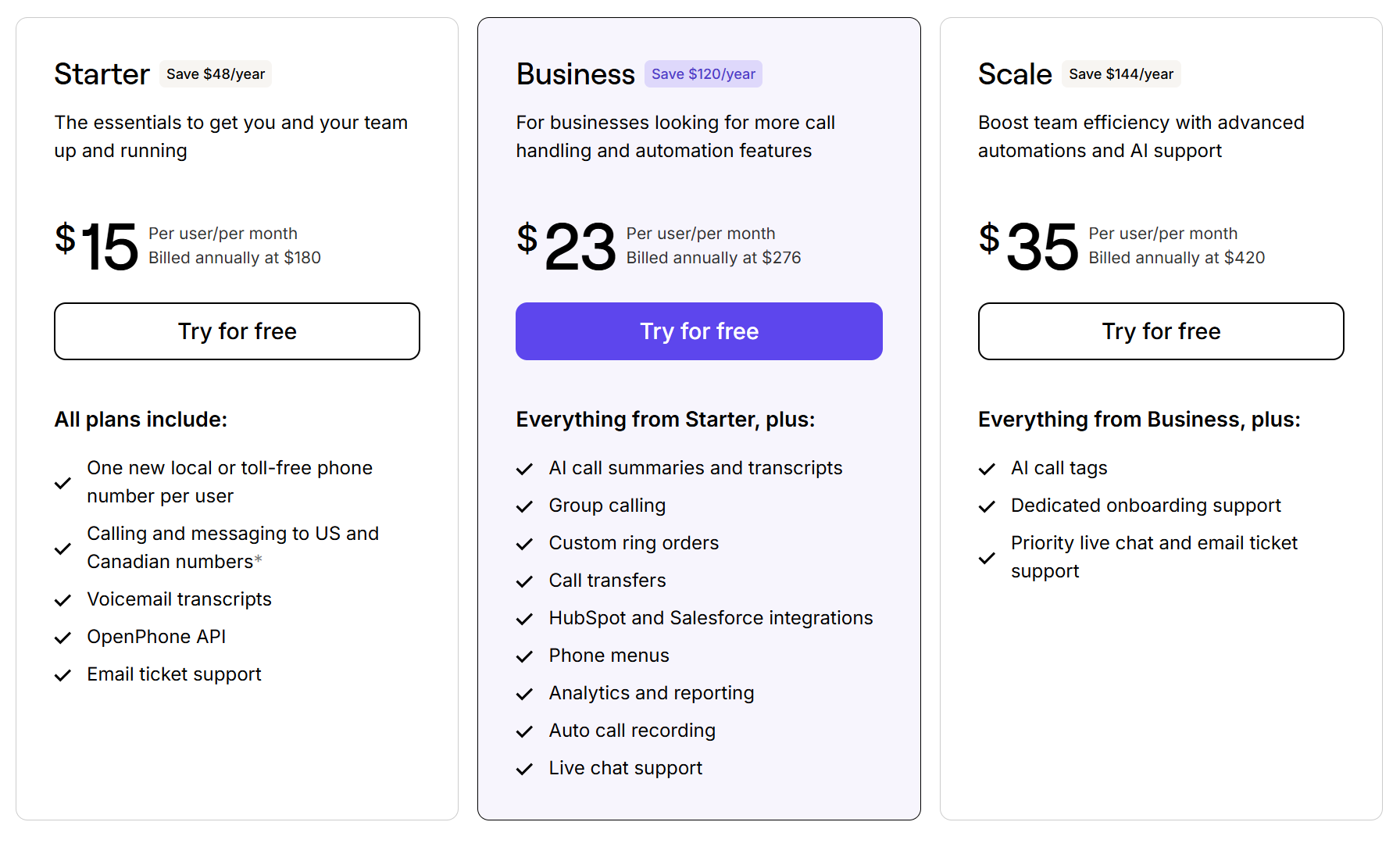
You can choose between three Quo pricing plans:
- Starter: $15 per user per month for free calls and texts to the US and Canada, texting automations, Sona, on-demand call recording, voicemail transcription, and more
- Business: $23 per user per month for phone menus, call transfers, analytics and reporting, integrations with CRMs like HubSpot and Salesforce, and more
- Scale: $35 per user per month for AI call tags, dedicated onboarding, and priority chat and email support
2. MightyCall: Best for small and medium-sized call centers

Pros
- Unlimited calls and texts on every plan
- HIPAA-compliant
- Advanced call center features
Cons
- Phone number limits
- Dialer and analytics require an upgrade
- Three-user minimum on every plan
MightyCall is a call center software designed for handling a high volume of calls and texts. It has features like preview and progressive dialers, live call monitoring, and real-time analytics. And as a manager, you can use the supervisor workspace to keep tabs on your team’s performance.
That said, all of MightyCall’s plans come with a three-user minimum. So even if you only need two numbers, you’ll have to pay for three. That’s a minimum of $45 per month just to access simple features.
Plus, all MightyCall plans only come with three local or toll-free numbers. Extra phone numbers cost $5 per number. In contrast, Quo offers a free local or toll-free number for each user. So you don’t have to pay for things that should be a given.
Key features of MightyCall
- Unlimited calling and texting
- Ring groups
- Multi-level IVR
- Business hours
- Simultaneous ring
- Cold and warm transfer
- International phone numbers are available at $15 per number
- Web and mobile app
- Voicemail-to-text and voicemail-to-email
- Call analytics with an upgrade
- Limited integrations
- HIPAA compliance
MightyCall pricing

MightyCall’s pricing offers four different plans that you can pick from:
- Core: $15 per user per month for unlimited calling and texting in the US and Canada, multi-level IVR, and call routing
- Pro: $23 per user per month for the supervisor workspace, live call monitoring, AI call summaries upon request, and advanced reports
- Power: $30 per user per month for the preview dialer, progressive dialer, priority support, answering machine detection, and a dedicated account manager
- Enterprise: Contact sales to get a quote for the predictive dialer with 10 lines per rep, SIP trunking support, and custom integrations
3. RingCentral: Best for UCaaS needs

Pros
- Unlimited calling to the US and Canada
- Offers video calls with an upgrade
- Offers desk phone rentals
Cons
- Texting is limited to 25 texts per user per month on the base plan
- CRM integrations require an upgrade
- Call recording requires an upgrade
- Toll-free calling is limited
RingCentral is a unified communications platform. It supports video, audio calls, and texts. Like Quo, RingCentral offers multi-level phone menus and the ability to call from your PC. It’s also compatible with desk phones. So it’s a solid choice for companies that still use on-premises hardware.
That said, RingCentral’s Core plan only offers 25 texts per user per month. You could run through that in a week. Plus, you only get 100 toll-free minutes per month, unless you upgrade to the Advanced plan.
Finally, RingCentral deletes all saved files, including call recordings, after 90 days. And you can only store up to 5,000 messages unless you upgrade to the most expensive plan for unlimited storage for $35 per user per month.
Key features of RingCentral
- Multi-level IVR
- Call queues
- Call flip
- Hot desking
- Group calling
- Unlimited domestic calls
- SMS and MMS support, but only 25 text messages per user per month on the base plan
- Video meetings with up to 100 video participants per meeting
- On-demand call recording with limited storage
- Desk phone rentals
RingCentral pricing

RingCentral’s pricing includes three plans:
- Core: $20 per user per month for 25 text messages per user, on-demand call recording, and up to 100 video meeting participants
- Advanced: $25 per user per month for 100 text messages per user, automatic call recording, and advanced call monitoring functions like call whispering and call barging
- Ultra: $35 per user per month for 200 text messages per user, device analytics and alerts, and “unlimited” storage with time-based limits
4. Dialpad: Best for large contact centers

Pros
- Internal collaboration features, like audio chat rooms, team messaging, and file sharing
- AI features are available on the base plan
- Unlimited calling in the US and Canada
Cons
- Minimum user requirements can hike up costs
- Slack and Zapier integrations require an upgrade
- No additional numbers on the base plan
Like RingCentral, Dialpad supports calls, texts, and video. It also offers call handling fundamentals, like call queues, forwarding, and routing. Plus, you get multi-level IVR on every plan. The tool also tracks which IVR menu options your callers use the most. So you can build a call flow that provides the most helpful options to your customers.
But Dialpad isn’t without its limits:
- You can’t get additional numbers for your team without upgrading to the Pro plan, which costs $10 more per user per month.
- You can’t send international text messages unless you upgrade.
- You’re locked out of every third-party integration except Google Workspace unless you upgrade.
- The Standard plan only offers three ring groups.
Finally, Dialpad’s Standard and Pro plans have a three-person minimum limit. So if you want essential features that are only available on higher-end plans, you’ll have to pay for more than you need.
Key features of Dialpad
- Call monitoring software
- Live speech coaching
- Call barging
- Call queues
- Customer callback
- Unlimited calls in the US and Canada
- Unlimited SMS and MMS to the US and Canada for US and Canadian customers
- Real-time call transcriptions
- CRM integrations with an upgrade
Dialpad pricing

Dialpad offers three pricing tiers to choose from:
- Standard: $15 per user per month for unlimited calling, multi-level IVR, toll-free number support, call recording, and call and voicemail transcription
- Pro: $25 per user per month for international texting support, additional numbers, third-party integrations, and 25 ring groups
- Enterprise: Custom quote for unlimited ring groups, more integrations, and a 100% uptime guarantee
5. Aircall: Best for sales call centers

Pros
- International numbers in 100+ countries
- Unlimited inbound calls to the US and Canada
- On-call AI coaching with an add-on
Cons
- SMS and MMS aren’t free
- User minimums on every plan
- No unlimited outbound calls
- Costly add-ons for analytics and AI features
Aircall offers call center software to sales and support teams. The Essentials plan covers the basics: IVR, call routing, ring groups, and forwarding.
On the Professional plan, you get features like call coaching, whispering, and mandatory tagging. If you want to monitor reps and track sentiment analysis, there are talk-to-listen ratios and customer sentiment scoring. For an additional $9 per user per month, that is.
That said, Aircall is more expensive than the other systems on this list. The basic plan costs $30 per user per month and has a three-user minimum. So really, it costs a minimum of $90 per month.
You also don’t get free or unlimited texting and outbound calls with Aircall. You have to reach out to sales for the rates.
Key features of Aircall
- IVR
- Limited conditional call routing
- Queue callback with an upgrade
- Call queuing
- Call routing
- Shared call inbox
- Unlimited inbound and internal calls in the US and Canada
- Call recording
Aircall pricing

Aircall pricing has three plans:
- Essentials: $30 per user per month with a three-user minimum for local, toll-free, or international numbers, IVR, call recording, and click-to-call
- Professional: $50 per user per month with a three-user minimum for the Power Dialer, mandatory call tagging, and the Salesforce integration
- Custom: Personalized quote with a 25-user minimum for custom onboarding, API developer support, and unlimited calls worldwide
Handle every call effectively with Quo

Good call handling helps you keep customers happy, respond faster, and stay organized as your business grows. But to make that happen, you need the right business phone system — one that helps you close more deals, offers the best support, and scales easily.
Quo’s business phone solution helps you provide the best call handling experience for your customers and your team. This way, you can close more deals, build better customer relationships, and scale easily.
With Quo, you can set up custom call flows to route calls where they need to go, based on business hours, team availability, or menu options. And when no one’s available to answer, Quo’s AI voice agent, Sona, can step in to handle calls, collect details, and respond to common questions.Plus, with call recording, summaries, and transcriptions, your team can actively listen to customers without needing to take notes on their calls.
Start handling your calls with excellence with Quo. Get started with a seven-day free trial today.
FAQs
It depends on your business. In call centers, managers oversee call handling policies and performance, while agents take care of the calls. In a growing or small business, team leads or supervisors often coach reps. They manage escalations and ensure follow-through. Meanwhile, team members handle calls, both taking and returning them. Larger companies might have quality assurance teams. These teams work with managers to check call performance and keep high standards.
AI-powered voice receptionists cost between $50 and $300+ per month. The exact cost depends on the number of minutes or calls included, as well as other features like call transfers or bilingual support. Human-powered voice receptionists cost anywhere from $300-$2,000+ per month.
It depends on your call volume, budget, and the complexity of your calls. Call centers can offer 24/7 coverage and scalability at a lower cost, but you may give up some control and could run into quality or cultural fit issues. Handling calls in-house gives you more control, easier training, and better product knowledge. But it can get expensive and doesn’t scale as easily.
As a middle-ground option, many businesses use an AI virtual receptionist. Tools like Sona can handle basic calls 24/7, are easy to set up, and cost less than hiring. With Quo, you can try Sona free for up to 10 calls a month and scale as needed.
Some of the most important call handling skills include:
– Active listening: Focus fully on the caller and avoid interrupting.
– Clear communication: Speak in a calm and easy-to-understand manner.
– Empathy: Show that you understand and care about the caller’s situation.
– Time management: Stay focused and avoid letting calls drag on.
– Problem-solving: Figure out what the caller needs and how to fix it.
– Patience: Remain calm, even when dealing with upset or confused callers.
– Product knowledge: Know your service or product well so you can answer questions accurately and efficiently.
Average handle time, or AHT, usually ranges between three and six minutes. But this depends on the industry, call type, and issue complexity. AHT includes talk time, hold time, and any follow-up work after the call.
Call handling is what happens during and shortly after each call, like answering, solving the issue, and logging the outcome of the call. Call management is the bigger picture. It covers how you organize and track all calls, including routing, queues, tools, and team performance.