

Not getting what you need from Comcast Business VoiceEdge or just looking to see what other options are out there?
This guide breaks down the seven best Comcast Business Voice alternatives for 2025, including their pros, cons, pricing, and key features. You’ll also learn what features to look for in a business phone system to set yourself up for success.
What is Comcast Business VoiceEdge?

Comcast Business VoiceEdge is a business phone system that combines traditional landline service with a cloud-hosted PBX. It’s marketed toward small and mid-sized businesses but is also used by larger enterprise teams.
Most VoiceEdge plans are usually bundled with other Comcast services, like internet and desk phone rentals. While that can make the upfront setup feel convenient, it makes it harder to switch or scale. You’ll typically need to commit to a multi-year contract, and early termination fees can apply if your needs change.
Comcast VoiceEdge doesn’t include texting either. You’ll need to add Comcast Business Mobile or a third-party tool like Alive5, starting at $5 per month, just to send a message.
Who Comcast’s phone service might still work for
A business may have originally chosen Comcast because it came bundled with their internet plan. Or because they’re taking advantage of the Microsoft 365 subscription that comes with it. But those aren’t necessarily good reasons to stick around, especially if the system no longer fits the way your team works.
That said, Comcast Business VoiceEdge might still work for:
- Companies that use desk phones and prefer a traditional setup: If your team is used to working from office desks and doesn’t need to take calls on the go, Comcast’s hardware-first approach might still suit your needs.
- Teams that don’t rely on texting: Since Comcast doesn’t include built-in texting, it may still work for teams that only need basic voice functionality and don’t need to message customers from a business number.
The 7 best Comcast Business Voice alternatives: Visual comparison
What do the top Comcast Business Voice alternatives have to offer? Here’s a quick overview of how they compare:
| Provider | Starting price | Unlimited calling to US & Canada | SMS/MMS to US & Canada | Shared phone numbers | Additional phone numbers |
|---|---|---|---|---|---|
| Comcast Business VoiceEdge | Not listed publicly | ✓ | x | x | Must contact support |
| Quo | $15 per user per month | ✓ | ✓ | ✓ | $5 per number per month |
| RingCentral | $20 per user per month | ✓ | Limited | ✓ | $4.99 per number per month |
| GoTo Connect | Not listed publicly | ✓ | Limited, available in the US, Canada, UK, and Australia only | Up to eight phones | Pricing not publicly available |
| Zoom Phone | $10 per user per month | Unlimited inbound only with upgrade | US and Canadian numbers only | ✓ | $5 per number per month |
| Nextiva | $15 per user per month | ✓ | Limited | ✓ | Pricing not publicly available |
| Dialpad | $15 per user per month | ✓ | ✓, MMS for US and Canadian customers only | ✓ | Requires upgrade |
| Spectrum | $20 per user per month when bundled, 1-year contract | ✓ | x | x | Local numbers require purchase of an additional user seat. Toll-free costs $2 per number per month |
Keep reading as we’ll cover each of these providers in more detail below.
The top Comcast Business Voice alternatives
Here’s everything you need to know about Comcast Business Voice alternatives, including each of their prices, features, and limitations.
1. Quo (formerly OpenPhone): The best modern alternative to Comcast Business Voice for growing teams

Pros
- Unlimited calls and texts to the US and Canada
- Local and toll-free second numbers are available
- Team collaboration features like internal threads, contact notes, and direct messaging
- Auto-attendant functions or IVR for inbound calls
- Messaging automations, including auto-replies, templated messages, and scheduled texts
- AI features like AI voice agent, call tags, and call transcripts and summaries
- Integrations with 7,000+ apps, including Slack, Salesforce, and HubSpot
Cons
- No verification through two-factor authentication*
*Nearly all virtual phone numbers share this problem. Companies like Facebook, Uber, and Google rarely let you authenticate accounts through a virtual phone number.
Quo is a Voice over Internet Protocol, or VoIP, phone service designed to help small and growing businesses build better relationships with their customers. Our platform works on any internet-enabled device you already own, like smartphones, tablets, and even laptops so you can call from your PC. You also get unlimited calling and texting, SMS and MMS, to the US and Canada on every plan.
We also offer competitive international rates in dozens of countries so you can keep growing your brand wherever your audience is.
Each user on your plan comes with one free US, Canadian, or North American toll-free number. This means everyone on your team can separate their personal calls from their business calls.
You can also route incoming calls to ring groups or specific teammates, set up auto-attendants, use our AI voice agent Sona to handle overflow calls, and forward calls during and after business hours so you never miss customers.
Want to help team members share responsibility for incoming calls? Shared numbers let members of a number answer calls and texts together. That way, everyone can work more efficiently as a team and follow up on conversations quickly and seamlessly.
Plus, you can get call recordings and AI-powered call transcripts and summaries for easier follow-ups.

There are no strict multi-year contracts with Quo. You can pay on a monthly or yearly basis and cancel whenever you need — perfect for growing businesses that need a scalable and flexible solution.
On the Quo Starter plan, you can add up to 10 users to a shared number. On the Business plan, you can can add an unlimited number of users. So you don’t have to upgrade to another until you’re ready.

How to get a virtual number with Quo
Getting a new phone number from almost anywhere in the world is a simple process when you choose Quo as your virtual phone number provider.
Follow these three steps:
- Create an account with Quo (when you sign up, you get a free, seven-day trial).
- During signup, choose your city or area code in the US to select your preferred phone number.
- Once the signup process is complete, you’re all set to use your new virtual phone number!
Thousands of growing teams and businesses use Quo to build better relationships with their customers. Test out Quo for yourself by signing up for our seven-day free trial today. Then, once you confirm Quo is the right fit, you can easily port any existing US, Canadian, or North American toll-free number straight from the web or desktop app.
Key features of Quo
- One free local US, Canadian number, or North American toll-free number per user
- Free SMS and MMS support to the US and Canada
- Free calls to the US and Canada
- Shared numbers
- Call forwarding to phones and computers
- IVR or phone menus
- Text messaging automations like snippets, auto-replies, and scheduled messages
- OpenPhone AI voice agent Sona
- Call recording, on-demand and automatic
- Voicemail-to-text transcriptions
- Integrations with Slack, Zapier, Make, Google Contacts, Jobber, HubSpot, and Salesforce
- Quo API to unlock more integrations
Quo pricing
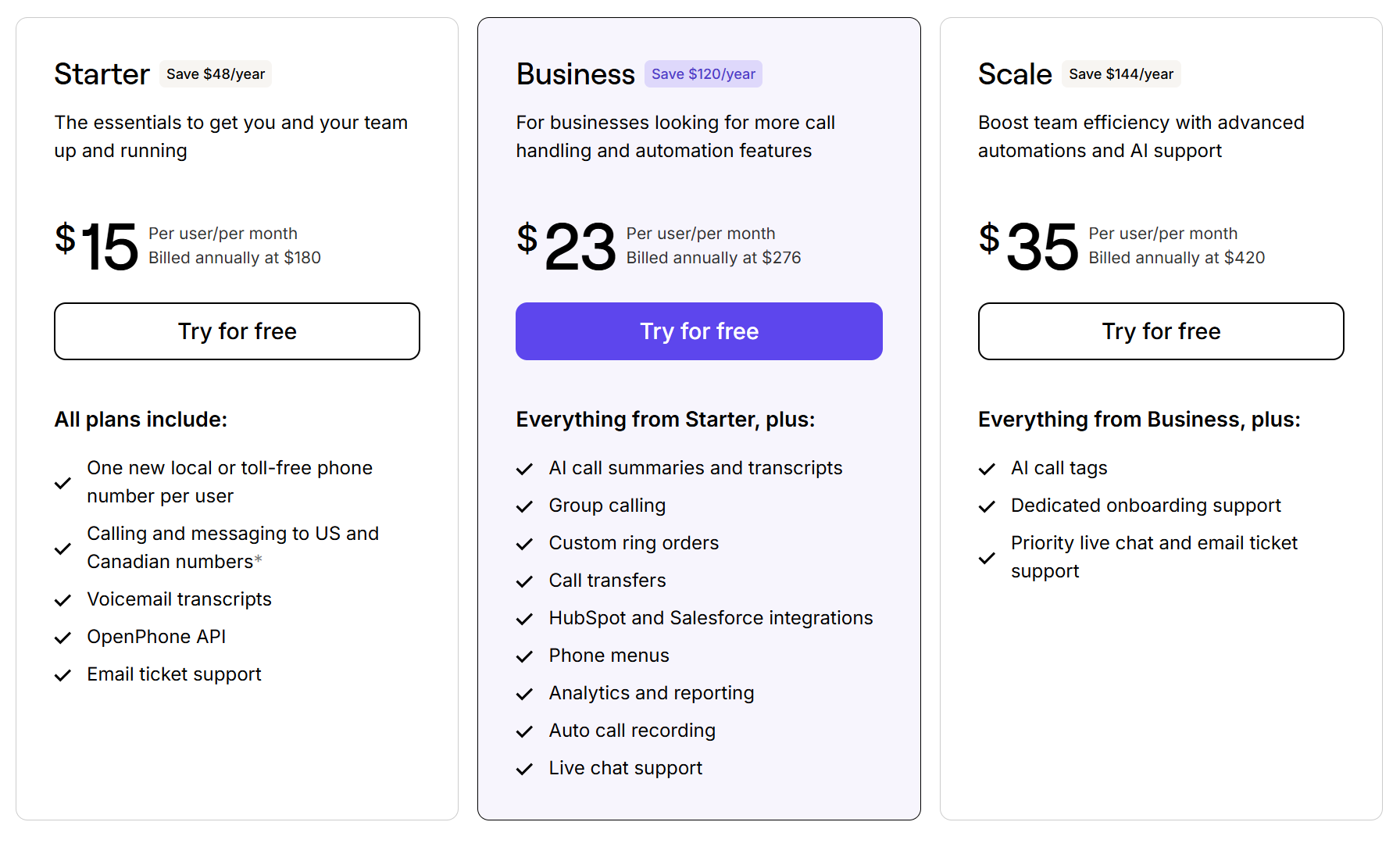
You can choose between three Quo pricing plans:
- Starter: $15 per user per month for free calls and texts to the US and Canada, texting automations, AI voice agent Sona, on-demand call recording, voicemail transcription, and more
- Business: $23 per user per month for phone menus, call transfers, analytics and reporting, integrations with CRMs like HubSpot and Salesforce, and more
- Scale: $35 per user per month for AI call tags, dedicated onboarding, and priority chat and email support
2. RingCentral: The top UCaaS platform

Pros
- Unlimited calls to the US and Canada
- Limited internal collaboration tools like document sharing and team messaging
- Offers video conferencing with an upgrade
- Offers desk phone rentals
Cons
- Texting is limited to 25 texts per month
- Toll-free calls are capped at 100 minutes on the Core plan
- CRM integrations require an upgrade
- Call recording requires an upgrade
RingCentral is a unified communications platform offering call, text, and video conferencing features on every plan. You also get unlimited calls within the US and Canada. Like Comcast, RingCentral offers desk phone rentals — a plus if that’s something your team still relies on.
However, keep in mind there are significant limitations on how much you can do through any of these channels.
On the Core plan, for example, you only get:
- 25 text messages per user per month
- 100 toll-free minutes, pooled for everyone on your account
- Limited storage for call recordings, texts, and call history
Getting more expensive plans can give you more freedom, but be careful — you can’t get unlimited messages or toll-free minutes on any RingCentral plan.
Even RingCentral’s option for “unlimited” storage on their more expensive plans only removes the capacity limit. Your call history and recordings are still subject to deletion after a period of 90 days to a year.
Another major limitation of RingCentral? A surprisingly limited free trial. Since the platform only lets you have up to five users during the trial, you can’t necessarily test everything with your team.
RingCentral also separates calls and texts into different folders, making it more difficult to piece together and follow up on conversations. This might throw a wrench in your team’s productivity. Plus, the only way to schedule text messages is to use a third-party app.
Key features of RingCentral
- SMS and MMS support, but only 25 text messages per user per month on the base plan
- Video meetings with up to 100 video participants per meeting
- Unlimited domestic calls
- Voicemail transcriptions
- Multi-level IVR
- Desk phone rentals
- Call queues
- Call recording, automatic requires an upgrade
- Mobile apps for iOS and Android
RingCentral pricing

RingCentral pricing depends on the number of users. For a team of one to five people, you have the following options:
- Core: $20 per user per month for 25 text messages per user, on-demand call recording, and up to 100 video meeting participants
- Advanced: $25 per user per month for 100 text messages per user, automatic call recording, and advanced call monitoring functions like call whispering and call barging
- Ultra: $35 per user per month for 200 text messages per user, device analytics and alerts, and “unlimited” storage with time-based limits
3. GoTo Connect: Best for sales and customer support teams

Pros
- Free calls to 50 countries
- Shared inboxes with an upgrade
- Offers video calls on the base plan
Cons
- Limited SMS and MMS
- Limited toll-free minutes across all plans
- Lack of collaboration features
- Integrations are lackluster unless you upgrade to the most expensive plan
GoTo Connect is a cloud-based communication tool that offers phone, text, and video software. It’s especially well-suited for sales and customer support teams that work across regions or channels. GoTo Connect includes unlimited calling to 50+ countries, though that might vary based on where you’re located. So always check with GoTo Connect yourself.
If you upgrade to the mid-tier plan or above, you also get dedicated call center and support solutions, which include a shared inbox to manage conversations across SMS and MMS, WhatsApp, Facebook, and Instagram.
That said, many features listed on their basic plan, like audio conferencing and texting, are standard on the average smartphone. And when it comes to integrations, the base plan is pretty limited. You only get a handful of tools like Microsoft Teams, Outlook, Google Workspace, and Miro. If you want to connect to your CRM or automate your workflows, you’ll need to upgrade.
As for texting, every GoTo Connect plan comes with limited credits per user per month. An overage rate applies once that limit is reached, though there’s not much up-to-date information on how many credits you get and what the overage rate is.
Want a platform that comes with business-ready features, better support for texting, and more transparent pricing? You’ll need a GoTo Connect alternative.
Key features of GoTo Connect
- Free calling to 50 countries, region-dependent
- Toll-free minutes included
- Video meetings for up to 250 participants
- Shared inboxes for channels like WhatsApp and Instagram
- Ring groups
- Screen sharing
- Smart call routing
- Instant response messages
GoTo Connect pricing

At the time of writing, GoTo Connect’s pricing isn’t publicly published. You’ll have to reach out to sales for a quote.
4. Zoom Phone: Best platform for existing Zoom users

Pros
- Desktop and mobile app
- Metered international calling
- Domestic SMS and MMS texting in the US and Canada
Cons
- Unlimited domestic calling in the US and Canada requires an upgrade
- Can’t text from shared numbers
- Limit of four calls on a shared number at once
- Confusing pricing plans
Zoom Phone is a business phone system built separately from Zoom’s video conferencing platform. You can choose from three standalone Zoom Phone plans or two bundles that combine Zoom Phone with Zoom Workplace at a discounted rate.
You should know that the base plan doesn’t offer unlimited domestic calling in the US and Canada. Instead, you’ll have to upgrade to the mid-tier Regional Unlimited plan for $15 per user per month.
Zoom Phone’s support for third-party integrations is also pretty limited. There are only nine other apps available for use, including:
- Salesforce
- Slack
- Microsoft Calendar and Outlook
- Google Calendar and Gmail
- Twilio
- Five9
- Genesys
- NICE inContact
- Talkdesk
You can use a Zoom Phone alternative if you want a cost-effective app with fewer limitations.
Key features of Zoom Phone
- Toll-free numbers
- Limited integrations
- iOS, Android, and desktop apps
- Voicemail transcriptions
- IVR
- Call queuing
- Holiday and business hour routing
- Call recording, automatic and on-demand
Zoom Phone pricing

Zoom Phone pricing includes three plans:
- Metered: $10 per user per month for metered outbound calling, toll-free numbers, auto-attendants, SMS and MMS, and voicemail transcriptions
- Regional unlimited: $15 per user per month for everything in Metered, plus unlimited outbound calling
- Global Select: $20 per user per month for everything in Regional Unlimited, plus local and toll-free telephony services across 49+ countries
You can also bundle Zoom Phone with Zoom Workplace at a discounted rate:

- Pro Plus: $18.33 per user per month for Zoom Phone US & Canada unlimited, video meetings for up to 100 participants, Zoom Docs, and the AI companion
- Business Plus: $22.49 per user per month for everything in Pro Plus, 15GB cloud storage, hybrid integration with legacy PBXs, 24/7 live chat and phone support, real-time reporting and quality dashboards, and bring your own carrier support
5. Nextiva: Best for omnichannel communication

Pros
- Unlimited voice and video calls
- Social and review management features
- Offers an omnichannel shared inbox
Cons
- Lackluster base plan
- SMS is limited to 100 texts per month on the base plan
- Essential tools like integrations are only offered as add-ons
- Toll-free numbers don’t support texting
Nextiva is a Unified Communications platform that offers calling, texting, and video conferencing. It also lets you bring messages from social media apps like WhatsApp and Instagram into one inbox so your team can manage them all in one place.
Nextiva is best for larger businesses and enterprises, but it offers the basics, like calling, to small businesses as well. That said, the base plan, which is the most affordable for small businesses, has some noticeable limitations. For example:
- SMS is limited to 100 texts per user per month
- Toll-free numbers require an upgrade
- Toll-free minutes are limited
- Voice call recording requires an upgrade
- Video calling requires an upgrade
- Voice analytics is an add-on
- CRM integration is an add-on
Nextiva’s base plan is really only useful for basic calling and social media review management. Unless you plan to pay for the Power Suite CX plan at $75 per month per user, you’d be better off looking into Nextiva alternatives.
Key features of Nextiva
- Desk phone rentals
- Unlimited internet fax
- Unlimited calling in the US and Canada
- Limited texting
- Live chat and chatbot as add-ons
- Basic IVR
- Voicemail transcriptions
- Call recording with an upgrade
- Social media and review management
- Integrations with social media channels like Instagram
Nextiva Pricing

The Nextiva pricing plans for small businesses include:
- Core: $15 per user per month for basic IVR, unlimited voice and video calls, limited texting, and voicemail transcription
- Engage: $25 per user per month for 500 text messages per user per month, voice and video recording, toll-free number, and up to 2,000 toll-free minutes
- Power Suite CX: $75 per user per month for everything in Engage, plus process automation, more advanced reporting and analytics, AI transcripts and summaries, and skills-based call routing
6. Dialpad: Best for contact centers with advanced AI needs

Pros
- Unlimited calling in the US and Canada
- Internal collaboration features like audio chat rooms, team messaging, and file sharing
- AI features are available on the base plan
Cons
- Additional numbers are not available on the base plan
- Minimum user requirements can hike up costs
- Slack and Zapier integrations require an upgrade
Dialpad is a cloud-based business communications platform. It’s built to help teams handle calls, texts, and meetings in one place. All plans come with unlimited calling in the US, Canada, and your home country. That way, your contact center can connect with customers without worrying about per-minute charges.
The basic plan comes with multiple AI-powered tools, including real-time call transcriptions and speech coaching for support teams.
But while Dialpad’s many AI tools can make it look like you’re getting a great bang for your buck, diving into their actual plans shows they’re missing or paywalling several features. For example:
- You can’t get additional numbers for your team without upgrading to the Pro plan, costing $10 more per user per month
- You can’t send international text messages unless you upgrade
- You’re also locked out of every third-party integration except Google Workspace without upgrading
- You only get three ring groups or departments on the base plan, so for more, you’d have to upgrade
Finally, Dialpad’s Pro plan has a three-person minimum limit, and the Enterprise plan has a 100-person minimum limit. So if you want essential features that are only available on higher-end plans, you’ll have to pay for a lot more than you need.
If you want access to similarly modernized features on a platform that offers more value for your money, you can check out some of Dialpad’s competitors.
Key features of Dialpad
- Unlimited calls in the US and Canada
- Unlimited SMS and MMS to the US and Canada for US and Canadian customers
- Live speech coaching
- Automated post-call summaries
- Real-time call transcriptions
Dialpad pricing

Here’s the Dialpad pricing breakdown:
- Standard: $15 per user per month for unlimited calling, multi-level IVR, toll-free number support, call recording, and call and voicemail transcription
- Pro: $25 per user per month for international texting support, additional numbers, third-party integrations, and 25 ring groups
- Enterprise: A customized quote for unlimited ring groups, more integrations, and a 100% uptime guarantee
7. Spectrum Business Voice: Best for businesses with clients in Mexico

Pros
- Unlimited calling to the US, Canada, and Puerto Rico
- 2,000 long-distance calling minutes per month to Mexico
Cons
- Toll-free numbers are add-ons
- No texting support, including SMS and MMS
- No mobile or desktop apps
Spectrum Business Phone is a business VoIP solution offered by Spectrum. You’ll get basic phone services on every plan, like call transfers, voicemail inboxes for missed calls, and unlimited phone calls in the US, Canada, and Puerto Rico. If you have customers in Mexico, you’ll also have 2,000 long-distance minutes to Mexico.
Spectrum Business Phone is a step above traditional business phone systems, but it’s pretty bare-bones. And you can expect to pay a premium for features, like remote forwarding and toll-free minutes, that other providers like Quo provide for free as part of their base plans.
For example, Spectrum doesn’t include free toll-free calling in its plans. It costs $0.04 per toll-free minute. At Quo, toll-free calls and numbers are included in every plan.
Need to send messages to colleagues and clients? This isn’t possible with Spectrum Business Phone. There’s no way to send SMS or MMS at all. This means:
- You can’t keep in touch with pre-existing customers via text if you port your number to Spectrum
- You can’t send things like photos, videos, or documents — so forget about sharing product demos, event flyers, or visual support with customers
Plus, you only get one phone menu for free. Any additional ones are an extra $15 per number per month. Finally, Spectrum Business Voice’s pricing isn’t very transparent, which can get you stuck with hidden fees if you’re not careful.
Key features of Spectrum
- Unlimited calling to US, Canada, and Puerto Rico
- Call hold and transfers
- Voicemail inbox for missed calls
- Three-way calling
- Simultaneous and sequential ring
- Fax mailbox and fax to email
- Voicemail to email
Spectrum pricing
Spectrum Business Phone costs $20 per number per month for the first year when bundled with Spectrum Business Internet.
After a year, the price of Business Voice Unlimited Service — the module that includes calling features — shoots up to $50 per number per month. Business Voice Unlimited Service includes unlimited local and long-distance calling, call waiting, anonymous call rejection, voicemail, call logs, and call hold. You’ll also have to budget for add-ons like remote number forwarding, toll-free minutes, and directory listing.
The total price, which includes the internet module, isn’t clearly advertised.
9 features to look for in a Comcast Business Voice alternative
Not every VoIP platform will solve the same problems, so it’s worth knowing which features will actually make your day-to-day easier:
- Unlimited calling and texting: Avoid extra charges for keeping in touch with customers.
- Shared numbers for teams: Let multiple people handle calls and texts from one business number. This also creates more visibility around customer communications.
- Flexible pricing with no long-term contracts: Scale up or down as your needs change.
- Call management features: Route calls, use auto-attendants, and forward to the right person so customers aren’t left waiting.
- CRM and app integrations: Keep conversations and customer info synced so you always have full context in every tool.
- Messaging automations: Send auto-replies, schedule messages, or use templated messages — called snippets in Quo — to save time on repeat conversations.
- Call recording and transcriptions: Review details later for training, quality control, or follow-ups.
- Ease-of-use: Look for a user-friendly platform that makes your and your team’s jobs easier. Check out reviews on third-party sites and try out the platform yourself to see.
- Free trials: Test the platform before committing to see if it fits your workflow.
Quo: The best Comcast Business VoiceEdge alternative for small businesses

There are a lot of Comcast Business Voice alternatives available on the market. However, there’s only one that lets you easily build relationships with your contacts while still saving time — and that’s OpenPhone.
In addition to unlimited calling and texting to the US and Canada, Quo offers shared numbers so your team can handle calls and texts from the same business number.
Call management features like auto-attendants, call routing, and forwarding help ensure every customer reaches the right person. And AI tools like Sona, call transcripts and summaries, and call tagging give your team even more ways to save time and deliver better service.
You can see for yourself why Quo has become the best Comcast Business Voice alternative for growing teams and small businesses. Sign up online for our seven-day free trial and see how much easier customer communication can be.
FAQs
Comcast doesn’t list prices publicly — you’ll need to request a quote.
Comcast Business VoiceEdge is a phone system for businesses that combines landline service with a cloud-hosted PBX, letting teams make and receive calls, use voicemail, and manage basic inbound routing.
Quo is the best Comcast Business Voice alternative for small and growing businesses. It offers unlimited calling and texting, shared numbers, call management features, and collaboration and AI tools on all plans. Other options include RingCentral, GoTo Connect, Zoom Phone, Nextiva, Dialpad, and Spectrum.
Yes, VoIP is secure for business use with the right service provider. Look for features like encryption, SOC 2 compliance, secure data centers, and account access controls to protect calls and messages.
To cancel Comcast Business, you’ll need to contact Comcast directly. Confirm your contract end date and return any rented equipment. If you want to keep your number, port it to your new provider before canceling. With Quo (formerly OpenPhone), you can port your existing US, Canadian, or North American toll-free number online in just a few steps.


