Information silos. Missed project deadlines. Duplicate work. These are a few of the reasons that push owner-operators to invest in a business communication solution.
A quick online search will show you that the term “business communication” covers a wide range of options. You’ve got internal communication tools that make team collaboration easier. You’ve also got external communication tools designed to help you connect with customers. That can get overwhelming, even in the research phase.
In this article, we’ll explore different communication platforms across various use cases. We’ll also share how you can choose the right platforms for your business.
What are communication platforms?
Communication platforms are digital tools that enable internal and external business-related communications. They allow team members to communicate with customers and each other via voice, text, and video.
Communication platforms can also bring business benefits like:
- Improved customer experience: Communication platforms help you communicate better with your customers. And 73% of organizations that invested in these platforms saw higher customer satisfaction scores.
- More efficient team collaboration: Teams can use communication software to share context and troubleshoot issues together. They also help strengthen team bonds, which is key for productivity. Forbes research found that 45% of workers feel more connected to their team due to digital communications tools.
- More remote project management: Communication platforms help businesses embrace the advantages of remote work. Tools like Slack, Trello, and Notion allow global teams to collaborate on projects without needing to be in the same place or even the same time zone.
Types of communication platforms
We’ve briefly touched on internal versus external communication platforms. Here’s a breakdown of the different categories of business communication tools you can choose from:
- Customer communication platforms. These tools combine multiple channels into a single system so your team can respond to customers more efficiently. Features like live chat, voice calling, AI communication tools, and SMS messaging let customers reach your team anytime. For example, Quo, formerly OpenPhone, is a business phone platform for voice and text communications. Your team can share a phone number and split responsibility for incoming calls and texts. You can reduce missed calls and deliver a better customer experience.
- Internal communication platforms. This platform type serves as a central hub for sharing information and solving issues. They can also act as virtual office spaces for remote teams. For example, Slack offers instant messaging and file sharing for teams. You can also make internal voice and video calls for real-time internal collaboration.
- Project management platforms. These platforms help streamline virtual projects. They often use visual tools like Kanban boards, calendars, and Gantt charts to guide tasks to completion. If you’ve used Notion, you understand how it works. Notion lets you customize databases, also known as wikis, and create your own project dashboards. This helps team members visualize priorities and deadlines.
- Team collaboration platforms. If you want your team to stay aligned as you work together on projects, you’ll need a collaboration platform. This keeps members updated on important announcements and customer conversations. Take HubSpot, for instance. Your sales team can use HubSpot to track leads, update deal information, and follow through with them until they become paying customers.
- Video conferencing platforms. Tools like Zoom enable real-time, face-to-face communication. They also include screensharing, digital whiteboarding, and file sharing features to enhance meetings. The best part? These platforms work on computers and smartphones. Your team members can collaborate from anywhere.
15 Best communication platforms for businesses
Here’s a quick look at our 15 best communication platforms for businesses and how they compare:
15 Best communication platforms for businesses breakdown
| Platform | Best for | Starting price |
|---|---|---|
| Quo | Reducing missed calls and streamlining calls and texts with customers | $15 per user per month |
| Nextiva | Social media and review management | $15 per user per month |
| RingCentral | Traditional office desk phone rentals | $20 per user per month |
| Slack | Internal team communication | $7.25 per user per month |
| Loom | Internal video updates | Free |
| Nectar | Improving employee engagement | Contact sales for pricing |
| Notion | Knowledge management | $12 per user per month |
| Monday.com | Task management | Free |
| Trello | Managing team to-do lists | Free |
| Zendesk | Customer support and relationship management | $19 per user per month |
| HubSpot | Sales and customer success teams | $9 per user per month |
| Google Drive | Users of Google Workspace | $8.40 per user per month |
| Zoom | AI-first video collaboration | $13.33 per user per month |
| Google Meet | Existing Google users | $8.40 per user per month |
| Microsoft Teams | Current Microsoft users | $4 per user per month, billed annually |
Scroll down to read more about each of these platforms in detail.
1. Quo: Best communication platform for small businesses

Pros
- Unlimited calling and messaging in the US and Canada
- Local and toll-free numbers
- Shared numbers to split responsibility for incoming calls and messages
- AI-generated call summaries and transcriptions
- 24/7 AI voice agent to answer calls automatically
- 8,000+ integrations, including Slack, HubSpot, and Salesforce
- Mac, Windows, Android, iPhone, and web apps are available
Cons
- Can’t verify accounts through two-factor authentication*
*Almost all virtual phone numbers share this problem. For security reasons, companies like Facebook, Uber, and Google rarely allow you to authenticate your accounts with a virtual phone number.
Quo is a business phone platform for small businesses that want to scale their customer relationships. With Quo, multiple team members can share one phone number, so customer calls and texts never go unanswered. When a call comes in, you can ring everyone on the team so that available team members pick up the phone. Every customer interaction is immediately logged in your workspace, so your team can easily catch up on past conversations.
Quo’s SMS and MMS messaging features ensure your team sends the right message at the right time. Automatically reply to customers after business hours with SMS auto-replies. Schedule texts to your customers when they’re available in their time zone. Set up automated texting workflows to reach customers on autopilot with our Make and Zapier integrations. For example, if a customer books an appointment with your sales team, you can automatically send reminders to reduce no-shows.
Save time for your team with Quo’s AI-powered features. AI call summaries and transcripts help your team take notes automatically, so that you don’t miss a single customer detail. With call tags, you can surface recurring issues and ongoing opportunities for your business. It uses AI to analyze your phone calls based on your specific business needs.
Quo can also help you handle incoming calls when your team is busy or unavailable with Sona, our 24/7 AI voice agent. Sona can answer common questions and take messages when a call comes in. You can train it on your company knowledge so that it provides accurate answers. You can also create custom scripts that it can follow for specific caller scenarios. Sona can send texts to customers and transfer calls to your team when needed.
Try Quo for yourself for free. Get started with a seven-day free trial.
Key features of Quo
- Drag and drop call flow builder
- Custom ring order
- Contact properties and contact notes
- Call analytics and insights
- Phone menus
- Collaboration features like internal threads
Quo pricing
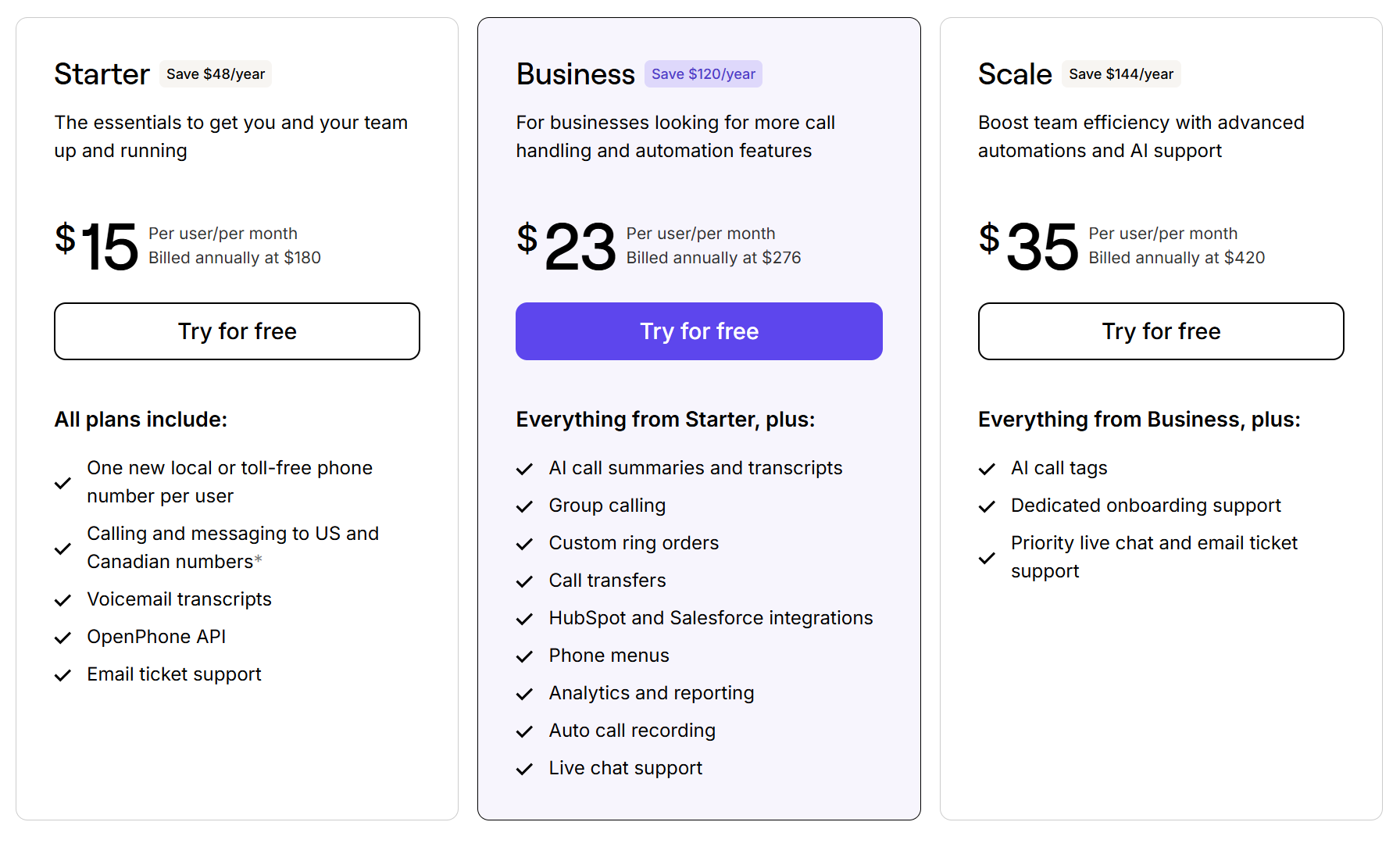
Quo offers transparent and consistent per-user-per-month pricing — no hidden costs:
- Starter: $15 per user per month for shared phone numbers (up to 10 teammates), free phone calls and texts in the US and Canada, one free number per user on your account, voicemail transcriptions, and more
- Business: $23 per user per month for custom ring order, auto attendants, group calling, our Salesforce and HubSpot CRM integration, call transcriptions, phone menus, and more
- Scale: $35 per user per month for AI call tags, dedicated onboarding, inbound phone support, and priority chat and email support
2. Nextiva: Best for omnichannel communications

Pros
- Online review management
- Videoconferencing features
Cons
- No unlimited texting or toll-free minutes
- Integrations are only available as an add-on
- Video call recording requires an upgrade
Nextiva is another VoIP platform that offers voice, video, and texting features. It also provides omnichannel management tools that bring your online interactions into a single inbox. That makes sense for businesses that want to track what consumers are saying across Facebook, Instagram, X, Google, and Yelp.
However, Nextiva has its drawbacks. Text messaging and toll-free minutes are capped even if you upgrade to their higher-tier plans. If you want to integrate with CRMs like Salesforce and HubSpot, you have to purchase an add-on on top of an existing plan.
Nextiva may make sense for large businesses that need an omnichannel communications solution. However, every plan has texting limitations. Its most expensive plan doesn’t include SMS as a channel, so you’ll have to get it as an add-on. If you want a business phone that scales with you, you should consider a different communication platform.
Key features of Nextiva
- Live chat and messaging apps for customer support
- Social media and review management suite
- Shared email inbox
- Limited SMS and MMS
Nextiva pricing

There are three tiers of Nextiva pricing:
- Core: $15 per user per month for voice calls, 100 text messages, team chat, voicemail transcriptions, and access to the mobile app
- Engage: $25 per user per month for the Microsoft Teams integration, 500 text messages, digital fax, voice analytics, 2,000 toll-free minutes, and call recording
- Power Suite CX: $75 per user per month for up to 100 agents for skills-based routing, IVR, call transcriptions and summaries, and API integrations
3. RingCentral: Best for traditional offices with desk phone rentals

Pros
- Unlimited calling to the US and Canada
Cons
- Base plan limits texting
- Call recordings are deleted after 90 days
- Toll-free minute limits on every plan
RingCentral is a legacy VoIP phone system for teams that prefer using traditional desk phones at work. It offers both local and toll-free numbers, video conferencing, and business SMS features.
Unfortunately, RingCentral’s pricing isn’t exactly straightforward. With its base plan, you can only send 25 texts per user per month. What’s more, you’ll only be able to store 200 on-demand call recordings per user. For more storage, text messages, and additional features, you’ll need to upgrade your plan. However, even when you upgrade to RingCentral’s most expensive tier, you won’t get access to unlimited calls, texts, and storage. If you want a business phone that doesn’t limit your usage as you scale, consider looking at other VoIP communication platforms.
Key features of RingCentral
- Basic call management
- Toll-free numbers
- Voicemail-to-text
- Team messaging
RingCentral pricing

You can choose from three RingCentral pricing plans for your team:
- Core: $20 per user per month for unlimited calls in the US and Canada, IVR, visual voicemail, and AI video meeting transcriptions
- Advanced: $25 per user per month for CRM integrations, business analytics, unlimited internet fax, hot desking, and call management tools
- Ultra: $35 per user per month for unlimited AI video meetings, device analytics/alerts, and unlimited storage for files and records that are subject to time-based deletion policies
If you want features like shared texting and text templates, you’ll need to purchase RingCentral’s Customer Engagement Bundle. This add-on costs an additional $25 per month. If you’re looking for a platform that brings all these features together, it might be confusing. The reason: there are five other service options outside of RingCentral’s business phone plans.
4. Slack: Best for internal team communication

Pros
- Interface is easy to navigate
- Integrates with over 2,000 apps
- Teams can communicate via text, audio message, or video
Cons
- Customer support is only available over chat, not phone
Slack is a popular real-time messaging platform for remote teams. It organizes conversations in dedicated communication channels. This way, your team can quickly find specific information. It also lets you share files, send audio messages, and set up one-on-one meetings or “huddles.”
Slack integrates with thousands of apps to facilitate effective communication across your tools. For example, with Quo’s integration with Slack, you can notify your team every time you receive a missed call, voicemail, or incoming text. You can loop in team members who aren’t using Quo for your customer needs.
Key features of Slack
- Dedicated channels for teams, projects, and conversations
- Team chat, plus voice notes and team “huddles”
- Workflow builder for custom automation
- AI-powered Slackbot can share information on conversations, files, and projects
Slack pricing

Slack offers three paid tiers for businesses that need unlimited message history:
- Pro: $7.25 per user per month for unlimited message history, app integrations, group meetings, external meetings, and access to AI conversation summaries
- Business Plus: $15 per user per month for more advanced AI features, including Slackbot, AI workflow generation, AI summaries, and AI search
- Enterprise Plus: Contact sales for pricing for additional EMM integration support and native data loss prevention
5. Loom: Best for internal video updates

Pros
- 4K high-definition screen recordings
- Custom branding
- Virtual backgrounds and speaker notes are available
Cons
- AI editing features require an upgrade
Loom is a video messaging platform that lets users record videos using their webcam, their computer screen, or both. Its platform is known for its ease of use. Team members with no technical capabilities can record and edit their videos in minutes. Once you’ve finished recording, Loom also makes it easy to share videos with your team. You can embed videos directly in your emails or in your Slack messages. It’s useful for remote teams that need to create quick demos, explainer tutorials, and product walkthroughs.
Another plus: built-in AI tools can remove filler words and automatically generate summaries for you. However, these tools are only available when you upgrade to Loom’s Business + AI plan, which costs $20 per user per month.
Key features of Loom
- User-friendly screen and camera recording
- Instant video sharing
- Automatic metadata creation, including titles and thumbnails
- Viewer interaction and analytics
Loom pricing

Loom offers four plans for teams:
- Starter: $0 to access 25 videos, five-minute screen recordings, transcriptions in 50+ languages
- Business: $15 per user per month with unlimited videos, recording time, and editing tools
- Business + AI: $20 per user per month for auto-titles, summaries, chapters, and filler-word removal
- Enterprise: Contact sales for custom pricing. Includes SAML SSO, SCIM provisioning, advanced content privacy, and dedicated support
6. Nectar: Best for employee engagement

Pros
- Lets you gather feedback on employee engagement
- Allows you to celebrate employees with shout-outs and rewards
- Can function as a kind of “intranet”
Cons
- No transparent pricing
Nectar is a communication tool designed to boost employee recognition and engagement. Managers and team members can use it to give digital shout-outs and gift cards. It acts as a company-wide employee communication platform. Nectar has tools for sharing newsletters and updates with employees. Looking to improve your employee experience? Nectar includes survey tools to gather employee feedback and act on it.
But remember: Nectar isn’t designed for real-time internal comms like Slack. It may work better as part of your larger communication tech stack.
Key features of Nectar
- No-code drag and drop announcement builder
- Employee engagement surveys
- Syncs with an HRIS
- Analytics and reporting
Nectar pricing

Nectar’s pricing isn’t available on its website. You’ll have to contact their sales team to get their latest pricing information.
7. Notion: Best for knowledge management

Pros
- Centralized knowledge hub
- Highly customizable
- Supports 10+ file types, plus YouTube and Vimeo embeds
Cons
- Requires time to set up
Notion is a project management platform for fast-growing teams. Teams can create a company knowledge base to store their files and documentation. They can also create custom dashboards, databases, and Kanban boards to manage ongoing projects. You won’t have to worry about information silos; Notion integrates with communication tools like Slack. That means your team is always notified about project updates.
Something you should know about Notion is that it can take a while to set up. You can get started using it with their pre-built templates. You’ll also need to get your team up to speed on how to use the platform before you build a custom workspace.
Key features of Notion
- Centralized knowledge management with wikis and docs
- Real-time project collaboration and feedback
- Dedicated team spaces for specific departments
- Customizable templates for recurring projects
Notion pricing

Notion’s paid plans are ideal for growing teams:
- Plus: $12 per user per month for unlimited blocks, 30-day page history, and up to 100 guests
- Business: $24 per user per month for 90-day page history, SAML SSO, and 250 guests
- Enterprise: Contact sales for custom pricing for unlimited page history, advanced security, and dedicated support
You can also add Notion AI for an additional $12 per user per month. Notion AI provides AI meeting notes, enterprise search, and AI agents inside your Notion workspace.
8. Monday.com: Best for task management

Pros
- Hundreds of customizable templates
- No-code automations for building workflows
- Over 200 pre-built integrations
Cons
- Requires a minimum of three seats for paid plans
Monday.com is a visual work management platform designed to help remote teams plan, track, and manage projects. Like Notion, it’s customizable and perfect for teamwork. Users can create boards using tools like Kanban boards, Gantt charts, calendars, and timelines. Monday.com can also reduce your manual workload. It allows you to set up automated “if/then” rules for notifications, assignments, and status updates.
Monday.com has plenty of AI tools for small businesses, like AI translation blocks and AI-powered project management. However, it requires a minimum number of users in its paid plans. If you’re just getting started with your operations, you might be paying extra for seats you don’t yet need.
Key features of Monday.com
- Visual project boards
- Customizable dashboards
- Multiple data views
- AI tools for content generation and summaries
Monday.com pricing

Monday.com offers five plans to teams:
- Free: $0 per month for up to two users and access for up to three boards, up to three docs, 200+ templates, and eight column types
- Basic: $12 per user per month for unlimited items, unlimited free viewers, five GB file storage, and priority customer support
- Standard: $14 per user per month for timeline, Gantt, and calendar views, 250 automation actions per month, and 20 GB of file storage
- Pro: $24 per user per month for 25,000 automation and integration actions per month, 100 GB of file storage, and private boards and docs
9. Trello: Best for managing team to-do lists

Pros
- Kanban layout is easy to learn
- Provides a clear overview of task status
- Extensive third-party integrations, including Slack and Google Drive
Cons
- Can’t handle complex projects
Trello is a project management tool that helps your team work better together. With Trello, you can set up visual boards to track projects across stages like “To Do,” “In Progress,” and “Done.” You can also create cards for individual tasks, which makes workloads more manageable. You can add detailed information to each card, including checklists, comments, and file attachments. This way, team members will always understand task expectations.
One thing to keep in mind with Trello: it can’t support complex projects. If you have a large project with multiple sub-tasks and dependencies, you might need to look at a different platform.
Key features of Trello
- Kanban boards, lists, and cards
- Built-in, no-code “Butler” automation
- Multiple board views
- Library of pre-built, industry-specific templates
Trello pricing

Trello’s free plan is free for up to 10 collaborators per workspace. Trello has three paid plans to choose from:
- Standard: $5 per user per month for unlimited boards, unlimited storage, advanced checklists, and custom fields
- Premium: $10 per user per month for multiple project views, unlimited workspace command runs, observer access, and Atlassian AI
- Enterprise: $17.50 per user per month for unlimited workspaces, public board management, multi-board guests, and free SSO and user provisioning
10. Zendesk: Best for customer support teams

Pros
- Advanced ticketing system
- Centralized inbox for customer data
- Highly customizable dashboards and workflows
Cons
- Costly advanced features limit scalability for small teams
Zendesk is a popular customer service software platform. It’s ideal for support teams because it pulls customer data from email, chat, phone, and social media into a single unified workspace. With automated ticketing, its platform can assign tickets to the right team member without manual oversight. It also lets your teamadd internal notes and comments to tickets when they need to ask for help or share context.
Team members can also have task-related side conversations via Zendesk. The platform allows agents to start separate email or message conversations. Customers won’t see these exchanges. However, this feature requires you to upgrade to Zendesk’s Suite Professional plan, which is double the cost of their previous plan.
Key features of Zendesk
- Unified agent workspace
- Side conversations
- Ticket sharing and follows
- Analytics for tracking success with collaboration
Zendesk pricing

Zendesk has four paid plans to offer support teams:
- Support Team: $19 per user per month for basic email and social ticketing, pre-defined responses, and foundational reporting
- Suite Team: $55 per user per month for email, chat, voice, and social messaging channels, plus a help center and basic bot
- Suite Professional: $115 for advanced analytics, skills-based routing, and HIPAA compliance
- Suite Enterprise: $169 for advanced security, custom roles, and sandboxes
11. HubSpot: Best for sales and customer success teams

Pros
- Drag-and-drop workflows for automatic lead nurturing
- Integrates with tools like Slack, Gmail, and LinkedIn
- Easy-to-learn, clean user interface
Cons
- High cost for added seats makes scalability difficult
HubSpot is an AI-powered customer relationship management platform, or CRM. It’s also referred to as customer communication management software. It links marketing, sales, and customer service data to streamline the customer lifecycle. Sales teams can oversee deals from prospecting to closing with HubSpot’s pipeline management features. Sales and customer success professionals can also use it to automate tasks like sending follow-up emails.
What sets HubSpot apart from other CRM tools? You can connect Quo and HubSpot using our HubSpot integration. Quo calls, texts, and other customer interactions can be automatically recorded in your HubSpot account. This saves your team hours of administrative work they might otherwise spend logging their calls.

Keep in mind that if you want to access advanced features in HubSpot, you may need to upgrade to a higher-tier plan. HubSpot’s Professional plan for sales teams costs $90 per user per month.
Key features of HubSpot
- Pipeline management
- Lead scoring
- Unified view of customer data
- AI tools to automate customer support tasks
HubSpot pricing

HubSpot has four plans to offer sales and customer success teams:
- Free: $0 for up to two users per month to access one deal pipeline, 10 dashboards, and three email templates
- Starter: $9 per user per month for simple ticket and automation workflows, two ticket pipelines, conversation routing, and simple reporting
- Professional: $90 per user per month for specialized customer success workspaces, advanced help desks, knowledge bases, customer self-service, and customer feedback surveys
- Enterprise: $150 per user per month for advanced SLAs and routing capabilities, playbooks, and SSO functionality
12. Google Drive: Best for Google Workspace users

Pros
- Includes access to other Google Workspace tools
- Cloud-first platform that works well on any device
- Cost-effective compared to other options
Cons
- More storage requires an upgrade
Google Drive, part of Google Workspace, is a popular cloud storage service. It lets you easily store and share documents and spreadsheets. But it can also store hundreds of other file types, including Microsoft Office documents and PDFs. Not only is Google Drive a great central hub for information sharing, but it’s also perfect for real-time project collaboration. Multiple team members can work on projects simultaneously.
Keep in mind that Google Workspace’s base plan only provides 30 GB of storage per user. If you want to access more cloud storage for your team, you’ll need to upgrade your plan.
Key features of Google Drive
- Secure cloud storage
- File sharing and permissions
- AI-powered search
- Offline access
Google Drive pricing

Small business teams will need a Google Workspace subscription to use Google Drive features. Google Workspace offers four paid plans:
- Starter: $8.40 per user per month for 30 GB of storage per user and 100 participants in video meetings
- Standard: $16.80 per user per month for two TB of storage per user and video meetings for up to 150 participants with recording and noise cancellation
- Plus: $26.40 per user per month for five TB of storage per user and video meetings for up to 500 users
- Enterprise: Contact sales for custom pricing for five TB of storage per user and in-domain live streaming
13. Zoom: Best for AI-first video collaboration

Pros
- Great video quality and stability
- Advanced meeting features
- Extensive third-party integrations
Cons
- No team chat outside of meetings
- Zoom Phone is an expensive phone solution
Zoom is well-known for video calls, but it also offers other, more advanced features for team collaboration. Tools like screensharing, whiteboards, and breakout rooms make video meetings more engaging. It can also support various meeting sizes, including large-scale webinars. With Zoom AI Companion, you can also automatically create action items from your meetings.
If you sign up for Zoom video meetings, it can be tempting to add Zoom Phone as your business phone platform. However, you should know that Zoom Phone has several limitations for small businesses. For example, it has limited outbound calling unless you upgrade and limited third-party integrations. Even though it offers toll-free numbers, you still have to purchase toll-free minutes in addition to your Zoom Phone plan. You’re better off signing up for Zoom to have video meetings with your customers and your team.
Key features of Zoom
- Real-time meeting summaries and action items
- In-meeting Q&A
- Real-time translated captions
Zoom pricing

Zoom offers four plans for business communication:
- Basic: $0 for one user license to access 40 minutes per meeting, instant in-meeting chat, and three editable whiteboards
- Pro: $13.33 for up to 99 user licenses to access a 30-hour meeting duration, 10 GB cloud storage, and AI Companion
- Business: $18.33 for up to 250 licenses to access appointment scheduler, company branding, unlimited whiteboards, and SSO
- Enterprise: Contact sales for custom pricing for a 500–1,000 participant capacity, unlimited cloud storage, dedicated support, and advanced features
14. Google Meet: Best for existing Google users

Pros
- Integrations with Gmail and Google Calendar
- Runs directly in browsers with no software installation required
- Free tier supports up to 100 participants with 60-minute limits
Cons
- Meeting recordings require an upgrade
Google Meet is a browser-based video conferencing tool. It’s integrated into Google Workspace, which means it connects seamlessly to tools like Gmail and Google Calendar. It’s also powered by Google’s Gemini AI, so it offers advanced features like automated note-taking and translation. Paid plans also include meeting recording and attendance tracking.
Keep in mind features like meeting recordings require you to upgrade to the Google Workspace Business Standard plan. They aren’t available in the Starter plan.
Key features of Google Meet
- Screen sharing and presenting tools
- Real-time chat and file sharing
- Interactive tools like polls and Q&A
- Automatic recording and transcription
Google Meet pricing
Small business teams will need a Google Workspace subscription to use Google Meet features. Google Workspace offers four paid plans:
- Starter: $7 per user per month for 30 GB of storage per user and 100 participants in video meetings
- Standard: $14 per user per month for two TB of storage per user and video meetings for up to 150 participants with recording and noise cancellation
- Plus: $22 per user per month for five TB of storage per user and video meetings for up to 500 users
- Enterprise: Contact sales for custom pricing for five TB of storage per user and in-domain live streaming
15. Microsoft Teams: Best for existing Microsoft users

Pros
- Integration with the Microsoft 365 ecosystem
- Chats are saved before, during, and after meetings
- Advanced features like screen sharing, whiteboard, and transcription
Cons
- Annual subscription only
Microsoft Teams is part of the Microsoft 365 suite, and it’s designed for communication and collaboration. That means you can work together on Word, Excel, or PowerPoint documents during meetings. It also combines persistent chat, video conferencing, and file storage in one place. And if you’re worried about meeting fatigue, check out its AI-powered Together Mode. It places meeting participants in a shared virtual background, such as a classroom.
If you want to sign up for Microsoft Teams, you can only purchase an annual subscription. However, you can try it out for one month before deciding if it’s right for you.
Key features of Microsoft Teams
- Direct messages with your team
- Microsoft SharePoint and Outlook integrations
- Document collaboration
- Microsoft AI Copilot for AI-powered assistance
- Robust security, including data encryption
Microsoft Teams pricing

You’ll need an annual subscription to access Microsoft Teams’ business plans:
- Teams Essentials: $4 per user per month for unlimited group meetings for up to 30 hours, 10 GB cloud storage per user, group chat, note-taking, and file sharing
- 365 Business Basic: $6 per user per month for web and mobile versions of Office apps, one TB cloud storage per user, and custom email
- 365 Business Standard: $12.50 per user per month for fully installable desktop versions of Office apps, webinar hosting, and attendee registration tools
How to choose a communication platform
Here’s what you should consider as you’re choosing cloud communications software for your team:
1. Identify your business needs. First, investigate your business’s communication gaps by asking the right questions. Are customers complaining about slow support? Is your team struggling to find alignment? Your answers should help you determine whether external or internal communication tools make more sense.
2. Estimate your budget. How much are you willing to spend on a platform over the next three to five years? Are you willing to allocate a larger budget for external tools than for internal tools? You’ll need this data when it’s time to calculate the Total Cost of Ownership, or TCO. As a general rule of thumb, most businesses spend 5% to 10% of their gross revenue on communication tools.
3. Evaluate your options. Use our article as a reference or create your own pros and cons for options in each category. Consider which features, value propositions, and integrations make the most sense for your unique situation.
4. Check out reviews and ratings. Visit sites like G2, Capterra, and TrustRadius to read what customers say about products you’re researching. You can also check out Reddit forums and social media for additional customer insights.
5. Try different tools. We recommend trying a platform for at least one week before deciding whether it’s worth it. That’s why you should definitely avoid platforms that don’t offer a free trial. You need time for team members to test how the tools will fit into their workflows.
Grow your business with the right communication platforms

The more connected your team members are with customers and with each other, the easier it is to scale. But that looks different for every business. The right platform can speed up collaboration and efficiency. The wrong one can slow you down with too many unnecessary features and irrelevant add-ons.
Quo is a customer communication platform that can help you grow faster. Quo helps boost small business customer satisfaction with:
- Shared phone numbers, contact notes, and conversation history
- Advanced texting tools like auto-replies and snippets
- Custom caller IDs, voicemail transcripts, and on-demand call recordings
- AI-powered tools like contact suggestions and call summaries
- Real-time collaboration tools like internal threads
- Over 8,000 third-party integrations
Ready to see how Quo can work for you? Get started with our seven-day free trial.