Juggling customer support without a quality assurance (QA) process is like cooking a five-star meal without a recipe. There’s always a chance you might get it right, but odds are it’ll fall short of what you wanted.
If this analogy hits too close to home, it might be time to invest in QA tools. These set expectations around team performance so you can address issues and boost customer satisfaction as your small business grows.
Below are 10 customer support quality assurance tools — plus pricing, features, and limitations — so you can pick the perfect ‘ingredients’ for your business.
Comparing the best customer support quality assurance tools
Here are the 10 best QA tools to help grow your small business:
1. Quo (formerly OpenPhone): Best for small and growing businesses

Quo is a phone system designed to help small businesses scale. It provides unlimited calls and messages to US and Canadian numbers, plus quality management tools so you can monitor and improve the quality of customer support your team provides without needing separate QA software.
One of the easiest ways to do this is by saving conversations for future reference with manual or automatic call recording. Since this doesn’t disrupt how your reps normally assist customers, they’re free to focus on providing great service without stressing about having an audience. Just be sure to check the call recording laws in your region, as some areas require consent from one or all parties on the call. If you want to automatically tell callers that the conversation is being recorded, you can also easily set up automatic notifications.
As a support manager, staying on top of conversations is key — but you shouldn’t have to listen to every call from start to finish. With Quo (formerly OpenPhone), you get AI-generated transcripts and post-call summaries that highlight important moments and action items, making it easy to spot follow-ups or coach your team. You can also use call views to monitor trends, like customers reaching out multiple times or missed calls, so you can step in where it matters most.

Call views also make it easier to sort conversations with AI-powered call tagging. These automatically tag calls with labels (think ‘Negative Sentiment’ or ‘Quote Request’). That way, teams can quickly understand customer sentiment and identify trends in everyday interactions.

Group calls (aka three-way calls) are a great way to coach your team and improve call quality. You can join a live call to offer real-time feedback or have newer reps join experienced team members to learn best practices before handling calls on their own.
Quo also offers more than 7,000 integrations that let you automate workflows for streamlining QA tasks. For example:
- Integrations with CRMs like HubSpot and Salesforce allow your call activity to be automatically recorded under the right contact (which means you don’t have to log it manually).
- Make and Zapier integrations let you automate workflows, like automatically sending a text to a lead that fills out a Typeform.
- Quo’s webhooks and API help you automate routine tasks and send real-time notifications (like notifying your #managers Slack channel whenever a call recording has ended).
For all these reasons and many more, Quo is the #1 business phone solution rated by G2.
See for yourself why thousands of growing businesses use Quo by signing up for a seven-day free trial.
Key features of Quo
- Call views and filters for open, missed, unresponded, and more types of calls
- 7,000+ integrations via Zapier and Make that let you automate your workflows
- Shared phone numbers (US and Canadian local and North American toll-free)
- Call listening tools such as call recording, voicemail transcriptions, and call summaries
- AI suggested contacts
- Team messaging tools like internal threads, mentions, and contact notes
Quo pricing
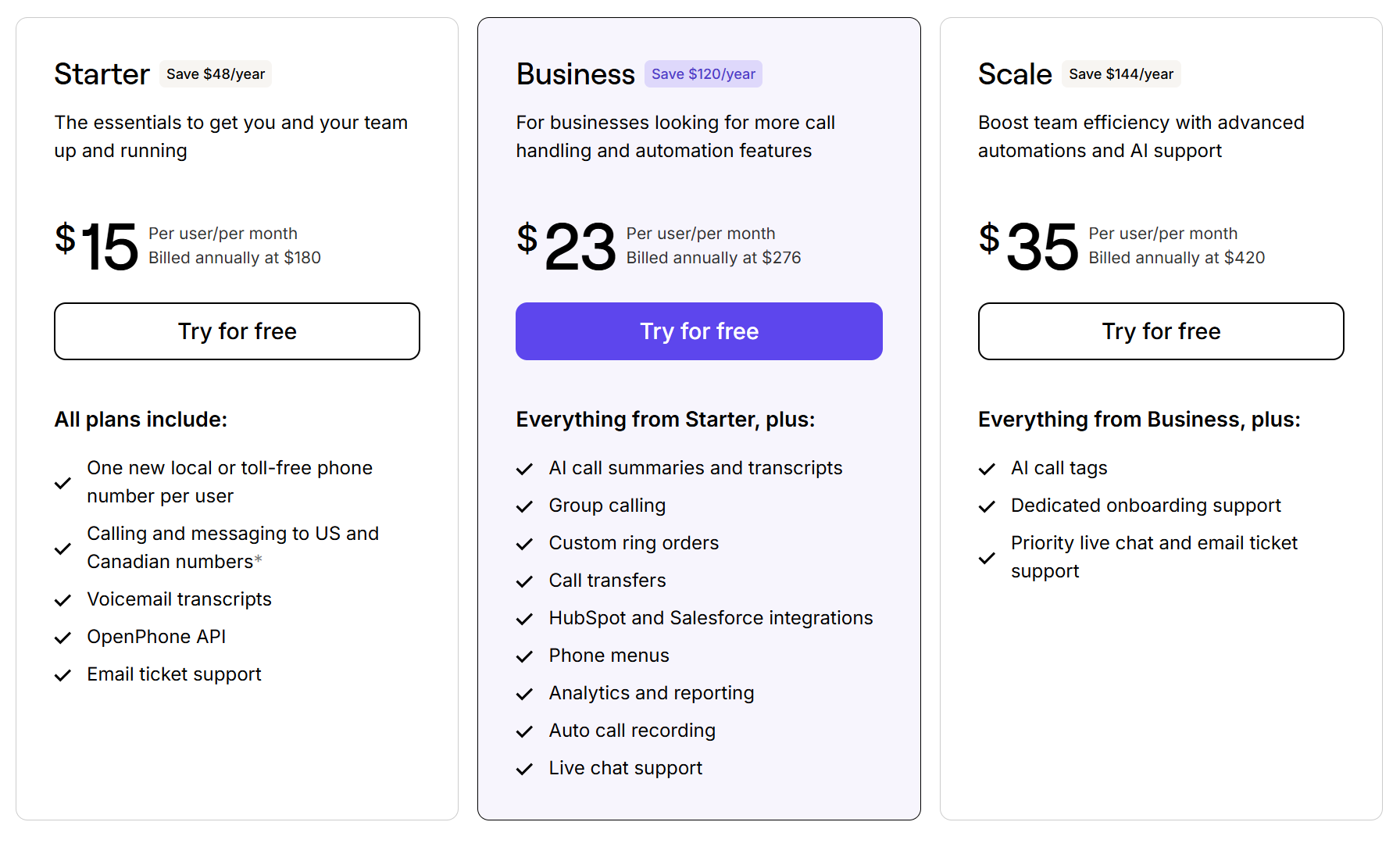
There are three Quo pricing plans:
- Starter: $15 per user per month for unlimited calls and messages in the US and Canada, on-demand call recording, voicemail to text, access to the Quo API, text automations (snippets, auto-replies, scheduled messages, etc.), call views, group messaging, and integrations with Slack, Zapier, and more
- Business: $23 per user per month for automatic call recording, phone menus (IVR), call transfers, AI call summaries and transcripts, Gong integration, ring order, advanced call forwarding, and more
- Scale: $35 per user per month for AI call tags, conditional call routing (coming soon), priority chat and email support, and dedicated onboarding
2. Zendesk: Best for ticket management

Zendesk is one of the world’s most popular customer service platforms, with features like a ticketing system, call routing, and help center. It also offers a Quality Assurance paid add-on, which costs $35 per user per month. It lets you use AI to analyze phone calls, email, chat, and social media messages to quickly see how your reps and AI agents provide customer support. You can also track performance trends with ticket insights that link to CSAT scores and filter data by department, team, or individual reps. That way, you get a clear view of where support efforts are succeeding (and where they’re not).
While Zendesk offers many features, they can be overwhelming for small and growing businesses. You probably won’t need them all if you’re not an enterprise brand — and considering the high cost, it’s tough to justify paying for features you’ll rarely use.
Another drawback about Zendesk: while it does support voice calls, it doesn’t let you make outbound calls from toll-free numbers. This can be a problem if you need to reach international customers or have an existing toll-free number that team members use.
Key features of Zendesk
- Voice support (no outbound calls from toll-free numbers)
- Identify churn risks, unusual interactions, and escalations (paid add-on)
- Schedule coaching sessions in-app (paid add-on)
- Help center (requires upgrade)
- CSAT tracking (requires upgrade)
Zendesk pricing

As mentioned, Zendesk offers a Quality Assurance add-on for $35 per user per month. You’ll have to pay for this add-on along with one of its four plans:
- Suite Team: $55 per user per month for a ticketing system, email, chat, voice, social messaging, help center, and basic integrations
- Suite Growth: $89 per user per month for multiple ticket forms, light agents, SLAs, CSAT tracking, multilingual support, and a self-service customer portal
- Suite Professional: $115 per user per month for custom and live analytics, side conversations, skills-based routing, integrated community forums, and data location options
- Suite Enterprise: Custom pricing for sandbox testing environments, AI-powered content cues, content blocks, and custom agent roles
3. MaestroQA: Best for remote process management

MaestroQA is a call center quality assurance software that provides solutions for businesses across industries like ecommerce, financial services, and healthcare. It offers features that simplify the QA process, like customizable scorecards that evaluate how well reps handle calls, emails, and social media.
A fan-favorite feature is MaestroQA’s screen capture tool, which lets you record team members’ on-screen activities during customer interactions. It gives you a full view of how reps work, making it easier to offer helpful suggestions on how they can improve.
But MaestroQA isn’t a flawless platform — many past users found the learning curve too steep. They feel its features are unnecessarily complicated, as highlighted in the review below:
“Accessing scored tickets and reviews can be sometimes more complex than it should be for the advisor, and sorting/filtering might unintentionally leave some reviews unread.” — Capterra
The biggest deal-breaker? No support for calling or texting. This means you’ll need to go without voice capabilities or purchase a business phone system you can integrate with MaestroQA.
Key features of MaestroQA
- Screen capture
- Scorecard builder
- Report builder
- Coaching workflows
- Performance dashboards
MaestroQA pricing
MaestroQA doesn’t list pricing online, so your best bet is to fill out the custom request form.
4. Scorebuddy QA: Best for monitoring multiple channels

Scorebuddy QA is a contact center quality assurance (QA) platform that integrates with CRMs, help desk tools, ticketing systems, and more. This makes it easy to connect Scorebuddy QA with your existing tech stack, letting you automate your workflows to save time.
Businesses use Scorebuddy to monitor rep performance across multiple channels — like calls, emails, and social media — in one place. This helps teams maintain consistent customer support quality across all communications.
But like many other QA platforms, Scorebuddy’s pricing isn’t publicly listed. Keep in mind key features are locked behind paid add-ons, like full reporting visibility, sentiment analysis, and in-depth QA reporting.
What’s more, Scorebuddy QA doesn’t support calling and texting, no matter how much you upgrade. You’ll either have to integrate with a business phone system or look for an alternative that comes with built-in voice and SMS features.
Key features of Scorebuddy QA
- Integrations with sales and CRM platforms
- Scorecard builder
- Compliance monitoring and audit trails
- Root cause analysis
- Sentiment analysis (paid add-on)
Scorebuddy QA pricing

Scorebuddy doesn’t list its pricing online. However, it does list the features you get on each plan:
- Business: Custom pricing for scorecards, compliance and calibration modules, reporting, integrations, and root cause analysis
- Enterprise: Custom pricing for Scorebuddy BI, Contact Center as a Service (CCaaS) platform integration, and peer and self-scoring
You’ll also need a custom quote for its add-ons, like business intelligence, coaching, learning, and automatic QA.
5. SupportLogic: Best for enterprise support

SupportLogic is a support experience (SX) management platform designed to boost customer lifetime value (CLV). It analyzes tone and sentiment in customer conversations to detect frustration or satisfaction, then flags potential issues before they escalate.
You can use Support Logic to serve customers in their native languages by translating support conversations into English — perfect for enterprises with a multinational customer base.
But where SupportLogic falls short is with integrations. Key platforms like Make and Zapier are missing, preventing you from creating automations that speed up workflows.
You should also know SupportLogic doesn’t let you make or receive calls. The only solution is to integrate with a third-party business phone system, which adds extra expenses.
Key features of SupportLogic
- Customer sentiment analysis
- Intelligent routing (paid add-on)
- Multilingual translation
- Case swarming
- Omnichannel support
SupportLogic pricing

While SupportLogic uses a combination of usage-based pricing and seat-based licensing, they don’t offer transparent pricing.
They do list two plans you can choose from:
- Core SX: Custom pricing for sentiment analysis, escalation management, text analytics, case swarming, CRM widget, and multilingual translations and summaries
- Resolve SX: Custom pricing for a Slack or Teams answer engine, multiple DB/KCS support, precision RAG-powered, and a portal knowledge engine
Keep in mind you may need to purchase add-ons for tools like intelligent routing and auto QA.
6. evaluagent: Best for seamless integrations

evaluagent is an older call center QA Software that was founded in 2012. With its 16+ integrations (including VoIP providers), you can pull in all your team’s calls, chats, emails, and tickets into the evaluagent app to get a full picture of every customer interaction in one place.
Bringing every conversation into the same shared system makes it easy to identify customer sentiment across different channels. For example, you can sort by high-risk interactions to find negative sentiment or spotlight high-value conversations to use as examples of great customer service.
The drawbacks? Some users have complained it has a confusing UI, while others find its reporting and analytics tools lacking. It might not be a fit for growing small businesses without a dedicated team for QA or IT.
See for yourself:
“Difficult to navigate interface, many incorrect clicks to find what I’m looking for.” — G2
“Reporting & analytics are too basic and require too much manual effort to get.” — G2
Key features of evaluagent
- Automatic QA scoring
- Call transcriptions and conversation summaries
- Gamification and reward systems
- 16+ integrations with CRMs, help desk software, and BI tools
- Coaching templates
evaluagent pricing
As you can probably guess, there’s no public pricing for evaluagent. You’ll have to request a custom quote.
7. CallMiner: Best for automatic call coaching

CallMiner is a leader in call intelligence and helps contact centers improve the customer experience by providing features that help you manage your QA platform. For example, you can automate QA forms, use screen recordings to see how reps resolve customer issues, and give each rep their own individual dashboard so they can coach themselves.
You can use CallMiner for other QA tasks, like helping agents identify compliance issues in real time and providing resolution guidance to resolve them before the conversation ends. After the call, you can use AI-driven insights to check customer sentiment and competitor mentions and spot ways to improve customer service quality.
But while CallMiner offers quite a few features, its onboarding process leaves much to be desired. Past users report a steep learning curve, and without transparent pricing, it’s hard to know if the expense is worth it.
One reviewer shared:
“As an analyst, there’s a significant loading time it takes to learn how to use the system before you’re able to pull any insights.”
Key features of CallMiner
- Automated QA
- Rep training and guidance during live conversations
- Screen record (see how support agents navigate your knowledge base)
- Track trends for individuals and teams
- Analyze competitive mentions and customer sentiment
CallMiner pricing
CallMiner doesn’t post pricing online. The best way to find pricing is to submit your info for a quote.
8. Talkdesk: Best for speech analytics

Talkdesk is a customer experience platform that provides various tools for monitoring and improving customer support. This includes real-time analytics dashboards and customizable customer feedback forms. Plus, it uses speech analytics to review voice data and flag potential issues your rep may have missed during the call.
You can also use Talkdesk to record screens and calls, which provides a more complete view of your reps’ interactions with customers for training and quality assurance. It also lets you give contextualized feedback by adding time-stamped comments and reactions to recordings.
But keep in mind that Talkdesk was designed for all communication channels, not just phone calls. You’ll have to upgrade your plan to access basic voice tools like business hours and unlimited call recording storage.
Plus, calling isn’t free — there are charges for both incoming and outgoing calls. If you’re looking for a phone platform that offers unlimited minutes, you might want to look for a Talkdesk alternative.
Key features of Talkdesk
- Real-time dashboards
- Conversations™ mobile app
- Quality management to evaluate customer interactions
- Access to the Talkdesk API
- Call routing (requires upgrade)
Talkdesk pricing

Talkdesk offers three options you can choose from:
- Digital Essentials: $85 per user per month for access to digital channels (text, chat, email, and social media), Ascend AI, Talkdesk API, and quality management tools
- Voice Essentials: $105 per user per month for custom routing, the automation designer, 70 integrations, and access to the AppConnect marketplace
- Cloud Elite: $165 per user per month for workforce management, proactive outbound engagement, screen recording, and the performance management system
9. Enthu.AI: Best for sales teams

Enthu.AI is a contact center and sales AI tool that monitors and coaches reps by analyzing customer conversations. To do this, it offers features like call transcripts, sentiment analysis, and call scoring so you can assess rep performance and pinpoint what leads to successful deals (and where opportunities are lost).
You can use Enthu.AI across multiple communication channels, including phone calls, web chats, and tickets from your help desk. Since everything is connected to a single inbox, you can look for big-picture patterns while drilling down into the details of each conversation.
But despite the name, Enthu.AI doesn’t offer AI tools on its base plan. Features like keyword spotting and AI-powered performance insights are only available if you upgrade to the aiQ plan.
To make matters worse, you can’t trial the base plan first to see if it fits your needs. You can only test its AI-powered plans — so if you just want the base plan, you’ll have to commit without testing it first.
Key features of Enthu.AI
- Call scoring assessments (AI-powered requires upgrade)
- Root cause analysis
- Quality workflow automation
- Sentiment analysis (requires upgrade)
- Automatic data redaction
Enthu.AI pricing

There’s no public pricing available for Enthu.AI. The only way to get a quote is to contact the sales team.
- eValu8: Custom pricing for playback recordings, review and score calls, custom scorecards, and zero tolerance questions
- aiQ: Custom pricing for AI-enabled call scoring, sentiment analysis, auto speaker separation, and auto-detect language
- aiQ++: Custom pricing for generative AI-enabled scans, configure custom questions for GenAI response, GenAI-enabled root cause analysis, and direct access to the product team
10. Observe.AI: Best for compliance monitoring

Observe.AI is a conversation intelligence platform, which is a fancy way of saying it analyzes customer interactions to help your team figure out what’s working (and what’s not). One of its biggest claims to fame is compliance monitoring — providing reps with on-screen prompts and guidance to help them follow compliance scripts and deliver disclosures correctly.
You can also use Observe.AI to automatically redact sensitive information, like PII (Personally Identifiable Information) and PCI (Payment Card Industry) data from audio recordings and transcripts.
But tools this robust rarely come cheap — although there’s no public pricing available online. Plus, many of Observe.AI’s best features require add-ons (including screen recording). The only way to know how much is to contact the sales team for a quote.
Key features of Observe.AI
- Auto QA and manual QA (requires upgrade)
- 18/5 customer support
- Knowledge base AI (add-on)
- Agent performance and coaching (requires upgrade)
- Voice AI agents for conversations
Observe.AI pricing

Like other QA software on this list, Observe.AI doesn’t publicly list its pricing. The best you can do is pick a plan with the features you want, then contact the sales team for a custom quote.
- Real-Time AI: Custom pricing for real-time agent assist and standard 18/5 support
- Post-Interaction AI: Custom pricing for auto QA, manual QA, and agent performance & coaching
- Enterprise Advanced: Custom pricing for real-time agent assist and premium 24/7 support
- Enterprise Unlimited: Custom pricing for screen recording and knowledge AI (included, no longer an add-on)
3 examples of quality assurance in customer service
Curious how you could implement QA for your growing small business?
Here are three examples of customer service QA with Quo:
- Track customer sentiment with call tags: Start by gathering data from customer conversations. In Quo, you can create custom AI tags that automatically label customer calls after they’ve ended (like ‘Happy’ or ‘Frustrated’). Then you can filter calls by tag in call views and see which team members average the lowest or highest scores.
- Review call transcripts and score them accordingly: You can use call transcripts in Quo to quickly review calls for solution accuracy, a positive tone, and quick resolution time. This also makes it easier to fill out a customer service QA checklist and present your team with data-driven feedback.
- Monitor reps with group calling: Maybe you want to keep tabs on a new rep or provide extra support to struggling team members. Either way, you can set up a three-way call to join customer calls with your coworkers, then jump in if the call starts to go south.
Features of the best customer support quality assurance software
While hunting for tools to support your quality assurance process, keep these key features in mind:
- SMB-friendly features: Small business support teams need easy-to-use tools that help maintain high-quality support without adding extra overhead. For example, AI-powered transcriptions, call recording, group calls, and call summaries let teams review customer interactions, even on a small scale. You can also organize conversations with AI call tags and sentiment analysis, making 1:1 coaching easier without needing a full QA department.
- Features for larger teams: If you do have a dedicated QA team, you’ll need tools that handle high call volumes and ensure consistency across multiple reps. Features like customizable QA scorecards, screen recording, and compliance monitoring help managers track performance, get actionable insights, provide real-time feedback, and optimize support quality at scale.
- Flexible pricing: More expensive doesn’t always mean better — and growing businesses need budget-friendly plans without excessive add-ons or per-minute pricing. Bonus points for finding a tool with month-to-month payment options so you’re not locked into a contract before you’re ready.
- User-friendly interface: The last thing you want is another complex tool that takes months of onboarding and rep training. Keep your eye out for platforms designed to be intuitive. If there’s no free trial or detailed demo, you may want to consider more transparent and flexible alternatives.
- Scalability as you grow: The bigger your company gets, the more QA tools you’ll need. The platform(s) you choose should scale alongside your business so you can upgrade for more (like real-time insights) or downgrade for less (like basic performance metrics if you find you’re not using the advanced ones).
Quo: The best customer support QA tool for voice calls

While many customer support quality assurance tools offer something different, what they share in common are complex features and non-transparent pricing. Plus, many of them don’t offer built-in voice features without upgrading — although a business phone system like Quo does on every plan.
Quo makes it easy to maintain customer support quality without adding more tools to your tech stack or buying expensive QA add-ons. Our Scale plan starts at $35 per user per month for access to AI call tags, transcriptions and summaries, shared phone numbers, thousands of integrations with the tools you’re already using, and other types of call monitoring software.
All that’s left is to take us for a spin.
Sign up today for Quo’s free seven-day trial.
FAQs
Some quality monitoring tools require add-on packages to unlock their best and most useful features. Others charge extra for inbound or outbound minutes, or worse, require you to purchase separate business phone systems for voice features.
There are generally three major types of customer support QA tools:
– For call and contact center agents: These tools focus on voice channels and the occasional text. Others support omnichannel communications (email, chatbots, social media, etc.) for enterprise contact centers.
– For sentiment analysis: These track topics, keywords, and emotions in conversations so you can look for patterns of predictive customer behavior and help you make data-driven decisions to solve recurring problems.
– For safety and compliance: These make sure conversations don’t violate legal statutes or security requirements.
Quality assurance tools help you ensure customer service teams are equipped to care for your callers. This includes functionality for rep training, providing feedback on past calls, and looking for trends with positive or negative sentiment.
You can use quality assurance to help train new team members, keep an eye on struggling reps, and set employee and customer expectations. That way, every caller gets the same level of support, which improves customer retention and satisfaction scores.
Many QA tools offer ways to speed up workflows, including third-party integrations, automations, and AI workflows. Plus, managers can use automated customer service scorecards to instantly score every inbound and outbound call.
Some of the most popular customer service quality assurance KPIs include:
– First response time
– First call resolution
– Customer satisfaction (CSAT)
– Net Promoter Score® (NPS)