Ringover is a VoIP platform that helps teams manage customer communications at scale. It offers voice, video, and messaging, and lets you buy international numbers. But many of the features that make it worth using — AI call summaries and sentiment analysis, CRM integrations, and power dialers — are locked behind higher-tier plans or sold as add-ons.
I tested and compiled the seven best Ringover alternatives for 2026. I reviewed each provider’s pricing, features, and limitations to help you find the right fit for your team.
Comparing the best 7 Ringover alternatives
Want to see how the best Ringover alternatives stack up? Here’s a quick rundown of the top options, followed by a deep dive into each one:
| Provider | Starting price | Best for | Free trial | Unlimited calling to US & Canada | SMS/MMS to US & Canada |
|---|---|---|---|---|---|
| Ringover | $15 per user per month | Small teams, simple CRM | 7-day | ✅ | ✅ |
| Quo, formerly OpenPhone | $15 per user per month | Small and growing businesses | 7-day | ✅ | ✅ |
| RingCentral | $20 per user per month | Larger businesses needing desk phones | 14-day | Limited toll-free minutes | 25 texts per user per month |
| Dialpad | $15 per user per month | Contact centers | 14-day | ✅ | For US and Canadian customers only |
| Nextiva | $15 per user per month | Enterprise customer support | Demo only | ✅ | 100 texts per user per month |
| JustCall | $29 per user per month | Outbound sales teams | 14-day | ✅ | ✅ |
| Grasshopper | $14 per month | Solopreneurs | 7-day | ✅ | ✅ |
| Aircall | $30 per user per month, three-user minimum | Advanced call monitoring | 7-day | ✅ | ✅ |
Keep reading for a thorough breakdown of each alternative.
1. Quo: Best for small businesses and growing teams

Pros
- Unlimited calling and texting in the US and Canada
- Shared numbers and inboxes with internal threads
- AI call tags, transcripts, and summaries
- 24/7 AI voice agent Sona, with per-call pricing
- 8,000+ integrations via Zapier and make
- Seven-day free trial
Cons
- No verification through two-factor authentication*
*Nearly all virtual phone numbers share this problem. For safety reasons, companies like Facebook, Uber, and Google rarely let you authenticate accounts through a virtual phone number.
Quo, formerly OpenPhone, is a business phone system built for small businesses and growing teams. It offers unlimited calling and texting in the US and Canada, so you don’t need to worry about per-message charges like with Ringover.
Quo lets multiple teammates work from the same inbox with shared numbers. These keep everyone on the same page across calls and texts. When a client reaches out, your team can leave internal notes on the conversation without the customer seeing them.
For teams doing high-volume outreach, click-to-call lets you call directly from your browser or CRM. You can also set up SMS auto-replies when your team is busy.
Sona, Quo’s conversational AI voice agent, handles incoming calls after hours or when your team is unavailable. With per-call pricing, you get more predictable monthly costs than Ringover’s per-minute AI voice pricing.
On the Scale plan, Quo automatically applies AI call tags to every conversation. This makes it easier to identify call drivers, like recurring billing questions and new inquiries.
Quo integrates directly with HubSpot, Salesforce, and Jobber. You can also connect 8,000+ tools via Zapier and Make. Your team can sync contacts, log calls, and automate follow-ups without any integration limits.
Key features of Quo
- Shared numbers with internal threading for team collaboration
- AI-powered call transcripts and summaries
- Visual call flow builder and IVR setup
- Advanced call routing with custom ring order
- Support for SMS and MMS
- 10+ native integrations, including HubSpot, Salesforce, and Attio
- Access to the Quo API
Quo pricing
Quo pricing includes three plans designed to grow alongside your team:
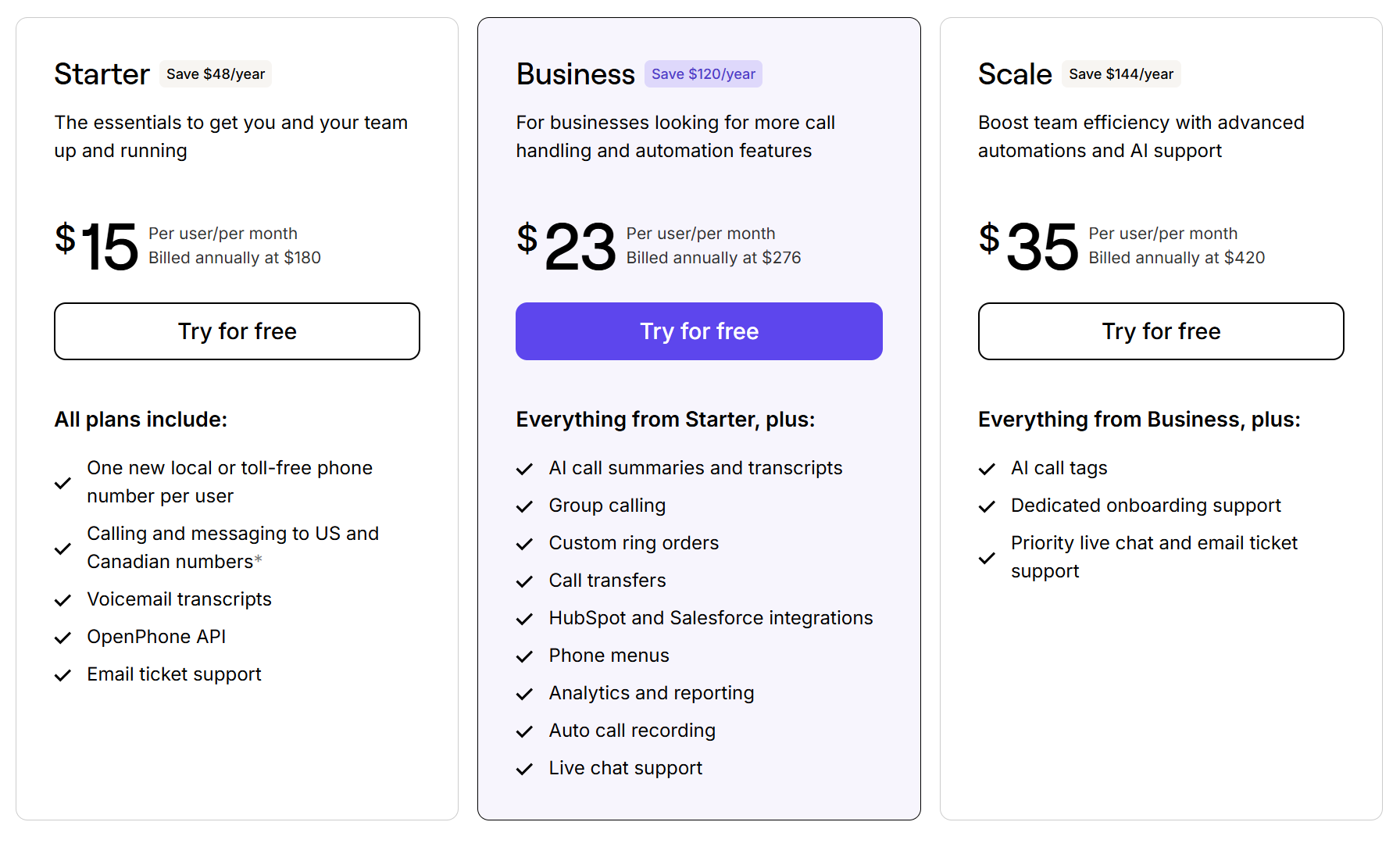
- Starter: $15 per user per month for unlimited calling and texting in the US and Canada, shared numbers, voicemail-to-text, on-demand call recording, call hold, basic call forwarding, Zapier and Make integrations, and more
- Business: $23 per user per month for phone menus with IVR, automatic call recording, call transfers, ring order, advanced call forwarding, analytics, CRM integrations including HubSpot, and more
- Scale: $35 per user per month for AI call tags, dedicated onboarding, inbound phone support, and priority chat and email support
Sona, Quo’s AI voice agent, includes the first 10 calls free. Credit tiers start at $25 per month for around 40 calls.
2. RingCentral: Best alternative for connecting desk phones

Pros
- Voice, video, and messaging in one place
- 300+ app integrations
- AI call summaries and conversation insights
- 99.999% uptime guarantee
- Works with desk phones
Cons
- Toll-free minutes and SMS capped on lower plans
- Advanced features cost extra
- Takes longer to set up than Ringover
RingCentral is a cloud communications platform for teams that have outgrown Ringover. It offers 330+ integrations with popular business tools, including Salesforce and Microsoft Teams. You also get a unified communications suite with voice, video, and messaging.
RingCentral AI, RingSense, delivers automated call summaries and sentiment analysis across your teams. Compared to Ringover’s AI, which is more focused on individual call coaching, RingSense gives you a wider view of overall team performance.
However, SMS with RingCentral is capped at 25 messages per user per month on the base plan. Toll-free minutes are limited, too. On the 14-day free trial, you’re restricted to five users, two desktop phones, and no SMS access.
Key features of RingCentral
- Unlimited domestic calling
- 300+ app integrations, including HubSpot and Microsoft Teams
- AI call summaries and conversation insights
- Real-time and historical analytics
- Captions and transcriptions
- Unlimited storage on higher-tier plans
RingCentral pricing
RingCentral’s pricing breaks down into three plans:
- Core: $20 per user per month for unlimited domestic calling, 25 SMS and MMS, 100 toll-free minutes, and Slack integration
- Advanced: $25 per user per month for automatic call recording, CRM integrations, call whispering, 1,000 toll-free minutes, and Zendesk integration
- Ultra: $35 per user per month for unlimited storage, 10,000 toll-free minutes, 200 SMS, and custom analytics and alerts
An AI voice agent add-on is also available for $59 per month for 100 minutes.
3. Dialpad: Best alternative for contact centers

Pros
- AI-powered call monitoring
- 14-day free trial
- Real-time AI coaching on all plans
- Integrations with Slack, Salesforce, and Microsoft Teams
Cons
- Limited international number availability
- Expensive international calls and SMS
- Learning curve for advanced AI features
Dialpad is a business communications platform with more advanced AI than Ringover. You get real-time transcription and automated call summaries built in. Live coaching shows agents suggested responses on screen mid-call, though this is only available on the Sell and Support plans.
But Dialpad has more limited international number availability than Ringover. Coverage is thinner, and some regions require extra steps to set up local numbers.
Dialpad users have also reported billing disputes going unresolved. Getting clear answers from the support team can be a challenge. Ringover is more responsive on support, though some users report dropped audio and call quality issues on Ringover during heavy usage.
Key features of Dialpad
- Unlimited calls and texts in the US and Canada
- Live speech coaching
- Shared phone numbers
- Video conferencing
- Voicemail transcription
- Google Workspace integration on the base plan
Dialpad pricing
Dialpad offers three plans to choose from:
- Standard: $15 per user per month for unlimited calls and texts in the US and Canada, SMS/MMS, AI call and voicemail transcriptions, and team messaging
- Pro: $25 per user per month for additional numbers, CRM integrations, 24/7 live agent support, and local numbers in 70+ countries
- Enterprise: Custom pricing for 99.9% uptime and unlimited office locations
4. Nextiva: Best alternative for enterprise customer support

Pros
- Voice, chat, SMS, and email in one workspace
- 99.999% uptime
- Secure payment collection during live calls
Cons
- Limited native integrations
- No free trial for small business plans
- Toll-free numbers require an upgrade
Nextiva is a cloud-based communications platform built for enterprise customer support. But it also works for smaller teams that need advanced call routing, reporting, and AI automation.
Nextiva sets itself apart with more advanced call management tools, including:
- IVR routing that prioritizes calls based on agent skills, languages, and availability
- Conversational AI for payments, appointment booking, and hotel reservations
- Intelligent virtual agents across voice, chat, SMS, and email 24/7
- Real-time dashboards and voice analytics for agent performance tracking
The trade-off is cost. These customer experience features are only available on the Power CX plan, which starts at $75 per user per month.
Key features of Nextiva
- Intelligent call routing based on agent skills and business hours
- AI copilot with real-time coaching during live calls
- AI transcriptions and call summaries
- 24/7 virtual agents for inbound queries
- Advanced call analytics and sentiment analysis
- AI knowledge base for instant agent answers
Nextiva pricing
Businesses can choose from three Nextiva pricing tiers:
- Core: $15 per user per month for voice calls, 100 SMS and MMS, voicemail transcriptions, team chat, and mobile app access
- Engage: $25 per user per month for call recording, voice analytics, Microsoft Teams integration, 500 SMS/MMS, and 2,000 toll-free minutes
- Power Suite: $75 per user per month for skills-based routing, advanced IVR, AI call transcriptions and summaries, and API integrations
5. JustCall: Best alternative for outbound sales teams

Pros
- 14-day free trial
- Multiple dialer options for high-volume outbound calling
- Real-time AI coaching and conversation intelligence during live calls
- SMS and WhatsApp in the same workspace as calling
- 24/7 AI voice agent
Cons
- SMS capped across plans
- Two-user minimum on most plans
- Advanced dialing features have a learning curve
JustCall is an AI-powered business phone system built for outbound sales teams. It offers multiple dialer modes to help your team reach more contacts in less time.
You get more channels to manage customer outreach, including email on top of voice, SMS, video, Instagram, Messenger, and WhatsApp. WhatsApp automation is more advanced, allowing you to trigger follow-up messages based on call outcomes.
JustCall’s AI goes further than Ringover’s as well. It coaches agents on screen during live calls and runs a 24/7 AI agent for after-hours inquiries. Ringover’s AI just focuses on transcription and analytics after the call ends.
But JustCall comes with two limitations worth knowing:
- International calls are charged per minute. Ringover bundles unlimited calling to 110+ destinations into its standard plans.
- Pricing is harder to predict, with advanced features often requiring a higher-tier plan.
Key features of JustCall
- Local numbers in 70+ countries
- One-click voicemail drop
- Automatic call and SMS logging in 100+ CRMs
- AI playbooks and scorecards for call performance
- Automated SMS follow-ups based on call outcomes
JustCall pricing
JustCall’s pricing provides four plans for you to pick from:
- Team: $29 per user per month* for unlimited calling, local phone numbers, AI call transcriptions, 500 text segments per user, and 100+ integrations
- Pro: $49 per user per month* for bulk SMS campaigns, intelligent call routing, Salesforce integration, 1,000 text segments per user, and live call monitoring with whisper, barge, and listen
- Pro Plus: $89 per user per month* for advanced coaching features, power dialer, AI SMS copilot, sentiment analysis, 1,000 text segments per user, and AI call scoring
- Business: Custom pricing for unlimited calling and SMS, HIPAA compliance, and a dedicated phone support line
*Two-license minimum
6. Grasshopper: Best no-frills alternative for solopreneurs

Pros
- Seven-day free trial
- Multi-digit extensions
- Toll-free, local, and vanity numbers
- Unlimited texting
Cons
- No CRM integrations
- Dated interface
- Limited customer support
Grasshopper is a simple cloud-based virtual phone system for solopreneurs and micro-businesses. It has been in the VoIP space for over 20 years.
Grasshopper covers the basics well. You can make and receive calls, set personalized greetings, and use a virtual number on your existing phone. Multi-digit extensions and a live receptionist add-on set it apart from most entry-level VoIP solutions.
But the base plan doesn’t have call recording or interactive voice response. Users also report the call flow feature has a learning curve, with no visual builder to work from.
Plus, Grasshopper only connects with Google Voice via call forwarding, while Ringover connects natively with CRMs like Salesforce, HubSpot, and Pipedrive.
On the AI front, Grasshopper offers voicemail and call transcripts, but that’s about it. Ringover and most alternatives provide call summaries, sentiment analysis, and more.
Key features of Grasshopper
- Voicemail-to-email transcription
- Virtual auto-attendant for professional call routing
- Call forwarding to your existing device
- Instant text response for missed calls
- Multiple extensions on a single number
Grasshopper pricing
Grasshopper offers three plans based on the number of phone numbers and extensions you need:
- True Solo: $14 per month for one user, one phone number, and one extension
- Solo Plus: $25 per month for unlimited users, one phone number, three extensions, call recording, IVR, and simultaneous ring
- Small Business: $55 per month for unlimited users, four phone numbers, and unlimited extensions
Additional numbers cost $9 per month.
7. Aircall: Best alternative for advanced call monitoring

Pros
- Seven-day free trial
- Real-time call monitoring with whisper and barge
- User-friendly interface
- Advanced analytics and performance dashboards
- 24/7 customer support
Cons
- Requires a minimum of three licenses
- AI tools and advanced analytics cost extra
- More complex setup
Aircall is a call center software for sales and support teams that handle high call volumes. It goes deeper into monitoring and coaching than Ringover but it requires a longer setup.
The AI add-on is the main differentiator. It tracks talk-to-listen ratios, scores customer sentiment, and generates call summaries. Managers can also whisper-coach agents mid-call without the customer hearing.
Aircall offers skill-based call queuing and a power dialer that works directly from your CRM. It connects natively with 100+ tools, including Salesforce, HubSpot, Pipedrive, and Zendesk.
A few things might give you pause, though:
- Aircall has no native team messaging. Ringover offers this out of the box.
- Pricing runs ~30% higher than Ringover, with a three-user minimum.
- AI features are a separate add-on, costing up to $49 per user per month.
Key features of Aircall
- Live call monitoring with private agent coaching and supervisor takeover
- AI call summaries and sentiment analysis
- Talk-to-listen ratio tracking for sales coaching
- Advanced analytics broken down by agent, team, and tag
- Skill-based call routing
- Customer data pulled from your CRM before each call
Aircall pricing
Aircall offers three pricing plans:
- Essentials: $30 per user per month for unlimited calls in the US and Canada, IVR, call recording, click-to-dial, and SMS, with a three-user minimum
- Professional: $50 per user per month for AI call summaries, advanced analytics, call monitoring, power dialer, and Salesforce integration, with a three-user minimum
- Custom: Custom pricing for unlimited calls worldwide, custom onboarding, and API developer support, with a 25-user minimum
Why businesses look for Ringover alternatives
Ringover is an omnichannel VoIP platform geared toward outbound sales teams. It lets you get local numbers in 65 countries and make unlimited calls to 90 destinations. However, there are a few limitations that might lead your business to look elsewhere.
Here are some of the main limitations:
SMS is usage-based
Ringover’s SMS runs on a credit-based pricing model rather than a flat rate. On top of that, Ringover mobile numbers only support national SMS — meaning you can only text within the same country as your number.
To send SMS to a different country, you need to purchase a separate local number for that region. For teams doing international outreach, this extra cost can be a deal-breaker.
Integrations are limited
Ringover’s CRM integrations are only available on the Business plan, starting at $44 per user per month. You’re limited to two integrations, with additional integrations costing $10 each per month. CRM autofill and syncing is also an add-on — a standard feature on most VoIP platforms today.
Ringover base pricing doesn’t include best features
Ringover’s base pricing doesn’t include its best features. You have to upgrade to access tools like the power dialer and call campaigns. The Empower AI add-on is also a separate charge.
Here’s how Ringover’s annual pricing breaks down:

- Talk: $15 per user per month for unlimited calls and a virtual AI receptionist
- Business: $44 per user per month for a local number from 65 countries, two CRM integrations, advanced IVR, analytics, and call coaching
- Advanced: Custom pricing for call campaigns, voicemail drop, and local presence dialing
And if you need more functionality, Ringover offers these as paid add-ons:
- Empower: Conversational AI with sentiment analysis and advanced transcription at $39 per license per month.
- AI voice agent: Automated 24/7 call handling starting at $0.39 per minute. To compare, Sona offers 10 free calls per month and scales up from $25 per month for around 40 calls.
- Omnichannel messaging: WhatsApp, Messenger, Instagram, and email in one dashboard at $29 per license per month.
- +1 integration: An extra CRM or helpdesk connection at $10 per license per month.
- Team activity analytics: Deeper workflow and performance insights at $6 per license per month.
What to look for in a Ringover alternative
Choosing a Ringover alternative comes down to a few key factors:
- Built-in AI vs add-on AI. Are AI features like call summaries and transcriptions included in pricing or sold separately? Many providers charge for these on top of the base price, raising the monthly cost. Quo AI tools on the Scale plan include AI call tags that automatically categorize conversations at no extra cost.
- SMS included vs usage based. Is SMS included in your plan or charged per message? Usage-based pricing can add up quickly for teams sending a high volume of texts. Quo includes unlimited texting to the US and Canada on all plans with no hidden fees.
- Integration capabilities. Your phone system should connect with the tools you already use. Consider whether the platform integrates with HubSpot, Salesforce, and other apps in your stack. Quo offers native integrations for the most popular apps and connects with thousands more through Zapier and Make.
- Setup complexity. Does the platform make it easy to get up and running? The best providers keep configuration simple and intuitive. Quo offers dedicated onboarding and shared number setup across its plans.
- Support quality. Check how easy it is to reach the support team and how quickly they respond. Providers that offer live chat and phone support make it easier to resolve issues without long wait times.
Quo: The best Ringover alternative for growing teams

Ringover is built for call centers and high-volume outbound teams. If that’s not you, you’re likely paying for features you don’t need.
Quo is built for businesses of all sizes. You get shared numbers, unlimited calling and texting in the US and Canada, and AI call summaries and tags — all without add-ons or user minimums. Sona handles after-hours calls and charges per call, so your bill stays predictable. And your team can be up and running in minutes.
Ready to experience a full-featured phone system? Start your free seven-day trial today and get the tools your team needs to build customer relationships.
Frequently asked questions about Ringover alternatives
Yes, you can keep your existing Ringover number and port it to a new provider like Quo. Number portability is available for local, mobile, and toll-free numbers.
To port your number to Quo:
1. Create a Quo account and choose a temporary number.
2. Find your Ringover bill from the last 90 days. Note the account holder name, billing address, and phone number. You will also need your account number or PIN.
3. Start the port request in Quo under Settings and Numbers. Keep your Ringover account active until the port is complete. Canceling early risks losing the number permanently.
4. Wait for the transfer. US numbers typically port in 5–7 business days, and Canadian numbers take 10–12. Quo will confirm the expected date.
5. Once Quo confirms the number is live, you can cancel your Ringover account. Note that SMS conversation history won’t transfer, but the number itself will be fully active in Quo.
Porting to Quo is free. Some providers charge a fee to port out, so check your Ringover contract before you start.
Ringover is a solid choice for US businesses that make a significant number of calls. However, it is more geared toward European firms with strict data privacy requirements and EU-based support hours. EU data hosting further confirms that it’s built with European teams in mind.
The main difference is the features you get with each plan. Ringover Talk offers unlimited calling, AI transcription, and basic IVR in its package. With Ringover Business, you get CRM integrations, call coaching, and local numbers across 65+ countries. If your team needs to manage agents or sync call activity with a CRM, the Business plan is the better fit.
How should I choose the right platform for my business?
Choosing the right platform for your business requires evaluating a few key factors, including:
– Budget: Look at the base price of the tool to help you find the right fit. Also consider any add-on fees for AI features, SMS, and call recording, as these can increase the overall pricing.
– Integrations: Make sure the platform connects with the CRM and tools you already use. Systems that fit into your existing workflow make it easy to sync data without manual entry.
– Support: See how easy it is to reach customer service and how quickly you can get help when something goes wrong. Look for providers that offer 24/7 live chat or phone support, with a dedicated help center as a backup.
– Scalability: See if the provider makes it easy to add more users or upgrade plans. These indicate that the phone system can grow alongside your team.