Maybe you’re trying to build a local presence in a new city. Or you want a toll-free number that sounds more professional. Or maybe there’s a specific business phone number you’ve had your eye on — one that just feels right for you.
Whatever the reason, yes — you can get a specific phone number.
Read on to learn about the different types of phone numbers to choose from, how to check if a number is available with our phone number availability checker tool, and ways to pick the perfect one for your business needs. Plus, five of the best Voice over Internet Protocol, or VoIP, service providers to pick your own number from.
How to get a specific phone number with Quo (formerly OpenPhone)
Not sure if the number you want is available for your business? With Quo (formerly OpenPhone), you don’t have to guess — you can search our available local US, Canadian, and toll-free numbers in the look-up tool. You can also port existing numbers for free, so you don’t have to worry about confusing your customers.
Here’s how to get your desired number with Quo:
- Sign up for an account with Quo. When you sign up, you can try out Quo free for seven days.
- During signup, select your city or area code in the US or Canada to pick your phone number or choose a North American toll-free number. Our phone picker tool is easy to use and lets you check if specific US, Canadian, and toll-free numbers are available.
Phone number look-up
- Verify your account with an existing phone number and a credit card. You won’t be charged until your trial expires, and we’ll even send a heads up to the email address you signed up with.
The different types of phone numbers
There are three different types of phone numbers for businesses:
Local numbers
Local numbers are 10-digit telephone numbers associated with a specific location. For example, if your business serves customers in New York, you can choose a number with a local area code specific to that location, like 917 or 347.
You don’t need to live in a specific location to purchase a number with a desirable area code. Even if you’re in North Dakota, you can buy a number with a Chicago area code.
Local numbers may also be readily available and more cost-effective, depending on your VoIP provider.
Toll-free numbers

Unlike local phone numbers, toll-free numbers bill the business, not the caller, for calls. They typically begin with three-digit prefixes like 800 and 833.
Toll-free numbers are ideal if you serve customers across the US or Canada or if you’re expanding your business to international markets. Just keep in mind incoming calls can look like spam to some customers, so you may want a local phone number in addition to a toll-free one.
📚Further reading: Local vs toll-free number
Vanity numbers
Vanity phone numbers function like toll-free numbers, where the owner of the number typically pays for the call. However, the last few digits also spell out a word or phrase, like 1-800-FLOWERS or 1-800-GO-FEDEX.
Vanity numbers are ideal if you want your phone number to represent the product or service you offer. They’re also a great way for customers to remember your message — it’s hard to forget something like 1-800-CONTACTS, for example.
But vanity numbers can get expensive, which doesn’t always make sense for a small business budget. Some of the most memorable 212 numbers, New York’s original area code, can cost tens of thousands of dollars.
How to choose a specific phone number for your business
Getting to choose a phone number? Nice. Navigating the whole process by yourself? Not so nice. So here’s a four-step process for narrowing down your options:
1. Identify the goals for your phone number
The first step is deciding what you want to accomplish with your phone number.
You may want to ask the following questions:
- Do you want to establish a local presence? Build trust by using local numbers since customers are more likely to recognize a familiar area code.
- Do you want to build a national presence or credibility? Consider a toll-free number provider.
- Do you want callers to remember your number? Purchase a vanity number that speaks for your business. With VoIP providers like Quo, you won’t have to pay for inbound or outbound minutes.
2. Avoid numbers you can’t port or keep long-term
Not every phone number is future-proof. FCC and CRTC rules require providers to support number porting. But in reality, not all providers will let you keep your number if you decide to switch services — such as VoIP or mobile — or carriers later.
For example, some providers like Google Voice only port in mobile numbers, not landlines or VoIP numbers. Alternatively, according to the CRTC, you might need to get a new phone number if you transfer from VoIP to mobile or vice versa.
This can become a real problem if customers have already gotten used to a specific number and you later discover you can’t take it with you.
Before picking a number — especially from a marketplace or third-party seller — check the provider’s porting policy and any restrictions tied to the number type. You want a number you fully “own,” not one tied to a single platform or service.

🚨 Be careful: If you’re getting a number from a marketplace or third-party vendor, make sure it’s a legit service. Some numbers may be flagged for spam or blocked by certain carriers, which could affect call deliverability.
3. Make your phone number memorable
Memorable phone numbers are easier for customers to recall since they usually share a pattern of similar digits — like 777 or 111 — or words. Thinking about a vanity number? Consider words that stand out to customers in your marketing and advertising and that are relevant to your business.
You’re not necessarily limited to seven digits, but any number after seven will be just for branding purposes. Take 1-800-PROGRESSIVE, for example: there are more than seven letters in the phrase, but just 10 digits in the actual number, like 1-800-776-4737.
💡 Pro tip: Many phone carriers and VoIP providers can help you request a specific phone number from their available inventory. Start by checking with their customer service or sales team.
4. Use a provider that scales with your business
Picking a business phone number is a long-term decision. And as your team grows or your business shifts, the provider you choose should still work for you. So pick one that can support your needs over time.
For example, a scalable provider offers:
- Access to shared numbers and a unified inbox makes it easy for multiple team members to handle calls and texts so you’re covered as your team grows or schedules change.
- Service and coverage across the US and Canada ensure you can serve customers wherever they are — or wherever your business expands — without switching providers later.
- Transparent plans and pricing that let you upgrade and downgrade as your business evolves. This allows you to access more or newer features and downgrade your plan if you’re not using them as much as you thought.
- Additional phone numbers are available to buy as your business grows. You should have the option to purchase local and toll-free numbers.
If you’re looking to get a virtual number, here are five VoIP providers to consider.
5 virtual phone solutions that offer specific phone numbers
As mentioned, picking the type of number you want is the first step in getting a specific phone number. You also need to choose a VoIP provider to host your number and provide business features.
Here are several VoIP number providers that can host the specific phone number you choose:
1. Quo (formerly OpenPhone): Best for small businesses and growing teams

Pros
- One free local, toll-free, or vanity number per user is included
- Unlimited calls in the US and Canada
- Shared phone numbers
- Auto-attendant functions, or IVR, for inbound calls
- AI features, like a voice agent
- Integrations with 7,000+ apps, including Zapier and HubSpot
Cons
- No verification through two-factor authentication*
*Nearly all virtual phone numbers share this problem. For safety reasons, companies like Facebook, Uber, and Google rarely let you authenticate accounts through a virtual phone number.
Quo is a modern business phone system that helps entrepreneurs and growing teams serve their customers better. On every Quo plan, each user gets one free local — US or Canadian — or toll-free number. You also get free calling and texting to the US and Canada.
Need an additional number? Easily add one to your account for $5 per number per month. And if you want to text or call internationally, just add credits to your account, and you’re good to go.
Prefer team members to split responsibility for incoming calls? Assign them to a shared phone number. Everyone sees the same call and message history in one shared inbox, so team members can step in to reply if someone else is busy. And yes, they can all use the same number across multiple devices.

If you have a number you want to keep, you can port it into Quo (formerly OpenPhone) for free. It’s all done through the app with step-by-step guidance, and all you have to do to start is fill out a two-minute form from your workspace.
If you’re scaling and need to do more with less, you can tap into Quo’s AI features. Keep accurate records of calls with AI transcripts and summaries, automatically surface customer insights with AI call tags, and take calls 24/7 with Sona, Quo’s AI agent.
Sona can answer calls whenever you can’t, respond to common questions, and take customer messages so you can follow up when you’re free — no caller left behind.

With reliable uptime as per our server status page, you’ll know your phone number is in good hands. See why thousands of businesses choose OpenPhone. Sign up for a free seven-day trial and get a local, toll-free, or vanity number today.
Key features of Quo
- Free calling and texting to the US and Canada
- Call recordings and voicemail transcriptions
- Texting automations like snippets, auto-replies, and scheduled messages
- Additional phone numbers for $5 per number per month
- Integrations with Gmail, Slack, Zapier, HubSpot, Make, and more
- AI agent, Sona
Quo pricing
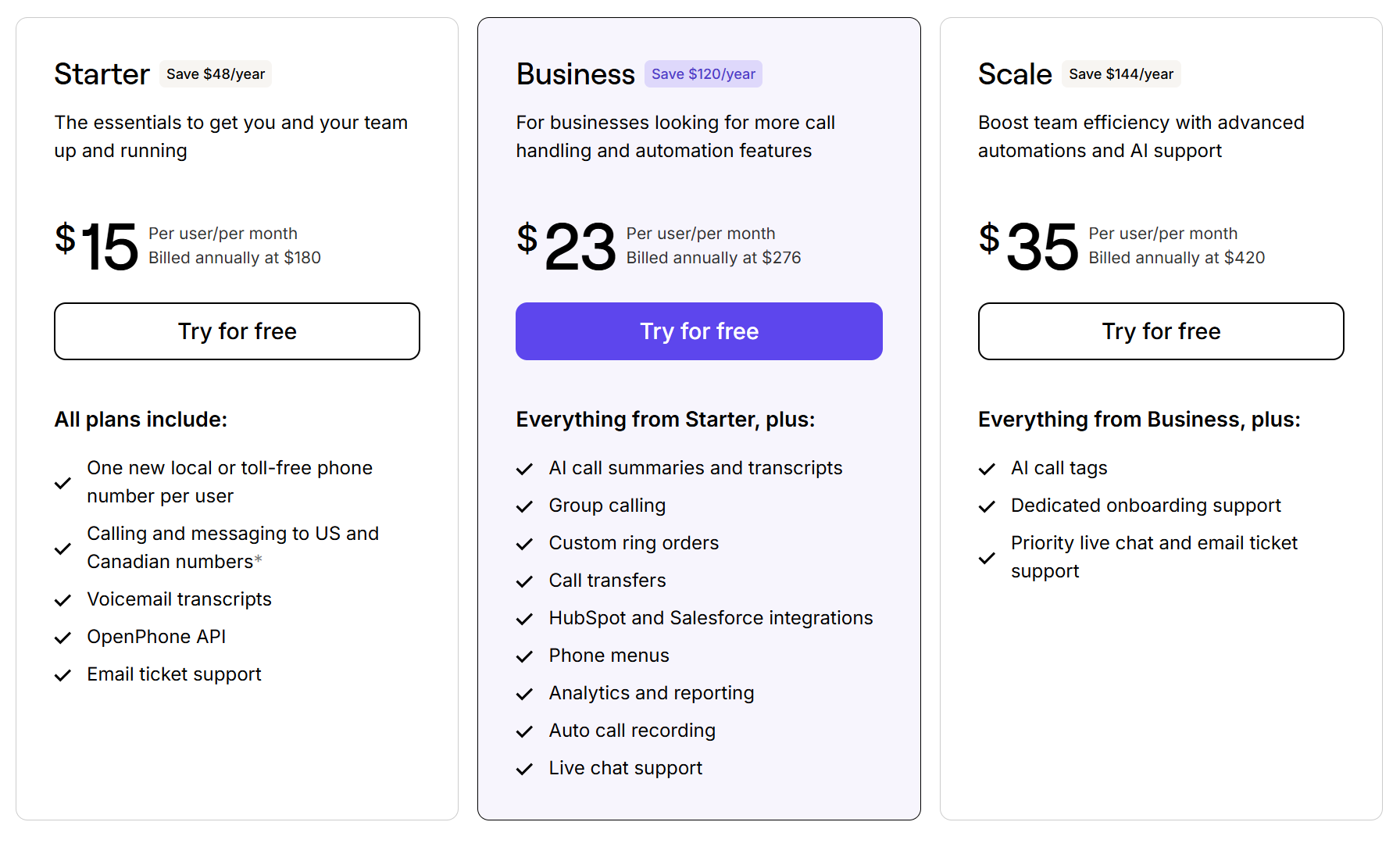
Quo’s pricing gives you three different plans to choose from:
- Starter: $15 per user per month for one free local or toll-free number per user, shared phone numbers, voicemail transcriptions, unlimited calls and texts in the US and Canada, Sona, and more
- Business: $23 per user per month for CRM integrations like Salesforce and HubSpot, call transferring, auto-attendant, or IVR, analytics, and more
- Scale: $35 per user per month for AI call tags, dedicated onboarding, and priority chat and email support
2. RingCentral: Best for desk phone rentals

Pros
- Unlimited calls to the US and Canada
- Limited internal collaboration tools, like document sharing and team messaging
- Offers video conferencing with an upgrade
- Desk phone rentals
Cons
- Texting is limited to 25 texts per month
- 100 toll-free minutes per month limit on the base plan
- CRM integrations require an upgrade
- Call recording requires an upgrade
RingCentral is one of the oldest VoIP services on the market. It’s also compatible with desk phones and PBX phone systems, which is good for companies that still use on-premises hardware. You can rent desk phones with a multi-year contract or connect devices you already own. If you’re a business with a tech stack, you can integrate with apps like Slack, Google Workspace, and Microsoft Teams.
Unfortunately, RingCentral imposes several limitations that might force you to upgrade before you’re ready. For example:
- On the base plan, you can only send up to 25 text segments per user per month, which is quite limiting for a growing business. The mid-tier plan only offers 100 segments per user per month, while the Ultra plan scales to just 200.
- All saved files, including call recordings, are deleted after 90 days. And you can only store up to 5,000 messages unless you upgrade to the most expensive plan for unlimited storage, at $35 per user per month.
- The base plan offers just 100 toll-free minutes per account. This means everyone on your plan will use these pooled toll-free minutes, and once they’re gone, you’ll pay 3.9 cents per minute.
Not a fan of unnecessary limits? You might want to consider some RingCentral alternatives..
Key features of RingCentral
- Unlimited domestic calling
- Local and toll-free numbers
- Visual voicemail
- IVR
- On-demand call recording, with limited storage
RingCentral pricing

RingCentral’s pricing differs based on the number of users you have. For teams of between one and five users, you have three options:
- Core: $20 per user per month for 100 toll-free minutes per account, unlimited calls in the US and Canada, local and toll-free numbers, incoming caller ID, and 25 text segments per user per month
- Advanced: $25 per user per month for 1,000 toll-free minutes per account, 100 text segments per user per month, CRM integrations with Salesforce and Zendesk, internet fax, and automatic call recording
- Ultra: $35 per user per month for 10,000 toll-free minutes per account, 200 text segments per user per month, unlimited storage, and device analytics and alerts
3. Grasshopper: Best for phone number extensions

Pros
- Unlimited calling to the US and Canada
- Desktop and mobile app
Cons
- No shared phone numbers
- No international text messaging
- No native integrations
- Expensive international calling
Grasshopper offers unlimited calling to the US and Canada. On the highest-tier plan, you also get unlimited extensions that let you forward incoming calls to another phone number. On the mid-tier plan, each extension costs $3. Extensions aren’t available on the base plan.
Grasshopper wasn’t designed for team collaboration — and it shows. For example, you don’t get shared numbers, making it difficult for reps to collaborate on fixing customer issues. And since you can’t integrate Grasshopper with your other apps, you’ll risk out-of-sync data across your tools.
If you need to make many international calls, Grasshopper might not be for you. Here’s why:
- You can’t enable international calling for accounts under 60 days old.
- Grasshopper requires a deposit of $500 to activate international calling.
- Alaska and Hawaii count as international locations, which can upset customers and incur unnecessary costs for you.
Additional numbers cost an extra $9 per month, which could get pricey if you want everyone on your plan to have their own number.
If you’re a solopreneur looking for a basic business number, Grasshopper might have what you need. But if you’re a growing small business with multiple team members, you might want to look into some Grasshopper alternatives.
Key features of Grasshopper
- Local and toll-free numbers, and additional numbers are $9 per month each
- Phone number extensions, additional extensions are $3 per month each and require an upgrade
- Business texting
- 24/7 customer support
- Auto-replies, only to first-time callers
- Call recording with an upgrade
- Mobile and desktop apps
- Call transfers with an upgrade
Grasshopper pricing

Grasshopper’s pricing offers three different plans:
- True Solo: $14 per month for one user, one phone number, and one extension
- Solo Plus: $25 per month for unlimited users, one phone number, and three extensions
- Small Business: $55 per month for unlimited users, four phone numbers, and unlimited extensions
4. JustCall: Best for contact centers

Pros
- Schedule text messages
- Bulk texting is available
- WhatsApp inbox
Cons
- No free toll-free minutes
- Limited texting, 500 per user per month on the base plan
- Only two numbers are included per account
- Minimum license requirements
JustCall is a business communication platform that offers phone and chat features for customer service teams. Companies can connect with customers through channels like SMS and WhatsApp. It also works on Windows, Mac, iOS, and Android, which is useful if your team members use different devices and operating systems.
But there are some limitations to be aware of. The pricing page can be a bit tricky, but while you get unlimited outbound calls within your region, inbound calls on certain higher-cost routes — priced at over $0.02 per minute — incur costs.
You also don’t get free toll-free calls and will be charged for shared service numbers, call forwards, and calls routed through JustCall’s Sales Dialer. The little things can add up.
Finally, you can’t send more than 500 segments per user per month on the base plan, which may cause issues if you send a lot of customer texts.
Don’t want restrictions on calls, texts, and number types? You’ll want to consider a JustCall alternative.
Key features of JustCall
- Local number in 70+ countries
- Toll-free numbers
- Limited SMS segments
- SMS scheduling
- Call forwarding
- CRM and data integrations
- AI coaching with an upgrade
- Call and SMS analytics
JustCall pricing

JustCall’s pricing provides four different plans that you can choose from:
- Team: $29 per user per month for access to local phone numbers, unlimited calling, 500 text segments per user, WhatsApp inbox, call transcription, analytics, two-user minimum
- Pro: $49 per user per month for 1,000 text messages per user, queue callback, intelligent call routing, Salesforce CTI integration, and advanced analytics
- Pro Plus: $89 per user per month for advanced coaching features, SMS copilot, call tags, power dialer, and sentiment analysis
- Business: Custom price for a dedicated phone support line, personalized onboarding, HIPAA compliance, and unlimited SMS and calling
5. Google Voice: Best for Google Workspace users

Pros
- Free VoIP calls to the US and Canada
- Integrates with other Google apps
- Comes with a local number
Cons
- No toll-free numbers, even if you already own them
- Texting is available in the US only
- No desktop app
- No integrations outside of Google Workspace
- Requires a Google Workspace subscription $20 fee to port in numbers
Google Voice for Business is a popular business VoIP app, suited for Google Workspace users. Google Voice offers free calls to the US and Canada for US users, along with unlimited texting in the US.
But beyond features like voicemail transcriptions and call forwarding, the offering is pretty bare-bones.
If you’re looking to automate repetitive tasks or give your team more context, you won’t be able to integrate Google Voice with any software except other Google apps. Plus, you’ll need a Google Workspace account which costs $7 per user per month minimum, so you’ll end up paying for two different tools.
Google Voice also lacks time-saving texting features like auto-replies, which means you can’t instantly respond to customers when you’re unavailable.
Finally, Google Voice doesn’t offer toll-free VoIP numbers. You can’t port over toll-free numbers or any number besides mobile numbers.
If toll-free numbers are critical for your business, you’ll want to consider a Google Voice alternative.
Key features of Google Voice
- Local phone numbers for the US and Canada
- Free unlimited calling to the US
- Free unlimited calling to Canada for US customers only
- Free texting to US numbers for US customers only
- Google Calendar and Google Meet integrations
- Business call recordings with an upgrade
- Ring groups with an upgrade
- Phone menus with an upgrade
- Mobile apps for iOS and Android
- Call forwarding
Google Voice pricing

Google Voice’s pricing provides three different plans for you to pick from:
- Starter: $10 per user per month for 10 users max, text messaging in the US, unlimited calls to the US and Canada, and integrations with Google Workspace tools, like Google Calendar and Google Meet
- Standard: $20 per user per month for unlimited users, SIP link support, multi-level auto-attendants, ad-hoc call recording, and ring groups
- Premier: $30 per user per month for advanced reporting with BigQuery and automatic call recording
Keep in mind, you’ll also need to pay for a Google Workspace subscription, which costs $7 per user per month.
Quo: The best way to get a specific phone number for your business

If you go through the trouble of picking your own number, you should make sure you also pick the right provider — one that gives you all the business features you need to serve your customers, doesn’t enforce unnecessary limits on calling and texting, and scales with you.
That’s why thousands of small business owners pick Quo as their phone number provider. We make it easy to purchase the best number for your business, including local, toll-free, and vanity numbers, so you can build better relationships with your customers.
Try Quo free for seven days and see if it’s the right fit for you.
FAQs
Buying a specific number makes it easier for people to reach your business and helps you build a stronger brand. Here’s why it’s worth considering:
– Easy to remember: Choosing a number with patterns, phone words aligned with your brand, or repeating digits makes it much easier for people to remember and dial your number. You stay top of mind when someone needs your services.
– Builds a more professional brand: Getting a local or branded number can help your business look more established and trustworthy. It shows you’re serious about your company and makes a better first impression on callers.
– Helps you stand out from competitors: A memorable number can make your business more recognizable when advertising or relying on word-of-mouth referrals.
– Gives you more control over your phone presence: When you request a specific phone number, you can choose the area code and number format that best fits your business. You can also buy multiple numbers to separate departments, create direct lines for team members, or expand into different regions as your business grows.
Yes — as long as the number you want is available, you can request it through your provider or choose it during signup with a VoIP service like Quo. Some providers let you browse available numbers by area code or prefix. If the exact number isn’t available, you’ll usually see similar alternatives.
Yes, you can request any unique phone number as long as it’s not in use. The best way to find out if a number is available is to use our phone number look-up tool. Alternatively, you can contact your provider directly.
You can ask your current provider, look it up on a third-party marketplace, or, more easily, use a phone number look-up tool like Quo’s available phone number look-up tool. Just enter your desired area code or prefix to browse available local, toll-free, or vanity numbers.
A business phone number is dedicated to managing business operations. This could be contacting customers, texting leads, or coordinating internal communications. Business phone numbers also help separate your personal number from your business so you don’t blur the lines between your personal and professional life.
Here’s how to get a specific cell phone number from a US provider, using Quo as an example:
1. Sign up for an account or a seven-day free trial.
2. For local phone numbers, select your preferred city or area code in the US or Canada. For a North American toll-free number, use our phone number look-up tool to check availability.
3. Use any existing phone number and a credit card to verify your account.
This process allows you to get a specific cell phone number in 15 minutes or less.
Yes, you can buy a mobile phone number with a specific area code. With a VoIP phone provider like Quo, you can choose from hundreds of local area codes in the US and Canada. You can also select a toll-free number with toll-free codes, such as 833 and 844.
Toll-free numbers are assigned on a first-come, first-served basis from a shared pool of prefixes, like 800, 833, or 888. You can claim one through your provider or by reaching out to the “Responsible organizations” or “RespOrgs” entity.
Yes, many providers let you choose a custom number, including vanity numbers or numbers with repeating digits. If your ideal number isn’t available, you can usually browse similar options or use a marketplace to find one that fits.
There’s no way to reserve a custom phone number without renting or buying it first. Your phone service provider can check availability and host your phone number through your internet connection. With Quo (formerly OpenPhone), you can purchase as many phone numbers as you need — including local, toll-free, and vanity numbers — to build better relationships with your customers.
Some VoIP providers, like Google Voice, charge a fee to port your number out. Quo doesn’t charge any fees if you want to move your number to another provider. It’s best to check with your new provider to see if they charge a porting fee.
You can get a specific number from a carrier, third-party vendor, online marketplace, or VoIP provider. Some options are more flexible and business-friendly than others. VoIP providers like Quo make it easy to search for and claim a VoIP number at an affordable price and get started using your number during a free seven-day trial.