Phone.com might look good on paper, but it doesn’t always deliver what small businesses need once you put it to work.
It’s not just about missing features like texting from a shared number or having to pay extra for call recording. These gaps can slow your team down, make it harder to scale, and leave your small business looking less professional. With Phone.com, you can feel like you’re working around your phone system instead of with it.
In this guide, we take a closer look at Phone.com, including its features, pricing, and limitations. We’ll also compare the best Phone.com alternatives to see if they offer what your business needs.
Comparing the best Phone.com alternatives
Before we dive into the top Phone.com alternatives, here’s a quick side-by-side comparison.
| Provider | Starting price | Unlimited calling to US & Canada | SMS/MMS to US & Canada | Shared phone numbers | Additional phone numbers |
|---|---|---|---|---|---|
| OpenPhone | $15 per user per month | ✔️ | ✔️ | ✔️ | $5 per number per month |
| Grasshopper | $14 per month | ✔️ | Local numbers only | ❌ | $9 per number per month |
| Dialpad | $15 per user per month | ✔️ | For US and Canadian customers only | ✔️ | Requires upgrade |
| Vonage | $13.99 per number per month for up to four users | ✔️ | Local US and Canadian numbers only | Requires upgrade | Cost varies |
| Nextiva | $30 per user per month | ✔️ | 100 SMS per user per month | Shared call appearance only | Contact sales for a quote |
| Ooma | $19.95 per user per month | ✔️ | Requires upgrade | ✔️ | Starts at $9.95 per number per month |
| GoTo Connect | Contact for a quote | ✔️ | For US & Canadian customers only | Shared inbox only | Price varies by country and number type |
| 8×8 | Contact for a quote | ✔️ | ✔️ | ✔️ | Contact for a quote |
| Unitel Voice | $9.99 per month | ❌ | 500 per account per month | Calls only | $4.99 per number per month |
| RingCentral | $20 per user per month | ✔️ | 25 messages per user per month | ✔️ | $4.99 per number per month |
1. Quo (formerly OpenPhone): Best Phone.com alternative for small and growing businesses

We might be a little biased, but we believe that Quo (formerly OpenPhone) offers the best small business phone system on the market. Our software works across any device that connects to WiFi, from cell phones and laptops to tablets and desktops.
Unlike Phone.com, Quo lets you make and receive unlimited calls and texts to US and Canadian numbers on every plan. Call recording is also included on every plan, while Phone.com makes you pay $8 per month just to turn it on.
Plus, Phone.com doesn’t support shared numbers for calling or texting, making it hard for teams to work together. With Quo (formerly OpenPhone), multiple teammates can call and text from the same number and manage conversations together in a shared inbox. You’ll also get access to internal threads and mentions, letting you tag teammates to get their help on a customer issue without leaving the app.
Need help answering calls when your team is tied up or away from their desks? Sona, our AI voice agent, can automatically handle calls on your behalf. It can take messages, answer FAQs, and generate summaries to help you avoid missing any calls or opportunities. Quo also provides AI call tags. These automatically label calls based on the conversation, like “Billing” or “Missed appointment,” so you can quickly decide what calls to follow up with first.
Best of all, compared to other Phone.com alternatives, we don’t expect you to upgrade to the most expensive plan just to connect your CRM.
Want a more detailed list of features? Strap in!
- Unlimited calls, texts, and MMS to US and Canadian numbers
- IVR/auto-attendants
- Voicemail transcriptions and call recordings
- AI call transcriptions and summaries
- Business hours
- Email, Slack, HubSpot, Salesforce, Make, and Zapier integrations
- Text scheduling, auto-replies, and snippets
- Custom greetings for voicemail
Quo pricing
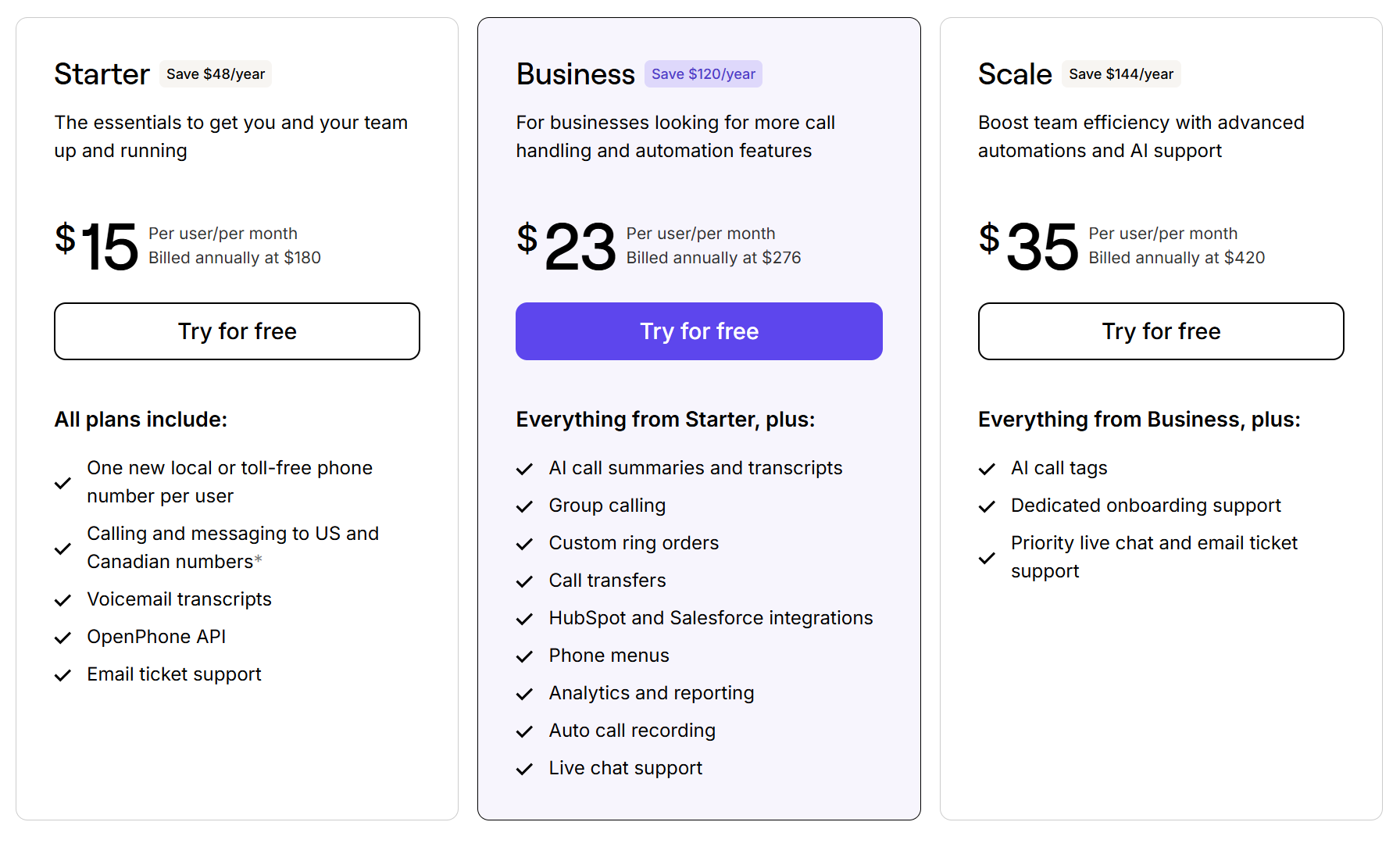
We like to keep things simple around here, which is why Quo offers a three-tier pricing plan with no hidden fees:
- Starter: $15 per user per month for calling and messaging US and Canadian numbers, voicemail transcriptions, on-demand call recording, Slack and Zapier integrations, and more
- Business: $23 per user per month for advanced call forwarding, custom ring orders, call transfers, phone menus, automatic call recording, and more
- Scale: $35 per user per month for AI call tags, conditional call routing (coming soon), dedicated onboarding support, and priority live chat and email ticket support
How to get a virtual number with OpenPhone
Getting a new phone number from almost anywhere in the world is a simple process when you choose Quo as your virtual phone number provider.
Follow these three steps:
-
- Create an account with OpenPhone (when you sign up, you get a free seven-day trial).
-
- During signup, choose your city or area code in the US to select your preferred phone number.
-
- Once the signup process is complete, you’re all set to use your new virtual phone number! You can also easily port in an existing US, Canadian, or North American toll-free number inside the Quo app.
2. Grasshopper: Best for multi-digit extensions

Grasshopper is a well-known VoIP provider that has been in business since 2003. Over the years, it has attracted customers with basic features like caller ID and automated greetings. The platform has extensions that add more than one number to your team members’ phone numbers. This lets callers reach the right person faster without going through a receptionist. You’ll also get access to unlimited calls and texts as long as you’re within the US and Canada.
Other Grasshopper features include:
- Access to local area codes
- Voicemail transcriptions
- Business SMS
- Call recording
Feeling underwhelmed? So are a lot of other people. The app isn’t just outdated compared to other Phone.com alternatives; it lacks any integrations with Slack, Zapier, and other tools that could speed up your workflow. Plus, it doesn’t offer texting automations like snippets or scheduled texts.
Bottom line: Although Grasshopper is an okay virtual phone system, you can get more for your money with another VoIP provider. If your SMB is considering scaling up in the future, this is definitely not the right platform for you.
Grasshopper pricing

Grasshopper’s pricing provides three different plans you can choose from:
- True Solo: $14 per month for one phone number, one user, and three extensions
- Solo Plus: $25 per month for one phone number, unlimited users, and three extensions
- Small Business: $55 per month for four phone numbers, unlimited users, and unlimited extensions
3. Dialpad: Best for contact centers

Dialpad is a cloud communications platform designed for large contact centers. It allows supervisors to see the sentiment for each customer call, so they can step in and help reps when conversations start to go south. The platform lets you make and receive unlimited calls in the US, Canada, and your own country. You’ll also get access to features like:
- IVR
- Extensions
- Ring groups
- Google Workspace and Office 365 integrations
Despite its business features, Dialpad comes with limitations. You’ll have to upgrade to the Pro plan to buy additional numbers, which costs $25 per user per month. Plus, you’ll also need to upgrade to the Pro plan if you want to send international texts.
Bottom line: Dialpad is a better Phone.com alternative if you run a large contact center. It helps supervisors jump in when reps need support and makes it easier to keep up with high call volumes.
Dialpad pricing

Dialpad’s pricing has three options:
- Standard: $15 per user per month for unlimited domestic calling, multi-level auto attendant, visual voicemail, and toll-free number support
- Pro: $25 per user per month for CRM integrations, 24/7 customer support, additional phone numbers, and 25 ring groups
- Enterprise: Contact sales for pricing for SSO access, unlimited office locations, unlimited ring groups, and extensions
4. Vonage: Best for video conferencing

Vonage is a legacy VoIP service that got its start in the early 2000s. It lets you send texts, make calls, and have video meetings using an internet connection.. For businesses that run large events, it also provides video APIs that let you host broadcasts for up to 15,000 people.
Vonage’s most popular features include:
- Softphone desktop app
- Team messaging
- Virtual receptionists
- Integrations with Microsoft Teams and Salesforce
Like many legacy services, Vonage’s dated interface and confusing software aren’t intuitive and can be clunky to use. You’ll also have to upgrade to the Advanced plan just to record calls.
Bottom line: While Vonage offers some useful call handling features and can solve a potential video conferencing need, you’ll have to pay more to unlock the basics. A simpler, more modern Phone.com alternative might be a better fit for small businesses.
Vonage pricing

Vonage’s pricing depends on how many people you have on your team. Here’s what you can expect to pay for up to four reps:
- Mobile: $13.99 per user per month for unlimited domestic calls, SMS and MMS, and voicemail
- Premium: $20.99 per user per month for video meetings, team messaging, and access to the VBC app center
- Advanced: $27.99 per user per month for call recordings (15 hours max), call groups, and visual voicemail
5. Nextiva: Best for omnichannel communication

Nextiva is a well-known player in the VoIP space, but it has evolved into a customer experience platform. For example, it provides features that let you route all customer messages from apps like Facebook and Instagram into one inbox. Nextiva also provides a list of features that include:
- Virtual voicemail
- Auto-attendants
- Toll-free numbers
- 24/7 customer support
- Inbound and outbound voice
Interested in Nextiva’s 24/7 customer support? You should know that user reviews complain about long wait times and multiple transfers:
“The product has zero self-serve functionality whatsoever combined with a support team that has no idea how to configure the product, along with 20min+ hold times and multiple transfers to even get to a person whose job title is supposed to be able to answer the question.”
Plus, on Nextiva’s base plan, you’re limited to just 100 SMS messages per user per month. If you want more, you’ll have to upgrade to the Engage plan, which costs $40 per user per month.
Bottom line: For smaller businesses just sticking their toes in the water, Nextiva’s features could be too overwhelming and pricey for what you need.
Nextiva pricing

Nextiva’s pricing provides three different plans you can pick from:
- Core: $30 per user per month for unlimited calls in the US and Canada, business SMS, and video meetings
- Engage: $40 per user per month for customer-to-team SMS messaging, toll-free numbers and minutes, and advanced reporting
- Power Suite: $60 per user per month for priority and skills-based routing, a unified team interface, and a supervisor dashboard
6. Ooma Office: Best for teams that need overhead paging

Ooma is a VoIP provider that offers unlimited calling to the US, Canada, Mexico, and Puerto Rico. This makes it a good fit for businesses that need to connect with customers across North America.
It also includes call management features like a virtual receptionist, ring groups, music on hold, and transfer music. These tools help teams route calls to the right rep or department and create a more professional experience.
Ooma is compatible with overhead paging systems, too. This means if you have a retail store, you can connect your current overhead paging system to Ooma, letting you make customer announcements or send emergency alerts.
Still, there are a few Ooma drawbacks to be aware of. For example, you can’t send messages on the base plan. Upgrading to the Pro plan at $24.95 per user per month gives you access, but you’re still limited to 250 texts. You also can’t make calls from the desktop app unless you’re on the Pro plan, which can slow your team down if they need to work from a laptop or computer.
Even on the highest-tier plan that costs $29.95 per user per month, you’ll only get 500 toll-free minutes across your account. If your customers prefer calling a toll-free number, you could hit that limit quickly and start paying extra. Ooma gives you the option to add 1,000 minutes for $15 or 2,500 minutes for $30 per month. After that, extra minutes cost up to 2.9¢ each.
Bottom line: Ooma can be a decent Phone.com alternative if you want basic calling features. But between texting and toll-free calling limitations, it may not give growing teams the flexibility they need.
💡Check out our VoIP cost comparison calculator to crunch the numbers in more detail.
Ooma pricing

Ooma’s pricing offers three different plans:
- Essentials: $19.95 per user per month for unlimited calling in the US, Canada, Mexico, and Puerto Rico, virtual receptionist, mobile app, and conference calling
- Pro: $24.95 per user per month for calling on its desktop app, video conferencing, and call recording
- Pro Plus: $29.95 per user per month for CRM integrations, video conferencing with up to 100 participants, and team chat
7. GoTo Connect: Best alternative for sales and customer support teams

GoTo Connect is a business phone system designed with sales and customer support teams in mind. For example, on the base plan, you can host video meetings with up to 250 participants. Plus, GoTo Connect includes calling to 50 countries, which can be helpful if your team regularly supports international customers.
But there are some limitations you’ll want to keep in mind. The shared SMS inbox, which lets teams manage conversations together, is only available if you upgrade to the Connect CX plan. Plus, each user is limited to just 80 messages per month. If you go over that, you’ll be charged $0.005 per text.
Also, every account comes with 1,000 toll-free minutes, shared across your entire team. If your business receives a high volume of calls, those minutes can go quickly.
Bottom line: GoTo Connect is a Phone.com alternative that comes with tight limits on calling and texting. This will make it tough to scale if your team handles lots of customer conversations.
GoTo Connect pricing

GoTo Connect’s pricing isn’t publicly available. Here’s what you can expect to get with its three plans:
- Phone System: Free calls to 50 countries, 1,000 toll-free minutes shared across your account, unlimited auto attendants, MS Teams integration, SMS, and MMS
- Connect CX: Shared inbox, reporting and analytics, AI call summaries, and the Zendesk integration
- Contact Center: AI chat analysis, supervisor reports, agent dashboard, auto dialer, and intelligent call routing
8. 8×8: Best alternative for online payments

8×8 is a legacy call center solution designed for teams that need tools to manage high call volumes across the globe. One standout feature is its conversational IVR agent. It can automatically handle customer calls when no one on your team is available — helping you avoid missed opportunities.
If you’re using 8×8’s Contact Center plan, you can also accept payments over the phone. This can be helpful for businesses that want to offer customers a convenient way to pay their invoices.
Still, 8×8 has a few drawbacks. Call recordings are only stored for 30 days unless you pay for an add-on. If you don’t pay, you risk losing important customer conversations that could be used for training or quality assurance.
You’ll face texting limitations, too. You don’t get unlimited texting to the US and Canada. Instead, you’ll pay $0.01 for every outbound message. You also can’t send texts from toll-free numbers. And if customers call your toll-free number, 8×8 charges $0.02 per minute for inbound calls and $0.028 for outbound.
Bottom line: 8×8 won’t work as a Phone.com alternative if your team sends a lot of customer texts or needs to access past conversations.
8×8 pricing

8×8’s pricing isn’t listed publicly. Here are the features you can expect to get on each plan:
- Contact Center: Omnichannel routing, AI-enabled self-service, secure payment processing, and analytics for contact centers
- CX Beyond the Contact Center: Advanced queue management, conversational intelligence, team lead analytics, and integrations
- Communications APIs: High-volume SMS, voice, video, and fraud authentication tools
- Unified Communications: Voice calls, high-volume messaging, and receptionist console
9. Unitel Voice: Best alternative for desk phones

Unitel Voice is a virtual phone system that lets you purchase toll-free or local numbers with any area code. You can also get vanity phone numbers, but they’ll cost you a one-time fee of $15.
Worried that your team won’t be able to connect your current landline office set up with your new VoIP phone system? Unitel Voice’s support team offers to walk you through the entire process, ensuring your desk phones work with its platform.
But there are a few trade-offs to be aware of. On the base plan, you only get access to 500 minutes to call customers. Once you hit that limit, you’ll need to pay 3.9¢ per minute. To get unlimited calling, you have to upgrade to the Unlimited plan, which costs $24.99 per month.
Keep in mind, Unitel Voice’s base plan only includes three users. To add more, you’ll need the Unlimited plan — but it doesn’t provide access to the desktop app, desk phone support, or team messaging.
To unlock those features, you’ll need to move up to the Office plan, which costs $29.99 per month. But once you do, unlimited users are no longer included. Instead, you’ll pay $9.99 per user per month.
Bottom line: Unitel Voice is a basic VoIP phone service that doesn’t offer many AI-powered or automation features compared to other Phone.com alternatives. Plus, its pricing plans are confusing.
Unitel Voice pricing

Unitel Voice provides four pricing plans to choose from:
- Start-Up: $9.99 per month for one phone number, 500 monthly minutes, three users, and mobile app access
- Unlimited: $24.99 per month for everything in the Start-Up plan, plus unlimited minutes and unlimited users
- Office: $29.99 per month for three users, unlimited minutes, desktop app, desk phones, presence indicator, team messaging, and $9.99 per additional user
- Office-Max: $69.99 per month for everything included in the Office plan, plus 10 users
10. RingCentral: Best for businesses that use Microsoft Teams

RingCentral is one of the most well-known business phone systems on the market. At first glance, it looks like it covers all the bases: calling, texting, video meetings, team messaging, and more. The platform also offers a direct integration with Microsoft Teams, which lets your team make and receive calls without switching apps.
But once you dig into its pricing page, many of its features come with limitations or require paid upgrades. For example, on its base plan, you’re limited to:
- 100 toll-free minutes
- 25 text messages per user each month
- No unlimited call recording storage
Bottom line: RingCentral’s entry-level plan comes with caps on texting, toll-free calling usage, and more. If you want more flexibility from the start, it’s worth exploring other Phone.com alternatives.
RingCentral pricing

RingCentral’s pricing offers three different options:
- Core: $20 per user per month for unlimited domestic calling, business SMS and MMS, on-demand call recording, and shared voicemail
- Advanced: $25 per user per month for CRM integrations, automatic call recording, and an AI assistant for call notes and summaries
- Ultra: Contact sales for pricing for customizable analytics and reporting, HD video meetings for up to 200 people, and unlimited storage for files and recording
What you should know about Phone.com

Phone.com is a communication solution that’s a popular choice for businesses that want to make and receive VoIP phone calls. The platform lets you purchase toll-free and local numbers. You’ll also get access to over 50 communication tools, including sending voicemail transcriptions to email and video calling via their mobile app.
However, Phone.com comes with many drawbacks you should know about before investing in the platform. Let’s take a closer look.
Limited texting
Texting isn’t available on the base plan. To unlock it, you’ll need to upgrade to the Plus plan for $22.50 per user per month. If your team relies on texting to follow up with leads or handle quick questions, that extra cost can add up fast.
No shared phone numbers for texting
Phone.com supports ring groups for voice calls, so multiple team members can answer calls from the same number. But that doesn’t apply to texting. You won’t be able to send or receive texts from a shared phone number, making it harder for your team to manage conversations.
Call recording requires a paid add-on
You won’t get call recording on the lower-tier plans unless you pay an extra $8 per month. It’s only built into the Pro plan, which costs $33.33 per user per month. So if your team needs to record calls, either way, you’ll have to pay more using Phone.com.
Users cite a broken app and more problems
Beyond its texting and call recording limitations, Phone.com has earned plenty of criticism from users — especially when it comes to its mobile experience. Many reviewers say the app is clunky and broken, while others mention its video meetings feature is useless for calling customers since they’d have to download the app as well.
Here’s what a couple of users had to say:
“The meetings require the other user to download the app, making them useless for businesses. The phone app takes over your phone, makes answering other calls impossible, and every time you connect to Bluetooth, it will start a “call” to yourself. The fax doesn’t have a “resend” option for failed faxes. Which happens kind of a lot, so you have to redownload and upload the info. Basically, everything I needed it for was non-functional.” — G2
“Cell phone app does not work anymore. Phone app takes 30 seconds to answer a call. People hang up” — G2
Phone.com pricing

Here’s the breakdown of Phone.com’s pricing plans:
- Basic: $15 per user per month for unlimited calling minutes, mobile and web apps, IVR, and video conferencing
- Plus: $22.50 per user per month for voicemail transcription, IP desk phone compatibility, and texting
- Pro: $33.33 per user per month for call recording, call analytics, CRM integration, and 10-year data retention
The verdict on Phone.com
Phone.com may look affordable, but once you factor in texting limits, paid add-ons, and app issues, the true cost starts to climb. If your team needs to collaborate over shared numbers, record calls, or rely on a stable app, Phone.com will likely hold you back as you grow.
Quo: The best alternative for Phone.com

Phone.com might seem like a good starting point, but its limits can slow your team down and hold your company back. If you’re ready for something more flexible and built for modern teams, Quo is the best Phone.com alternative to consider for your business.
With Quo (formerly OpenPhone), every user gets to make unlimited business calls and texts to US and Canadian phone numbers. You can share phone numbers across your team, so no conversation slips through the cracks. Voicemail transcriptions, the Quo API, and on-demand call recordings are all included in the base plan — no upgrades required.
Give us a spin for yourself with a seven-day free trial.